.png)
Launching an activewear brand in the U.S. can be exciting, but it also gets complicated fast. Most founders do not get stuck on the idea itself. They get stuck when they have to make real decisions about product scope, fabric, MOQs, manufacturing, pricing, compliance, and how much cash to commit before they know what will actually sell.
If you are trying to figure out where to start, the short answer is this:
Most activewear startups do best when they begin with a narrow niche, a small first collection, a realistic budget, and a manufacturer that can support sampling before bulk production. In many cases, founders spend somewhere between $15,000 and $50,000 to get from concept to first inventory, depending on product complexity, order quantity, and whether production is done in the USA or overseas.
At Wearzio, we work with startup and growing brands on activewear development, fabric sourcing, sampling, and production support. This article is based on the questions founders ask us most often when they are preparing to launch in the U.S. market.
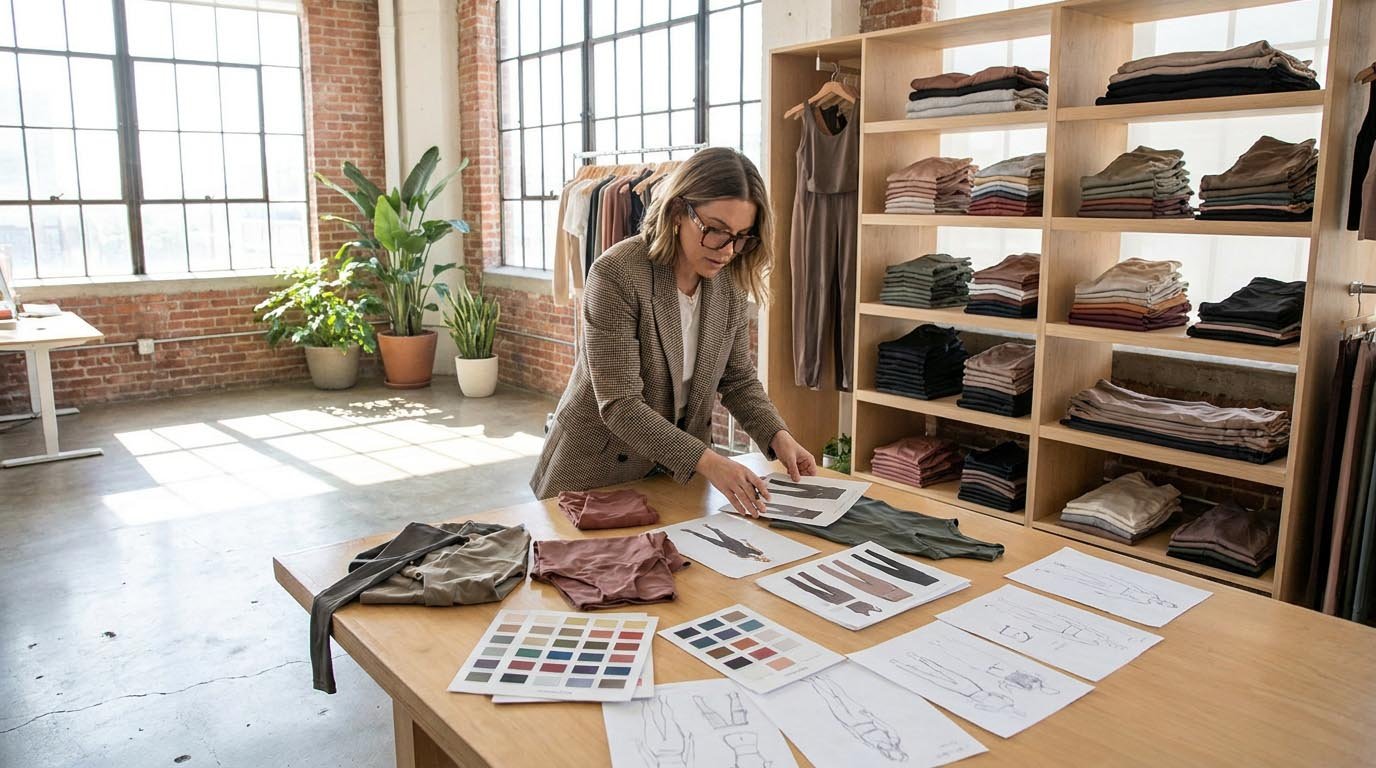
Quick Answer: What Does It Take to Start an Activewear Brand?
In practical terms, there are five parts to the process:
- Choose a specific niche instead of trying to serve everyone.
- Develop a small first collection, usually 2 to 4 styles.
- Create strong tech packs and go through sampling properly.
- Find a reliable activewear manufacturer and test quality before committing to production.
- Set up your business, pricing, and launch plan before inventory arrives.
That is the simple version. The hard part is execution.
A lot of founders lose money early because they skip validation, overbuild the first collection, or rush into bulk production before the fit is right. If you can avoid those mistakes, your launch becomes much easier to manage.
Why Activewear Is Still a Good Category for New Brands
Activewear is competitive, but that does not mean there is no room for new brands.
What makes the category attractive is that consumers no longer treat activewear as workout-only clothing[^1]. For many customers, leggings, bras, tanks, and matching sets now sit somewhere between fitness apparel, loungewear, and everyday uniform. That creates room for specialized products and niche positioning.
The mistake is assuming you need to build the next giant lifestyle brand on day one.
You do not.
In our experience, smaller brands usually perform better when they solve a specific problem for a specific customer. That could mean:
- leggings that actually fit tall women
- postpartum activewear that feels supportive without feeling restrictive
- modest activewear
- sustainable studio wear with cleaner fabric choices
- premium basics for Pilates and yoga customers
- training wear built for a men's niche that larger brands overlook
Broad positioning sounds appealing at first, but narrow positioning usually makes product decisions and marketing much easier.
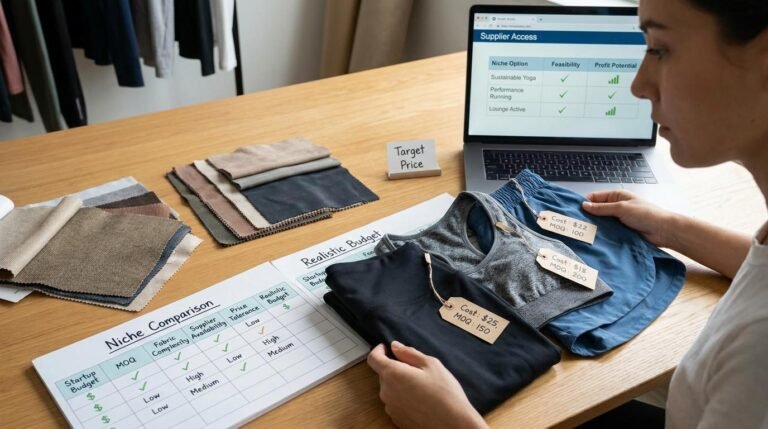
How to Choose Your Niche and Target Customer
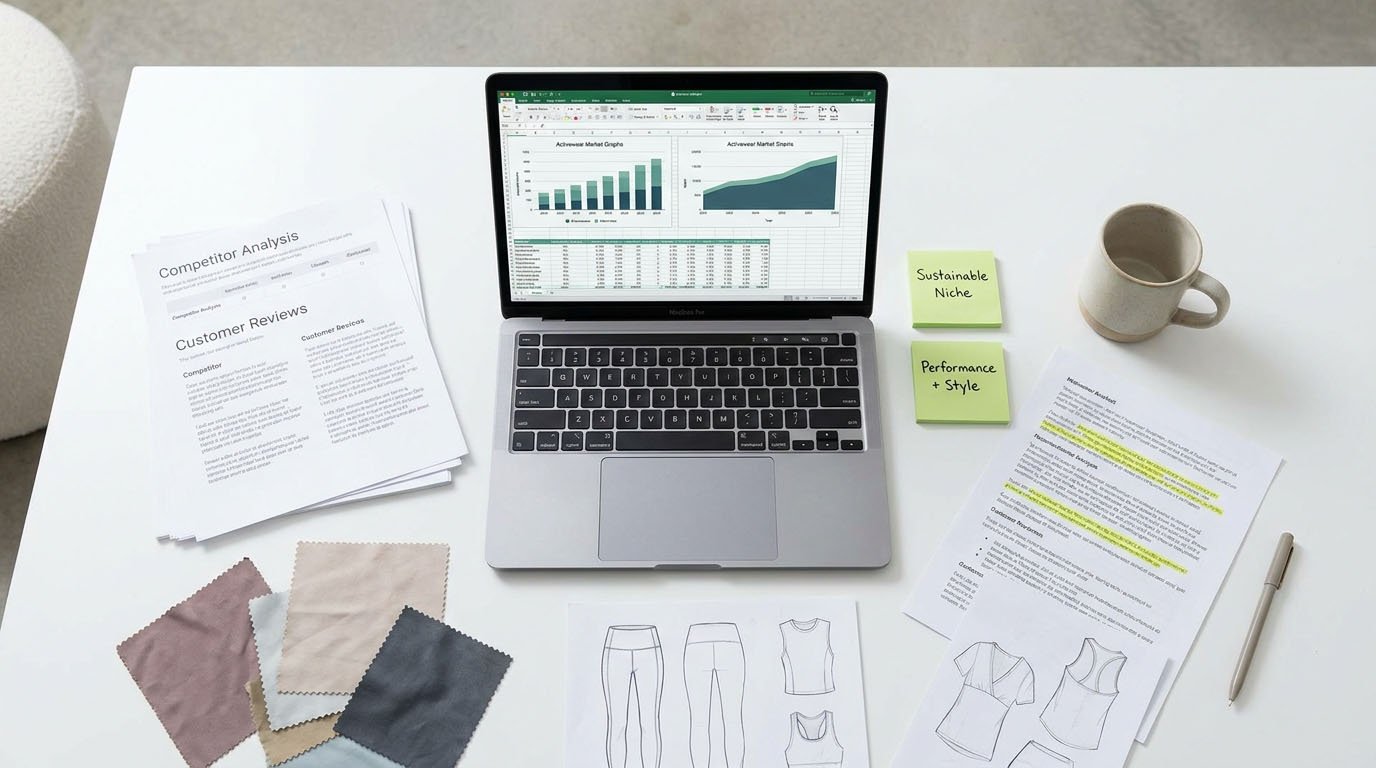
One of the first things we ask founders is: who exactly is this for?
If the answer is “women who work out,” that is still too broad.
A useful niche usually has three parts[^2]:
- who the customer is
- what activity or lifestyle the product supports
- what problem your product solves better than other options
For example:
- women 28 to 40 doing Pilates who want premium matching sets that do not turn sheer
- new mothers returning to light fitness who want flattering, supportive activewear
- runners who want high-compression shorts with secure pocket placement
- plus-size customers who want better fit grading, not just larger versions of straight-size leggings
How to Research a Niche
Before designing anything, spend time looking at places where customers complain honestly[^3]:
- Amazon reviews
- Reddit threads
- TikTok comment sections
- fitness Facebook groups
- product review pages
- niche subcommunities for yoga, running, lifting, postpartum fitness, or plus-size fashion
What you are looking for is not just inspiration. You are looking for repeated frustration.
Some of the most useful comments are simple:
- “These leggings slide down.”
- “The waistband digs in.”
- “I can never find sports bras that feel supportive but still flattering.”
- “Everything is made for one body type.”
- “The fabric feels nice, but it pills after a few washes.”
Those complaints tell you what to build.
A Better Way to Define the Customer
Do not stop at age and income. Think in terms of buying behavior.
Questions worth answering:
- Where does this customer shop now?
- What do they like about current brands?
- What do they wish they could improve?
- Do they care more about softness, compression, shaping, or sustainability?
- Are they impulse buyers or research-heavy buyers?
- What price would feel reasonable to them?
- What would make them switch from a brand they already know?
The clearer the customer, the easier everything else becomes.
Validate Before You Produce
This is where many founders move too fast.
Before you commit to inventory, test the concept in lower-risk ways:
- share mockups with potential buyers
- create a simple landing page and collect emails
- post concept visuals on social media
- interview people in your target niche
- ask what they currently buy and what they cannot find
- test a few price points in surveys or ads
You do not need a massive research budget. You just need enough feedback to avoid building products based on assumptions.
What to Include in Your First Collection
One of the most common early mistakes is trying to launch with too many styles.
On paper, a large collection sounds exciting. In production, it usually creates more fit problems, more inventory risk, and more money tied up in slower-moving items.
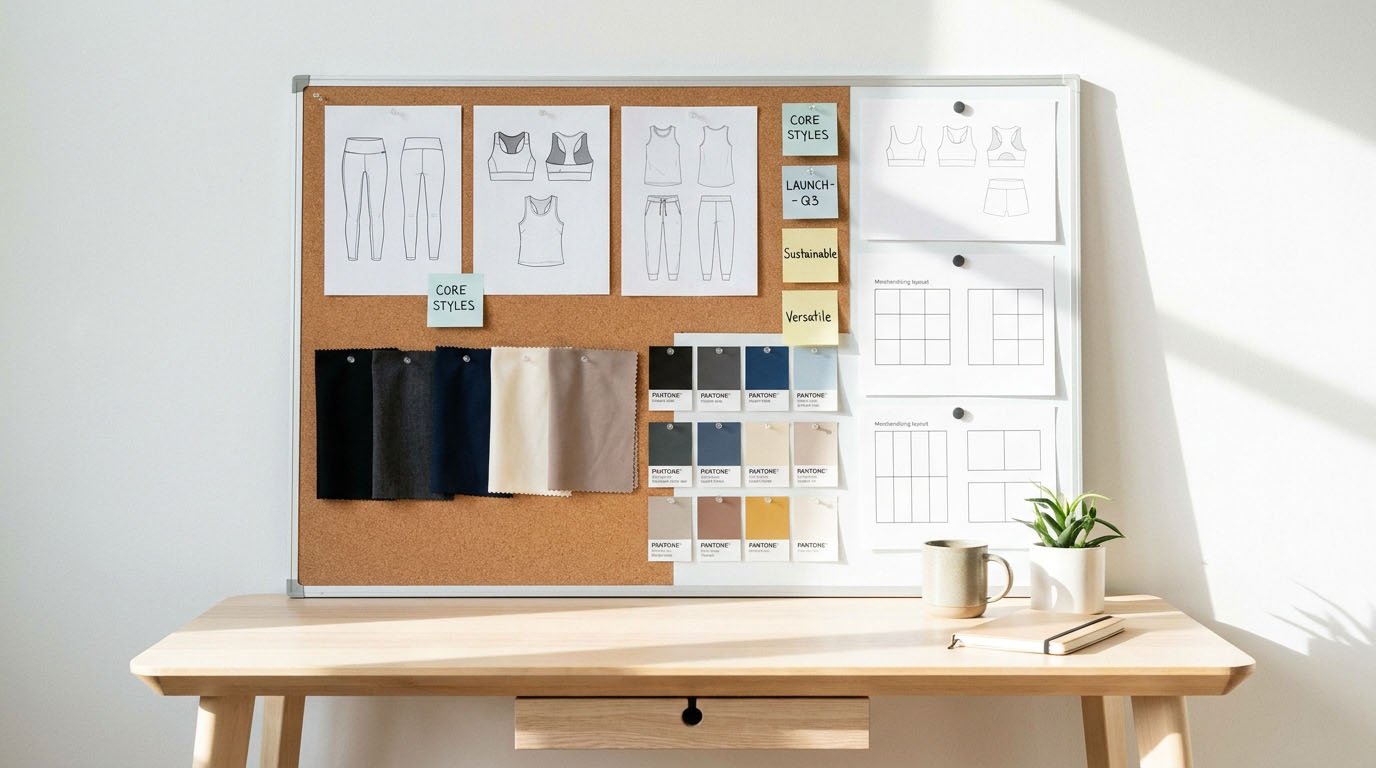
For most startups, a first line of 2 to 4 core styles is enough.
A practical first collection might include:
- one signature legging
- one sports bra
- one fitted tank or top
- optionally, one short or jogger if it fits your niche
That is enough to create a complete visual story without turning the first launch into an inventory management problem.
Why Smaller Collections Usually Work Better
A tight collection helps you:
- spend more time getting the fit right
- keep development costs under control
- buy deeper into your best products instead of spreading money across too many SKUs
- photograph and market the collection more clearly
- learn faster from real customer feedback
We have seen founders try to launch leggings, bras, tanks, jackets, shorts, and accessories all at once, then end up spending weeks in revisions because every silhouette has a different fit issue. That usually delays the launch and adds costs they did not plan for.
Start With Commercially Safe Choices
For a first release, it is usually smarter to keep a few things simple:
- limit the number of colors
- use one or two proven fabrics
- build around your strongest hero item
- avoid overly complex trims or construction details unless they are central to your brand
Black is still black for a reason. It sells, it photographs easily, and it reduces risk.
That does not mean your collection has to feel generic. It means your first launch should be disciplined.
Why Tech Packs and Sampling Matter More Than Most Founders Expect
If you are building custom activewear, the tech pack is not a formality. It is one of the main tools that determines whether your product comes out the way you expect.
A weak tech pack usually leads to vague communication. Vague communication leads to sample errors. Sample errors lead to more revisions, longer timelines, and more money spent before production even starts.
What a Good Activewear Tech Pack Should Include
A proper tech pack typically includes:
- flat sketches
- construction details
- point-of-measure specs
- grading notes
- fabric composition
- fabric weight or GSM where relevant
- stretch direction or recovery requirements
- stitching details
- trims and elastics
- labels and packaging notes
- color references
- logo placement
For activewear, details like waistband height, seam placement, gusset construction, and fabric recovery are not minor points. They directly affect comfort, fit, and how the product performs during movement.
The First Sample Is Rarely the Final Sample
This surprises a lot of first-time founders.
They expect to send a design, receive a sample, make one or two comments, and move into production.
That is not usually how it goes.
More often, sampling looks like this:
- initial prototype
- fit review
- revisions
- second fit sample
- pre-production sample
- final approval
Sometimes the issue is construction. Sometimes it is fabric. Sometimes the garment technically matches the spec, but still does not feel right on-body.
For leggings, some of the most common revision points are:
- waistband tension
- front rise depth
- inseam balance
- opacity under stretch
- overall compression feel
For bras, strap placement and underband tension often need more refinement than founders expect.
How to Source Fabric for Activewear
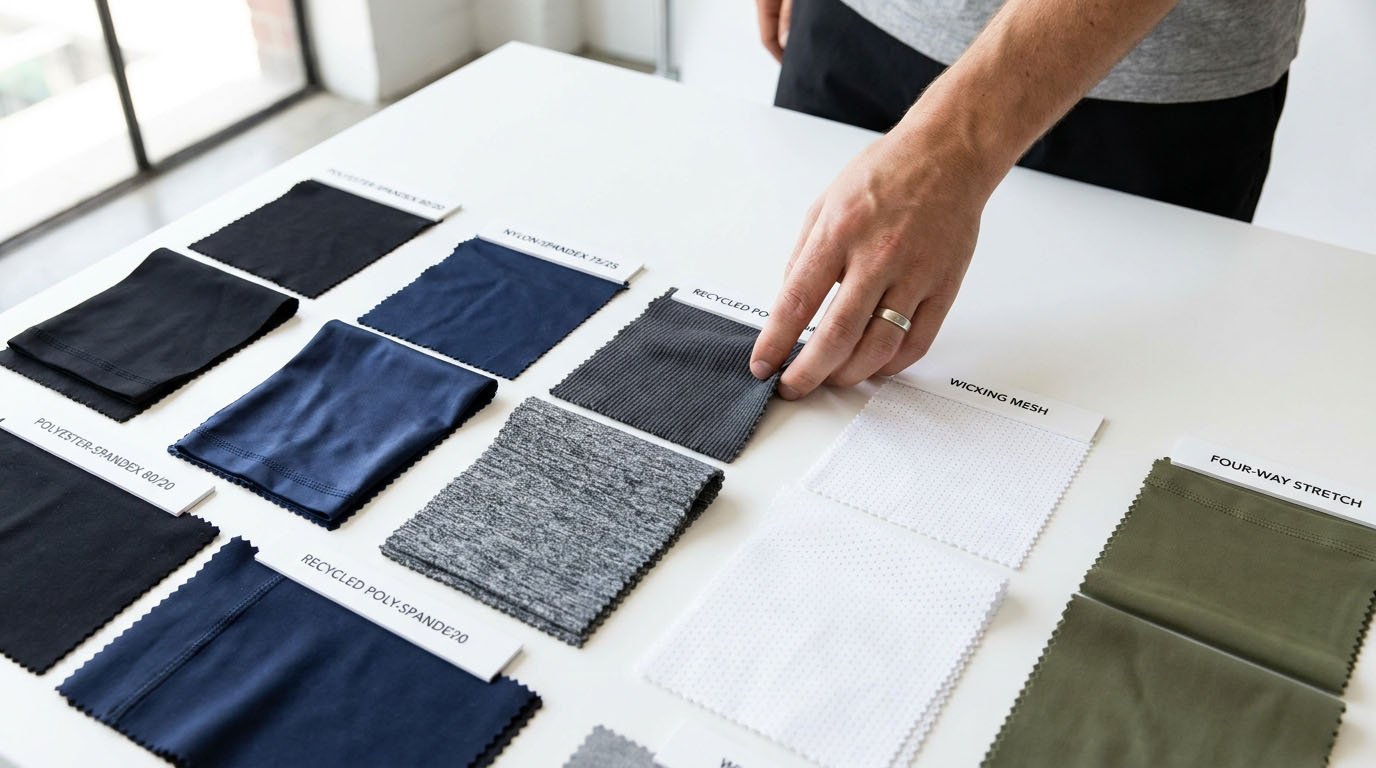
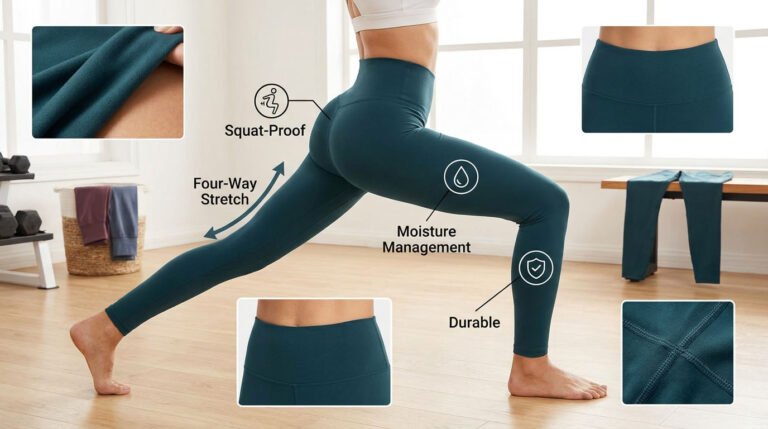
Fabric selection is one of the biggest decisions in the whole process because customers notice it immediately.
If the fit is good but the fabric feels cheap, pills quickly, or turns sheer under tension, the product is difficult to sell again. On the other hand, a strong fabric can make even a simple style feel premium.
Common Fabric Types for Activewear
| Fabric Type | Common Use | What It Is Usually Chosen For |
|---|---|---|
| Polyester-spandex | Leggings, shorts, tops | Performance, cost-efficiency, moisture management |
| Nylon-spandex | Leggings, bras, premium sets | Softer hand feel, shape retention, durability |
| Recycled polyester blends | Sustainable lines | Performance with a stronger sustainability story |
| Cotton blends | Lifestyle tops or lounge pieces | Softness and casual comfort |
| Ribbed stretch fabrics | Fashion active sets | Texture and visual differentiation |
What to Test Before Approving Fabric
Do not choose fabric from a swatch alone if you can avoid it.
For activewear, test:
- stretch and recovery
- opacity during movement
- softness and skin feel
- pilling resistance
- colorfastness
- fabric weight
- compression level
- drying behavior
- shrinkage if applicable
A fabric that feels great in hand can still behave badly in the finished garment. This is especially true for leggings and sports bras.
Should You Source Fabric Yourself?
If you are new, it is often easier to work with fabric options your manufacturer already knows and has tested. That usually reduces risk.
Independent fabric sourcing gives you more control, but it also adds complexity:
- you need to coordinate yardage
- you need to make sure the factory is comfortable sewing that material
- you may need to manage freight separately
- delays become harder to control
For most first launches, simpler is better unless your brand depends on a very specific material or sustainability certification.
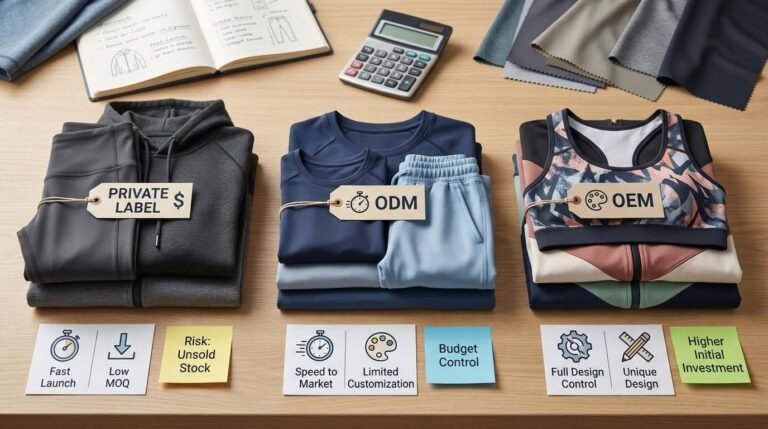
How to Find the Right Activewear Manufacturer
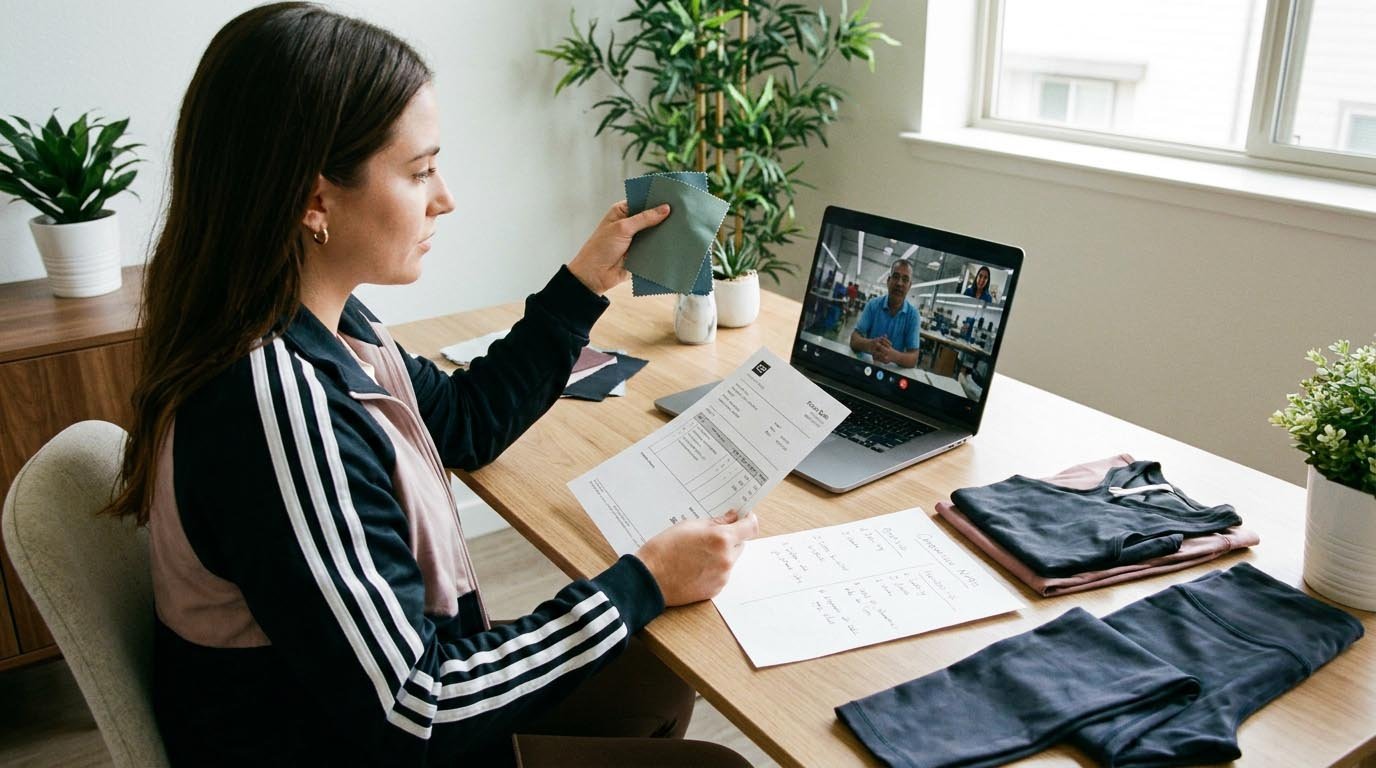
The right manufacturer does more than sew your garments. They affect lead times, communication, fit consistency, defect risk, and how stressful the entire process becomes.
Where Founders Usually Search
A few common routes:
- Maker’s Row
- Alibaba
- trade shows like Texworld NYC[^4]
- sourcing consultants
- referrals from other founders
- direct Google searches
Useful search terms include:
- custom activewear manufacturer USA
- private label activewear manufacturer
- leggings manufacturer for startups
- sportswear manufacturer low MOQ
- yoga wear manufacturer
What to Ask Before Moving Forward
When you first contact a factory, ask practical questions:
- What is your MOQ per style and color?
- Do you produce activewear regularly?
- Can you work from custom tech packs[^5]?
- Do you help with fabric sourcing?
- What is your sample turnaround time?
- What is your bulk production lead time?
- What are your payment terms?
- Can you share examples of similar products?
- How do you handle quality control?
The goal is not just to collect quotes. It is to understand how they work.
What We Suggest During Vetting
For most startup brands, a safer process looks like this:
1. Compare multiple factories
Do not rely on the first promising conversation. Get several quotes and compare not just price, but communication quality and specialization.
2. Order samples
This matters more than almost anything else. A decent sample tells you far more than a polished sales message.
Look closely at:
- stitch consistency[^6]
- seam strength
- fabric feel
- logo application
- fit accuracy
- finishing quality
3. Review how they communicate
If communication is messy before money changes hands, it usually does not improve later.
4. Start smaller if possible
A test order can expose problems that do not show up in a single sample.
Red Flags to Watch For
Be careful with manufacturers who:
- avoid specific answers
- refuse to sample
- push for full payment upfront
- keep changing quoted terms
- cannot explain their process clearly
- take too long to respond early on
A lot of production issues can be traced back to warning signs that were already present during sourcing.
Should You Manufacture in the USA or Overseas?
This is one of the most common questions founders ask, and there is no single answer that fits everyone.
USA Manufacturing
What founders usually like
- easier communication
- faster shipping
- easier visits or oversight
- lower complexity for some startups
- made-in-USA brand positioning
What founders usually struggle with
- higher unit costs
- fewer factory options depending on product type
- capacity limitations in some cases
Overseas Manufacturing
What founders usually like
- lower per-unit cost
- larger production capacity
- wider range of trims and fabric options
- strong specialization in some activewear categories
What founders usually struggle with
- longer lead times
- more shipping and import complexity
- more distance between brand and factory
- quality issues can be harder to correct quickly
Which One Makes Sense?
In general:
- choose USA production if oversight, speed, and local positioning matter most
- choose overseas production if cost and scale matter most and you are prepared to manage development carefully
Some brands start with domestic sampling and move overseas later. Others launch overseas from the beginning because the price structure works better. What matters is choosing a setup that fits your stage and your margin goals.
Business Setup and Compliance Basics in the USA
The product side gets most of the attention, but the business setup matters too.
Many founders begin with:
- an LLC or corporation
- an EIN
- a business bank account
- bookkeeping setup
- resale or sales tax registration where needed
- insurance
State rules vary, so it is a good idea to verify specifics with a qualified accountant or attorney.
Apparel Compliance Basics
If you are selling apparel in the U.S., review requirements around:
- fiber content labeling
- country of origin labeling
- care labels
- identity labeling
Depending on your materials and sales channels, there may be additional requirements or retailer standards to consider. Treat this guide as general information, not legal advice.
Insurance Is Easy to Delay and Easy to Regret Ignoring
Founders often focus so hard on product and launch costs that they postpone insurance. That is understandable, but risky.
At minimum, many apparel businesses look into:
- general liability insurance
- product liability insurance
The exact coverage you need depends on your business model, products, and sales volume, but it is worth planning for early.
How to Price Activewear Without Killing Your Margin
Pricing is one of the easiest places to make a mistake because founders tend to focus on manufacturing cost and forget everything else.
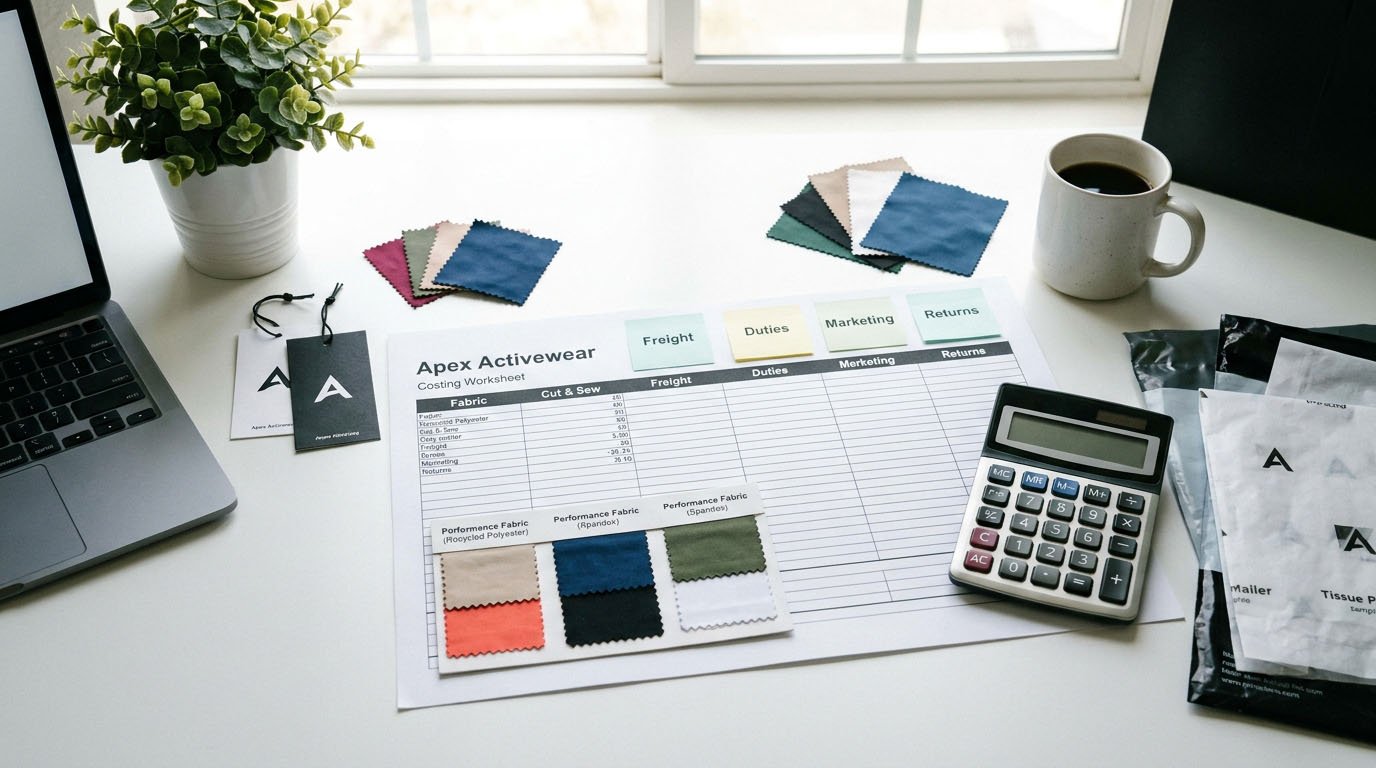
Your real cost is not just what the factory charges.
It also includes:
- development and sampling
- freight
- duties if applicable
- packaging
- payment processing
- marketing
- returns
- discounts
- platform fees
Example Landed Cost Breakdown
| Cost Component | Example Per Unit |
|---|---|
| Manufacturing | $8.00 |
| Fabric upgrade or trims | $1.50 |
| Freight | $1.20 |
| Duties and import-related fees | $0.80 |
| Packaging | $0.50 |
| Estimated landed cost | $12.00 |
And even that is not your fully loaded business cost.
A Simple Pricing Framework
A common rough model is:
- wholesale around 2x landed cost
- retail around 2.5x to 4x landed cost depending on brand positioning
That does not mean every product should follow the same multiplier. It means your margin structure needs enough room to support growth.
If your product looks premium, your content looks premium, and your audience expects quality, pricing too low can actually hurt conversion because it signals the wrong position.
A Realistic Production Timeline for New Brands
A lot of first-time founders plan their launch around manufacturing lead time alone. That usually creates frustration.
The real timeline includes development, revisions, approvals, production, and freight.
A more realistic outline often looks like this:
1. Product planning and manufacturer outreach
2 to 4 weeks
This includes:
- niche clarification
- line planning
- tech pack prep
- factory research
- quote comparison
2. Sampling and revisions
3 to 8 weeks
This includes:
- first sample
- fit comments
- revisions
- second sample or pre-production sample
- approval
3. Bulk production
4 to 8 weeks
This includes:
- material allocation
- cutting
- sewing
- finishing
- internal QC
4. Freight and customs
1 to 5 weeks
This depends on:
- air vs sea shipping
- origin country
- customs processing
- local delivery
For a first collection, 4 to 6 months is a realistic planning window in many cases.
How to Launch and Sell Your Activewear Brand
A good launch does not require ten channels at once. In fact, trying to be everywhere too early usually spreads a small budget too thin.
For most new brands, the cleanest first move is direct-to-consumer.
Start With a DTC Store
Platforms founders commonly use:
- Shopify
- WooCommerce
A direct store gives you:
- stronger margins
- control over brand presentation
- customer data
- email capture
- room to build repeat purchase systems
Content Usually Matters Before Ads
A lot of brands rush to paid ads before they have strong product photos, social proof, or good creative.
That is backwards.
Before spending heavily on ads, build:
- clear product pages
- strong fit photos or videos
- useful social content
- customer email capture
- a simple launch story
For activewear, visual proof matters. People want to see how the garment fits, moves, stretches, and looks on real bodies.
Marketing Tactics That Tend to Work Early
Organic social content
Post:
- try-on videos
- movement clips
- fit explanations
- behind-the-scenes development
- founder content
- customer feedback
Influencer seeding
Micro-influencers can work well when the audience matches your niche. Relevance usually matters more than raw follower count.
Email marketing
Collect emails before launch and use:
- waitlists
- early access
- first-purchase offers
- restock alerts
Small paid tests
Use paid ads carefully once you know:
- which product converts best
- which content gets attention
- which audience responds
If you need support with activewear development, sourcing, sampling, or production, Wearzio can help.
Request a consultation to discuss your launch plan.
Mistakes New Activewear Brands Make Early
This is the part many generic articles skip, but it is often the most useful.
Here are some of the mistakes we see most often.
1. Launching too many styles too early
More styles feel impressive, but they create more complexity, more revisions, and more inventory risk.
2. Choosing fabric based only on feel
A soft fabric is not automatically a good activewear fabric. Recovery, opacity, and durability matter just as much.
3. Underestimating sampling time
The first sample is rarely production-ready. Build that reality into your timeline and budget.
4. Approving products before fit is truly solved
Founders sometimes get tired of revisions and approve too early just to keep the project moving. That usually becomes a more expensive problem in bulk production.
5. Ignoring total landed cost
A low unit quote can look great until shipping, duties, packaging, and returns are added.
6. Trying to market before the brand story is clear
If customers cannot understand who the brand is for and why the product is different, content and ads become much harder to convert.
7. Not thinking about reorder timing
Selling out sounds great, but if your lead times are long and you did not plan your reorder point, momentum can stall quickly.
Final Thoughts
Starting an activewear brand is not just about having a good design idea. It is about making good decisions early, especially around niche, product scope, fabric, sampling, manufacturing, and margin.
If there is one piece of advice we would give most first-time founders, it is this: keep the first launch tighter than you think you need to.
A small, well-developed collection usually teaches you more than a large, unfocused one.
If you are planning your first activewear collection and want help with development, sourcing, tech packs, sampling, or production, Wearzio can help you move from concept to launch.
Ready to build your activewear brand?
Contact Wearzio to discuss your project, MOQ, and next steps.
[^1]: "Athleisure Market Size, Share & Growth Report 2035", https://www.marketresearchfuture.com/reports/athleisure-market-7412. Recent market analyses and consumer surveys indicate that activewear is increasingly worn for non-exercise purposes, supporting the claim that consumers no longer treat activewear as workout-only clothing. Evidence role: statistic; source type: research. Supports: consumers no longer treat activewear as workout-only clothing. Scope note: Market trends may vary by region and demographic.
[^2]: "A 20-Question Framework That Took Me 3 Years to Build - LinkedIn", https://www.linkedin.com/pulse/how-find-your-niche-20-question-framework-took-me-3-years-makwana-xnrff. Entrepreneurship guides and business textbooks commonly recommend defining a niche by customer identity, activity or lifestyle, and a specific problem solved, supporting the three-part framework described. Evidence role: definition; source type: education. Supports: A useful niche usually has three parts. Scope note: Frameworks may vary slightly across sources.
[^3]: "Customer Complaints Analysis Using Text Mining and Outcome-Driven ...", https://www.mdpi.com/2071-1050/11/1/40. Consumer research methodologies recommend analyzing online reviews, forums, and social media to identify genuine customer complaints and unmet needs. Evidence role: mechanism; source type: education. Supports: spend time looking at places where customers complain honestly. Scope note: Online complaints may not represent all customer segments.
[^4]: "Apparel Sourcing NYC: Leading Event for Fashion Industry", https://texworld-usa.us.messefrankfurt.com/new-york/en/facts-figures/ApparelSourcingNYC.html. Texworld NYC is recognized as a major trade show for textile and apparel sourcing, including activewear, in the United States. Evidence role: historical_context; source type: institution. Supports: Trade shows like Texworld NYC are common routes for founders to search for manufacturers.. Scope note: The event covers a broad range of textile categories, not exclusively activewear.
[^5]: "Can anyone help me understand tech packs? : r/sewing - Reddit", https://www.reddit.com/r/sewing/comments/1fz8d24/can_anyone_help_me_understand_tech_packs/. A tech pack is a detailed document used in apparel manufacturing to communicate design specifications, materials, measurements, and construction details to factories. Evidence role: definition; source type: encyclopedia. Supports: Tech packs are used for custom production and are important to ask about when vetting factories.. Scope note: Tech pack formats and requirements may differ by manufacturer.
[^6]: "How To Evaluate Sewing Quality On A Garment Sample (with example ...", https://alisonhoenes.com/2025/01/how-to-evaluate-sewing-quality-on-a-garment-sample-with-example-pictures/. Stitch consistency is a recognized indicator of garment quality, affecting durability and appearance in apparel manufacturing. Evidence role: mechanism; source type: education. Supports: Stitch consistency is an important aspect to evaluate when reviewing samples from manufacturers.. Scope note: Stitch consistency is one of several quality factors; overall garment quality depends on multiple elements.