.png)
You may already know your target customer and have a mood board full of ideas, but turning those ideas into a realistic activewear collection is where many new brands get stuck.
To plan your first activewear collection, define your customer's workout scenarios, translate those needs into fabric and construction requirements, choose 2-3 hero products, and limit colors and sizes to a SKU plan that fits your MOQ and budget.
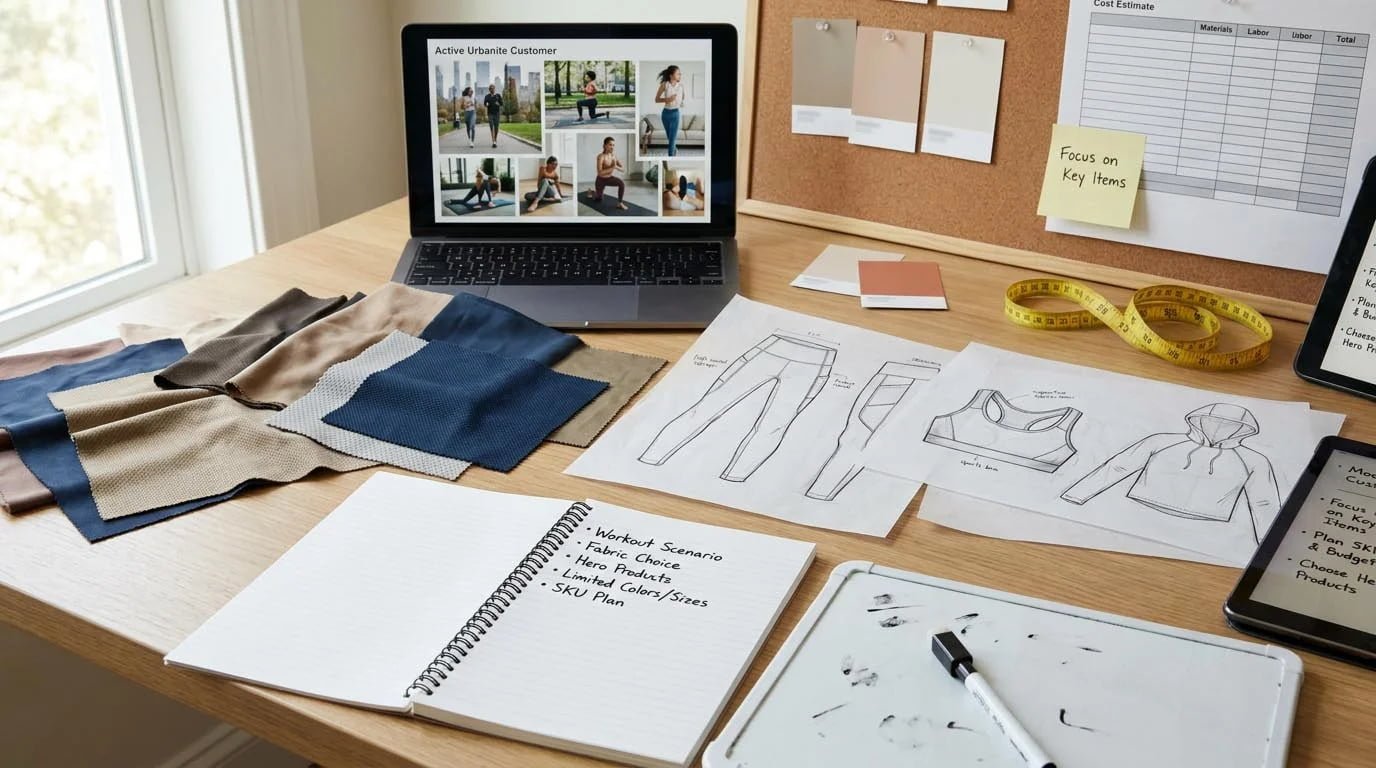
For most new brands, the challenge is not creativity. It is product focus. A strong launch collection is not a full wardrobe. It is a small, strategic lineup that solves specific problems for a specific customer and can actually be produced within your cost limits.
Quick Answers: First Activewear Collection Planning
- Start with workout scenarios, not age or gender alone: Your customer's sweat level, movement range, climate, and training frequency should shape fabric, fit, and construction decisions
- Keep your first collection small: Most new brands should launch with 4-6 pieces, including 2-3 hero products
- Hero products carry your brand story: Put your biggest product development effort into the items your customer will wear most often
- Colors and sizes drive SKU count fast: 3 styles × 3 colors × 4 sizes = 36 SKUs, so control variations early
- MOQ planning matters as much as design: A good collection idea can still fail if your size, color, and style count create an order volume you cannot afford
- Do not design backward: Start with customer use cases, then build the product line around performance needs, not just visual inspiration
How Do You Define Your Target Customer for an Activewear Collection?
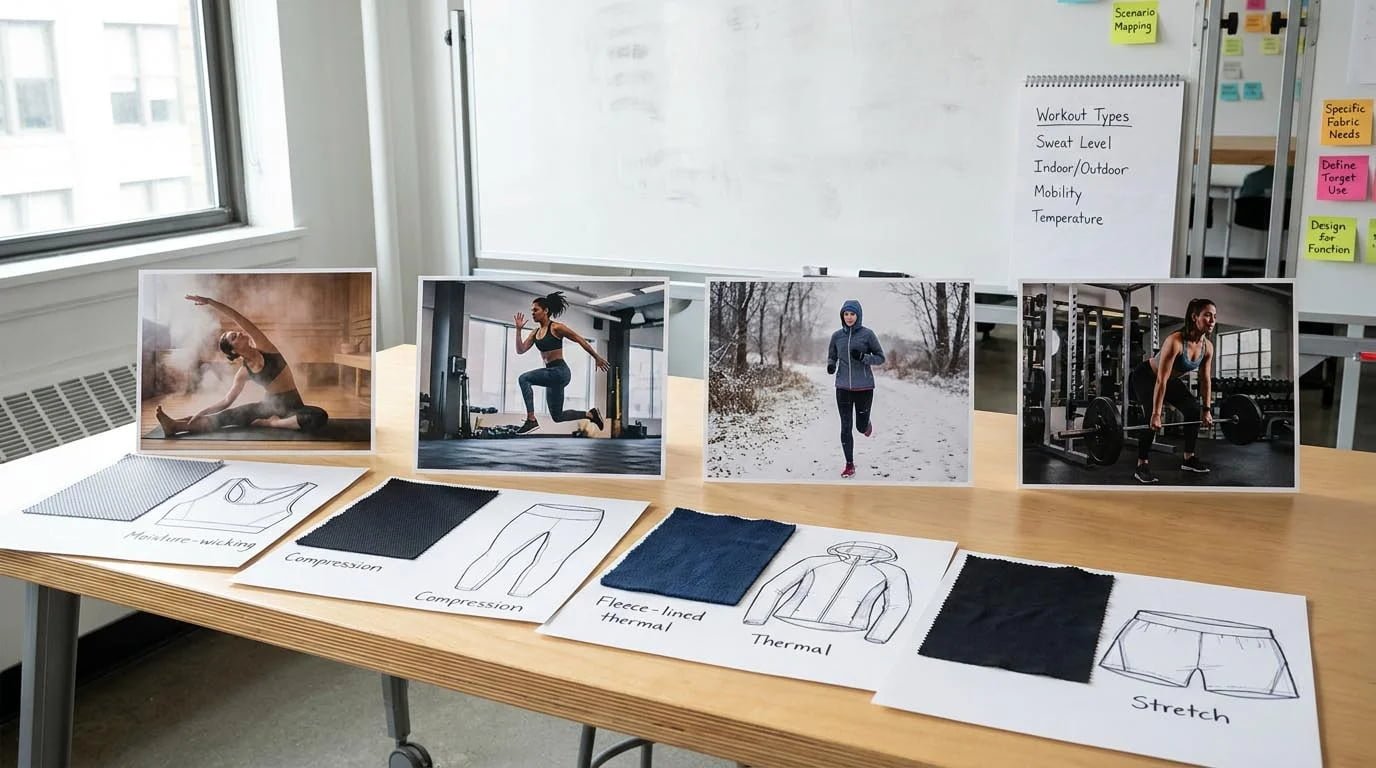
Most founders begin with broad descriptions like "women aged 25-35 who do yoga" or "urban fitness consumers." That may help with branding, but it does not help much with product development.
To design an activewear collection that fits your target market, you need to define what your customer actually does while wearing the product.
Ask these questions first:
- What type of workout do they do most often?
- How much do they sweat?
- Do they train indoors or outdoors?
- What temperature range do they exercise in?
- How much stretching, bending, jumping, or impact is involved?
- How often will they wash the garments?
These answers directly affect product specifications.
For example:
| Workout Scenario | Product Need | Fabric/Construction Requirement |
|---|---|---|
| Hot yoga | Sweat control and stretch | Moisture-wicking knit, soft hand-feel, high stretch recovery |
| HIIT training | Compression, durability, opacity | Mid-to-high compression fabric, squat-proof coverage, reinforced seams |
| Outdoor running in winter | Warmth and weather protection | Thermal brushed fabric, layering pieces, wind-resistant panels |
| Strength training | Mobility and durability | Four-way stretch, gussets, strong seams at stress points |
A customer who trains in hot studios has very different needs from one who runs outside in cold weather. If you skip this step, you risk choosing the wrong fabric weight, stretch level, or garment structure.
One of the most common mistakes new brands make is trying to design for "general fitness." In reality, the more specific your first collection is, the easier it becomes to choose the right products and control costs.
How Do You Decide the Purpose of Your First Activewear Collection?
Your first collection should not try to cover every workout type, every trend, and every product category.
A better approach is to decide whether your launch collection is built to solve a specific performance problem or to offer a broader lifestyle-activewear look.
In general, first collections fall into two categories:
1. Performance-focused collections
These are built around a clear use case, such as:
- running
- yoga
- cycling
- HIIT
- strength training
Performance collections usually need more technical fabrics and more functional construction details. That raises development cost, but it also gives you a stronger reason for customers to choose your brand.
2. Lifestyle-crossover collections
These are meant to work both in workouts and in casual daily wear.
They often combine:
- a few true performance pieces
- a few easier-to-produce athleisure basics
- broader styling appeal
- more flexible pricing tiers
This can be a smart model if your target customer wants gym-to-street products rather than highly technical sportswear.
Which is better for a new brand?
That depends on your positioning and budget.
| Collection Type | Best For | Main Advantage | Main Risk |
|---|---|---|---|
| Performance-focused | Brands solving a specific workout problem | Strong differentiation and clearer product story | Higher fabric and development cost |
| Lifestyle-crossover | Brands targeting broader activewear use | Easier to mix fabric price points and lower technical risk | Brand message can become too generic |
If your budget is limited, trying to do both at once often leads to weak results. It is usually better to choose one direction for your first launch and expand later.
How Do You Choose Hero Products for Your Activewear Launch?
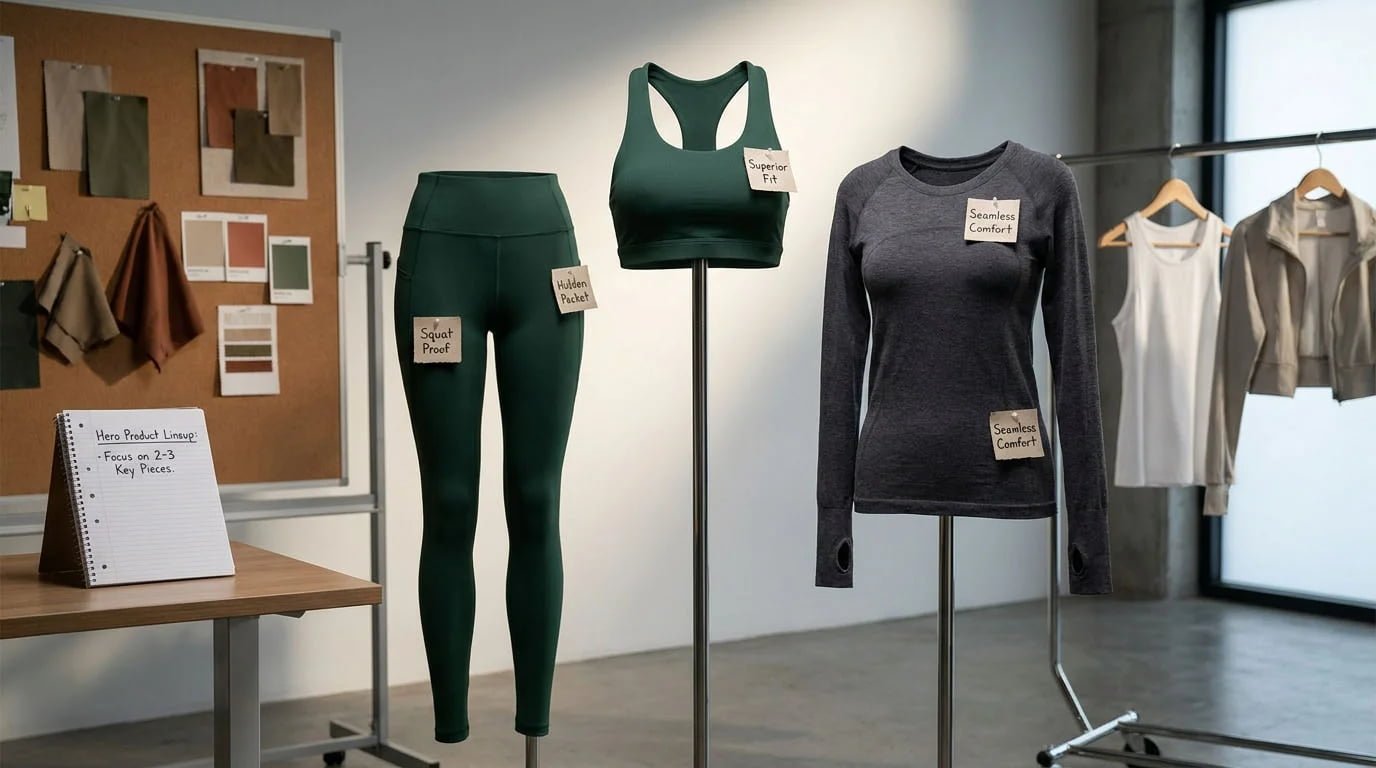
Every first collection needs a few anchor products that define the brand.
Your hero products should be the pieces your customer uses most often and the items where your product story is strongest.
For most new activewear brands, 2-3 hero products is enough.
These hero pieces should:
- solve the most common customer pain points
- match the core workout scenario
- justify your brand positioning
- deserve more investment in fit, fabric, and testing
Examples:
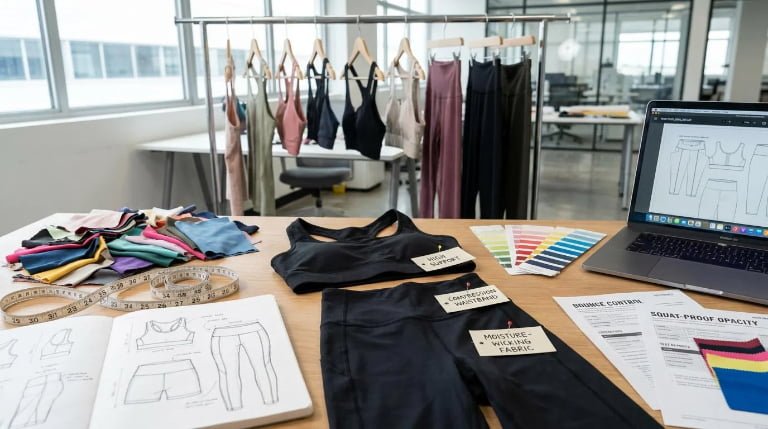
- For yoga: high-waist leggings and a medium-support bra
- For HIIT: squat-proof leggings, a high-support sports bra, and a fitted tank
- For cycling: bib shorts and a performance jersey
- For athleisure: signature leggings, a bra top, and a matching jacket
Supporting pieces can be simpler and lower risk. Their job is to complete the outfit and raise average order value, not to carry the entire brand story.
What makes a strong hero product?
A strong hero product usually includes one or more standout features, such as:
- better-than-average fit
- superior opacity at full stretch
- more durable waistband construction
- hidden utility features like pockets or drawcords
- premium recovery and comfort
- lower chafing through flatlock or bonded construction
Your hero products do not need to be complicated. They need to be clear, useful, and better aligned with your target customer than generic market options.
How Many Pieces Should a First Activewear Collection Have?
One of the biggest mistakes new brands make is launching with too many styles.
For most startups, a first activewear collection should include around 4-6 pieces total.
A simple structure looks like this:
- 2-3 hero products
- 2-3 supporting pieces
This is usually enough to:
- present a clear brand identity
- create complete outfits
- test customer demand
- reduce development complexity
- keep MOQ and inventory under control
Why smaller collections work better
| Benefit | Why It Matters |
|---|---|
| Better quality control | Fewer styles mean more focus during sampling and production |
| Lower inventory risk | You avoid spreading your budget across too many low-volume styles |
| Easier MOQ planning | You can concentrate order volume into fewer products |
| Clearer customer message | Shoppers understand faster what your brand stands for |
Think of your first collection as a system, not a catalog. Each item should earn its place. If a piece does not support your core customer use case or your launch story, it can wait for collection two.
How Do You Match Fabric to Workout Scenarios?
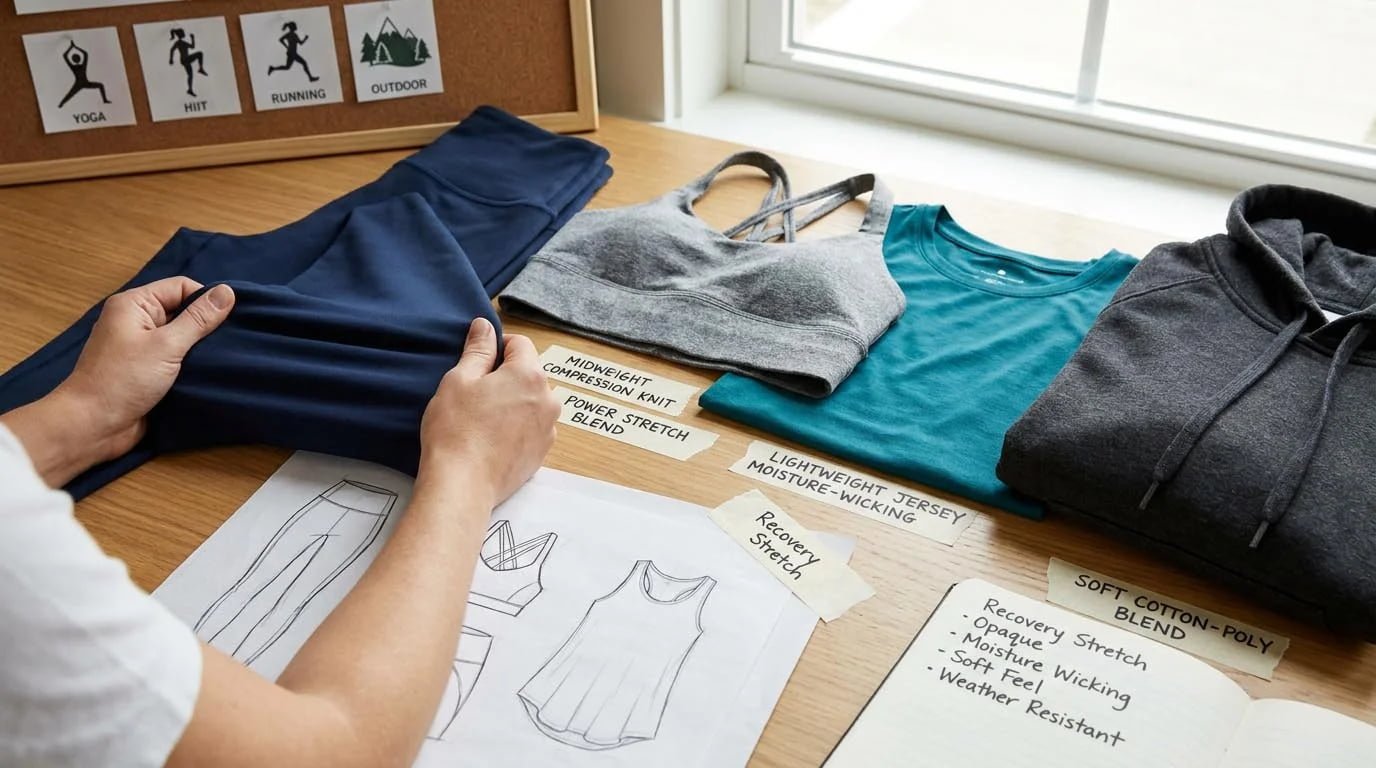
Fabric selection is where activewear product planning becomes real.
The best activewear fabric is not the most expensive one. It is the fabric that matches your customer's movement, sweat level, comfort expectations, and price point.
Here are the key fabric factors to evaluate:
1. Stretch and recovery
For activewear, stretch alone is not enough. Recovery matters just as much.
Look for:
- four-way stretch for dynamic movement
- strong recovery after repeated wear
- stable shape retention at knees, seat, and waistband
2. Moisture management
If the product is for intense training, moisture-wicking should be built into the yarn or finish strategy.
This matters most for:
- HIIT
- running
- hot yoga
- studio training
3. Opacity
Leggings and fitted bottoms must stay opaque at full stretch.
Always test:
- squat position
- forward bend
- bright light stretch visibility
4. Fabric weight
Heavier is not always better. Lighter is not always more breathable.
Typical direction:
- lightweight for hot studio and summer training
- midweight for versatile year-round indoor use
- heavier or brushed for cold-weather training
5. Surface feel and comfort
Soft hand-feel matters for products worn close to the skin, especially:
- bras
- leggings
- fitted tops
Fabric planning by product role
| Product Type | Typical Priority | Fabric Direction |
|---|---|---|
| Leggings | Opacity, stretch, recovery | Midweight compression knit with good recovery |
| Sports bra | Support, comfort, sweat handling | Power knit or supportive stretch blend |
| Tank top | Breathability, comfort | Lightweight moisture-wicking jersey |
| Hoodie/jogger | Softness, structure, price control | Cotton-poly or poly-spandex blend depending on use |
| Outer layer | Protection, shape retention | Woven or double-knit with weather resistance if needed |
For a first collection, it often makes sense to spend more on core training pieces and use simpler fabric programs for outer or lounge items.
How Do You Balance Style, Comfort, and Performance in Activewear?
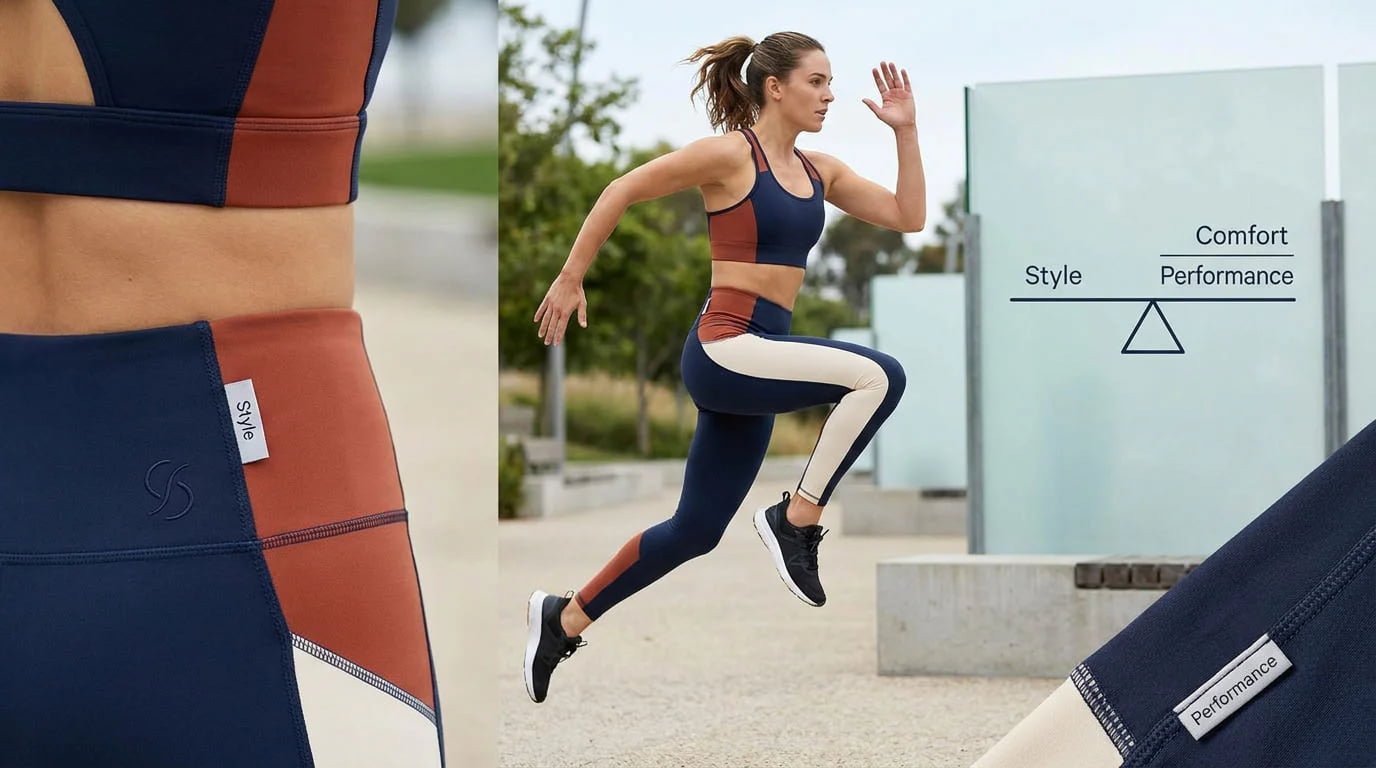
Activewear only works when these three elements support each other.
If the garment looks great but pills quickly, digs into the skin, or turns see-through during movement, customers will not buy again.
A balanced product usually includes:
- style that reflects your brand identity
- comfort that supports repeat wear
- performance that fits the activity
Start with the performance baseline
Before adding visual details, confirm the basics:
- Does the fabric match the workout intensity?
- Are the seams suitable for active use?
- Is there enough stretch for the movement range?
- Does the waistband stay in place?
- Is the fabric comfortable against skin?
- Does the garment remain opaque in motion?
Then add style through practical design choices
Once performance and comfort are covered, style can come from:
- colorblocking
- flattering seam placement
- subtle mesh panels
- branded waistbands
- smart neckline or back-shape variations
Style should not create production problems unnecessarily. For first collections, avoid too many decorative details that increase cost without improving function.
How Do You Plan Colors, Sizes, and SKU Count Without Losing Control of MOQ?
This is where many first collections become too expensive.
Style count is only part of the cost equation. Colorways and size ranges multiply SKU count quickly, and that drives MOQ, inventory, and budget pressure.
Here is the math:
3 styles × 3 colors × 4 sizes = 36 SKUs
That may still sound manageable, but if your factory has a MOQ per color per style, total units add up fast.
Why SKU planning matters
If your MOQ is:
- 300 pieces per color per style
Then:
- 3 styles × 3 colors × 300 pieces = 2,700 total pieces
That is before you even start discussing size ratios.
Best practices for first collections
- Start with 2-3 core colors
- Add only 1 accent color if needed
- Keep size range focused unless inclusive sizing is central to your brand from day one
- Use proven ratios for size breakdown
- Avoid too many colorways in slow-moving styles
A practical first-launch approach
| Variable | Recommended Starting Point |
|---|---|
| Total styles | 4-6 pieces |
| Hero products | 2-3 |
| Core colors | 2-3 neutrals |
| Accent colors | 0-1 |
| Sizes | 4 standard sizes to start |
| Fabric programs | Keep as few as possible across styles |
Choosing stock fabric colors instead of custom dye lots can also reduce minimums and shorten lead times, especially for early production runs.
How Does MOQ Affect First Activewear Collection Planning?
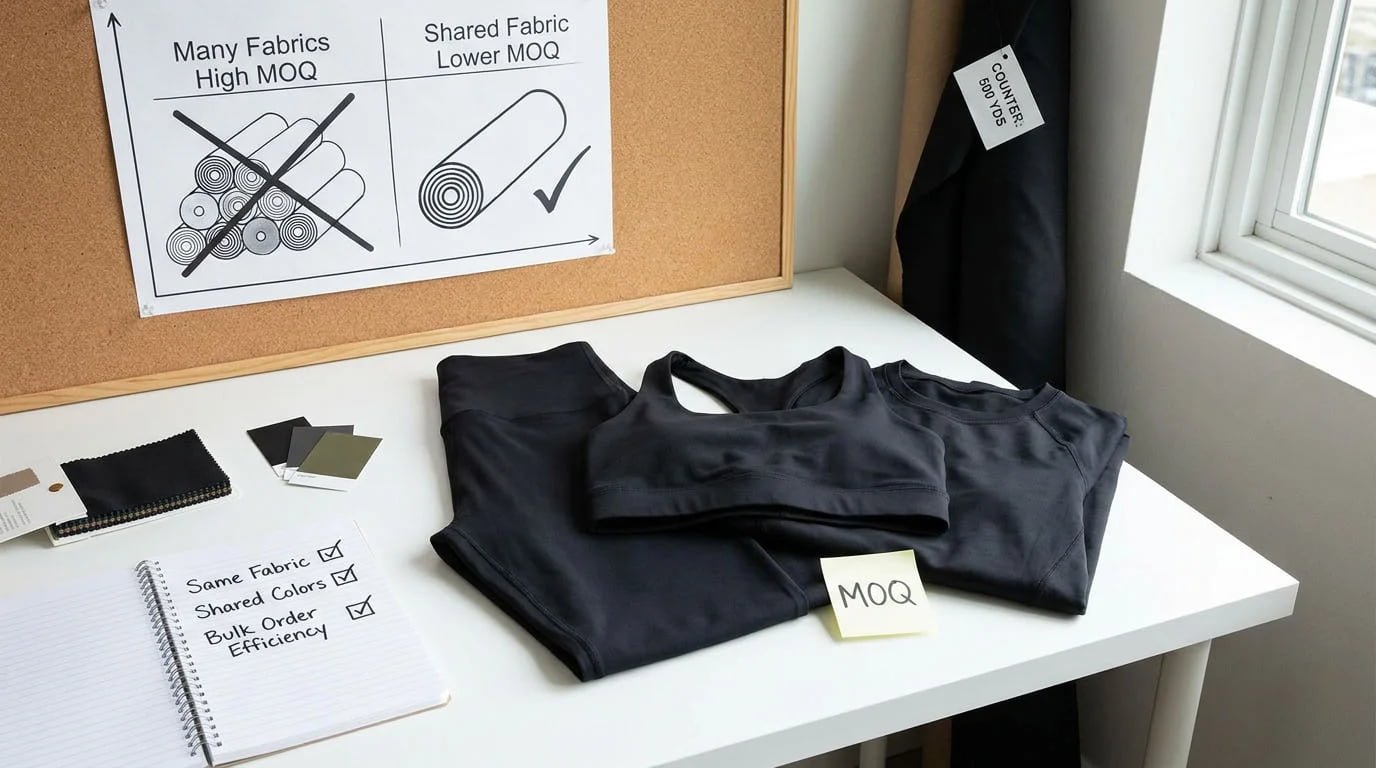
MOQ is not just a factory issue. It should shape your collection structure from the beginning.
A collection with too many styles, colors, and fabrics can become unworkable even if each individual design looks reasonable on paper.
When planning MOQ, ask these questions:
- Is MOQ per style, per color, or total order?
- Can fabric minimums be shared across styles?
- Are stock fabrics available?
- Does size splitting affect efficiency?
- Can matching tops and bottoms use the same fabric base?
Why fewer fabric programs help
If your leggings, bra, and fitted top all use the same main fabric family, you can often:
- simplify sourcing
- improve color consistency
- reduce development complexity
- hit material minimums more easily
This is one of the smartest ways to make a first collection more factory-friendly and budget-friendly.
How Should You Think About Seasonality in Activewear Product Planning?
Even if you sell online year-round, seasonality still affects development.
Fabric weight, color choice, and product mix should reflect when and how your customer trains, not just the fashion calendar.
For many indoor-focused activewear brands, a year-round core range works better than strict seasonal collections.
Typical product directions
| Season/Use | Product Direction |
|---|---|
| Spring/Summer | Lighter fabrics, more ventilation, brighter color accents |
| Fall/Winter | Heavier fabrics, thermal features, layering pieces |
| Indoor year-round training | Midweight versatile fabrics, stable core assortment |
If your customer mainly trains in gyms, studios, or home workouts, you may not need a highly seasonal line. A stable core range with occasional color refreshes can be easier to manage.
That approach often works especially well for first-time brands because it simplifies forecasting and repeat orders.
What Are the Most Common Mistakes When Designing a First Activewear Collection?
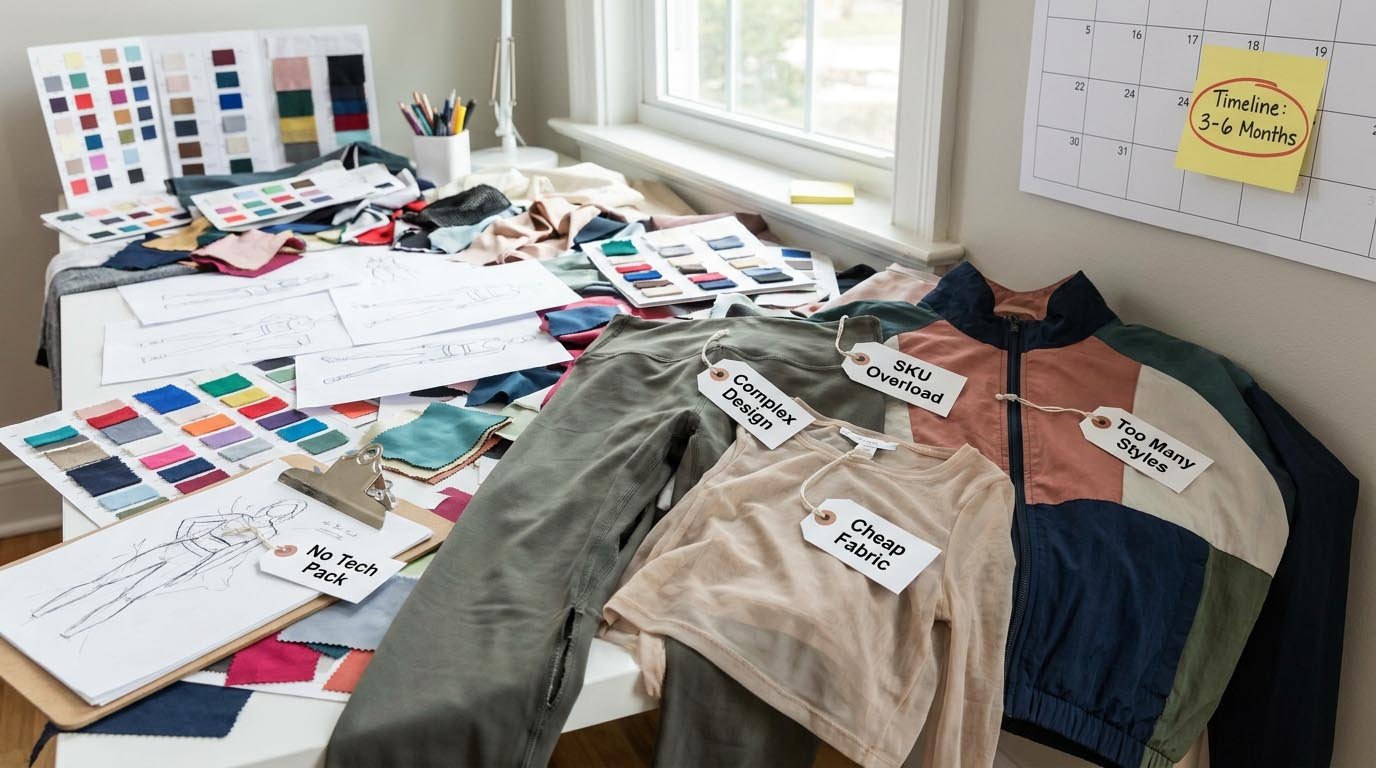
Most collection planning mistakes happen before production starts.
The biggest one is trying to launch too many ideas at once instead of building a small collection around the clearest customer need.
Here are the most common issues:
1. Designing from mood boards instead of use cases
Inspiration is helpful, but if it is not tied to workout scenarios, it does not guide product development clearly.
2. Launching too many styles
More styles often mean weaker focus, slower development, higher MOQs, and more inventory risk.
3. Ignoring size and color multiplication
A simple-looking collection can turn into dozens of SKUs very quickly.
4. Choosing fabric by price alone
Cheap fabric can create expensive problems through pilling, poor recovery, transparency, or discomfort.
5. Overcomplicating construction
Complex panels, too many fabric combinations, and intricate styling details can increase cost and create production issues.
6. Skipping technical development
Without proper tech packs, fit comments, and fabric specifications, sampling becomes slower and less accurate.
7. Underestimating lead time
A first collection usually takes longer than expected because of:
- sourcing
- testing
- sample revisions
- fit corrections
- production scheduling
- shipping
A realistic timeline from approved tech pack to delivered goods is often 3-6 months, depending on complexity and supplier responsiveness.
FAQ: Planning Your First Activewear Collection
How many pieces should a first activewear collection have?
For most new brands, 4-6 pieces is a practical starting point. That is enough to build a clear launch story without creating too many SKUs or overwhelming your budget.
What are the best hero products for a new activewear brand?
That depends on your target customer, but common hero pieces include leggings, sports bras, fitted tanks, cycling shorts, and performance jackets. Focus on the products your customer wears most often.
How do I choose the right fabric for activewear?
Start with the workout scenario. Evaluate stretch, recovery, opacity, moisture management, comfort, and fabric weight based on how the garment will actually be used.
How many colors should I launch with?
Usually 2-3 core colors are enough for a first collection. Add one accent color only if it supports your brand identity and budget.
What is the biggest mistake in first activewear collection planning?
Trying to do too much at once. Too many styles, too many colors, and too many product categories usually create MOQ pressure, high development cost, and inventory risk.
How long does it take to develop a first activewear collection?
In many cases, 3-6 months is a realistic timeline from finalized product direction to bulk delivery, depending on your supplier, sample revisions, and shipping method.
Final Thoughts
A strong first activewear collection is not built by copying trends or launching as many styles as possible.
It is built by understanding your target customer's workout needs, choosing a small number of products with clear roles, and matching your design ambition to your MOQ, fabric, and budget reality.
If you start with focused hero products, controlled SKU planning, and the right fabric strategy, your first activewear collection will be easier to develop, easier to manufacture, and more likely to connect with the market.