.png)
If you are planning to launch an activewear brand in the U.S., one of the first questions is usually the most practical one: how much money do you actually need to get started?
The short answer is that many early-stage activewear brands spend somewhere between $15,000 and $50,000 to get from concept to first inventory, though some spend less with a narrow private label launch and others spend far more on custom development, content, and marketing.
That range usually covers the major startup categories:
- product development
- tech packs and samples
- manufacturing
- packaging
- shipping and import-related costs
- ecommerce setup
- launch content and early marketing
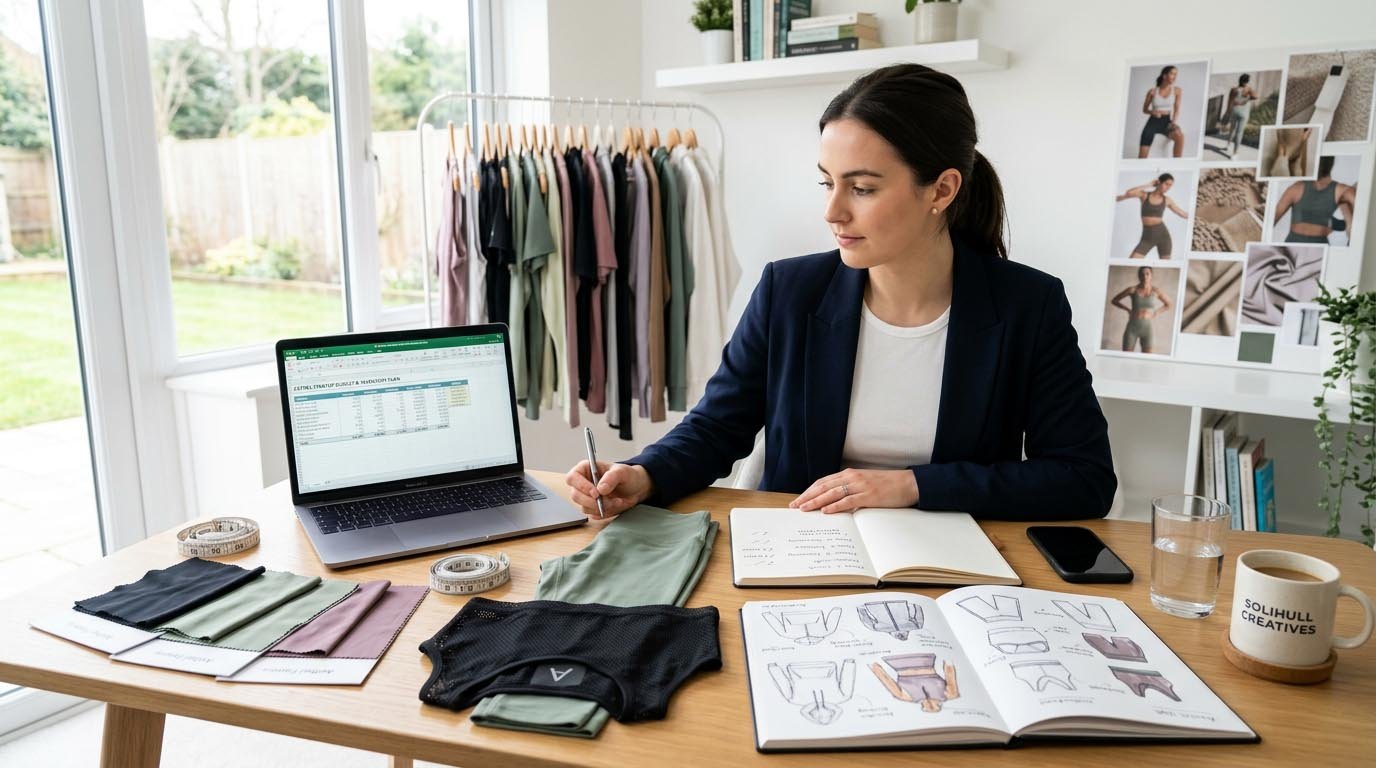
The exact number depends on a few big variables: how many styles you launch with, whether you choose private label or custom production, where you manufacture, what fabrics you use, and how much you invest in your first launch.
At Wearzio, we work with startup and growing apparel brands on activewear development, sourcing, sampling, and production support. This guide is based on the budgeting questions founders ask most often before their first launch.
Quick Answer: What Budget Do You Need to Start an Activewear Brand?
For most startups, a practical budget falls into one of these ranges:
- $15,000 to $25,000 for a smaller launch using private label or low-complexity development
- $25,000 to $40,000 for a more serious launch with semi-custom development and stronger launch assets
- $40,000 to $60,000+ for a more customized brand with larger production runs, more styles, and higher upfront marketing spend
A lot of first-time founders assume the biggest cost is design. In reality, inventory and production usually take the largest share of the budget, followed by development, marketing, and logistics.
Just as important, the total is not only about what the factory charges. New brands often underestimate:
- sample revisions
- packaging
- freight
- duties or import-related fees
- photography and content creation
- launch marketing
- buffer for delays or corrections
What It Typically Costs to Start an Activewear Brand
A realistic startup budget for a new activewear brand in the U.S. often lands between $15,000 and $50,000, but that range only makes sense when you know what it actually includes.
For many founders, the first launch budget needs to cover:
- product design and technical development
- samples and fit revisions
- first production run
- packaging and labels
- shipping and landed costs
- a basic ecommerce setup
- launch photography or content
- early marketing spend
Some very lean brands launch below that range by keeping the product line small, using stock fabrics, and relying on private label or lower-MOQ suppliers. On the other hand, brands that want custom fits, custom fabrics, or a stronger day-one brand presence can exceed that range quickly.
What matters most is not chasing the lowest possible number. It is building a budget that matches your product, positioning, and launch plan.
In our experience, brands tend to get into trouble when they budget only for product cost and forget everything around it. The manufacturing quote is just one part of the picture. A product that costs $12 to make can land much higher once freight, packaging, payment fees, and content are added.
Budget Tiers: Starter, Growth, and Premium Launches
While every brand is different, most early launches fall into one of three practical tiers.
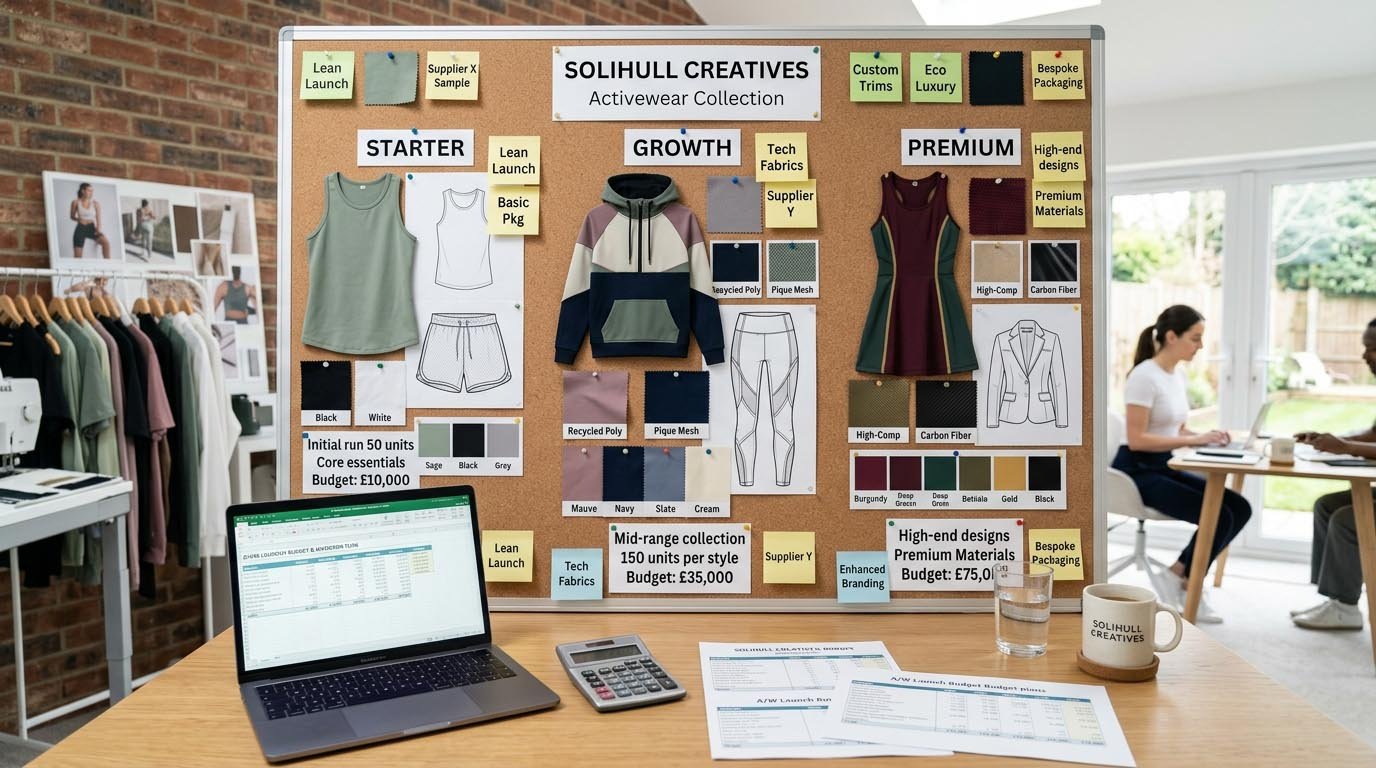
Starter Launch: $15,000 to $25,000
This budget level usually works best for founders who want to test the market carefully.
Typical characteristics:
- 2 to 4 initial styles
- lower first order quantities
- private label or low-complexity custom development
- simpler packaging
- lean launch marketing
- basic ecommerce setup
This tier often suits:
- first-time founders
- side-hustle brands
- niche product tests
- creators or trainers launching a small capsule
A smaller launch does not necessarily mean weak brand potential. In many cases, a focused first release performs better because the founder can put more attention into a few core products rather than spreading budget too thin.
Growth Launch: $25,000 to $40,000
This is often the most balanced range for startup brands that want a more complete launch.
Typical characteristics:
- 3 to 6 well-developed styles
- more flexibility in fabric and trim choices
- semi-custom or custom elements
- stronger product photos and content
- more room for sample revisions
- a real launch marketing budget
This budget tends to be the sweet spot for founders who want enough inventory to launch with confidence without overcommitting too early.
Premium Launch: $40,000 to $60,000+
This range is more common when founders want higher customization, more inventory, or more aggressive brand positioning from day one.
Typical characteristics:
- larger first production run
- more styles or colorways
- fully custom development
- stronger packaging and brand presentation
- more polished launch assets
- larger paid marketing budget
There is nothing wrong with launching at this level if the product strategy and capital are there. But it is also where overbuilding becomes a real risk.
Design, Tech Packs, Sampling, and Development Costs
One of the most misunderstood parts of launching an activewear brand is development.
From the outside, it can seem like the product is “just a legging” or “just a sports bra.” In reality, activewear is one of the categories where development details matter most. Fit, fabric recovery, seam placement, waistband tension, and opacity under stretch all affect how the final product performs.
For many new brands, design and development costs often land somewhere between $2,000 and $6,000, though complex products or repeated revisions can push that number higher.
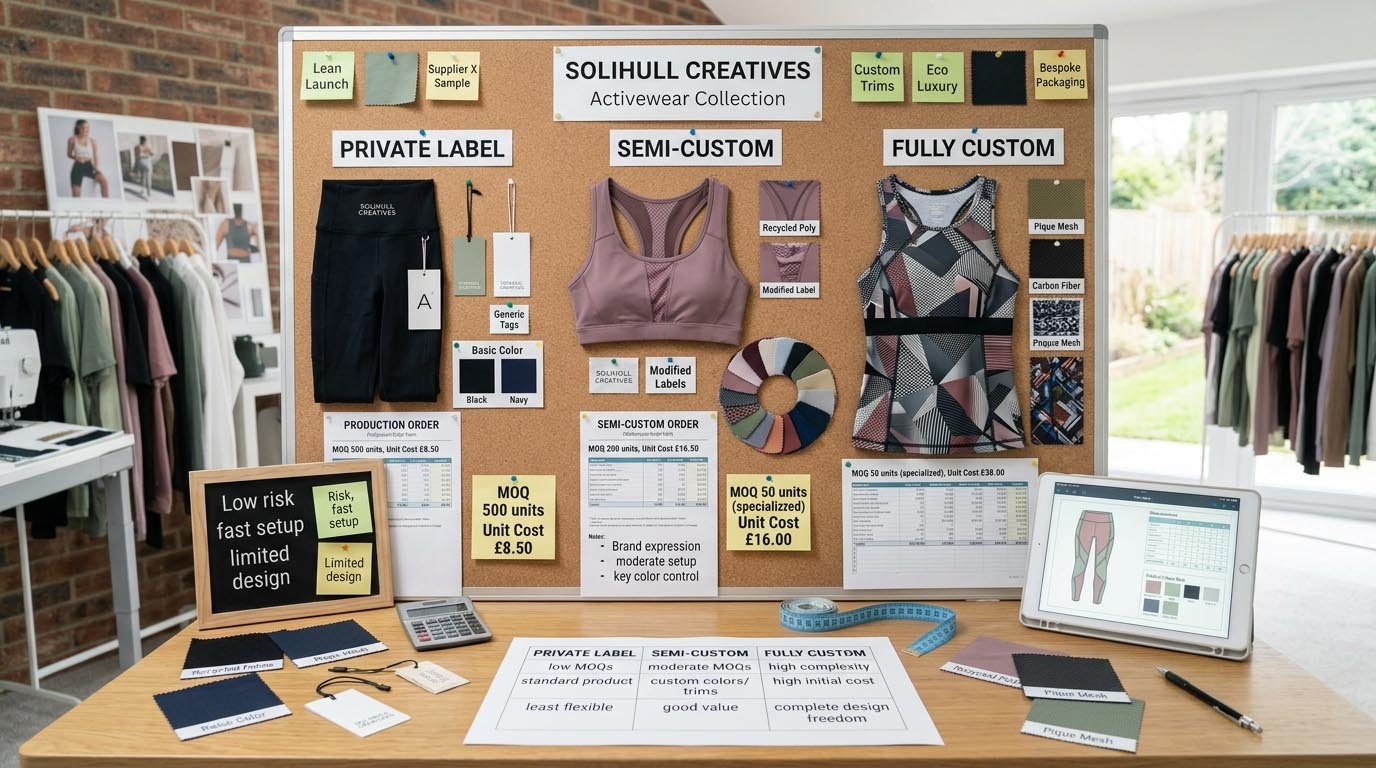
Typical Development Cost Categories
You may need to budget for:
- design support or technical design
- flat sketches
- tech pack creation
- pattern development or modification
- grading
- first prototype samples
- fit sample revisions
- pre-production samples
- fabric swatches and test yardage
Example Cost Ranges
These numbers vary by supplier, region, and product complexity, but common startup ranges look like this:
| Development Item | Typical Range |
|---|---|
| Flat sketches / design support | $150–$400 per style |
| Full tech pack | $200–$600 per style |
| Pattern development or modifications | $150–$500 per style |
| First prototype sample | $50–$180 per piece |
| Fit sample revisions | $30–$100 per round |
| Pre-production sample | $50–$120 per piece |
| Fabric testing / evaluation | $150–$600 depending on scope |
If you are launching 3 to 5 styles, it is easy to see how this stage adds up before bulk production even begins.
Why Sampling Costs More Than Founders Expect
A common first-time mistake is assuming one sample round will be enough.
Usually it is not.
With activewear, fit issues often appear only after the garment is worn, stretched, or compared against intended performance. A legging can look fine laid flat and still fail during movement. A sports bra can match the spec sheet and still need changes in underband tension, strap placement, or coverage.
In one recent development project, a founder planned for two sample rounds on a sports bra and ended up needing five. The issue was not that the factory failed. It was that the support level felt different on-body than it looked on paper. That is normal in product development, especially in more technical categories.
This is why it is safer to budget for revision rounds rather than assuming the first sample will be production-ready.
Where Good Development Saves Money
Founders often try to save money by reducing design time, skipping testing, or rushing sample approvals. In most cases, that creates bigger costs later:
- fit-related returns
- customer complaints
- wasted inventory
- more expensive production corrections
- weaker repeat purchase rates
A better approach is to keep the first collection small enough that you can afford to develop it properly.
Manufacturing Costs: Private Label vs Custom Activewear Production
Manufacturing is usually the largest startup cost category, and it is also where your strategy matters most.
The broad question is not just “what does it cost per unit?”
It is also:
- how custom the product needs to be
- what your MOQs are
- what quality level you need
- how much differentiation matters for your brand
- how much inventory you can realistically carry
For startup activewear brands, manufacturing often falls into three broad models: private label, semi-custom, and fully custom.
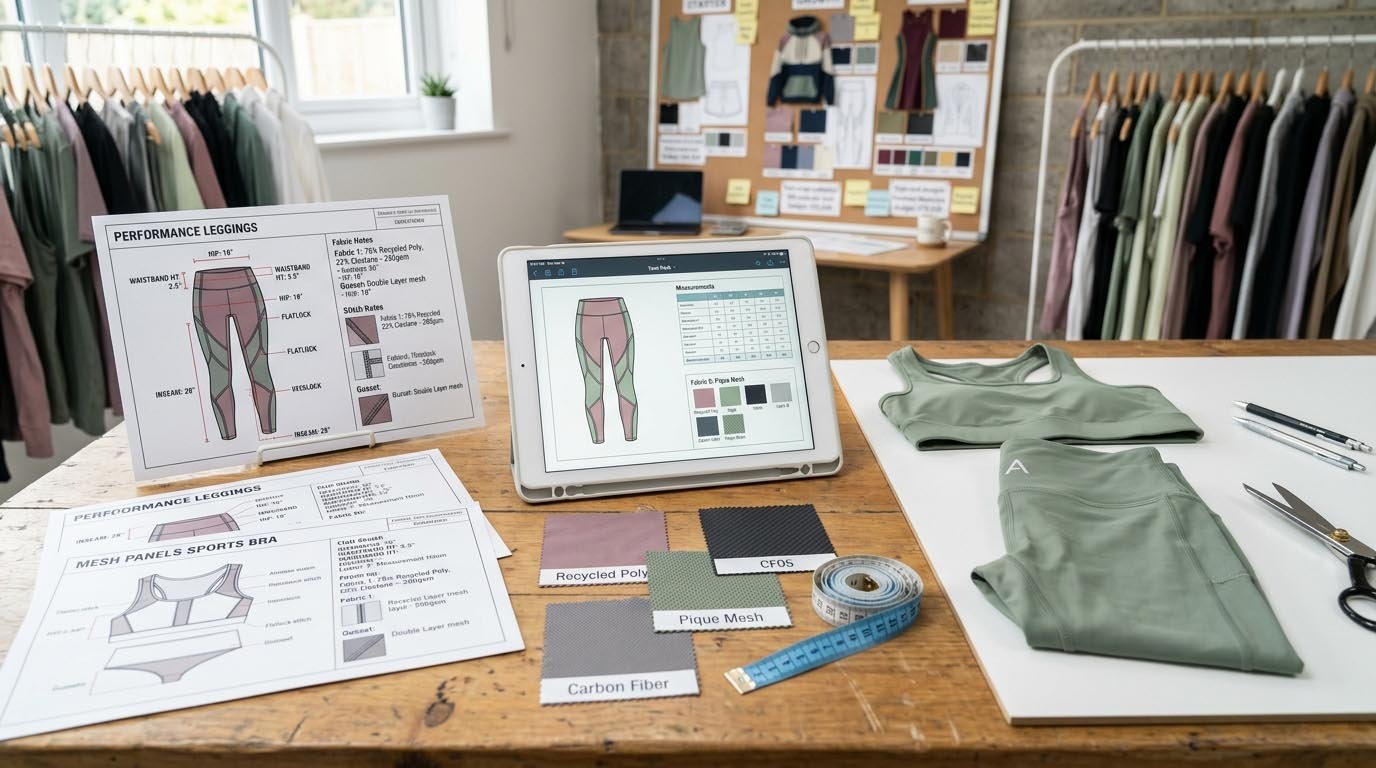
Private Label Activewear
Private label usually means selecting existing styles from a factory or supplier and applying your branding, with limited customization.
Typical characteristics:
- lower MOQs
- faster lead times
- lower development costs
- less unique product
- fewer fit-related unknowns
Common range:
- around $8 to $14 per unit
- often 300-piece minimums, sometimes lower depending on supplier and style
This approach can work well if your goal is to test demand without taking on a full custom development process.
Semi-Custom Activewear
Semi-custom is often the middle ground that makes sense for emerging brands.
Typical characteristics:
- use of an existing base pattern with modifications
- more control over trims, fabric, color, or details
- moderate development cost
- stronger brand differentiation than private label
Common range:
- around $12 to $22 per unit
- often 500-piece minimums, though this depends heavily on the product and factory setup
For many founders, this is the most practical path because it gives some uniqueness without the cost of fully custom development.
Fully Custom Activewear
Fully custom production gives you the most control, but also demands the most planning and capital.
Typical characteristics:
- custom patterns and fit
- more development time
- more sample rounds
- higher MOQs
- more complete control over final product
Common range:
- around $18 to $35+ per unit
- often 1,000+ pieces for a style run, depending on construction, fabric sourcing, and production location
This path tends to make more sense when:
- your brand is built on a distinct fit or product innovation
- you already understand your customer demand
- you have enough capital to absorb development and inventory risk
Example Manufacturing Comparison
| Manufacturing Model | Typical Unit Cost | Typical MOQ | Best Fit For |
|---|---|---|---|
| Private label | $8–$14 | 300 pcs | Lean first launch, market testing |
| Semi-custom | $12–$22 | 500 pcs | Growing startup brands |
| Fully custom | $18–$35+ | 1,000+ pcs | Premium positioning, larger launch |
These are not universal numbers, and real costs vary based on fabric, construction, decoration, and where production happens. A simple tank and a high-compression legging will not cost the same to make, even within the same production model.
Why Unit Cost Alone Can Be Misleading
Some founders choose a supplier based only on the lowest quote. That usually creates problems.
A cheaper unit price does not help much if:
- the fabric quality is weak
- the fit is inconsistent
- the MOQ forces too much inventory
- communication causes delays
- the garment needs heavy discounts to sell
The better question is whether the production setup gives you a product you can confidently price, market, and reorder.
Packaging, Shipping, Compliance, and Logistics Costs
Once founders begin pricing products, they often focus on manufacturing and forget about what happens after production. This is where budgets start to drift.
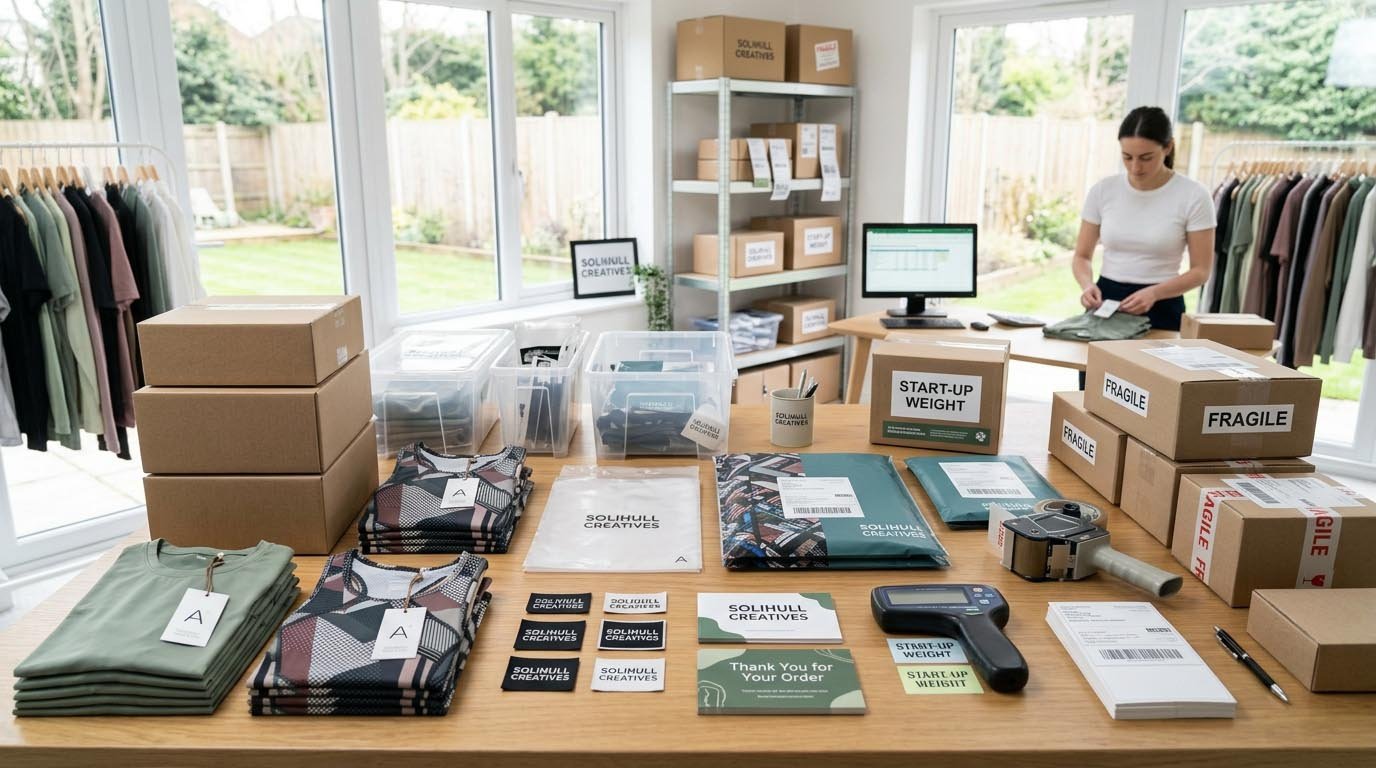
For many startup brands, packaging, shipping, and logistics can add several thousand dollars to the launch budget, depending on order size and production location.
Packaging Costs
Basic branded packaging may include:
- hangtags
- woven labels
- care labels
- poly bags
- shipping mailers or cartons
- insert cards or simple thank-you notes
Common startup ranges:
- poly bag with custom print: $0.15–$0.40 per unit
- hangtags and labels: $0.20–$0.70 per unit
- outer shipping materials: $1.50–$3.50 per order if self-fulfilling
If your first order is 500 units, basic packaging can still add up quickly, especially if you want the presentation to feel premium.
Freight and Shipping
How you manufacture affects your freight budget.
For overseas production, founders often need to consider:
- ocean or air freight
- customs duties or import-related fees
- customs broker fees
- local delivery from port or warehouse
For domestic production, freight is usually simpler, but shipping still needs to be planned into the landed cost.
Common startup freight ranges:
- ocean freight for a smaller first order: roughly $800–$2,000 in many cases
- air freight: often much higher, depending on timing and volume
- broker or clearance-related fees: often a few hundred dollars depending on shipment structure
These are directional ranges only. Freight moves constantly, and landed cost depends heavily on shipment size, origin, timing, and delivery terms.
Compliance and Labeling
This is an area where founders should be careful not to oversimplify.
If you are selling apparel in the U.S., you should review requirements around:
- fiber content labeling
- country of origin labeling
- care instructions
- identity labeling
Depending on your materials, product claims, retail channels, and production setup, you may also need to budget for additional testing or compliance support. This varies widely, so it is better to treat compliance as a planning category rather than assume one flat cost applies to every brand.
In other words: budget for it, but do not assume every startup needs the exact same testing package.
Warehousing and Fulfillment
You also need to plan for where inventory goes after production.
Options often include:
- self-fulfillment at low volume
- a small warehouse or storage solution
- a 3PL fulfillment partner
Common early costs may include:
- inbound receiving
- storage
- pick-and-pack fees
- shipping software or order management tools
A founder shipping 20 orders per month can often keep this simple. A founder doing 200 orders per month usually needs a more structured setup.
Website, Content, and Launch Marketing Costs
You can have a great product and still struggle if the brand presentation is weak.
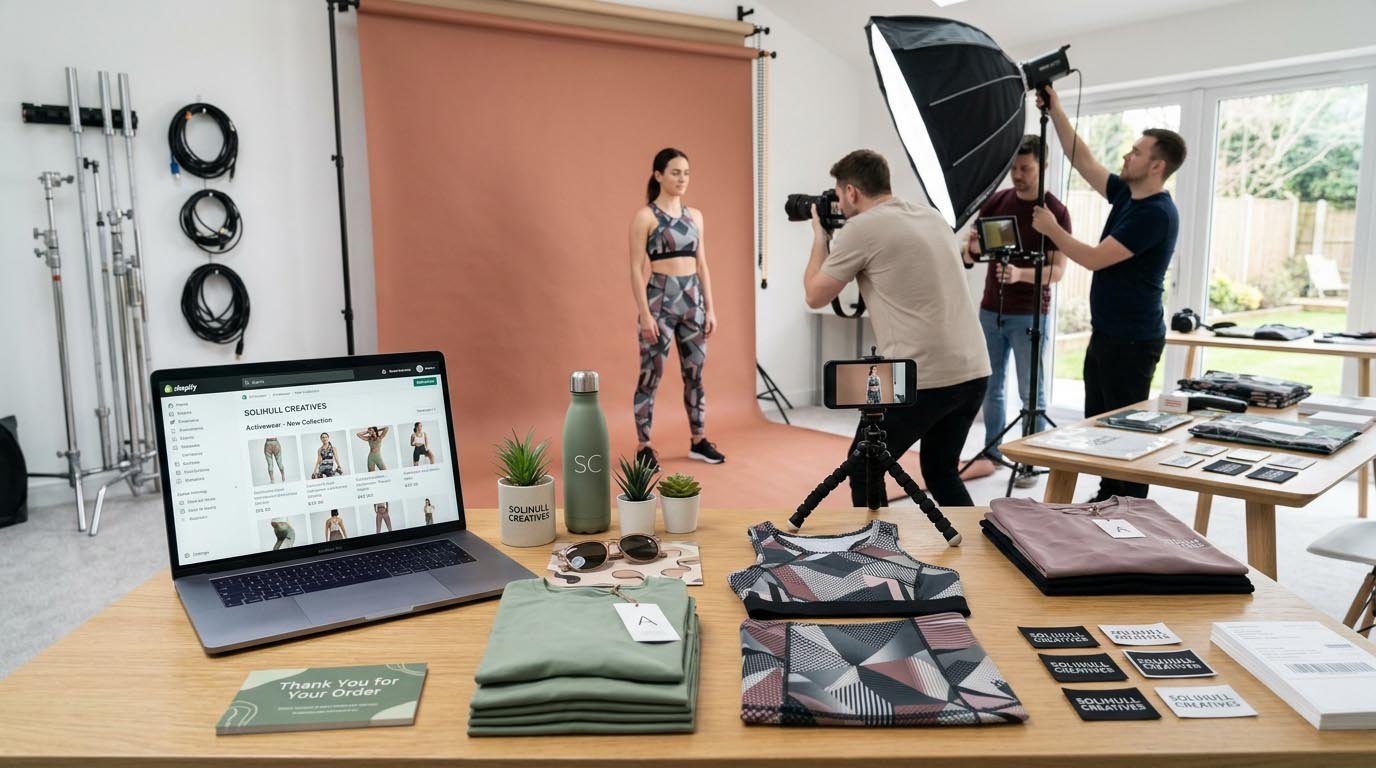
For most startup activewear brands, website setup, photography, content creation, and early marketing can easily require $3,000 to $10,000+, depending on how polished you want the launch to feel.
Ecommerce Setup
Most founders start with Shopify or a similar platform.
Typical costs may include:
- platform subscription
- theme purchase or customization
- essential apps
- email marketing setup
- product page writing
- basic site design support
A simple startup site can be relatively lean. A more customized storefront with stronger brand design costs more.
Product Photography and Content
This is one of the most important launch investments.
For activewear, customers want to see:
- fit on body
- movement
- fabric appearance
- waistband height
- support level
- product details under natural lighting
Common startup content costs:
- studio product photos
- lifestyle model photography
- short-form video clips
- try-on or movement content
- basic editing and retouching
A polished content shoot can cost several thousand dollars, but the exact number depends on how much you produce and whether you organize it yourself or hire a team.
Paid and Organic Launch Marketing
Most new brands need some budget for visibility, even if they rely heavily on organic social content.
That may include:
- Instagram or Meta ads
- influencer gifting or seeding
- email platform tools
- launch offers
- founder-led content creation
- short-form video editing
Some brands launch lean and rely on audience-building before inventory arrives. Others invest more heavily in paid traffic. Neither path is automatically right. The better approach is to match the marketing budget to your product readiness and content quality.
A common startup mistake is spending heavily on inventory and leaving almost nothing for launch. Another is overbuilding the website before there is enough content or traffic to justify it.
How to Keep Startup Costs Under Control
Founders often ask how to reduce costs without hurting the brand. Usually the answer is not “spend nothing.” It is “spend in the right places.”
Here are some of the most practical ways to control startup costs:
1. Start with fewer styles
Launching with 2 to 4 strong styles is usually easier than launching with 8 to 10 average ones.
This reduces:
- development costs
- sample rounds
- production complexity
- inventory risk
- photography and content needs
2. Limit your first color range
Too many colorways create more SKUs, more inventory spread, and more forecasting risk.
For many first launches, a few proven colors are enough.
3. Avoid overcomplicating trims and construction
Custom trims, specialty elastics, complex seaming, and unusual finishes can all increase cost. Some are worth it. Many are not necessary in a first release.
4. Use proven fabrics before developing your own
Custom fabric development can be valuable later, but it is often too expensive and slow for an early launch unless the fabric itself is your core brand differentiator.
5. Keep packaging clean, not excessive
Strong branding does not require expensive unboxing at the beginning. A simple, professional packaging system is often enough.
6. Build launch content around a few hero products
Instead of trying to photograph everything in a huge campaign, focus on the items most likely to drive sales.
7. Leave room for buffer
The brands that stay calm during launch are usually the ones that kept reserve budget for sample changes, freight shifts, or timing issues.
Common Budgeting Mistakes New Activewear Brands Make
A lot of startup budget problems are predictable. The same issues come up again and again.
Underestimating sample revisions
The first sample is rarely the final sample. Brands that budget for only one or two rounds often get squeezed later.
Spending too much on too many SKUs
More products can make a launch look impressive, but they also spread budget and attention too thin.
Looking only at factory price
Low quotes can hide bigger problems if communication, quality, or lead times are weak.
Ignoring landed cost
The real cost is not just production. It is production plus freight, packaging, duties where applicable, storage, and launch expenses.
Leaving too little for content and marketing
A product cannot sell if people cannot see it clearly, understand it, or trust the brand.
Approving product too early
Some founders get tired of revisions and approve garments before the fit is truly solved. That can become a much bigger problem after bulk production begins.
Building the launch around unrealistic projections
A careful first launch usually performs better than an oversized one built on optimistic assumptions.
Final Thoughts
Starting an activewear brand in the U.S. does not require unlimited capital, but it does require realistic planning.
For many startups, a good first budget lands somewhere between $15,000 and $50,000. The most important thing is not launching with the biggest line. It is launching with a collection you can actually afford to develop well, produce responsibly, and market clearly.
If there is one pattern we see repeatedly, it is this: brands usually do better when the first launch is smaller, tighter, and better developed than they originally planned.
That means:
- fewer styles
- better samples
- cleaner positioning
- more realistic inventory planning
- enough budget left to actually launch properly
If you are planning your first activewear collection and need help with development, sourcing, tech packs, sampling, or production planning, Wearzio can help.
Ready to map out your launch budget?
Contact Wearzio to discuss your product, MOQ, and next steps.