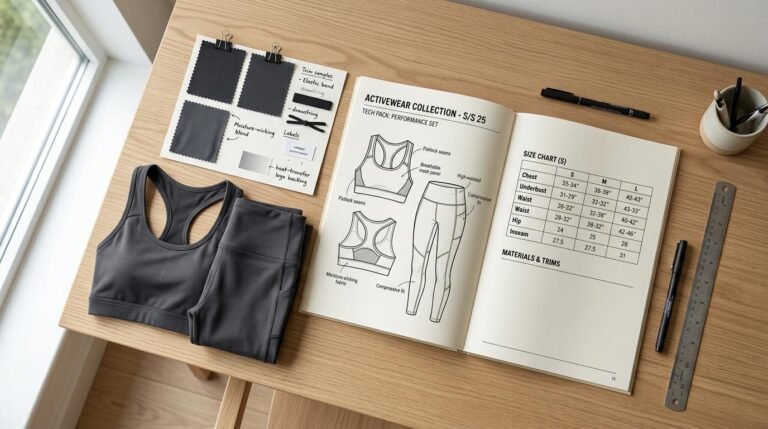
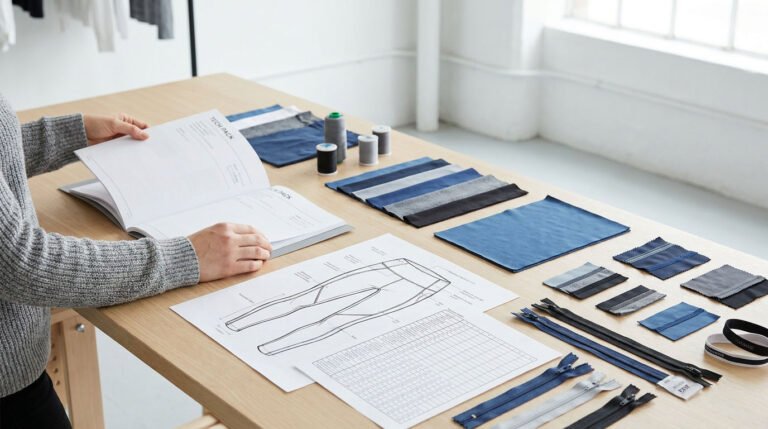
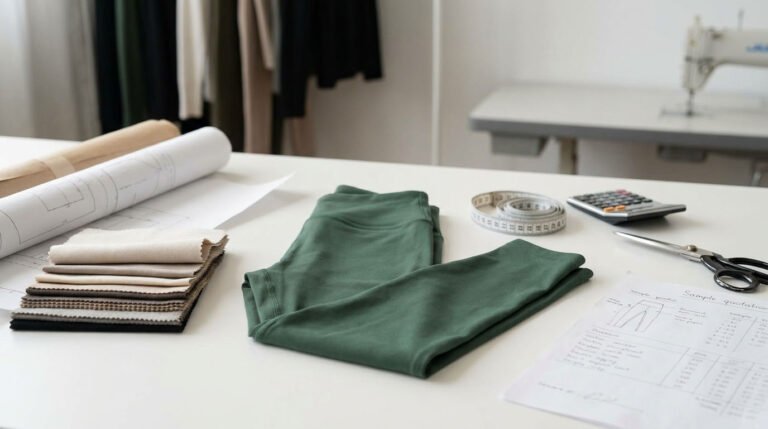
Your activewear sample has finally arrived. The fabric feels comfortable, the stitching looks clean, and the design matches your expectations. But is it ready for approval?
A sample that looks excellent on a hanger may still fail during squats, stretch out during exercise, or feel uncomfortable after extended wear.
To review an activewear sample before approval, verify its specifications, measure the garment against your tech pack, test fit during movement, inspect fabric and construction, and document any required revisions. Only approve the sample for its intended production stage when the relevant issues have been resolved and verified.
This guide provides a practical seven-step activewear sample review checklist for brands preparing leggings, sports bras, shorts, and other performance apparel for production.
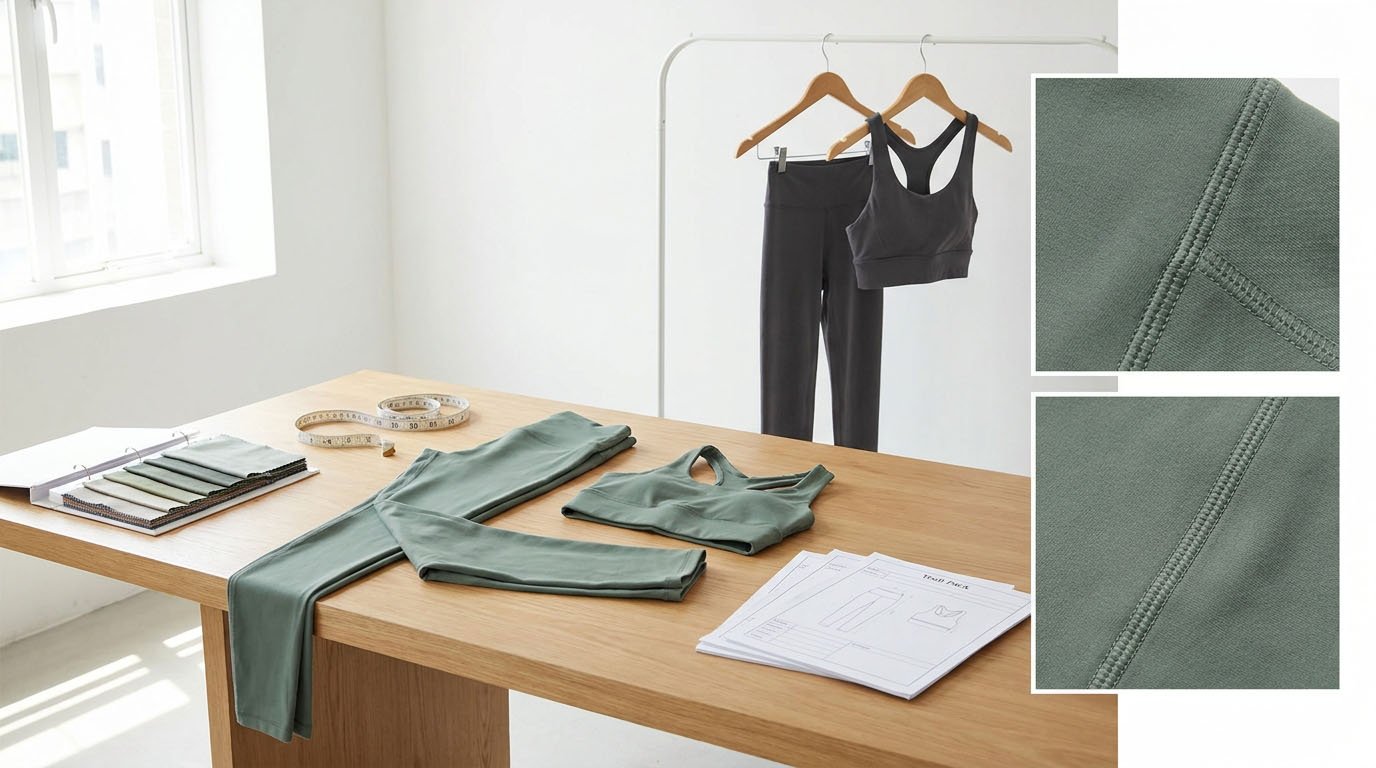
Quick Answer: Activewear Sample Review Checklist
Before approving a sample, use this checklist to confirm that the garment meets your requirements.
| Step | What to Check | Expected Result |
|---|---|---|
| 1. Sample details | Version, size, fabric, specifications | Correct sample identified |
| 2. Measurements | Actual dimensions vs. tech pack | Within agreed tolerances |
| 3. Fit and movement | Squats, stretches, jumps, arm movements | Fit performs as intended |
| 4. Materials and construction | Seams, fabric, trims, colors, logos | Matches approved requirements |
| 5. Comfort and function | Opacity, support, recovery, pockets | No unresolved functional failures |
| 6. Revision feedback | Defects, measurements, marked photos | Clear corrective actions |
| 7. Approval decision | Outstanding issues and evidence | Appropriate approval status |
Important: A sample can pass visual inspection but still fail functional testing. Both measurements and real-world performance must be considered before final approval.
Step 1: Confirm the Sample Version and Review Stage
Before measuring or trying on the garment, confirm exactly which sample you received.
Factories may provide several sample versions throughout development. Reviewing the wrong version or comparing it against outdated specifications can result in unnecessary revisions.
Check the Sample Identification
Start by recording:
- Style number and product name
- Sample version or revision number
- Sample size and color
- Fabric and trim references
- Tech pack revision date
- Previous correction requests, if applicable
For example, if you requested a revised Size M legging sample with a higher back waistband, confirm that the factory sent the correct version before evaluating the fit.
Know What You Are Approving
Different sample stages require different approval decisions.
| Sample Stage | Main Review Focus | Approval Scope |
|---|---|---|
| Prototype | Design feasibility, basic construction | Concept or development approval |
| Fit Sample | Measurements, fit, movement | Fit or pattern approval |
| Pre-Production Sample | Final materials, construction, branding | Production-readiness approval |
A prototype made with substitute fabric may be suitable for reviewing design proportions, but it should not automatically become the standard for bulk production.
For a more detailed explanation of the development stages, see our Activewear Sampling Process Explained.
The key is to approve only what the sample actually demonstrates.
Step 2: Check Measurements Against the Tech Pack
A garment can look correctly sized without meeting its documented specifications.
This is why accurate measurement is one of the most important steps in reviewing an activewear sample.
How to Measure an Activewear Sample
Place the garment on a flat surface and follow the measurement method defined in your approved tech pack.
Before measuring:
- Allow the fabric to relax according to the agreed measurement procedure.
- Position the garment without unnecessarily stretching it.
- Identify each Point of Measure (POM).
- Record the actual measurements.
- Compare results against the target dimensions and agreed tolerances.
Common measurement points for leggings include waist width, hip width, inseam, front rise, back rise, and leg opening.
For sports bras, important points may include underbust width, body length, strap length, neckline width, and armhole measurements.
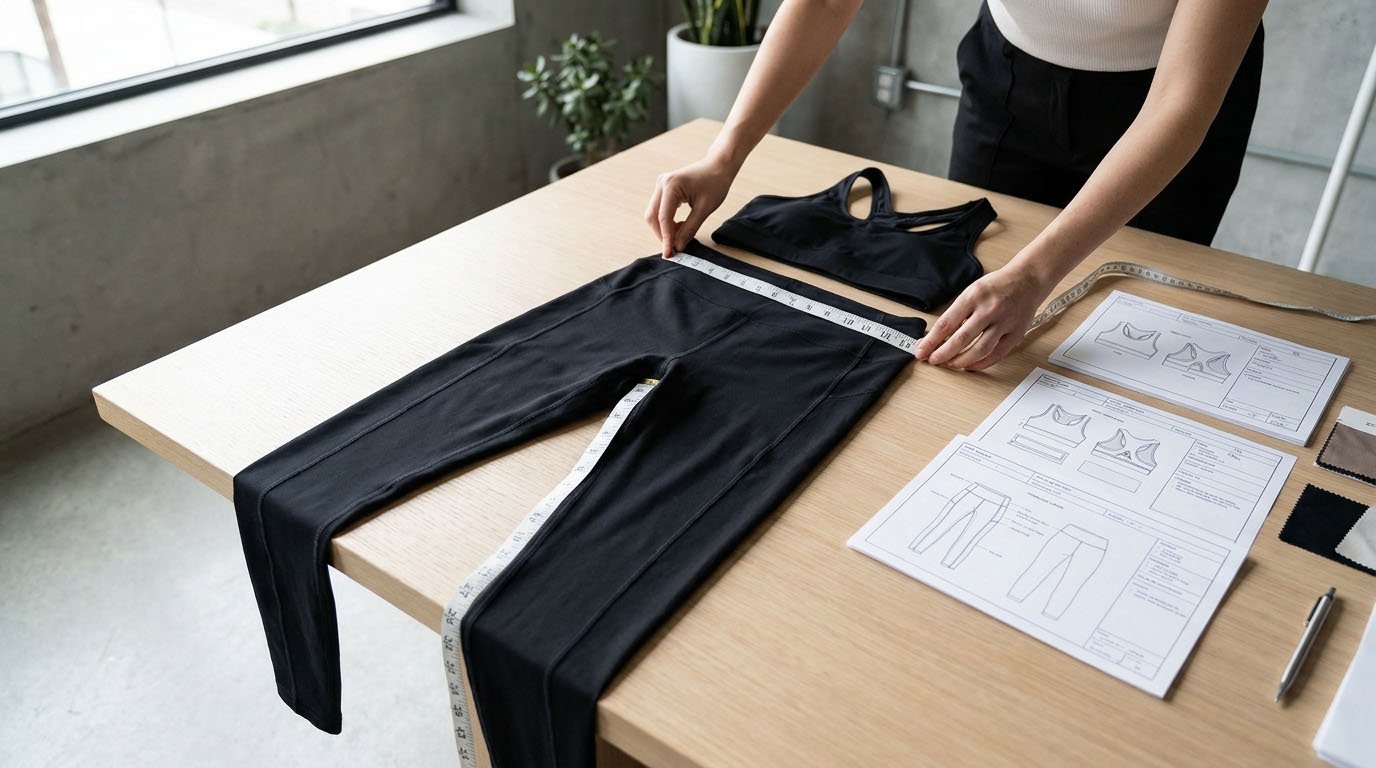
Example: Size M Leggings Measurement Review
The following is an illustrative review record, not a universal activewear tolerance standard.
| Point of Measure | Target | Actual | Difference | Agreed Tolerance | Result |
|---|---|---|---|---|---|
| Waist width, flat | 33.0 cm | 34.0 cm | +1.0 cm | ±0.5 cm | Review |
| Inseam | 68.0 cm | 67.7 cm | -0.3 cm | ±1.0 cm | Pass |
| Front rise | 28.0 cm | 28.2 cm | +0.2 cm | ±0.5 cm | Pass |
In this example, the waist width exceeds the agreed tolerance and requires investigation.
However, a measurement outside tolerance does not automatically identify the underlying pattern problem. The factory should investigate the cause before deciding how to correct it.
Likewise, measurements within tolerance do not guarantee a good fit.
The approval rule is simple: dimensional accuracy and actual garment performance must both be acceptable.
Step 3: Test Fit and Movement on the Intended Wearer
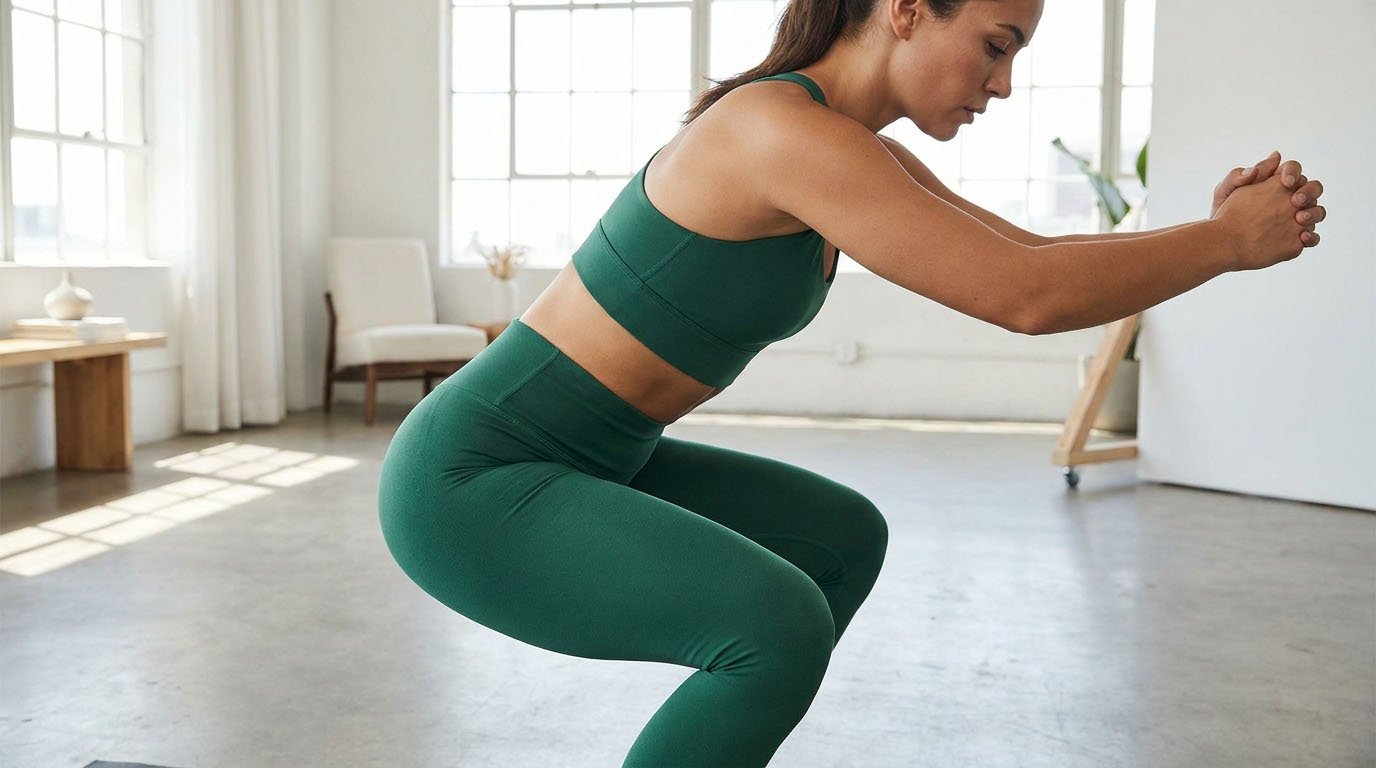
Activewear is designed for movement. Evaluating a sample while standing still is not enough.
A fit model representing your target customer should wear the sample during activities relevant to the product's intended use.
Check both how the garment looks and how it behaves.
Movement Tests by Product Type
| Product | Suggested Movements | Common Problems to Look For |
|---|---|---|
| Leggings | Squats, lunges, forward bends | Waistband rolling, sheerness, seam tension |
| Sports Bras | Arm raises, jumps, jogging in place | Band movement, strap pressure, inadequate support |
| Training Shorts | Squats, lunges, running | Leg opening restrictions, riding up |
| Activewear Tops | Reaching, twisting, stretching | Hem lifting, shoulder restriction |
Choose movements appropriate to the intended activity. A low-impact yoga bra and a high-support running bra should not be judged against identical performance expectations.
Practical Example: Reviewing a Leggings Fit Sample
Imagine reviewing a Size M high-waisted legging sample.
When standing, the waistband looks even, and the garment fits comfortably.
During movement, however, you notice three problems:
- The back waistband slides down during repeated squats.
- The knee fabric becomes visibly sheer under deep stretch.
- The inner-thigh seam causes discomfort during lunges.
These problems require separate evaluation.
The waistband issue may involve pattern balance, garment dimensions, elastic tension, or fabric recovery. The opacity issue may relate to fabric construction, color, or stretch behavior. The seam discomfort may involve seam placement or construction.
Do not assume one pattern adjustment will solve all three.
Record each problem individually and ask the sample development team to investigate the appropriate correction.
Check More Than One Size When Necessary
A middle-size sample does not always represent the full size range.
For new patterns or products with demanding fit requirements, consider reviewing additional sizes to identify grading-related issues.
Sports bras and leggings are particularly sensitive to changes in compression, waistband tension, and body proportions.
For more information about the product-development considerations behind these garments, read our Sports Bra and Legging Set Development Guide.
Step 4: Inspect Fabric, Seams, Trims, and Branding
After checking measurements and fit, examine the physical construction.
These details influence appearance, comfort, durability, and consistency during production.
Fabric and Color Inspection
Compare the sample against the approved fabric reference.
Check:
- Fabric composition and specified weight
- Surface texture and hand feel
- Stretch and recovery
- Color against the approved physical reference
- Visible defects, stains, or inconsistencies
If the sample uses a substitute fabric, record that limitation clearly. A fit decision made using substitute material may need to be reconfirmed once the final fabric is available.
Fabric properties can significantly affect compression, fit, and movement. Our Fabric Sourcing Services explain how Wearzio supports brands with material selection and development.
Seam and Construction Inspection
Turn the garment inside out and examine the stitching.
Look for:
- Skipped or broken stitches
- Uneven seam tension
- Puckering or twisting
- Uncomfortable seam allowances
- Weak attachment points
- Construction that restricts the intended stretch
Gently assess whether the seams accommodate normal garment movement. Do not stretch them beyond intended use or assume that a manual pull replaces a defined seam-strength test.
Also inspect stress areas such as the crotch, underarm, waistband, and strap attachments.
These are important considerations in custom cut-and-sew activewear manufacturing.
Trims and Branding
Review any relevant zippers, drawcords, elastics, removable pads, labels, and logos.
Check that logos are correctly positioned, properly applied, and compatible with the garment's stretch.
A heat-transfer logo, for example, should not show visible cracking or peeling during normal movement.
Compare branding placement with the approved artwork and measurement references rather than relying on visual judgment alone.
Step 5: Evaluate Comfort and Functional Performance
A sample may meet its dimensions and look well constructed while still failing in actual use.
Functional review helps identify problems that basic visual inspection cannot reveal.
Check Comfort During Wear
Ask the fit model to describe any pressure, rubbing, or restriction during the intended activity.
Pay attention to:
- Underbust and shoulder pressure on sports bras
- Waistband tension on leggings
- Inner-thigh seam friction
- Restriction during bending or reaching
- Garment shifting during extended movement
For pockets, use an item representative of the intended contents and check whether it remains secure during movement.
Test Opacity and Fabric Recovery
For leggings and fitted shorts, check whether the fabric becomes unexpectedly transparent during squats and bends.
Inspect the fabric under consistent lighting and at realistic levels of stretch.
After movement, observe whether the garment recovers its original shape or remains stretched out.
These checks are particularly useful for evaluating whether a fabric is suitable for the garment's intended function.
Review Washing and Performance Evidence
Where relevant, wash a test sample according to the intended care instructions and inspect changes in:
- Dimensions and overall shape
- Color and appearance
- Seam condition
- Elastic recovery
- Logo adhesion
- Pilling or surface changes
Record the washing procedure and results so the observations can be reproduced.
Wear testing cannot replace laboratory testing.
Claims such as a specified UPF rating, antibacterial performance, or quantified moisture-wicking performance require appropriate supporting test evidence.
A comfortable sample should not automatically be described as technically compliant with every intended performance claim.
Step 6: Document Sample Issues and Revision Feedback
Finding a defect is only useful if the factory can understand and correct it.
Vague feedback such as "make the waistband better" or "the leggings feel strange" can lead to repeated sampling without resolving the original problem.
Effective sample feedback should be specific, measurable where possible, and supported by visual evidence.
Use a Consistent Feedback Format
Each issue should identify four things:
- Location: Where the problem occurs.
- Observation: What happens and under which conditions.
- Evidence: Measurements, photographs, or test results.
- Requested outcome: What needs to be corrected or verified.
For example:
Poor feedback:
"The waistband is too loose. Please make it tighter."
Better feedback:
"Size M, back waistband: the waistband moves downward by approximately 2 cm during repeated deep squats. See the attached side-view and back-view photographs. Please review waistband tension, rise balance, and relevant POM measurements, then confirm the recommended correction before making the next fit sample."
This gives the manufacturer a measurable problem without prescribing an unverified pattern alteration.
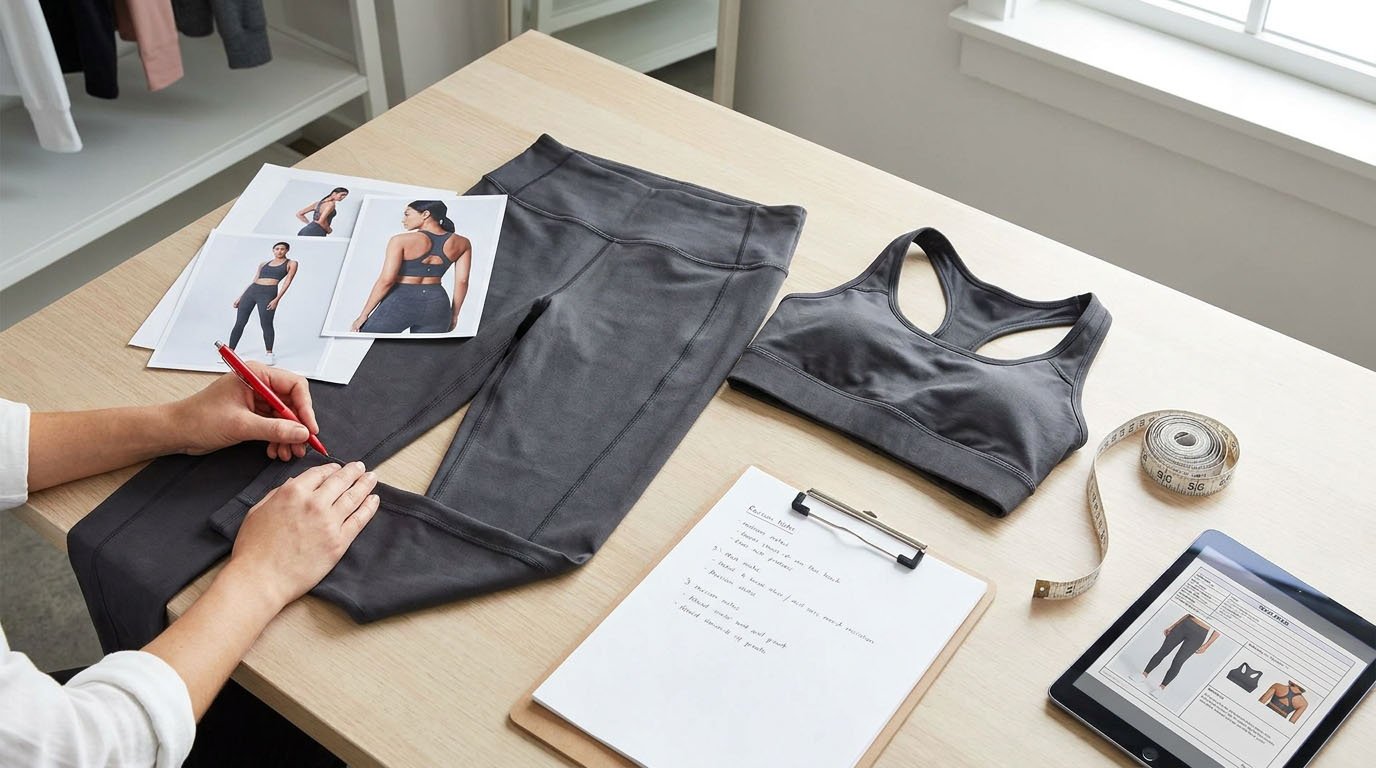
Example: Sample Revision Record
| Issue | Observation | Required Action | Verification |
|---|---|---|---|
| Waistband slipping | Moves during squats | Review pattern and elastic tension | Revised fit test |
| Fabric opacity | Sheer under expected stretch | Investigate fabric suitability | Repeat opacity review |
| Seam discomfort | Rubbing at inner thigh | Review seam construction and placement | Wear test |
| Logo placement | Outside approved position | Correct placement against artwork | Measured photo |
The manufacturer should confirm the proposed technical changes before producing the revised version.
Keep One Revision Record per Sample Version
A useful revision record includes the sample identification, review date, observations, photographs, factory responses, and current decision status.
When a new sample arrives, check both the corrections and the previously approved characteristics.
Fixing one problem must not introduce another.
Step 7: Decide Whether to Approve or Request Another Sample
After reviewing the sample, the final task is deciding whether it meets the requirements of the current development stage.
Not every issue requires the same action.
However, approving a sample for a particular stage is different from authorizing bulk production.
Activewear Sample Approval Decision Matrix
| Decision | When to Use It | Next Action |
|---|---|---|
| Approve for current stage | All requirements for that stage are satisfied | Record approval and proceed to the next stage |
| Hold — verification pending | A correction or supporting evidence is still required | Obtain proof and review before final sign-off |
| Revise and resample | Important fit, fabric, construction, or function requirements fail | Correct and evaluate a new sample |
For example, a fit sample may be approved for pattern development while its final fabric color remains pending.
That does not mean the garment is ready for bulk production.
Problems That Usually Block Final Production Approval
A revised sample or additional verification is generally required when the garment has unresolved problems such as:
- Significant fit failures during intended movement
- Fabric becoming unacceptably sheer
- Seams breaking or separating under normal use
- Measurements outside agreed tolerances
- Incorrect or unapproved production materials
- Branding or construction that fails critical specifications
A cosmetic difference may be less serious, but it should still be judged against the approved requirements.
Avoid accepting a change merely because it appears small. Its impact on the final garment matters more than its apparent size.
What Must Be Confirmed Before Bulk Production?
Before authorizing production, ensure the final approval record covers the applicable items:
- Approved sample version and reference photos
- Final measurements and tolerances
- Approved fabric, color, and trims
- Construction and branding specifications
- Relevant test results
- Resolved revision comments
- Written production authorization
The retained approved sample and the latest technical documents should provide a consistent reference for production and quality control.
Remember that sample approval establishes the production target; it does not guarantee that every bulk garment will be identical.
Appropriate production inspections and agreed quality standards remain necessary.
Frequently Asked Questions About Activewear Sample Approval
1. Can I Approve an Activewear Sample Without Trying It On?
Visual inspection alone is insufficient for fit-sensitive activewear. Use a fit model representing the intended wearer and perform movements relevant to the product. Measurements and actual wear performance should both inform the decision.
2. How Many Sample Rounds Are Needed Before Approval?
There is no universal number. Simple styles based on established patterns may need fewer rounds, while new leggings, sports bras, or complex designs may require additional revisions. The goal is to resolve critical issues, not to meet a predetermined sample count.
3. Can I Approve a Sample If the Fabric Color Is Slightly Different?
You may approve the fit or construction for the current development stage if color is explicitly excluded from that approval. Final production approval still requires the agreed color requirements to be confirmed.
4. Does Sample Approval Guarantee Bulk Production Quality?
No. An approved sample establishes an agreed reference for measurements, construction, appearance, and function. Bulk production must still be controlled through documented specifications and appropriate quality inspections.
Conclusion: Approve the Sample, Not Just the Appearance
Reviewing an activewear sample before approval requires more than checking whether it looks good.
A reliable review combines accurate measurements, dynamic fit testing, material and construction inspection, functional evaluation, and documented revision feedback.
Most importantly, every approval should identify what has been verified and what remains unresolved.
This helps brands communicate more clearly with their manufacturers and reduce avoidable production risks.
Need Help Reviewing or Developing Your Activewear Samples?
At Wearzio, we support activewear brands with OEM/ODM development, fabric sourcing, sample refinement, and custom manufacturing.
Whether you are developing leggings, sports bras, fitness tops, or training apparel, clear technical requirements and sample feedback help create a more reliable production standard.
Contact Wearzio to discuss your activewear development requirements and prepare your next sample for review.