.png)
Developing a sports bra and legging set is not just a design task. For activewear brands, the real challenge is turning an idea into a product that fits well, performs for the right activity, holds up after repeated wash and wear, and can be produced within realistic cost and MOQ limits.
That is where many new collections run into trouble.
A set may look strong in sketches or even in the first sample, but if the support level, fabric ratio, cup construction, waistband structure, grading, and target customer use case were not defined clearly at the start, development often slows down with extra revisions, delayed launches, and post-sale fit or support complaints.
For most successful activewear launches, the key principle is simple:
Match product specifications to the customer’s real activity level before sampling begins.
A yoga set and a running set are not built the same way. A bra made for low-impact studio wear will usually not deliver true high-impact support without changes to fabric, structure, elastics, and pattern engineering. The same applies to leggings: compression, opacity, waistband hold, gusset shape, and seam placement all depend on how the garment will actually be worn.
This guide explains how activewear brands can develop sports bra and legging sets that are easier to sample, easier to produce, and more likely to sell well. It covers:
- how to define the right support level
- how to choose the correct fabric composition and GSM
- how to plan bra styles, legging fits, and launch colors
- how to evaluate cups, elastics, straps, linings, seams, and gussets
- how to test bounce control, squat-proof opacity, comfort, and wash durability
- how to manage MOQ, costing, QC, and launch inventory
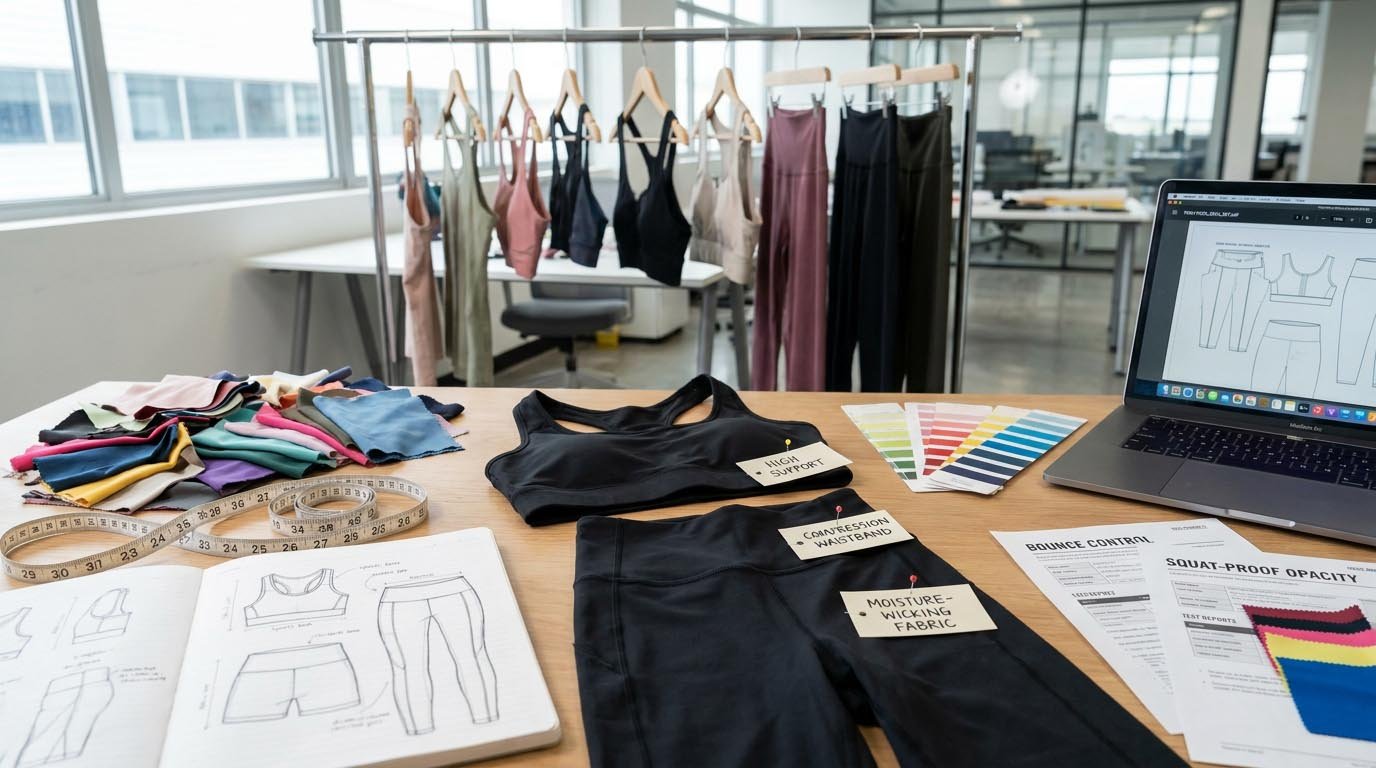
Quick Answer: How Do Activewear Brands Develop Best-Selling Sports Bra and Legging Sets?
The strongest sports bra and legging sets are usually developed by aligning five things from the beginning:
-
target activity
such as yoga, pilates, training, running, cycling, or studio wear -
support requirement
low, medium, or high impact -
fabric and component specifications
including fiber ratio, GSM, elastane level, elastic width, lining, and cup structure -
fit and grading strategy
based on size range, bust range, and movement testing -
commercial reality
including MOQ, target retail price, target margin, and launch inventory depth
For many new activewear brands, the safest first-launch structure is:
- one core legging fit
- one or two sports bra support levels
- two launch colors
- stock fabrics where possible
- movement and wash testing before bulk production
If brands skip technical planning and move straight from mood board to sample request, the result is usually:
- more fit revisions
- higher sampling costs
- longer development timelines
- support complaints after launch
- weaker margins due to redesigns or remakes
Why Sports Bra and Legging Set Development Often Fails
Most activewear development problems do not begin in production. They begin much earlier, in the product brief.
A brand may request:
- a sports bra “for yoga and running”
- leggings that are “soft, supportive, squat-proof, and lightweight”
- a set that works for “all body types”
- one bra design that can serve every activity level
The issue is that these goals often conflict unless the product is engineered very carefully from the start.
Common reasons activewear set development fails
- support level is not defined early
- fabric is chosen by hand feel instead of performance
- bra sizing strategy ignores bust variation
- legging opacity is not tested under stretch
- sampling starts before cost and MOQ targets are clear
- too many styles are launched at once
- one bra is expected to serve every activity
- fit is checked only statically, not in motion
In actual development, that can lead to:
- multiple sample rounds
- delayed launch schedules
- higher remake costs
- fit and support complaints after launch
- inventory spread too thin across too many SKUs
Key takeaway:
The best sports bra and legging sets are usually simple, targeted products with clear performance goals, not “do everything” styles.
Start With Customer Activity and Support Level
Before discussing design details, an activewear brand should answer one question:
What is the main activity this set is built for?
That one decision affects almost every technical choice that follows.
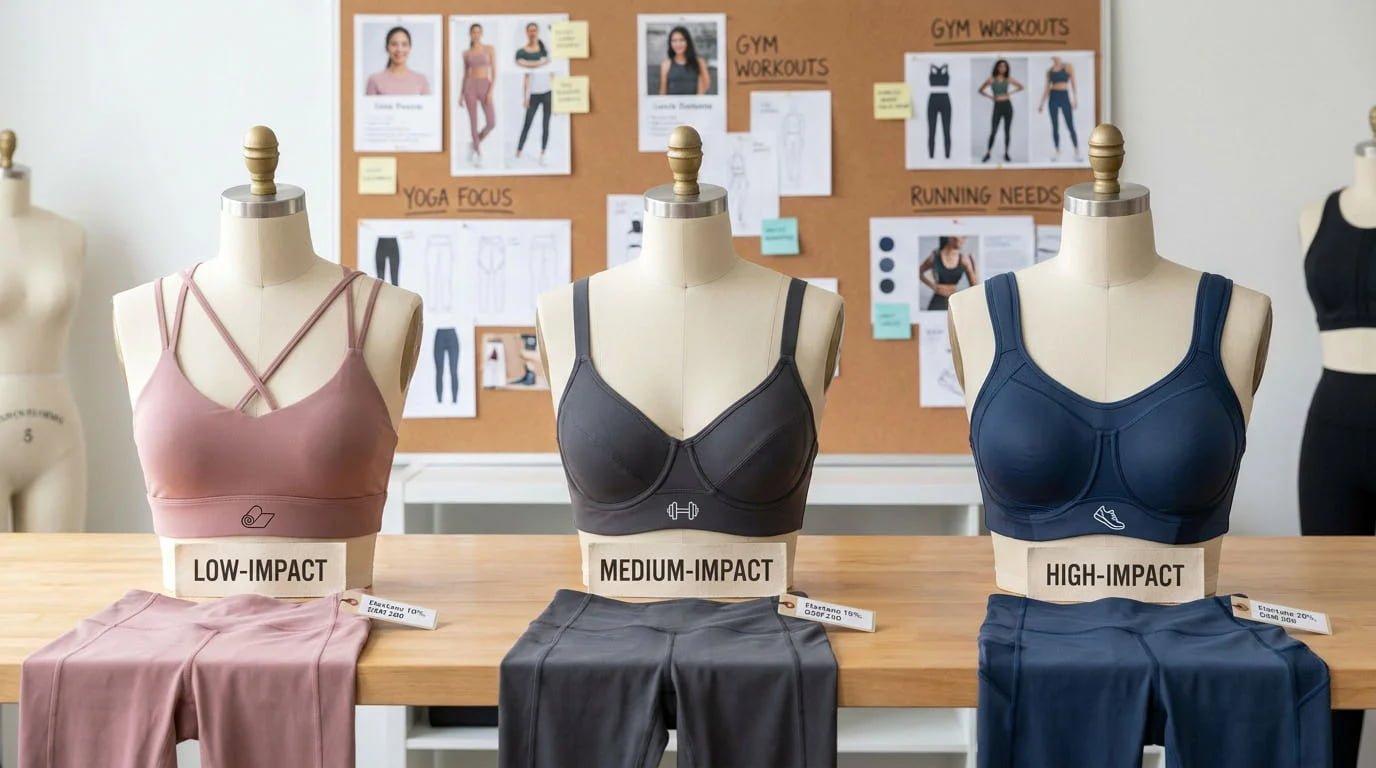
Low-impact activewear sets
Best for:
- yoga
- pilates
- barre
- walking
- stretching
What the product usually needs:
- lighter compression
- more flexibility
- easier range of motion
- lower bounce control requirement
Typical sports bra direction:
- lighter underband
- removable or light pads
- thinner straps
- softer hand feel
- lower neckline or strappier styling if support demand is limited
Typical fabric direction:
Medium-impact activewear sets
Best for:
- gym workouts
- cycling
- dance
- weight training
- hiking
- general training
What the product usually needs:
- balanced support
- moderate compression
- improved hold without losing comfort
- better recovery after repeated movement
Typical sports bra direction:
- stronger underband
- more stable cup construction
- medium-width straps
- better side support and hold
Typical fabric direction:
- 18-22% elastane
- 260-300 GSM
High-impact activewear sets
Best for:
- running
- HIIT
- jumping workouts
- court sports
- intense cardio training
What the product usually needs:
- stronger bounce control
- firmer compression
- more structured support system
- better strap and underband engineering
- secure neckline and back construction
Typical sports bra direction:
- molded or structured cups
- wider underband
- wider straps
- stronger elastic recovery
- higher coverage and more stable fit
Typical fabric direction:
- 22-25% elastane
- 280-320 GSM
Why “one bra for all activities” usually underperforms
A bra comfortable enough for yoga is often too flexible for serious running.
A bra supportive enough for high-impact training often feels too restrictive for yoga or lounge-style wear.
For most brands, a better approach is to:
- develop one targeted bra for the brand’s core activity
- or develop two support levels if budget allows
Map your customer before designing
Before finalizing styles, it helps to ask:
- What activities does the customer do most in activewear?
- Does she prioritize support, comfort, or styling?
- Does she usually buy one bra for everything, or different bras for different workouts?
- What are her biggest complaints with existing sports bras and leggings?
If most of your audience is doing yoga and pilates, the product brief should reflect that. If your audience is mostly doing gym classes and cardio training, the support strategy should change accordingly.
For many new activewear brands, it is better to serve one use case extremely well than to serve several use cases poorly.
How to Plan Your First Sports Bra and Legging Collection
One of the most common first-launch mistakes is trying to offer too many styles too early.
A brand may want to launch:
- 3 sports bra styles
- 3 legging lengths
- 4 colors
- 6 sizes
That quickly creates too many SKUs for a first drop, especially when MOQ and inventory depth are limited.
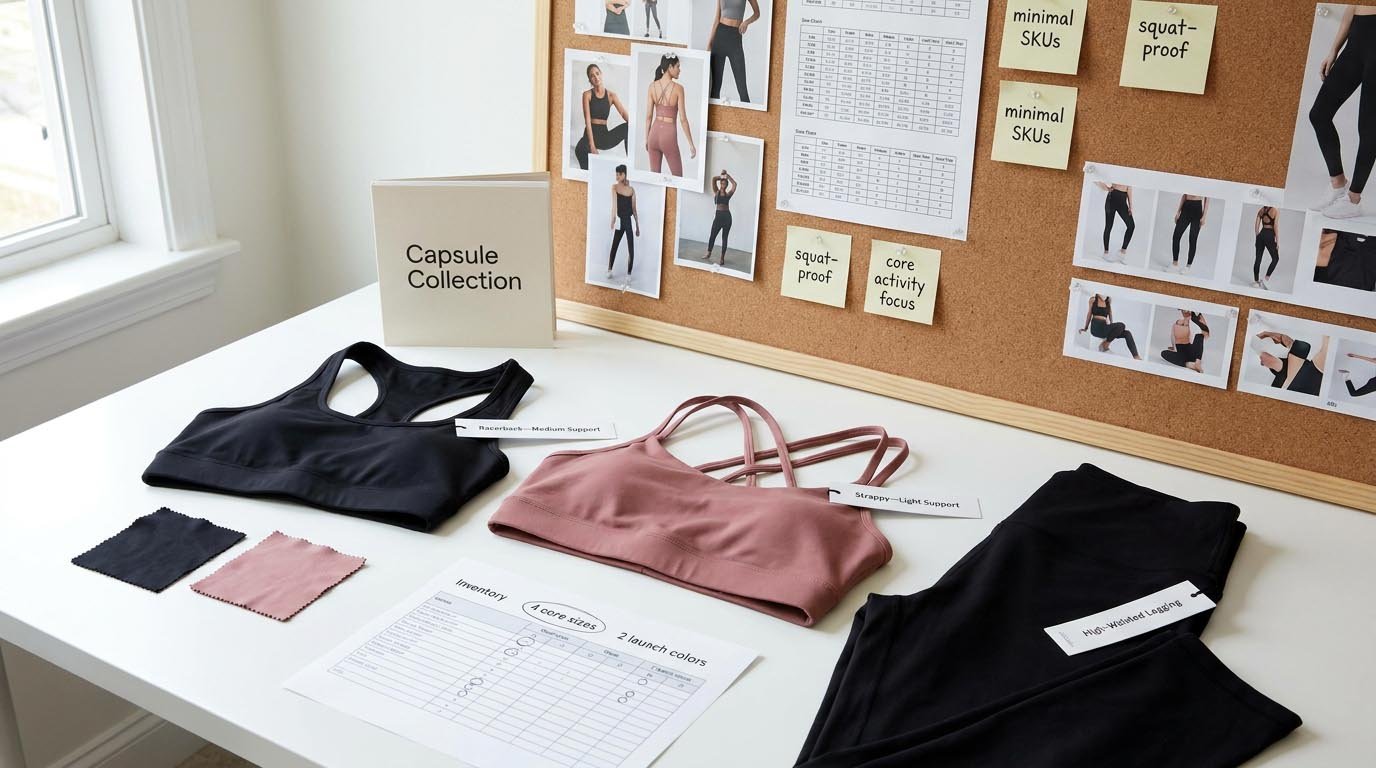
A practical first-launch structure
For most startup or growing activewear brands, a practical first collection is:
- 1 core legging fit
- 1 or 2 sports bra styles
- 2 launch colors
- 4 core sizes
- a clean matching capsule presentation
This gives enough variety to feel like a real collection without making production and inventory difficult to manage.
Best first legging style
The safest first legging is usually:
- high-waisted
- full length or 7/8 length
- squat-proof
- minimal seam complexity
- aligned with the brand’s core activity
Why this usually works:
- high-rise is the most accepted fit in activewear
- one core legging is easier to perfect than several versions
- inventory planning becomes simpler
- restocking is easier when a winner emerges
Best first sports bra approach
For many brands, a good starting point is:
- one light-support bra for yoga or studio customer
or - one medium-support bra for broader training use
If budget allows, a stronger launch structure is:
- one light-support bra
- one medium- or high-support bra
- one matching legging
That gives customers meaningful choice without overbuilding the line.
Bra style selection for a first launch
A few common options include:
Racerback bras
Best for:
- training
- broader support appeal
- customers who want secure strap positioning
Advantages:
- usually stable in motion
- good shoulder freedom
- commercially safe for first collections
Cross-back or strappy bras
Best for:
- yoga
- studio wear
- fashion-led activewear capsules
Advantages:
- strong visual appeal
- lighter support positioning
- often popular in social media styling
Limitations:
- may provide less support
- strap placement must be tested carefully to prevent slipping
Adjustable strap bras
Best for:
- brands wanting broader fit flexibility
- customers with more torso-length variation
Advantages:
- more customizable fit
- can improve satisfaction across size range
Limitations:
- higher cost
- more component complexity
Color strategy for first launch
The safest formula is usually:
- black
- one secondary color
Why:
- black is often the strongest seller
- one secondary color keeps the launch feeling fresh
- fewer colors make MOQ and inventory easier to manage
- color matching is easier to control
For most first collections, it is wiser to go deeper on two strong colors than to spread inventory across four or five uncertain ones.
A focused activewear launch usually performs better than a broad, understocked one.
Choosing Fabrics: Nylon, Polyester, Elastane, and GSM
Fabric selection is one of the biggest performance decisions in sports bra and legging development.
A request like “nylon spandex” or “polyester elastane” is not enough. Activewear brands should define:
- fiber ratio
- GSM
- knit structure
- stretch and recovery behavior
- surface finish
- intended activity level
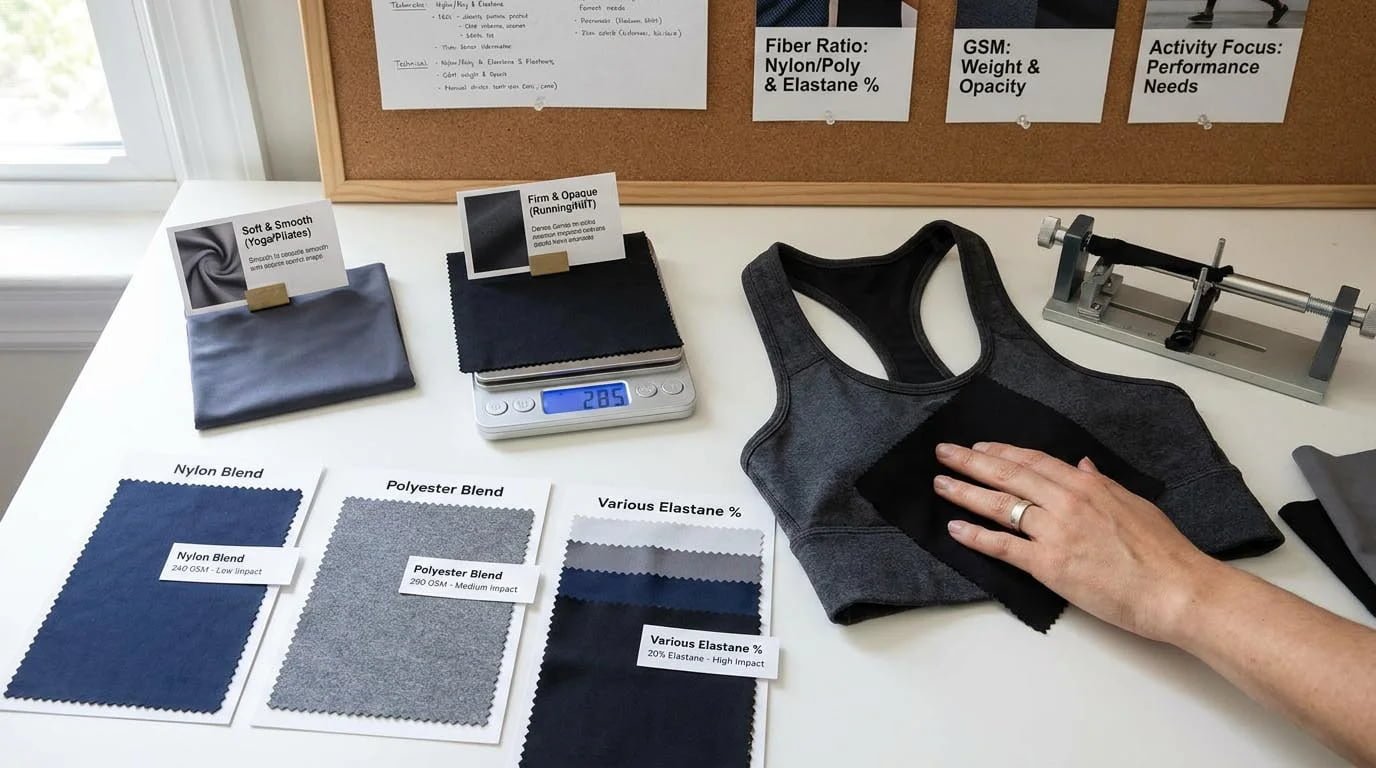
Nylon vs. polyester for activewear sets
Nylon blends
Advantages:
- softer hand feel
- smoother surface
- more premium perception
- often lower visible pilling risk
- commonly preferred for premium activewear programs
Best for:
- premium activewear
- yoga and studio collections
- brands positioning around feel and perceived quality
Polyester blends
Advantages:
- lower cost
- easier sourcing
- broader stock color availability
- suitable performance for many mid-market programs
Best for:
- value or mid-tier activewear
- faster developments
- brands prioritizing cost control
- more color-heavy launches
Elastane percentage by support level
Elastane should be matched to support needs, not simply pushed as high as possible.
General guide:
- 12-15% elastane: low impact
- 18-22% elastane: medium impact
- 22-25% elastane: high impact
Higher elastane does not automatically create a better product. If elastane is too high or the quality is poor, durability and recovery can worsen over time.
GSM by product function
Sports bra fabric GSM
- 220-260 GSM: softer, lighter support use cases
- 260-300 GSM: balanced support for medium activity
- 280-320 GSM: firmer compression and stronger control
Legging fabric GSM
- 220-240 GSM: basic range, often safer in dark colors
- 240-280 GSM: strong starting range for most activewear leggings
- 280-320 GSM: higher compression and better opacity, especially for lighter shades or stronger support positioning
Why GSM matters
Two fabrics with similar fiber content can behave very differently if their GSM and knit density differ.
For example:
- 87% nylon / 13% elastane at 240 GSM may feel softer and lighter
- 78% nylon / 22% elastane at 290 GSM may feel firmer and offer more control
They are not interchangeable.
Fabric should be chosen by use case, not only by hand feel
A common development issue happens when a brand wants a high-support bra but approves a soft, low-compression fabric because it feels nice in hand. Once sampled, the support is not there, and the style must be remade with a more suitable fabric.
For activewear development, fabric composition should always be specified together with GSM, stretch behavior, and intended use.
Sports Bra Components: Cups, Bands, Straps, and Linings
Sports bra performance depends on more than fabric. Components and construction are what turn fabric into actual support.
Cup options for sports bras
Removable pads
Best for:
- low-impact bras
- yoga bras
- customers who want flexible coverage
Advantages:
- adjustable coverage
- easier for customers to customize
- lighter structure
Limitations:
- pads can shift in washing
- not enough for high-impact structural support on their own
Sewn-in pads
Best for:
- low to medium impact
- brands wanting more consistent appearance
Advantages:
- stable placement
- cleaner presentation
- less shifting than removable pads
Molded cups
Best for:
- medium to high support bras
- larger bust ranges
- structured performance bras
Advantages:
- better shape retention
- improved support architecture
- stronger encapsulation effect
Limitations:
- higher cost
- more fitting complexity
- less forgiving across wide size assumptions
No cup or no padding
Best for:
- minimal studio bras
- breathable low-impact styles
- customers who prefer compression-only construction
Limitations:
- less shaping
- lower coverage
- not suitable for every customer preference
Underband construction
The underband is one of the most important support zones in a sports bra.
A good underband should:
- stay in place
- carry support effectively
- avoid cutting into skin
- recover well after repeated wear
General direction:
- low support: softer or narrower underband may be acceptable
- medium support: firmer band with stronger recovery
- high support: wider, more stable underband often needed
If the underband is too soft or too narrow, the bra may ride up even when the body fabric seems supportive.
Strap width and placement
Straps should be selected based on support need and bust range.
General direction:
- low support: narrower straps may be acceptable
- medium support: medium-width straps preferred
- high support: wider straps often needed for better load distribution
Placement matters as much as width. If straps are too wide-set, they may slip off shoulders during yoga or training even if the garment looks fine on a static fit model.
Lining and support layers
Depending on activity, price point, and support goal, brands may add:
- power mesh lining
- moisture-wicking lining
- double front layers
- stabilizer layers
- elastic reinforcement zones
These details often make the difference between a bra that looks supportive and one that actually performs.
Bust range matters more than many brands expect
One major challenge in sports bra development is that support needs vary heavily by cup size, not only by garment size.
That means:
- a size small customer with fuller bust may need more support engineering than a larger size customer with smaller bust
- one simple S-XL grading strategy may not serve all bust profiles equally well
For first launches, many brands handle this by:
- choosing a primary target bust range
- adding adjustable or forgiving features
- or separating support levels by intended use
In sports bra development, support comes from the system: fabric + cups + underband + straps + pattern.
Legging Construction: Waistbands, Gussets, Seams, and Opacity
Leggings are often treated as the easier half of a matching set, but poor construction can create just as many complaints as a weak sports bra.
Waistband engineering
A good activewear legging waistband should:
- stay in place during movement
- avoid rolling down
- provide support without discomfort
- recover after repeated wash and wear
For many activewear brands, the safest first option is:
- high-rise waistband
- stable multi-layer construction
- enough height to resist rolling
- strong recovery without feeling overly rigid
Gusset construction
A gusset helps improve comfort and movement by reducing pressure in the crotch area and improving seam layout.
Benefits of including a gusset:
- less seam discomfort
- lower chafing risk
- better mobility
- improved fit during squats and stretches
For activewear leggings, a gusset is usually a strong choice, especially in performance-oriented products.
Seam construction
For high-friction zones, seam type matters.
Preferred directions:
- flatlock seams for comfort and lower chafing
- careful seam placement in inner leg and crotch zones
- stretch-compatible thread and correct stitch density
Poor seam choices can lead to:
- rubbing
- seam pressure
- puckering after washing
- restricted stretch during wear
Squat-proof opacity
Opacity should never be assumed from how a legging looks on a hanger or sample table.
Leggings should be tested in:
- squat position
- forward bend
- deep lunge
- bright light conditions
Opacity depends on:
- GSM
- fabric density
- knit structure
- color
- stretch level
Light colors usually require more density than black, navy, or dark charcoal.
Length and rise options for first launch
For most brands:
- full length is the safest all-season first launch
- 7/8 length can also work well if it fits your customer profile
- high-rise is usually the strongest commercial choice
Shorts, capris, or multiple inseam options can be added later once demand is clearer.
If a legging will be sold as performance activewear, squat-proof testing should be part of development, not an afterthought.
Pattern Development, Grading, and Fit Testing
Even the right fabric and components will underperform if the pattern is not developed and tested correctly.
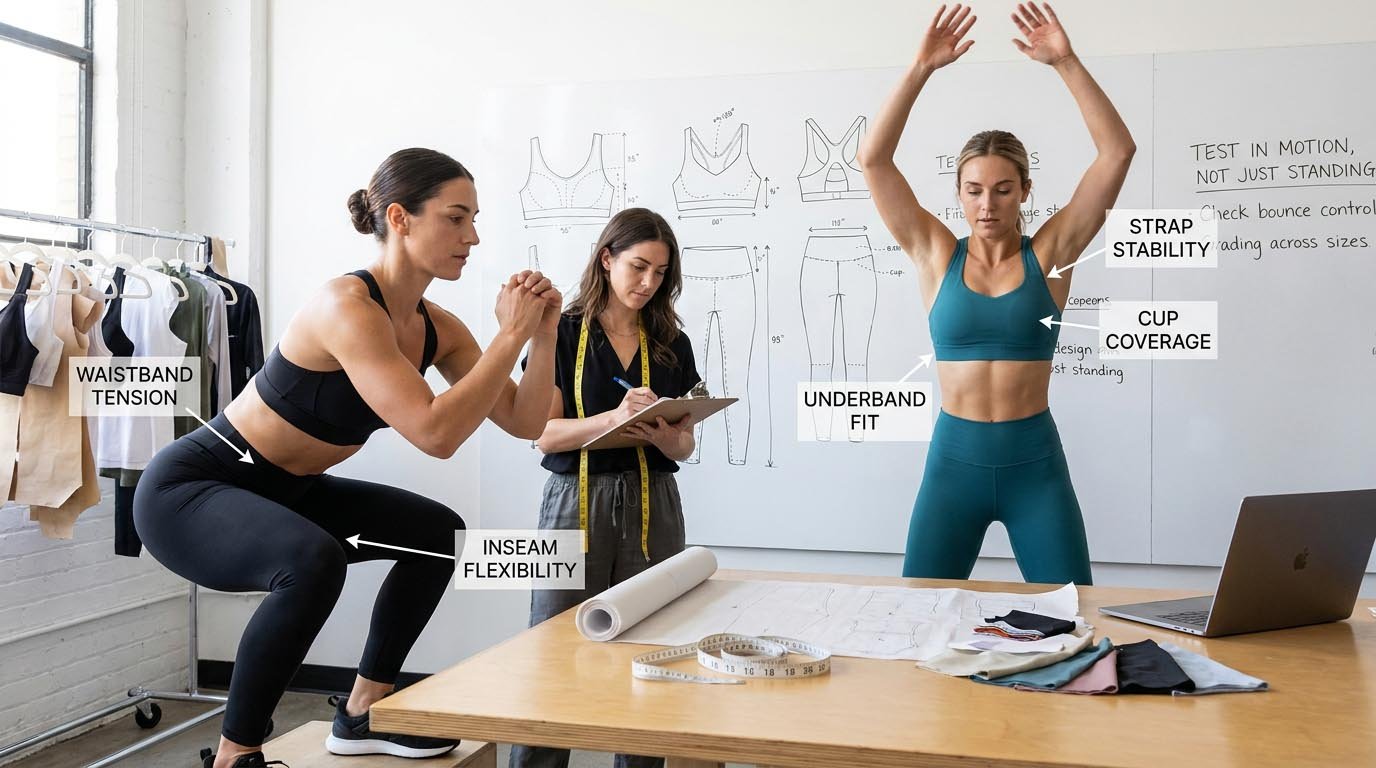
Sports bra pattern priorities
A strong sports bra pattern should define:
- underband circumference
- cup depth and width
- neckline height
- side coverage
- strap attachment position
- back construction
Common fit problems include:
- band riding up
- cup gaping
- side spillage
- straps slipping
- excessive pressure at the underband edge
Band and cup balance
A bra can fail even if only one area is wrong:
- a supportive fabric cannot compensate for a loose underband
- a correct band cannot fix poorly proportioned cup depth
- good cups cannot overcome unstable strap positioning
For many sports bras, the pattern must be refined with the intended support level in mind from the first sample stage.
Legging grading priorities
For leggings, grading must keep proportions balanced across sizes, especially in:
- waistband tension
- rise height
- hip ease
- thigh fit
- inseam consistency
A legging that looks strong in size M may feel too restrictive in XS or too unstable in XL if grading is not tested on multiple bodies.
Why dynamic fitting matters
Static fit checks are not enough for activewear.
A sports bra should be tested during:
- arm raise
- jump
- jog in place
- repeated upper-body movement
Leggings should be tested during:
- squat
- forward bend
- deep lunge
- extended wear
Size range reality for new brands
For first launches, many brands choose:
- S, M, L, XL
- two colors
- one core fit
That is usually more manageable than launching an extended size range with too little inventory per SKU.
Larger or more technical size architecture can come later, once customer data starts showing where demand is strongest.
Activewear fit is not proven in front of a mirror. It is proven in motion.
How to Test Sports Bras and Leggings Before Production
Sample approval should be based on performance, not only appearance.
Sports bra testing checklist
Test for:
- support level during movement
- bounce control
- strap stability
- underband stay-up
- neckline security
- comfort after 30-60 minutes of wear
For medium- and high-support bras, include:
- jumping
- jogging in place
- repeated arm movement
- longer wear checks if possible
Legging testing checklist
Test for:
- squat-proof opacity
- waistband stay-up
- crotch comfort
- seam comfort
- recovery after stretch
- overall fit during movement
Wear testing matters
A sample may look fine in a short try-on, then become uncomfortable during an actual workout.
If possible, test garments in:
- a yoga session
- a gym workout
- a walk or light run
- at least 30-60 minutes of active wear
This helps reveal:
- strap slipping
- underband pressure
- waistband rolling
- inner-thigh chafing
- gusset discomfort
- overheating or moisture issues
Wash and recovery testing
Before approving bulk production, wash test samples multiple times.
Check for:
- shape retention
- waistband recovery
- bra band recovery
- pilling
- color change
- seam puckering
- padding distortion
- fabric growth or dead stretch
What should be approved before bulk production
Before production starts, the brand should ideally confirm:
- final approved sample
- fabric composition and GSM
- color approval
- measurement chart
- construction details
- logo placement
- label and care instructions
- expected performance standards
A sample that only looks good once is not ready for production.
MOQ, Costing, and Vendor Planning for Activewear Brands
Activewear set development has to work not only technically, but commercially.
Start from retail target, not only design ideas
Before locking product features, define:
- target retail price
- target customer
- sales channel
- required margin
- acceptable landed cost
This matters because every decision affects cost, including:
- fabric quality
- cup type
- support level
- seam complexity
- color count
- number of styles
- packaging
- shipping method
Typical first-launch structure
A practical starting setup may look like:
- 1 legging style
- 1-2 bra styles
- 2 colors
- 4 core sizes
This is usually easier to manage than a wide launch with many low-depth SKUs.
MOQ reality
For activewear manufacturers, MOQ is often driven by:
- style count
- fabric and color choices
- trim customization
- production efficiency
- print or dye complexity
- whether fabrics are stock or custom-developed
If you launch too many styles at once, your inventory per SKU becomes too thin. That creates problems for:
- sell-through
- restocking
- forecasting
- warehouse efficiency
- reorder confidence
Stock fabrics vs. custom fabrics
For first launches, stock fabrics often make sense because they can:
- reduce development risk
- shorten lead times
- lower fabric MOQ pressure
- simplify color approval
Custom fabrics can be worthwhile later, once your volume and product direction are more proven.
A simple way to think about first-launch budgeting
Your first collection should prove demand, not try to cover the entire category.
For many brands, the better investment is:
- one excellent legging
- one strong core bra
- possibly one second bra for different support need
- good photography and a clean launch story
Rather than:
- many styles
- too many colors
- low stock depth
- weak ability to reorder winners
The first collection should validate product-market fit, not maximize style count.
Quality Control and Launch Planning
Production success depends on catching issues early.
Key QC checkpoints for activewear sets
1. Sample approval
Confirm:
- fit
- support
- opacity
- comfort
- construction accuracy
2. Pre-production confirmation
Confirm:
- bulk fabric matches approved sample
- trims and elastics are correct
- colors are approved
- measurements are locked
3. In-line inspection
Check during production:
- seam consistency
- measurement stability
- logo application
- component accuracy
- workmanship quality
4. Final inspection
Check before shipment:
- packaging
- visual defects
- measurements
- construction consistency
- overall shipment quality level
Launch planning tips for activewear brands
For first launches:
- go deeper on black or your main neutral
- be conservative with trend colors
- avoid too many style variations at once
- monitor which SKUs move first
- reorder winners before they fully stock out
Size allocation matters
In many first launches, initial depth is often strongest in:
- S
- M
- L
while edge sizes should be planned more carefully based on actual customer profile and budget.
Sets or separates?
You can merchandise activewear in two main ways:
- as matching sets
- as separates with coordinated styling
For many new brands, the strongest approach is:
- show them as matching sets in photography
- allow separate purchase where possible
That gives better merchandising flexibility while reducing customer hesitation.
A successful launch is not just about making the product. It is also about making the right amount of the right SKUs.
FAQ: Sports Bra and Legging Set Development
How many styles should a new activewear brand launch first?
For many brands, a focused launch works best: one core legging and one or two bra styles. Too many styles create MOQ pressure and weak inventory depth.
Should I develop one sports bra for all activities?
Usually no. A bra for yoga and a bra for running typically require different support engineering. If budget is limited, prioritize the activity your main customer does most.
What is the best fabric for sports bra and legging sets?
That depends on activity and positioning, but nylon-elastane blends are often preferred for premium activewear, while polyester-elastane blends are common for more price-sensitive programs.
How much elastane should a sports bra have?
A general guide is:
- 12-15% for low impact
- 18-22% for medium impact
- 22-25% for high impact
The exact percentage still needs to be matched with GSM, fabric recovery, and construction.
What GSM is best for activewear leggings?
For many performance leggings, 240-280 GSM is a strong starting range. Lighter colors often need more density for opacity.
Do activewear leggings need a gusset?
In most cases, yes. A gusset usually improves comfort, mobility, and seam performance.
How should sports bras be tested before production?
At minimum, test for:
- bounce control
- band stability
- strap placement
- comfort during movement
- recovery after washing
Is nylon better than polyester for activewear?
Nylon often feels more premium and smoother, while polyester is more cost-efficient and easier to source. The better choice depends on your retail price, brand positioning, and sourcing plan.
What causes the biggest delays in activewear development?
The most common causes are:
- unclear support targets
- too many early style variations
- repeated fit revisions
- fabric changes after first sample
- lack of movement and wash testing before approval
Should I launch full-length leggings or 7/8 leggings first?
For most brands, full-length or 7/8 high-rise leggings are the safest first launch options. The better choice depends on your customer profile, climate, and styling direction.
Final Takeaway
For activewear brands, developing a best-selling sports bra and legging set starts with clarity, not complexity.
The strongest collections usually begin by defining:
- who the customer is
- what activity the product is for
- what support level is required
- what cost and MOQ are realistic
- how the product will be tested before production
From there, everything becomes easier:
- fabric choices become more accurate
- bras are built with the right support features
- leggings are developed with the right opacity and waistband structure
- sample revisions decrease
- production becomes more predictable
- launch decisions become more commercial and less emotional
If you want a safer first collection, start with:
- one excellent legging
- one or two clearly positioned sports bras
- two strong launch colors
- movement testing and wash testing before production
That approach usually performs better than trying to launch a large collection with unclear support logic.
Need Help Developing Sports Bra and Legging Sets?
As an activewear manufacturer, we work with brands on:
- sports bra and legging set development
- fabric selection and sourcing
- support-level matching
- sampling and fit correction
- private label activewear production
- MOQ planning and bulk manufacturing
If you already have sketches, reference products, or a target price point, send us your brief and we can help turn it into a production-ready activewear set.