Two activewear manufacturers quote $8.50 and $9.20 for the same leggings. The cheaper offer looks better—until you discover that it excludes custom labels, packaging, and part of the shipping preparation.
For activewear brands, comparing manufacturers by unit price alone can lead to misleading decisions. Fabric performance, bulk consistency, delivery reliability, and hidden costs all influence the actual value of a production partnership.
To compare activewear manufacturers beyond unit price, standardize each quotation, evaluate product and bulk-production quality, calculate total sourcing costs, and use a weighted supplier scorecard. The best manufacturer is the one that can meet your product specifications consistently at a commercially sustainable cost—not necessarily the one offering the lowest initial price.
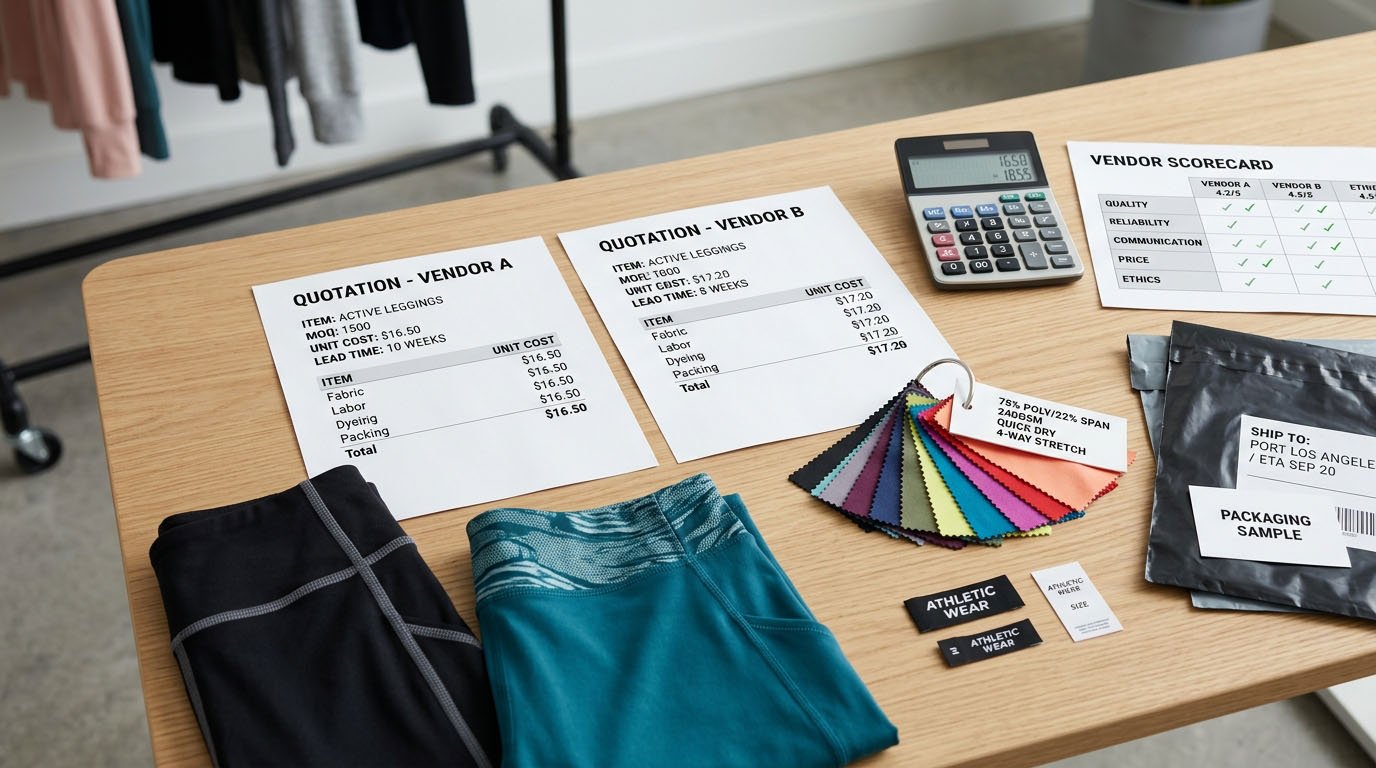
This guide focuses on comparing manufacturers after you have identified potential partners and received quotations. If you are still building your supplier shortlist, start with our guide to choosing a reliable activewear manufacturer.
Quick Answer: What Should You Compare Besides Unit Price?
When evaluating activewear manufacturers, focus on six areas:
| Evaluation Area | What to Compare | Why It Matters |
|---|---|---|
| Quotation transparency | Fabric, construction, trims, packaging, Incoterms | Prevents misleading price comparisons |
| Product capability | Fabric performance, fit, stitching, sampling | Determines whether the factory can meet your specifications |
| Bulk consistency | Production controls, testing, inspection records | Reduces differences between approved samples and bulk orders |
| Total sourcing cost | Inspection, freight, rework, defects, delays | Reveals costs beyond the manufacturing quote |
| Commercial reliability | MOQ, capacity, lead times, communication | Protects launch schedules and future orders |
| Overall supplier value | Weighted scorecard supported by evidence | Helps compare multiple factories objectively |
The most important rule is simple: compare equivalent products under equivalent commercial conditions before comparing prices.
A manufacturer offering a slightly higher unit price may deliver better overall value if it includes stronger materials, reliable quality controls, or services that another factory charges separately.
Step 1: Normalize Factory Quotes Before Comparing Prices
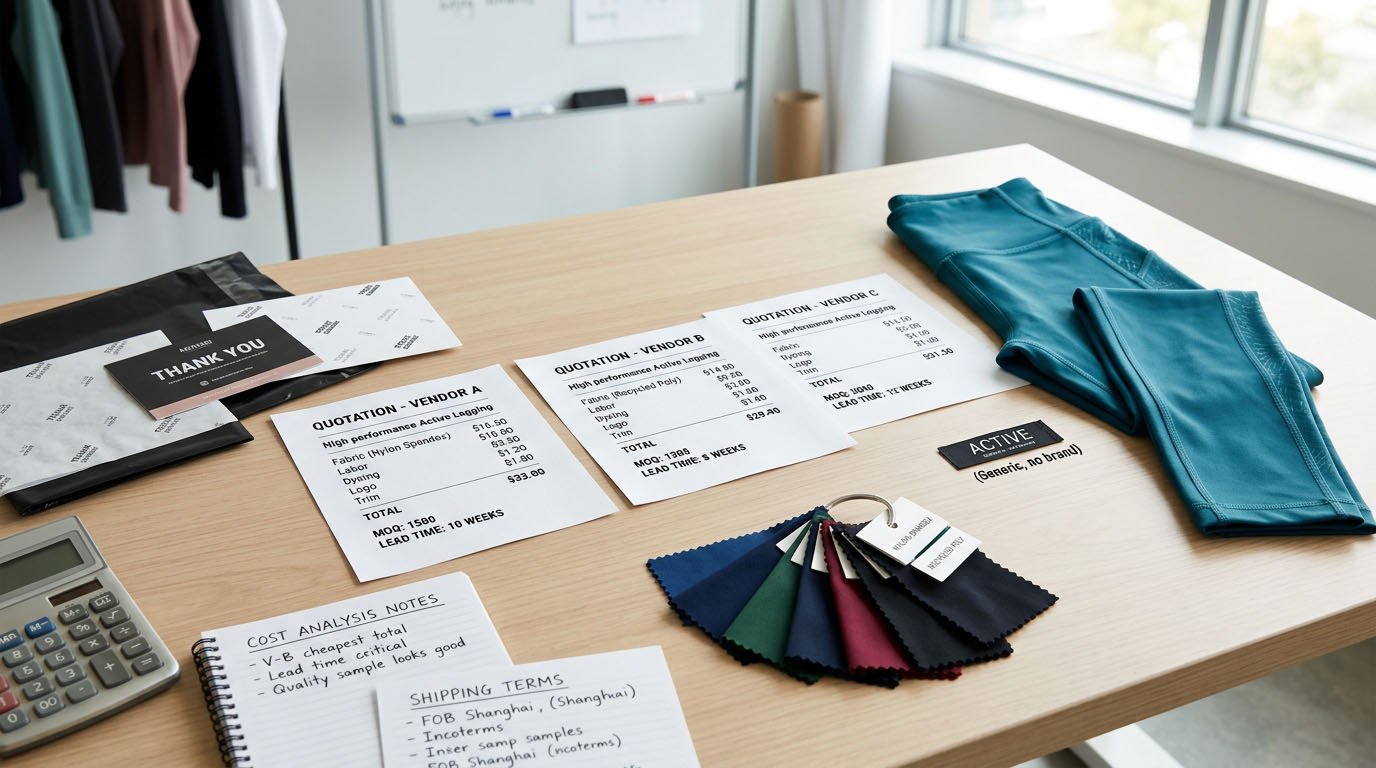
Manufacturers often quote different prices because they are not pricing the same product specifications or commercial terms.
A quotation for 220 GSM nylon-spandex leggings with custom packaging cannot be compared directly with one using unspecified performance fabric and standard packaging.
Check the Same Specifications Across All Quotes
Before evaluating price, confirm that every manufacturer is quoting against the same requirements.
| Quotation Item | What to Confirm |
|---|---|
| Fabric | Composition, GSM, construction, finish, performance requirements |
| Garment construction | Stitch types, seam placement, waistband structure |
| Customization | Logos, labels, colors, printing or embroidery |
| Sizing | Size chart, grading, measurement tolerances |
| Order quantity | Pieces per style, color and size allocation |
| Packaging | Polybags, hangtags, cartons and labeling |
| Testing and QC | Agreed tests, inspections and acceptance criteria |
| Commercial terms | Currency, Incoterms, payment terms, delivery point |
For functional activewear, even apparently identical fabric descriptions can hide meaningful differences.
For example, two fabrics labeled 75% nylon / 25% elastane, 220 GSM may differ in stretch recovery, opacity, pilling resistance, and hand feel.
Do not assume they are interchangeable without reviewing the fabric specifications and appropriate test results.
Example: Comparing Three Activewear Factory Quotes
Suppose you request quotations for 500 pairs of custom leggings.
All three manufacturers are asked to quote against the same technical specifications.
| Cost Item | Factory A | Factory B | Factory C |
|---|---|---|---|
| Initial unit quote | $8.50 | $9.20 | $9.80 |
| Quotation term | EXW | FOB | FOB |
| Custom logo | Extra | Included | Included |
| Custom packaging | Extra | Included | Included |
| Export-side costs | Buyer responsibility | Included to agreed FOB point | Included to agreed FOB point |
| Fabric specifications | Clarification needed | Documented | Documented |
| Initial assessment | Incomplete | Comparable | Comparable |
At first glance, Factory A appears cheapest.
However, its initial quotation excludes several items.
Assume the following illustrative additional costs for Factory A:
- Logo application: $0.35 per piece
- Packaging: $0.20 per piece
- Relevant origin and export-side costs: $0.65 per piece
Its estimated comparable cost becomes:
$8.50 + $0.35 + $0.20 + $0.65 = $9.70 per piece
| Manufacturer | Estimated Comparable Unit Cost |
|---|---|
| Factory A | $9.70 |
| Factory B | $9.20 |
| Factory C | $9.80 |
These figures are hypothetical examples, not actual manufacturer quotations. Factory A's comparison remains provisional until its fabric specifications and contractual delivery responsibilities are confirmed.
The result changes the initial ranking. Factory B now has the lowest comparable estimate, even though Factory A advertised the lowest unit price.
For international orders, pay particular attention to Incoterms. EXW and FOB assign different costs and responsibilities to the buyer and seller. For containerized shipments, FCA may be more appropriate than FOB, depending on the transport arrangement.
Buyer takeaway: Request a revised quotation whenever product specifications, included services, or delivery terms are unclear. Never select a manufacturer based on an incomplete price comparison.
Step 2: Evaluate Fabric, Construction and Sample Quality
Once prices are comparable, evaluate whether each manufacturer can deliver the required product quality.
Activewear creates specific manufacturing challenges because garments must often stretch repeatedly, maintain shape, resist abrasion, and remain comfortable during movement.
Compare Fabric Performance, Not Just Composition
For products such as leggings, sports bras, and compression garments, consider the following:
| Performance Factor | What to Check |
|---|---|
| Stretch and recovery | Whether fabric returns to shape after repeated extension |
| Opacity | Whether leggings become transparent during stretching |
| Pilling resistance | Surface appearance after abrasion |
| Colorfastness | Resistance to washing, perspiration and rubbing |
| Dimensional stability | Shrinkage and distortion after washing |
| Moisture management | Performance against the intended use requirements |
Not every product needs every test.
For example, squat-proof opacity is particularly important for leggings, while moisture management and seam comfort may be priorities for training shirts.
Ask manufacturers to provide relevant fabric swatches and available test reports. Compare the test methods and results against your approved requirements rather than relying only on marketing descriptions.
Where material selection is still open, experienced activewear fabric sourcing support can help brands evaluate suitable constructions before committing to bulk fabric.
Examine Construction and Stitching
Different manufacturing methods create different costs and performance characteristics.
For example:
- Overlock seams are commonly used in stretch garments.
- Flatlock construction can reduce seam bulk in suitable designs.
- Coverstitching is commonly used for stretch hems.
- Bonded construction may be appropriate for selected seamless-feel applications.
No single construction method is automatically superior for every product.
When comparing manufacturers, ensure they quote the construction specified in your tech pack and demonstrate suitable workmanship.
Our cut-and-sew manufacturing services illustrate how pattern development, cutting, sewing methods and quality control connect during activewear production.
Use Samples as Comparable Evidence
Request samples developed to the same approved specifications.
Evaluate each sample using consistent criteria:
- Fit and measurements across relevant sizes.
- Fabric hand feel, stretch and recovery.
- Stitch quality and seam appearance.
- Comfort during intended movement.
- Washing performance and dimensional stability.
- Logo placement and finishing details.
Record the results rather than relying on overall appearance.
A factory with a lower quotation but repeated sample revisions may require more development time and additional costs.
However, an excellent sample does not prove the factory can reproduce the same quality consistently in bulk production.
That requires a separate evaluation.
Step 3: Check Sample-to-Bulk Consistency and Quality Control
One of the biggest risks in activewear sourcing is the gap between an approved sample and the actual production shipment.
A sample may be carefully constructed by an experienced technician, while bulk production involves different operators, equipment, material batches, and production speeds.
The key question is not simply whether a manufacturer can make one excellent garment.
It is whether the manufacturer can reproduce the approved standard across hundreds or thousands of pieces.
Evaluate Production Control Points
A reliable manufacturer should be able to explain how it controls quality throughout production.
| Production Stage | What to Verify |
|---|---|
| Incoming fabric | Material identity, shade consistency and relevant test requirements |
| Fabric preparation | Appropriate handling and relaxation procedures where necessary |
| Cutting | Pattern accuracy, fabric alignment and size consistency |
| Sewing | Stitch quality, seam stretch and workmanship |
| In-line inspection | Detection and correction of recurring defects |
| Final inspection | Measurements, appearance, functionality and packaging |
Fabric relaxation deserves attention for stretch materials, but the required process depends on fabric characteristics and manufacturing conditions. There is no universal preparation time suitable for every fabric.
Similarly, machinery alone does not guarantee quality. Operator training, process instructions, maintenance, and inspection procedures are equally important.
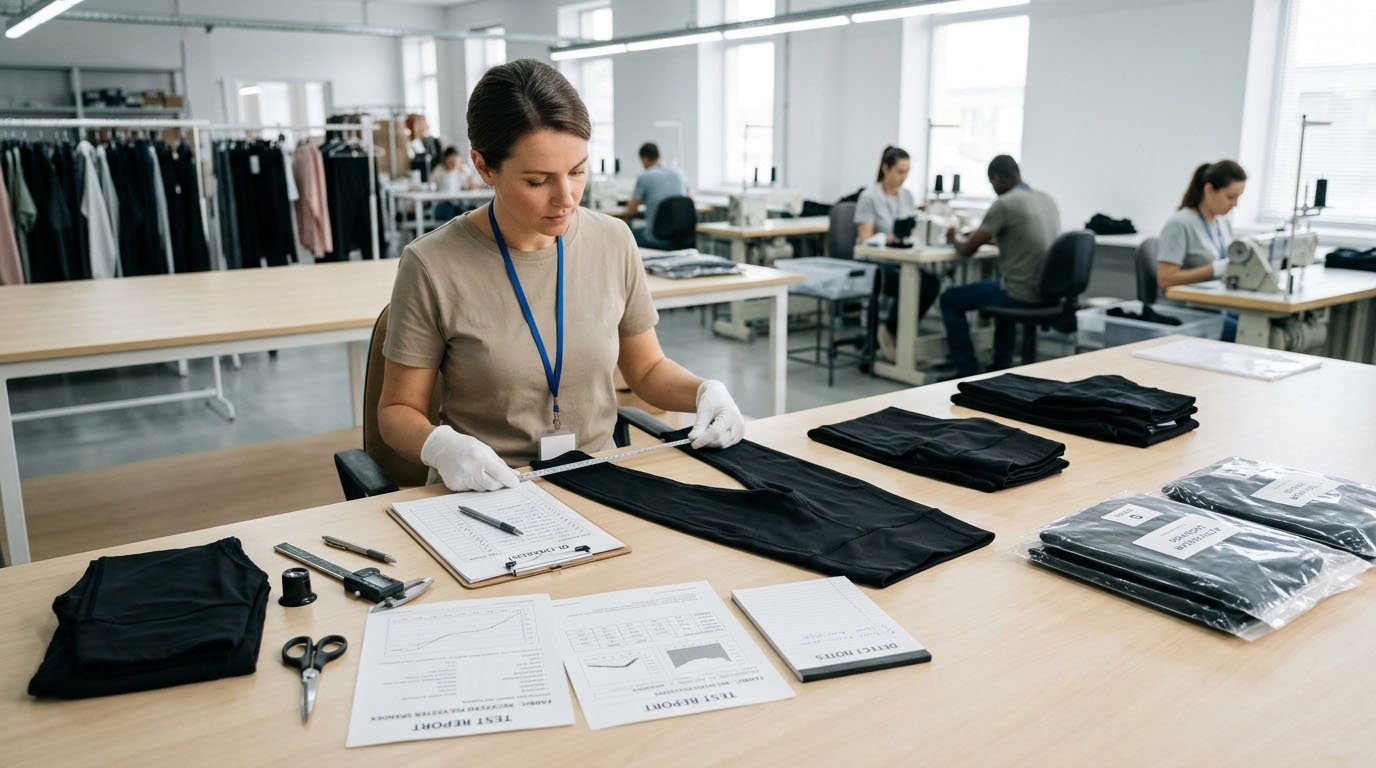
Ask for Evidence of Bulk Quality
Rather than accepting general claims such as "strict quality control," ask for practical evidence:
- An anonymized in-line inspection record.
- A sample measurement inspection sheet.
- Relevant fabric test reports.
- A documented process for handling nonconforming products.
- An explanation of how the approved sample becomes the bulk-production reference.
If the factory uses an AQL-based final inspection, confirm the agreed standard, inspection level, defect classification, sample size, and acceptance criteria.
For example, ISO 2859-1 defines attribute-based acceptance sampling procedures. An AQL value is used to select sampling plans and acceptance criteria; it is not a simple permission for that percentage of defective garments in a shipment.
Confirm What Happens When Bulk Production Fails
The factory's response to a quality problem is often as important as its inspection system.
Clarify the following before production:
- Who investigates production defects?
- Who pays for rework or replacement when responsibility is established?
- When is reinspection required?
- What happens if the shipment fails agreed acceptance criteria?
- How are corrective actions documented before future orders?
These terms should be agreed in writing.
For a detailed factory-level investigation, use a separate factory audit checklist rather than turning the quotation comparison into a complete audit.
Buyer takeaway: A strong sample demonstrates product capability. Consistent production records and effective quality controls provide stronger evidence of bulk manufacturing reliability.
Step 4: Calculate Total Sourcing Cost Beyond Unit Price
The quoted garment price is only one component of your actual sourcing cost.
Other expenses may arise during development, inspection, transportation, customs clearance, and after-sales handling.
Some costs are predictable, while others depend on production and delivery risks.
Understand the Total Sourcing Cost Formula
A practical framework is:
Total Sourcing Cost = Manufacturing + Development + Inspection + Logistics + Import Costs + Expected Quality and Delay Costs
Where applicable, include:
| Cost Category | Examples |
|---|---|
| Manufacturing | Garments, agreed customization, labels and packaging |
| Development | Samples, revisions, patterns, tooling when applicable |
| Quality assurance | Product testing and independent inspections |
| Logistics | Freight, insurance, handling and delivery |
| Import costs | Applicable duties, taxes and customs charges |
| Quality-related losses | Rework, sorting, replacements and customer returns |
| Delay-related losses | Expedited freight or other measurable delay expenses |
Only include expenses that are not already covered by the quoted price.
Avoid double-counting freight, packaging, inspection, or other costs included under the supplier's commercial terms.
Taxes that a business can recover should also be treated differently from nonrecoverable costs when evaluating the final financial impact.
Why a Lower Unit Price May Cost More
Return to the earlier example.
After adjusting the quotation scope:
- Factory A: $9.70 per piece
- Factory B: $9.20 per piece
For 500 pieces, Factory B's comparable price is $250 lower.
But the comparison should not end there.
Suppose one supplier has incomplete fabric specifications, uncertain inspection arrangements, and no clear policy for defective shipments.
Those uncertainties create financial exposure that may justify further verification before placing an order.
You should not automatically assign arbitrary defect or delay costs to that factory. Instead, estimate potential risks using available evidence, contract terms, previous performance records, and realistic scenarios.
For example, ask what the additional cost would be if a shipment needed reinspection or rework before dispatch.
This scenario-based approach reveals risks without pretending every potential expense will occur.
Consider Long-Term Reorder Costs
The first order may not be the most important one.
For an activewear brand, future orders depend on maintaining fabric, color, fit, and construction consistency.
Ask manufacturers whether they can:
- Source the same approved fabric again.
- Maintain an approved material specification and color reference.
- Reproduce confirmed garment measurements.
- Document changes to material suppliers or production methods.
- Provide stable and clearly defined reorder pricing.
A slightly higher initial cost may be justified by stronger reorder reliability, but that value should be supported by evidence rather than assumptions.
Step 5: Compare MOQ, Lead Times and Communication
A manufacturer offering a competitive quotation may still be unsuitable for your business if its minimum quantities, production capacity, or delivery schedule do not match your needs.
These factors are especially important for startups and growing activewear brands.
Compare MOQ Against Your Actual Order Plan
Minimum Order Quantity (MOQ) should be evaluated together with order structure.
Ask whether the minimum applies:
- Per style.
- Per color.
- Per fabric.
- Per customization configuration.
- Per total order.
A factory advertising a low overall MOQ may still require separate minimums for different custom colors or materials.
Also compare price breaks at different order quantities. A larger order may reduce unit price while increasing unsold-inventory and cash-flow risk.
If you are launching with limited quantities, consider whether private label activewear offers a more appropriate development route than creating every product from scratch.
Compare Realistic Production Milestones
Do not compare lead times without checking what each manufacturer includes.
One factory may quote the sewing production period only, while another includes fabric sourcing and final packing.
Request a schedule covering:
| Milestone | Key Question |
|---|---|
| Tech pack review | Are all specifications approved? |
| Sampling | How many revisions are included? |
| Materials | Are fabric and trims available or custom-made? |
| Pre-production approval | When must the buyer confirm the sample? |
| Bulk manufacturing | Is production capacity reserved? |
| Final inspection | Is sufficient time allocated for corrections? |
| Dispatch | What is the agreed shipment-ready date? |
Manufacturing lead time and international transit time should be distinguished.
For seasonal activewear collections, ask how the manufacturer manages peak periods, unexpected material delays, and repeat orders.
Evaluate Communication Through Actual Responses
Communication quality can be measured during the quotation and sampling stages.
Consider whether the manufacturer:
- Responds directly to technical questions.
- Identifies missing specifications before quoting.
- Explains price differences rather than making vague promises.
- Provides clear written confirmations.
- Reports delays or quality problems promptly.
The fastest response is not necessarily the best one.
Clear, accurate, and actionable communication is more valuable than quick replies that leave important questions unanswered.
Step 6: Use a Weighted Scorecard to Compare Manufacturers
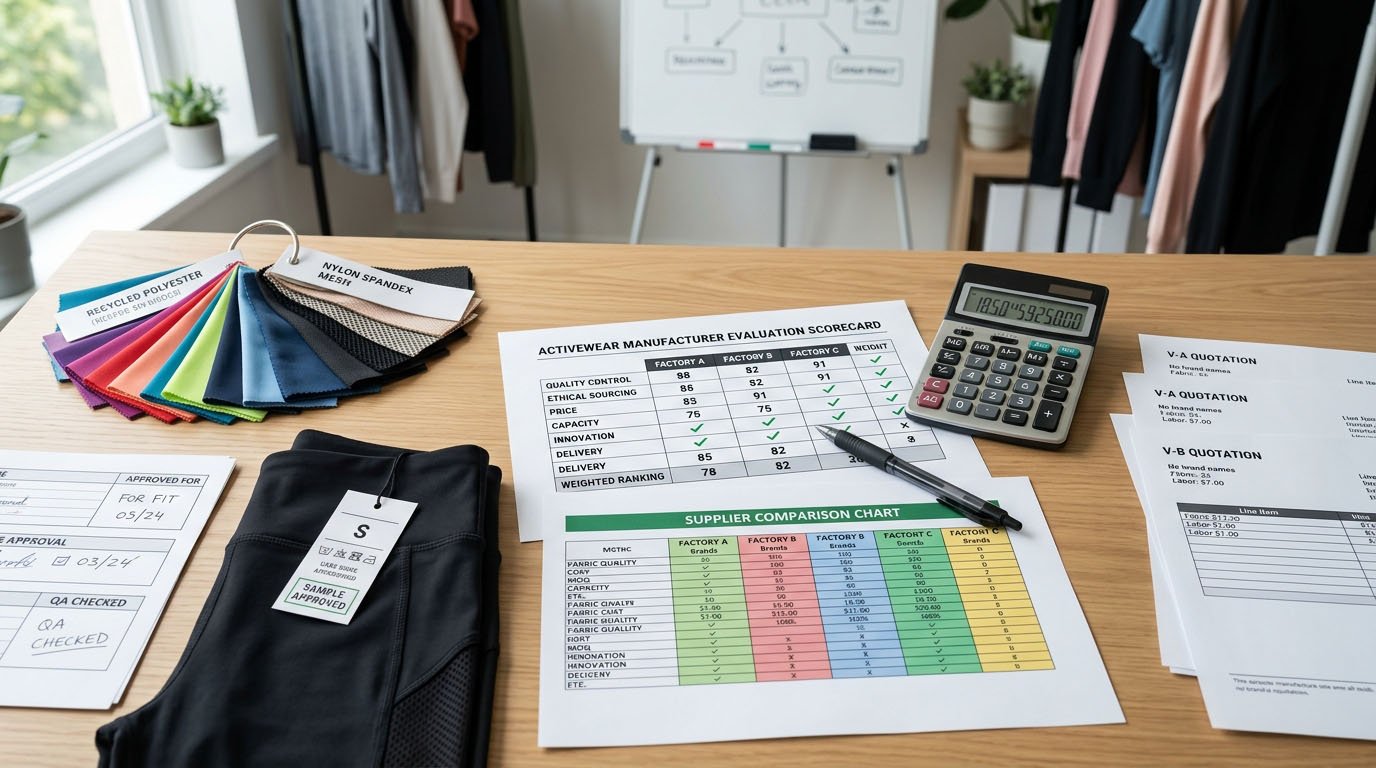
After standardizing quotations and reviewing available evidence, use a scorecard to compare manufacturers consistently.
A weighted scorecard prevents one attractive price from dominating the entire decision.
Recommended Activewear Manufacturer Evaluation Scorecard
The following weights are illustrative and can be adjusted based on product complexity and brand priorities.
| Evaluation Criteria | Weight | What to Measure |
|---|---|---|
| Technical specification fit | 25% | Fabric capability, garment construction, sample quality |
| Bulk consistency and QC | 25% | Quality records, process controls, corrective actions |
| Communication and problem-solving | 20% | Clarity, responsiveness, technical support |
| Delivery reliability | 15% | Capacity, production schedules, lead-time credibility |
| Normalized pricing and transparency | 15% | Comparable pricing, included costs, payment and reorder terms |
| Total | 100% |
Rate each manufacturer from 1 to 5:
- 1: Poor or insufficient evidence.
- 2: Significant concerns remain.
- 3: Meets basic requirements.
- 4: Strong capability supported by evidence.
- 5: Excellent match with convincing documentation and results.
Calculate the weighted score:
Total Score = Σ (Criteria Score × Criteria Weight)
Example: Comparing Factory A, B and C
Assume the manufacturers have been evaluated using their samples, quotation documents, and production evidence.
| Criteria | Weight | Factory A | Factory B | Factory C |
|---|---|---|---|---|
| Technical specification fit | 25% | 3 | 4 | 5 |
| Bulk consistency and QC | 25% | 2 | 4 | 4 |
| Communication | 20% | 3 | 4 | 4 |
| Delivery reliability | 15% | 4 | 4 | 3 |
| Pricing and transparency | 15% | 2 | 4 | 3 |
| Weighted score / 5 | 100% | 2.75 | 4.00 | 3.95 |
All scores are illustrative. They do not represent actual evaluations of Wearzio or other manufacturers.
Factory B achieves the highest overall score, despite not having the lowest initial advertised quotation.
Factory C performs particularly well in technical capability but receives a slightly lower score because of delivery and commercial considerations.
For a complex compression garment, Factory C might become the preferred option if technical performance receives a higher weight.
The scorecard should support your decision—not replace supplier evidence, approved samples, or contractual requirements.
Make the Final Decision With Three Checks
Before selecting your manufacturer, complete these final checks.
1. Confirm product and quotation equivalence.
Ensure you are comparing the same specifications, quantities, customization, inspection requirements, and delivery responsibilities.
2. Verify claims with evidence.
Review physical samples, test reports, production records, and relevant certificates. Confirm that any certification or test result applies to the materials, products, or operations being evaluated.
3. Agree on production responsibilities.
Document the approved specifications, quality acceptance criteria, milestones, payment terms, change control, and handling of nonconforming goods.
For a high-value or technically complex order, additional factory verification or a third-party audit may be appropriate before committing significant funds.
Frequently Asked Questions
Is the Cheapest Activewear Manufacturer Always the Riskiest?
No. A lower price may result from efficient production, better material purchasing, higher utilization, or simpler commercial terms.
However, a substantially lower quote should be investigated to confirm that the specifications, included services, and quality requirements are equivalent.
Price differences are questions to investigate, not automatic proof of poor quality.
How Many Activewear Manufacturers Should I Compare?
For many small and growing brands, comparing three to five qualified manufacturers is a manageable starting point.
The right number depends on your product complexity, sourcing resources, and available suppliers.
A smaller shortlist with properly standardized quotations and tested samples is often more useful than collecting numerous incomplete prices.
What Is More Important: Sample Quality or Bulk Quality?
Both matter, but they demonstrate different capabilities.
Sample quality shows whether a manufacturer can develop the required garment. Bulk quality demonstrates whether it can reproduce the approved specifications consistently at production scale.
Brands should evaluate both before committing to significant volume.
Should I Choose a Manufacturer With a Higher Unit Price but Better QC?
Potentially.
A higher price may be justified when the manufacturer offers stronger quality controls, better technical performance, clearer documentation, or lower expected sourcing risks.
However, evaluate whether those advantages are relevant to your product and supported by evidence. Paying more does not automatically guarantee better quality.
What Documents Should I Request Before Placing an Order?
For a custom activewear project, useful documents include:
- A detailed, agreed quotation.
- An approved tech pack and measurement chart.
- A fabric specification and relevant test evidence.
- An approved pre-production sample record.
- A documented inspection and acceptance plan.
- Written delivery, payment, and defect-resolution terms.
The exact documents depend on the product, target market, and project complexity.
Can I Compare OEM, ODM and Private Label Manufacturers Using the Same Scorecard?
Yes, but first ensure the comparison reflects each manufacturing model.
OEM, ODM, and private label services may differ in development responsibility, design flexibility, tooling, sampling costs, and production minimums.
You can use the same overall evaluation categories, but adjust the requirements and weights to match the services being purchased.
Conclusion: Choose the Best Overall Manufacturing Value
Comparing activewear manufacturers requires more than ranking unit prices.
A reliable decision considers equivalent product specifications, sample quality, bulk consistency, total sourcing costs, realistic delivery schedules, and commercial transparency.
The most effective approach is to:
- Standardize quotations.
- Compare technical and product quality.
- Verify bulk-production controls.
- Calculate sourcing costs beyond unit price.
- Evaluate MOQ, capacity and communication.
- Rank qualified manufacturers with a weighted scorecard.
The best manufacturing partner is the one that can deliver your approved product consistently, on schedule, and at a cost your business can sustain.
At Wearzio, we support activewear brands with fabric sourcing, product development, private label solutions, and custom manufacturing.
If you are comparing suppliers for your next collection, contact Wearzio to discuss your product specifications, quantities, and sourcing requirements.