.png)
I get calls from brand owners who think developing men's activewear is simple. They want to take their women's leggings pattern and scale it up. Three months later they're dealing with crotch seam failures and customer complaints about restricted movement.
Men's activewear requires different fabric engineering, cut logic, and fit parameters than women's wear. The development process is not about customization features—it's about identifying which technical variables affect your specific use case and budget constraints.
Most new brands approach development backwards. They start with aesthetic preferences before understanding performance requirements. I want to show you how to structure the development process to reduce the most expensive risks.
Quick Answers: Developing Custom Men's Activewear
Q: What's the very first step?
Precisely define use case and performance needs (e.g., running, training), not just style. These dictate fabric, fit, and function from the start.
Q: What's the total cost to launch a new style?
$1,500–3,500 for development and sampling per style, plus $8,000–15,000 (first production order).
Q: How long will the process take?
90–120 days end-to-end:
- Tech packs (2–3 wks)
- Sampling/fit (3–4 wks)
- Production (6–8 wks)
- Shipping time (varies)
Q: Can I use/customize existing factory styles instead?
Yes—ODM customization cuts development time by 40–50% and costs 30–40% less, but only cosmetic changes (fabric, color, trims, logos).
Q: What is the realistic MOQ?
Fully custom: 500–1,000 pcs/style
ODM modifications: 300–500 pcs
Going lower adds 20–35%/unit premium.
Define Your Market, Use Cases and Brand Positioning?
A brand owner once asked me to develop "versatile activewear for active men." When I asked what activities, he said "everything from gym to casual wear." I had to explain why that's impossible with one product.
Before you design anything, define specific use cases, target customer body types, and performance priorities. Vague positioning leads to products that don't excel at anything and force you to compete on price alone.
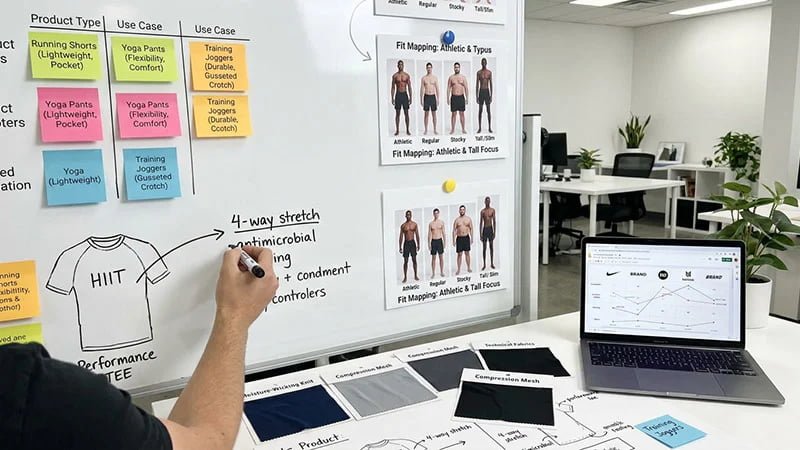
I see this pattern weekly. Brand owners skip market definition because they want to appeal to everyone. Then they develop products that don't solve anyone's specific problems.
Start with Use Case Specificity
"Men's activewear" covers completely different technical requirements. Break down exactly what your customer needs:
High-intensity training (HIIT, CrossFit, weightlifting):
- Fabric needs: 200-240 GSM four-way stretch with recovery
- Cut requirements: Gusseted crotch, articulated knees, reinforced stress points
- Sweat management: High wicking speed, anti-microbial finish
Running and cardio:
- Fabric needs: 140-180 GSM lightweight mesh panels
- Cut requirements: Shorter inseams (5-7 inches for shorts), minimal seams
- Movement priorities: Hip flexor mobility, no chafing zones
Yoga and stretching:
- Fabric needs: 220-260 GSM with 60%+ stretch retention
- Cut requirements: Higher rise waistband, longer torso coverage
- Support zones: Compression at waist and thighs without restriction
I ask clients: what's the primary activity your customer does? Not "what else might they do" but what drives their purchase decision. That answer determines every technical choice downstream.
Understand Men's Body Variance
Here's a misconception I address constantly: men's sizing is simpler than women's. It's not. Men's bodies vary significantly in ways that affect activewear fit:
| Body Type | Key Characteristics | Fit Challenges |
|---|---|---|
| Athletic build | Broad shoulders, narrow waist | Tops gap at waist, shorts slide down |
| Regular build | Proportional chest-waist ratio | Standard grading works |
| Stocky build | Thick torso, shorter limbs | Sleeve/inseam length issues, tight chest |
| Tall/slim | Long limbs, narrow frame | Inseam too short, waist too loose |
Your tech pack must account for the body type that represents 60%+ of your target market. You can't fit everyone with one size curve. I tell clients: choose your core customer body type, then add size range later.
Position Against Competitors Based on Technical Gaps
Most brands position on price or aesthetics. That's a losing strategy. Position on technical performance gaps in your category:
-
Gap example 1: Running shorts market has products for 5K runners (lightweight, minimal support) and marathon runners (compression, storage), but few options for heavy runners who need support without excessive compression.
-
Gap example 2: Training tees offer moisture wicking or odor control, rarely both with durability over 50+ washes.
When you identify a technical gap, you can specify fabric and construction parameters that address it. That gives your supplier clear targets and gives your brand defensible positioning.
Budget Reality and Product Range
I need to address this directly: you cannot launch 12 styles in your first collection. The development cost and inventory risk will drain your budget.
Here's what I recommend for first-time brands:
- 2-3 core styles that address one specific use case
- 2-3 colorways per style (one neutral, one statement)
- 4-5 sizes (S, M, L, XL, plus one extended size based on market)
Total first order investment: $12,000-25,000 depending on customization level and MOQ. If that's beyond your budget, start with ODM modifications (covered later) which reduce development costs by 30-40%.
Turn Ideas into Specs: Design Briefs, Tech Packs and Fit Blocks?
Design briefs without technical specifications waste everyone's time. I've received "briefs" that are Pinterest boards with no measurements, fabric preferences, or construction details. No manufacturer can quote that.
Tech packs translate your design vision into producible specifications by defining every measurement, fabric parameter, construction detail, and quality standard. Without detailed tech packs, you'll get samples that don't match your expectations.
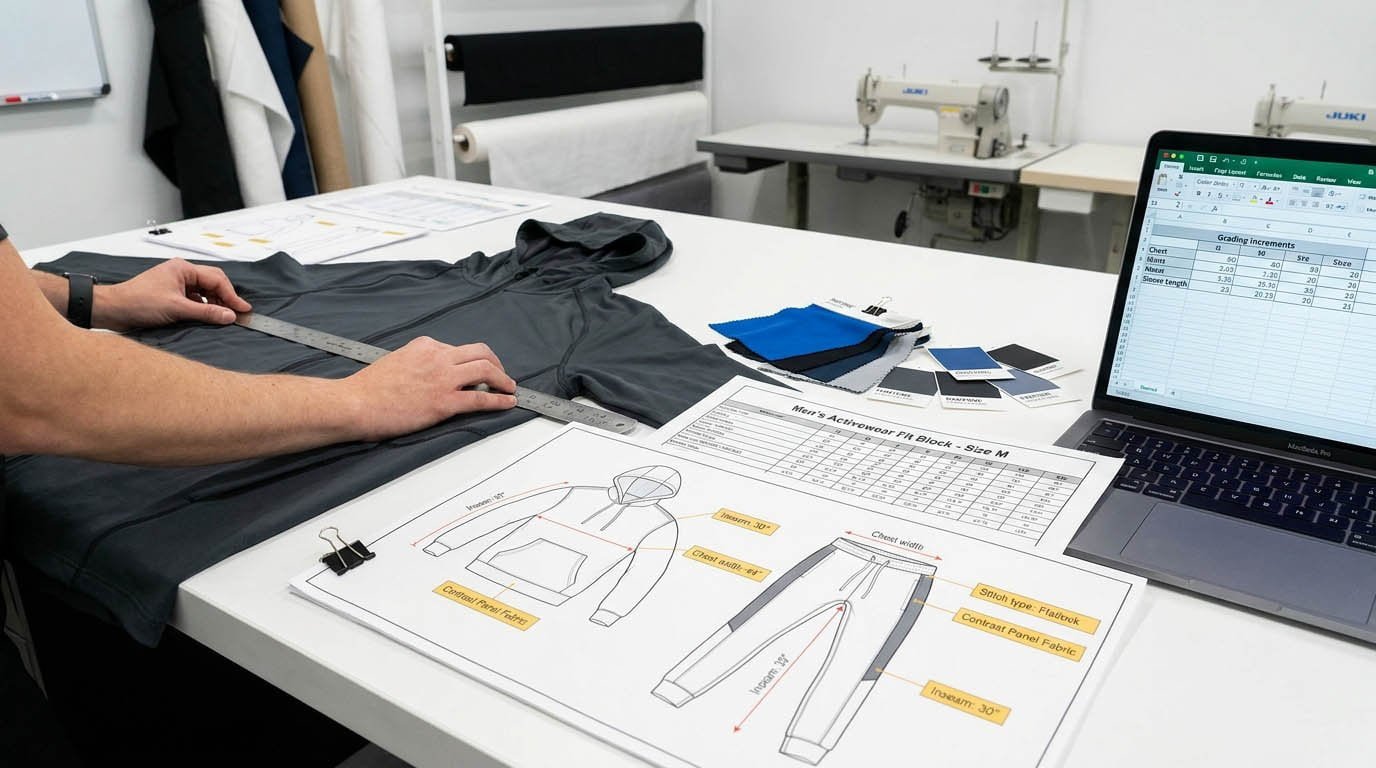
The gap between what brand owners imagine and what factories produce comes from incomplete specifications. Tech packs close that gap.
What a Complete Tech Pack Includes
A production-ready tech pack for men's activewear must contain:
Design overview:
- Front, back, and detail views (flat technical drawings, not fashion illustrations)
- Colorways with Pantone references
- Logo and graphic placement with dimensions
Measurements (for base size, typically M):
- Every critical dimension: chest width, body length, sleeve length, inseam, rise
- Tolerances (typically ±0.5 cm for most measurements)
- Measurement points of reference (POMs) clearly marked
Construction details:
- Stitch types and thread specifications
- Seam allowances
- Hem finishes
- Elastics and bindings with stretch specifications
Materials:
- Main fabric specifications (content, weight, stretch percentage)
- Contrast fabrics or mesh panels
- Trims: labels, hang tags, care labels, drawcords
I tell clients: if a factory can build your product from the tech pack without asking questions, it's complete. If they need to clarify basic details, your tech pack has gaps.
Getting Tech Packs Created
You have three options:
-
Hire a freelance technical designer: Cost $500-1,200 per style. They need your sketches and reference products. Turnaround 1-2 weeks.
-
Use your manufacturer's design team: Many factories offer this as part of ODM service. Cost is built into unit price. Less control over specifications.
-
Use tech pack templates and software: Tools like Techpacker or Adobe Illustrator templates. Cost $0-300. Requires technical knowledge.
For first-time brands, I recommend option 2 for your initial styles, then option 1 once you understand what specifications matter most for your products.
Understanding Fit Blocks and Size Grading
A fit block is your base size pattern (usually size M) that becomes the reference for all other sizes. This is where men's activewear diverges from standard apparel:
Standard apparel grading typically adds/subtracts 1 inch (2.5 cm) across chest and waist per size. But activewear uses different grading rules:
| Measurement | Grading Increment | Why It Differs |
|---|---|---|
| Chest width | ±2.5 cm | Stretch fabric accommodates variance |
| Body length | ±1.5 cm | Torso proportion varies less |
| Sleeve length | ±1 cm | Arm length more variable |
| Waist (bottoms) | ±2 cm | Hip-to-waist ratio critical |
| Inseam | ±2 cm | Leg length highly variable |
Ask your supplier: what grading rules do you use for activewear? If they apply standard apparel grading, your sizes won't fit properly. Different body proportions need adjusted grade rules.
Sample Development Rounds
Expect 2-4 sample rounds before production approval:
Round 1 - Proto sample: Made from placeholder fabrics to verify pattern and construction. Cost $50-80 per unit. Timeline 2-3 weeks.
Round 2 - Fit sample: Made from actual fabrics in base size plus 1-2 adjacent sizes. Verify measurements and proportion. Cost $60-100 per unit.
Round 3 - Pre-production sample: Made on production line with all correct materials. This is your approval standard. Cost $80-120 per unit.
Round 4 - Size set (optional): Full size range to verify grading. Cost $400-800 for complete set.
Red flag: Suppliers pushing you to approve after one sample. Either they're overconfident or they don't expect you to catch quality issues. Insist on at least two rounds with the right to request adjustments.
Fabrics, Trims and Performance: Selection and Testing?
Fabric selection is where I see the most expensive mistakes. Brand owners choose based on hand feel during one showroom visit. Then they discover the fabric pills after three washes or loses stretch after ten.
Fabric selection for men's activewear requires matching specific performance parameters to use case requirements, then verifying those parameters through documented testing before committing to bulk orders.
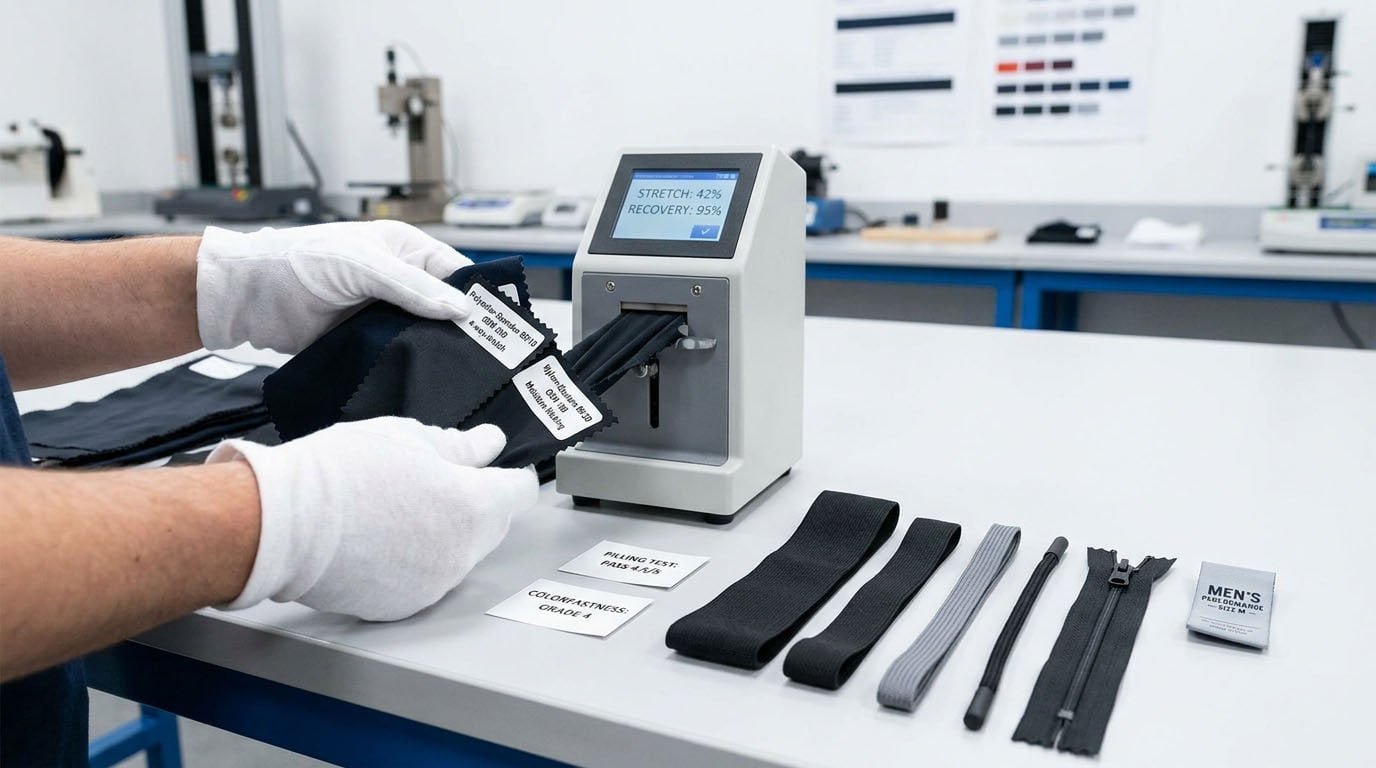
Hand feel matters, but it's the least predictive variable for long-term performance. I need to walk you through what actually predicts fabric success.
Fabric Performance Parameters That Matter
When suppliers send you fabric swatches, ask for these specifications:
Composition:
- Polyester-spandex blends: 85/15 to 92/8 ratio (higher polyester = better wicking, higher spandex = more stretch)
- Nylon-spandex blends: 80/20 to 88/12 (softer hand feel, less durable than polyester)
- Content affects cost: nylon typically 15-20% more expensive than polyester
Weight (GSM - grams per square meter):
- 140-180 GSM: Lightweight running gear, summer training
- 180-220 GSM: All-purpose training, gym wear
- 220-260 GSM: Compression wear, cold-weather base layers
- 260+ GSM: Hoodies, joggers, outerwear
Stretch and recovery:
- Two-way stretch: Stretches in one direction (usually width)
- Four-way stretch: Stretches in both directions (width and length)
- Recovery percentage: Should return to 95%+ of original dimensions after stretching
Ask: can you provide test reports for stretch percentage and recovery? Good suppliers have this data from fabric mills. If they say "it's good stretch," that's not measurable.
Common Fabric Misconceptions from Customer Inquiries
I field these questions constantly, each revealing a misunderstanding about men's activewear fabrics:
"Can I use compression fabric for training shorts?"
Compression fabric (240+ GSM, high spandex content) is engineered for muscle support. It creates excessive pressure during dynamic movement like squats or sprints. For training shorts, use 180-200 GSM with moderate stretch instead.
"Why can't I use the same fabric as women's leggings for men's joggers?"
Women's leggings typically use 200-220 GSM with high stretch for fit. Men's joggers need 240-280 GSM with less stretch because they're designed for relaxed fit with drawstring waist. The use case drives the specification.
"This fabric feels premium, so it must be better quality."
Hand feel indicates finish treatment, not durability. Brushed or peached fabrics feel soft but pill faster. I ask: what matters more for your customer—initial softness or maintaining appearance after 20 washes?
Performance Testing Requirements
Before bulk production, insist on these fabric tests:
- Colorfastness to washing: ISO 105 C06, minimum Grade 4 (no color transfer to skin or other garments)
- Pilling resistance: ASTM D3512, minimum Grade 3 after 2,000 rubs
- Dimensional stability: AATCC 135, shrinkage under 3% after five washes
- Stretch and recovery: ASTM D2594, should maintain 90%+ recovery after 50 cycles
Testing cost: $400-700 per fabric type through labs like SGS or Intertek. This feels expensive until you calculate the cost of selling 1,000 defective units.
Trims and Details That Affect Function
Trims seem minor but they cause disproportionate quality complaints:
Waistbands for bottoms:
- Elastic width: 3-4 cm standard, 5-6 cm for high-rise or compression
- Elastic modulus: Should recover without rolling or digging into skin
- Drawcord material: Flat tape preferred over round cord (less tangling)
Labels and tags:
- Printed labels instead of woven (reduce irritation)
- Placement: Back neck for tops, inside waistband for bottoms
- Size and care information must be readable after 20 washes
Zippers (for hoodies, jackets):
- YKK or SBS brand recommended (generic zippers fail at 3-5x higher rate)
- Auto-lock sliders prevent zipper slide-down during movement
I tell clients: spend $0.15-0.30 extra per unit on quality trims. Cheap zippers and elastic cause more returns than fabric defects.
From Prototype to Production: Grading, Size Sets and Quality Control?
Approving your first sample feels like progress. Then bulk production arrives and 30% of the units don't match the approved sample. This is the gap that kills new brands.
Sample approval does not guarantee production consistency. You need documented quality standards, inspection protocols at multiple production stages, and contractual recourse if quality fails to meet specifications.
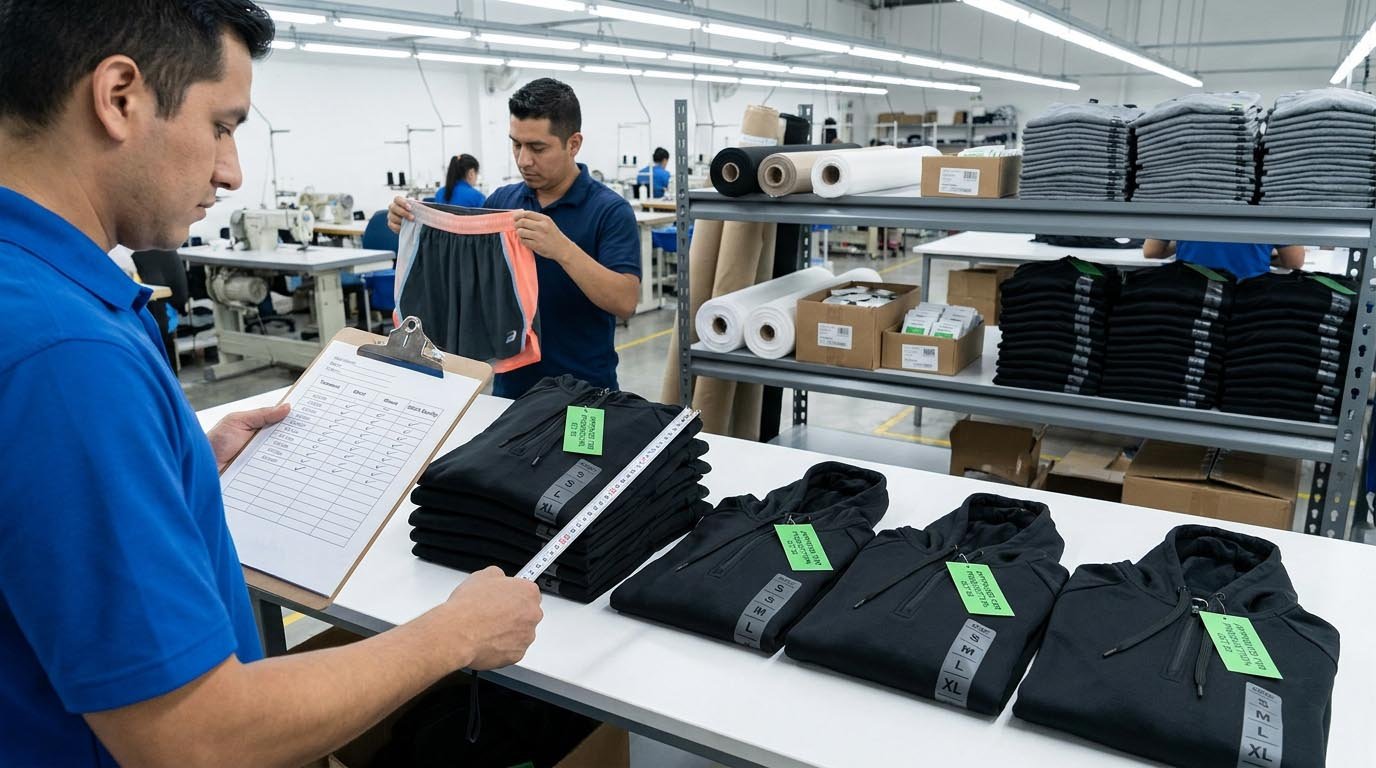
I need to explain what actually predicts production consistency, because most brand owners focus on the wrong variables.
Size Grading Verification
Your approved sample is typically size M. Grading scales that pattern to create S, L, XL, XXL. Here's where problems emerge:
Common grading issues in men's activewear:
- Proportional errors: Chest width grades correctly but sleeve length doesn't adjust proportionally
- Stretch miscalculation: Grading assumes non-stretch fabric rules, causing fit problems in stretch materials
- Rise/inseam errors: Waist size increases but inseam doesn't adjust, causing crotch fit problems
Before bulk production, request a size set (one unit in every size). Try them on body types that represent each size range. Cost $400-800 for complete set, but this catches grading errors that would affect hundreds of units.
Ask your supplier: do you have a fit model for each size? If they only fit-test size M, you're taking risk on all other sizes.
Pre-Production Meeting Checklist
Schedule a pre-production meeting (video call or in-person) to confirm every specification:
Fabric confirmation:
- Lab dip approval (color standard)
- Physical swatch from actual fabric lot
- Test reports from that specific fabric batch
Construction confirmation:
- Approved sample on hand (both parties reference the same unit)
- Measurement tolerance agreement (typically ±0.5 cm)
- Stitch specifications (thread color, stitch density, seam type)
Quality standards:
- AQL levels agreed (2.5 for major defects, 4.0 for minor)
- Inspection checkpoints defined
- Defect classification examples documented
I've seen orders go wrong because the brand owner and factory were looking at different samples during production. Label your approved sample with "APPROVED FOR PRODUCTION - [Date]" and require the factory to reference that specific unit.
Quality Control Checkpoints
Quality inspection needs to happen at multiple stages, not just at the end:
1. Fabric inspection (before cutting):
Check for weaving defects, shade variation between rolls, physical properties match specifications. Catching fabric problems here saves cutting and sewing costs.
2. Cutting audit:
Random measurement checks on cut pieces. Verify pattern placement and fabric direction (especially important for stretch fabrics with different stretch directions).
3. In-line inspection (during sewing):
Check 10-15% of units during production. Catch systematic problems before entire batch is complete. Look for stitch tension issues, seam puckering, measurement drift.
4. Final inspection (100% or AQL sampling):
For first production run, I recommend 100% inspection even though it adds $0.20-0.40 per unit. Subsequent orders can use AQL sampling once you've confirmed factory consistency.
What Inspection Should Verify
Your inspector (in-house or third-party) should check:
| Inspection Point | Acceptable Variance | Common Defects |
|---|---|---|
| Measurements | ±0.5 cm from tech pack | Chest width, body length, inseam |
| Stitch quality | No skipped stitches | Puckering, loose tension, thread breaks |
| Color match | Within approved tolerance | Shade variation, color bleeding |
| Print/logo | Centered, no cracks | Misalignment, incomplete print |
| Trims | Functional, secure | Loose labels, rolling elastic |
Red flags during inspection:
- Factory resistant to checkpoint access
- No documented measurement tracking
- Claims "we already checked" without records
- High defect rates above 5% in initial inspection rounds
Managing Production Changes
During production, the factory may request changes due to material availability or technical challenges. Every change needs your written approval:
Change request protocol:
- Factory submits written request with reason and proposed solution
- They provide sample showing the change if it affects appearance or function
- You approve or request alternative in writing
- Updated tech pack reflects the change with version number
I've seen factories make "small adjustments" that cascade into quality problems. One client's factory changed the elastic supplier mid-production without notice. The waistband rolled after first wash. Always require approval for any deviation from approved specifications.
Sourcing & Ops: OEM/ODM Partners, MOQs, Costing and Timelines?
Choosing between OEM and ODM affects everything downstream: development cost, timeline, differentiation potential, and MOQ requirements. Most new brands don't understand this decision tree.
OEM means you own the design and provide complete specifications. ODM means the factory has existing designs you modify. Your choice depends on budget constraints, timeline pressure, and how much differentiation matters for your market position.
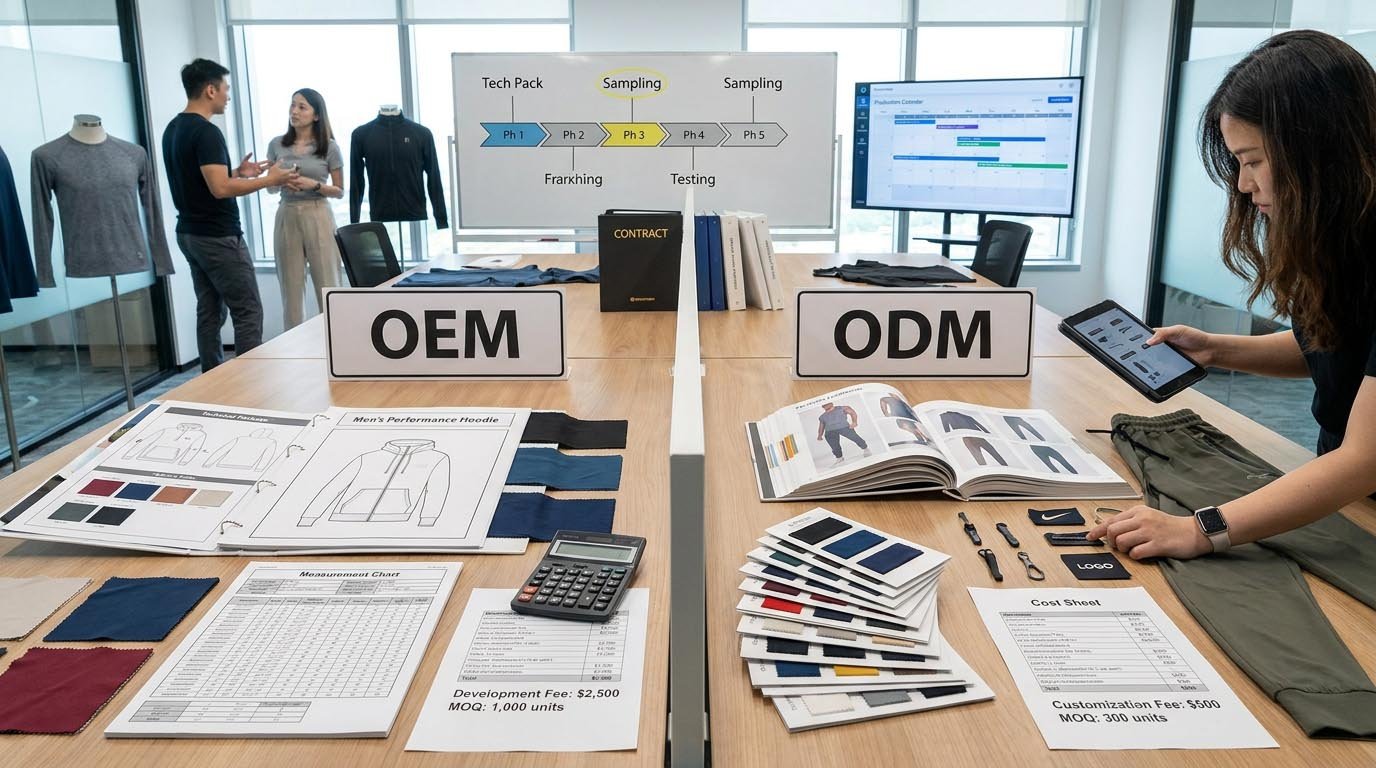
This decision affects your first-year cash flow more than almost any other factor. I need to show you how to evaluate it.
OEM vs ODM: Cost and Control Tradeoffs
OEM (Original Equipment Manufacturing):
You provide complete tech packs, select all materials, define all specifications. The factory manufactures to your design.
Advantages:
- Full design control and brand differentiation
- Exclusive product (factory can't sell to competitors)
- You own patterns and can switch manufacturers
Disadvantages:
- Development cost $1,500-3,500 per style
- Higher MOQs: 500-1,000 pieces per style
- Longer timeline: 90-120 days from concept to production
- You bear all design risk
ODM (Original Design Manufacturing):
Factory has existing style library. You choose styles and customize fabrics, colors, logos, trims.
Advantages:
- Lower development cost: $300-800 per style for modifications
- Lower MOQs: 300-500 pieces per style
- Faster timeline: 60-75 days from selection to production
- Factory bears pattern development risk
Disadvantages:
- Limited differentiation (other brands may use similar base styles)
- Less design control
- Factory may produce similar products for competitors
I tell first-time brands: start with ODM to validate market demand and cash flow model. Once you have 3-6 months of sales data, invest in OEM for your best-selling categories.
MOQ Structure and Negotiation
MOQs aren't arbitrary numbers. They reflect fabric minimums, cutting efficiency, and production line setup costs:
Fabric MOQs:
Most performance fabrics require minimum 300-500 meters per color. At 1.5-2 meters per garment, that sets a floor on units per color.
Production efficiency:
Setup costs (pattern making, quality checkpoints, machine adjustments) get amortized across order quantity. Under 300 pieces, setup costs add 25-40% to unit price.
Negotiable MOQ scenarios:
- Mix colors within same style: Instead of 500 units in one color, offer 300 + 200 in two colors
- Combine styles using same fabric: Order 300 units each of shorts + tee using identical fabric
- Accept higher unit cost: Factories may accept 200-300 pieces with 20-30% price premium
Non-negotiable: Total order value. Most factories have minimum order values of $8,000-15,000 for custom activewear. You can distribute that across multiple styles and colors.
Cost Structure and Price Calculation
When comparing quotes, break down the cost components:
Typical cost breakdown for men's activewear:
- Fabric and materials: 45-55% of unit cost
- Labor (cutting, sewing, finishing): 20-25%
- Trims and packaging: 8-12%
- Quality control and overhead: 10-15%
- Factory profit margin: 8-12%
If one quote is 20%+ cheaper than others, ask which cost component is lower. Common answers:
- Lower fabric grade (cheaper polyester, lower GSM)
- Reduced QC checkpoints (only final inspection)
- Lower labor costs (less experienced operators)
None of these save you money if they result in quality issues. I ask clients: what's the cost of one bad review from product failure? Usually far more than unit cost savings.
Costing Variables You Can Control
You can reduce costs without sacrificing quality by adjusting these variables:
Fabric customization level:
- Stock fabric colors: baseline cost
- Custom dye lots: add 10-15%
- Custom yarn specifications: add 20-30%
Trim complexity:
- Woven labels: add $0.15-0.25 per unit
- Custom zipper pulls: add $0.30-0.50 per unit
- Custom packaging: add $0.40-0.80 per unit
Order timing:
- Off-season production (April-June, September-November): potential 5-10% discount
- Peak season (July-August, December-January): expect 5-8% premium or extended lead times
Timeline Planning and Buffer
The 90-120 day development timeline breaks down into phases you can't compress without risk:
Phase 1 - Pre-production (20-30 days):
- Tech pack finalization: 5-7 days
- Fabric sourcing and lab dip approval: 10-15 days
- Sample development: 7-10 days
Phase 2 - Sampling and revisions (15-25 days):
- First sample review and feedback: 3-5 days
- Revised samples: 7-10 days
- Final approval and pre-production sample: 5-10 days
Phase 3 - Production (35-45 days):
- Fabric cutting: 3-5 days
- Sewing and assembly: 20-25 days
- Quality inspection: 5-7 days
- Packing and preparation: 5-7 days
Phase 4 - Shipping:
- Ocean freight: 25-40 days (depends on origin/destination)
- Air freight: 5-8 days (costs 4-6x more)
Add 15-20% buffer time to all phases. I see brands launch late because they planned for best-case timeline. Production delays, fabric availability issues, or required sample revisions are normal.
Red Flags in Supplier Proposals
Watch for these warning signs when evaluating manufacturers:
- Promises unusually fast timelines: "We can deliver in 45 days" for fully custom products
- Unclear on fabric sourcing: Can't name fabric suppliers or provide mill information
- Vague quality standards: No mention of AQL, inspection protocols, or testing
- Pressure to order without samples: "Samples delay production, let's start immediately"
- Payment terms heavily front-loaded: Requiring 60-70% deposit
- No contract or minimal terms: Verbal agreements or one-page order confirmations
I tell clients: if something seems too good to be true (price, speed, flexibility), ask specifically how they achieve it. Legitimate manufacturers explain their efficiency sources. Questionable ones deflect or provide non-specific answers.
FAQ: Building Custom Men's Activewear for Your Brand
What's the difference between men's and women's activewear development?
Men's patterns use different hip-to-waist ratios, longer torso proportions, and adjust for broader shoulders. Fabric requirements differ too—men's compression needs lower pressure zones and different support placement. Using women's patterns scaled up causes fit problems around crotch rise, sleeve length, and torso coverage.
Should I develop all sizes from the start or start with core sizes?
Start with 4 core sizes (S, M, L, XL) representing 80%+ of your target market. Add extended sizes (XXS, XXL, XXXL) once you have sales data showing demand. Each additional size adds $100-200 to sampling costs and increases inventory complexity.
How do I protect my designs from being copied by my manufacturer?
Include Non-Disclosure Agreement (NDA) and intellectual property clauses in your contract. Specify they cannot produce your designs for other clients. Register design patents or trademarks before sharing tech packs. Choose manufacturers who work with established brands—they understand IP protection. Avoid factories displaying other brands' samples without permission.
Can I use the same fabric supplier my manufacturer uses?
You can request specific fabric mills, but expect pricing to increase 8-15% if your manufacturer needs to change their supply chain. Manufacturers get volume discounts from their regular mills. If fabric sourcing flexibility is critical, discuss this upfront and compare pricing impacts.
What happens if my bulk production doesn't match approved samples?
Your contract should define recourse. Standard terms: manufacturer must rework defective units at their cost if defect rate exceeds AQL. If timeline is missed due to quality issues, you should have delay penalties. This is why third-party inspection before final payment is critical—it gives you documentation if disputes arise.
How do I know if quoted lead time is realistic?
Ask for a detailed production schedule breaking down each phase. Compare their timeline to industry standards (90-120 days for custom, 60-75 days for ODM). Request references from current clients about on-time delivery rates. Factories consistently meeting deadlines have documented production planning systems.
Should I work with domestic or overseas manufacturers?
This depends on your budget and order volume. Overseas (typically Asia) costs 40-60% less but adds shipping time and communication complexity. Domestic manufacturers offer faster sampling, easier communication, and smaller MOQs but higher per-unit costs. Most brands start overseas for inventory cost control, then consider domestic for reorders and seasonal products.
Conclusion
Developing custom men's activewear is not about design creativity—it's about matching technical specifications to use cases and finding manufacturers who can maintain quality consistency. Start with clear requirements, invest in proper tech packs, test fabrics before committing, and structure contracts with quality accountability.