.png)
A brand owner asked me why everyone is ordering yoga pants. She wanted to know if this was just a trend or something deeper. I pulled order data from the past three years. High-waisted leggings and sports bra orders increased 180% while traditional gym shorts only grew 25%. The numbers tell a clear story.
Yoga wear and athleisure are driving activewear market growth because they solve a specific problem: garments that work across multiple contexts without compromising comfort or appearance. This translates to specific fabric requirements, construction methods, and minimum order quantities that differ significantly from traditional performance activewear.
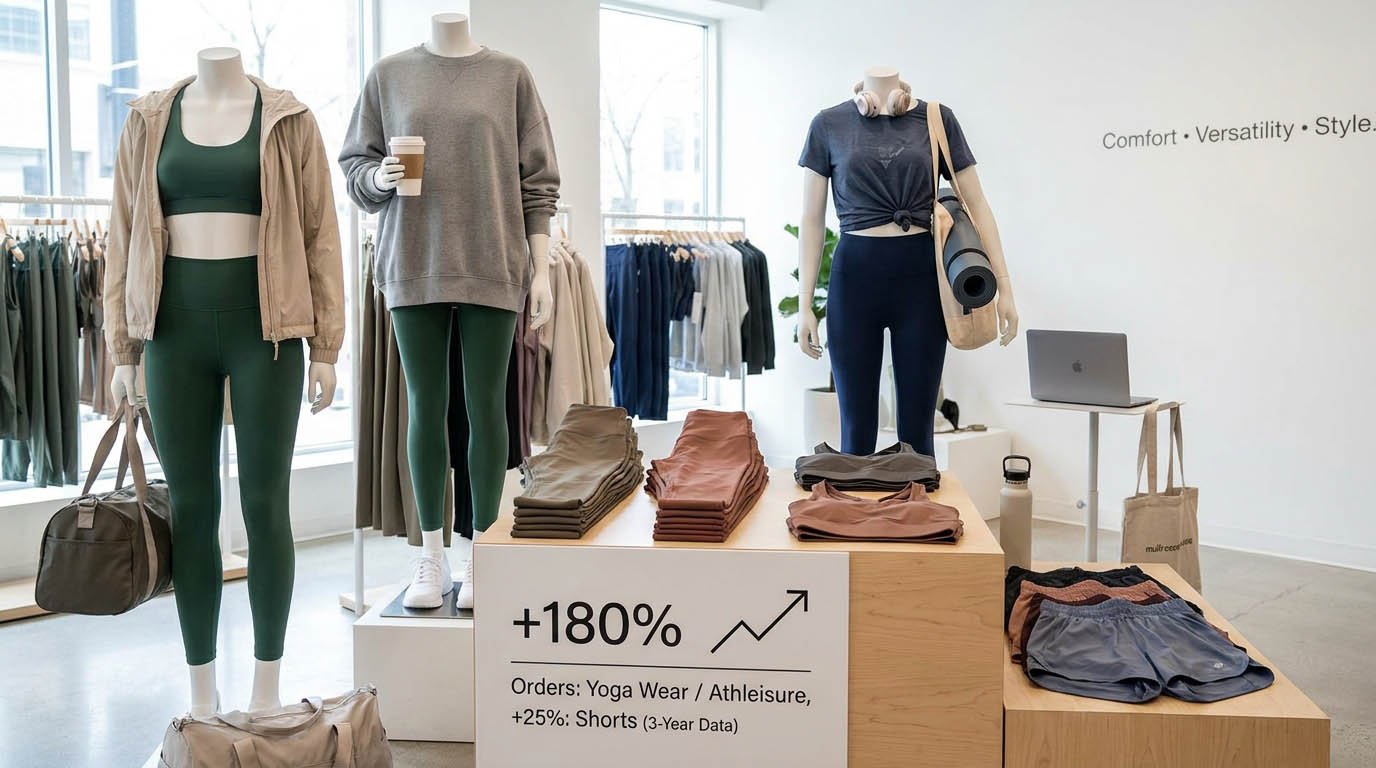
I see this shift in every order conversation. Brand owners are no longer asking about gym-specific gear. They want products that customers can wear to yoga class, run errands, work from home, and meet friends. That requirement changes everything about fabric selection and construction.
Quick Answers: Yoga Wear and Athleisure Growth
Why is yoga wear growing faster than traditional gym wear?
Yoga wear serves multiple use cases (workout, casual wear, work-from-home) while traditional gym wear is single-purpose. This versatility drives 2-3x higher purchase frequency per customer. Orders for high-waisted leggings have grown 180% in three years vs. 25% for performance shorts.
What fabric specifications make yoga wear different from regular activewear?
Yoga wear requires four-way stretch (vs. two-way for gym wear), 220-280 GSM weight for opacity, 20-25% spandex content for recovery, and squat-proof construction. These specs add $2-4 per unit to production costs but drive significantly lower return rates.
Why do yoga wear orders have higher MOQs than other activewear?
Four-way stretch fabrics typically require 500-800 meters minimum orders from fabric mills. This sets floor quantities at 300-500 pieces per color. Seamless construction (popular in yoga wear) requires specialized equipment with higher setup costs, pushing minimums to 500-800 units.
What's driving the shift from individual pieces to coordinated sets?
Customer expectations changed. 60%+ of yoga wear orders now include matching sets (leggings + sports bra or leggings + crop top) vs. 30% three years ago. This reflects buyer behavior shifting toward outfit coordination, not individual pieces.
How does athleisure's production timeline differ from performance activewear?
Athleisure often uses softer, more complex fabrics (modal blends, brushed polyester, ponte knits) that add 15-30 days to fabric sourcing. Construction details (ribbed waistbands, decorative stitching, multiple color blocking) add another 10-15 days. Plan 105-135 days vs. 90-120 days for standard activewear.
Comfort-First Lifestyles: Work-From-Anywhere and Wardrobe Versatility?
Last year a wholesale buyer told me she needed "real clothes that feel like pajamas." I understood immediately. The pandemic permanently changed what people consider acceptable daily wear. The numbers prove it.
The shift to work-from-anywhere eliminated the need for separate wardrobes for work, exercise, and leisure. Yoga wear and athleisure fill this gap with garments comfortable enough for all-day wear but structured enough to appear intentional. This translates to specific fabric softness requirements and construction features that affect sourcing.
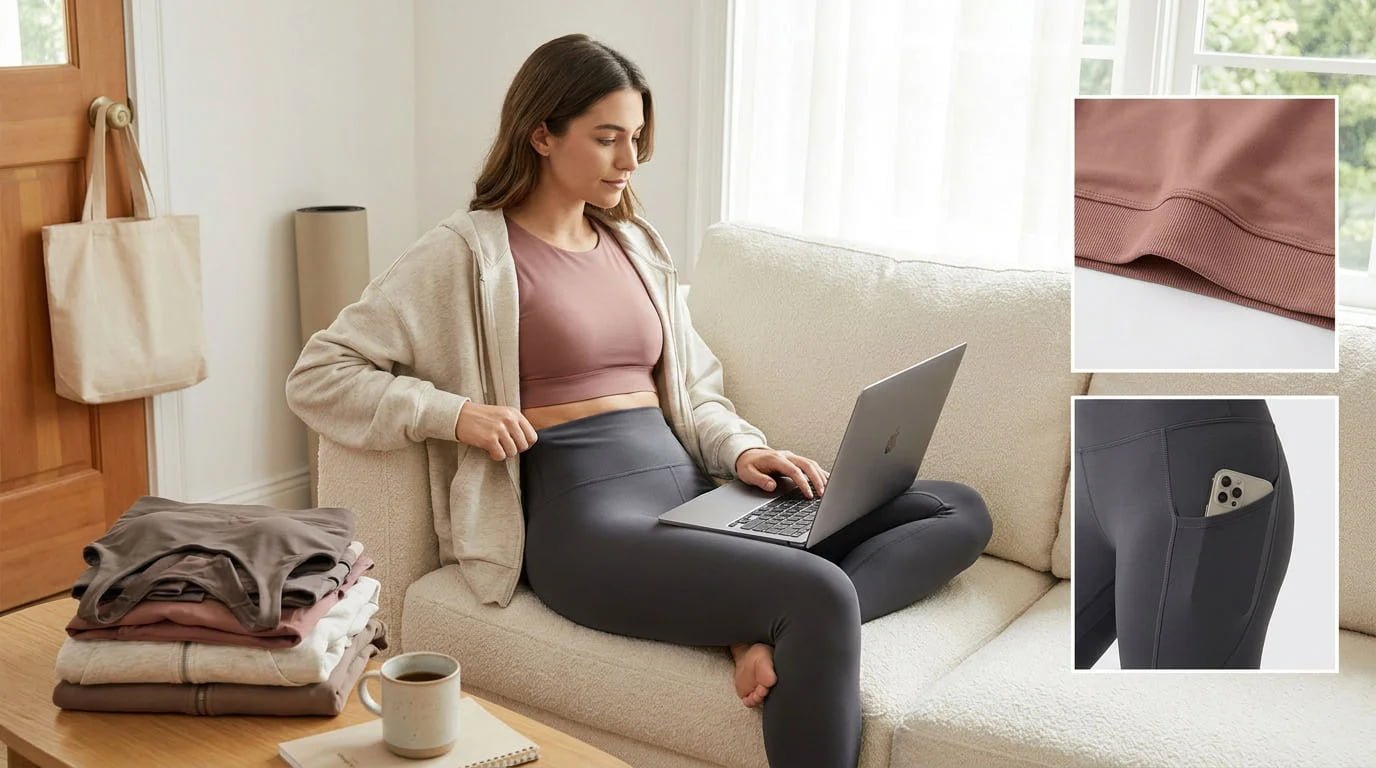
When I review order changes from 2021 to 2024, the pattern is clear. Brands are ordering fewer "performance" features and more "comfort with structure" features. This changes fabric specifications significantly.
What "All-Day Comfort" Actually Requires
"Comfortable" is not just soft fabric. From a production standpoint, all-day wearability requires:
Fabric characteristics:
- Stretch and recovery: Must maintain shape after 8+ hours of wear
- Breathability: Needs to handle sitting, light movement, and occasional activity
- Softness: Hand feel matters more than in pure performance wear
- Weight balance: Heavy enough for opacity, light enough to not feel restrictive
Technical specifications for all-day wear:
| Feature | Gym-Only Wear | All-Day Athleisure | Production Impact |
|---|---|---|---|
| Spandex content | 12-18% | 20-28% | Higher material cost |
| Fabric weight | 180-220 GSM | 240-280 GSM | More fabric per unit |
| Stretch type | Two-way acceptable | Four-way required | Specialized mills |
| Recovery retention | After 2 hours | After 8+ hours | Better quality spandex |
| Waistband width | 3-4 cm | 5-8 cm | More fabric, labor |
Cost impact:
All-day comfort specs add $2.50-4.50 per unit compared to basic performance leggings. But brands accept this because return rates drop and repurchase rates increase.
Wardrobe Versatility in Order Patterns
I track what brands are ordering together. The patterns show clear multi-context thinking:
2021 typical order (gym-focused brand):
- Performance leggings: 1,000 units
- Sports bras: 600 units
- Training shorts: 500 units
- Total: 3 separate items, different fabric specs each
2024 typical order (athleisure brand):
- High-waisted leggings: 800 units
- Matching sports bras: 800 units
- Coordinating crop tops: 600 units
- Oversized hoodies: 400 units
- Total: 4+ items, coordinated fabrics and colors
What this shift means for production:
- Fabric coordination: Need to source matching colors across different fabric constructions
- Color consistency: Matching across jersey, rib, and fleece requires careful dye lot management
- Set packaging: Some brands request coordinated packaging for sets
- Development complexity: More styles but related specs (easier than completely different products)
Construction Features for Non-Gym Contexts
When garments need to work outside the gym, construction requirements change:
Features I see in growing order volumes:
- High-waisted cuts (7-9 cm rise vs. 4-6 cm standard): Provides coverage for bending, sitting
- Double-layer waistbands: Adds structure without compression feel
- Ribbed details: Adds visual interest for casual wear contexts
- Longer length options: 7/8 and full-length outselling cropped (reversal from 2019-2020)
- Hidden pockets: Phone pockets becoming standard, not optional
Production considerations:
These features don't just add aesthetic appeal. They have real manufacturing implications:
- Double-layer waistbands: Add $0.40-0.80 per unit in fabric and labor
- Ribbed trims: Require separate fabric sourcing, add $0.30-0.60 per unit
- Hidden pockets: Add $0.50-0.90 per unit depending on placement and size
- Length variations: Each length is a separate SKU for cutting and grading
A DTC brand wanted to offer 3 lengths (crop, 7/8, full) in 4 colors with 5 sizes. That's 60 SKUs from what looks like one design. I explained the inventory implications. We restructured to 2 lengths in 3 colors (30 SKUs), which still felt comprehensive but was manageable.
Why "Versatility" Matters to Production Planning
Multi-context wear changes how brands plan orders:
Implications I explain to clients:
- Longer selling seasons: Not tied to workout trends or seasons, sells year-round
- Higher reorder rates: Customers buy multiples when items work for multiple uses
- Better margin tolerance: Customers pay more for versatility, supporting higher fabric costs
- More predictable demand: Less vulnerable to fitness trend cycles
But versatility also means:
- Higher quality expectations: Customers wear these 3-5x more frequently than gym-only gear
- Durability testing critical: Must hold up to 50+ washes while maintaining shape
- Color fastness requirements: Worn in more contexts means more scrutiny on color bleeding
- Fabric pilling resistance: High-wear items need Grade 4+ pilling resistance
The Wellness Boom: Yoga, Mindfulness and Habit Stacking?
Three years ago, most yoga wear orders came from yoga studios or yoga-focused brands. Now I get orders from general wellness brands, meditation apps launching product lines, and lifestyle brands adding yoga categories. The customer base expanded dramatically.
Yoga transitioned from a specific exercise practice to a broader wellness lifestyle category. This expanded the addressable market from yoga practitioners to wellness-focused consumers. For manufacturers, this means yoga wear orders now come from brands without traditional activewear experience, requiring more specification guidance.
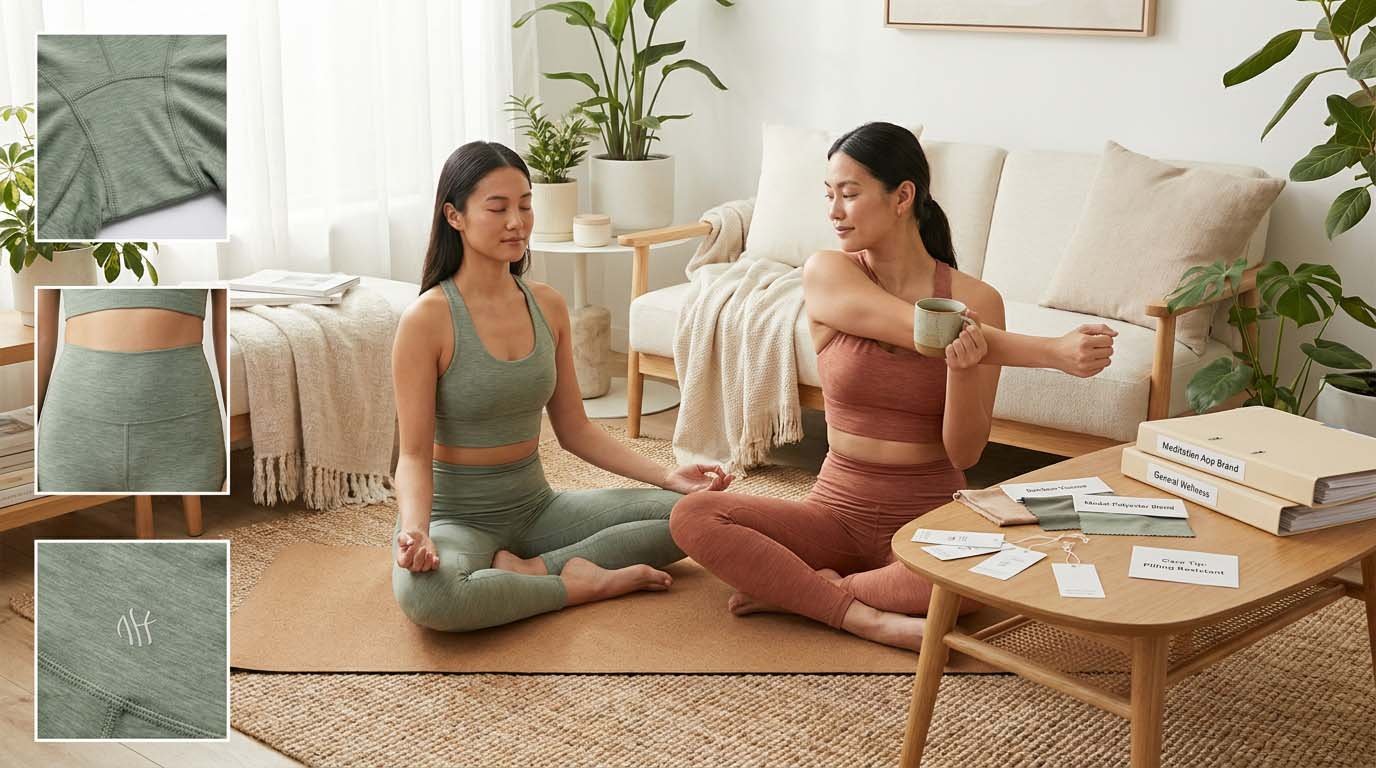
When brands approach yoga wear from a wellness angle rather than a performance angle, their specification priorities shift. I need to understand their positioning to guide fabric and construction choices.
Yoga-Specific Technical Requirements
True yoga wear has specific technical requirements different from general athleisure:
Movement range requirements:
- Hip flexor mobility: Gusset construction essential for deep lunges
- Forward fold accommodation: Waistband must stay in place during inversions
- Twist and stretch: Four-way stretch with 60%+ recovery after stretching
- Floor work: Fabric must not pill from mat contact
Fabric specifications for yoga performance:
| Requirement | Standard Spec | Why It Matters |
|---|---|---|
| Four-way stretch | Minimum 40% stretch both directions | Deep poses require extreme range |
| Spandex content | 20-25% (higher than gym wear) | Shape retention during holds |
| Fabric weight | 240-280 GSM | Opacity during bending, squat-proof |
| Moisture wicking | Less critical than gym wear | Yoga generates less sweat volume |
| Compression | Moderate, not high | Must not restrict breathing |
Construction features for yoga:
- Gusseted crotch: Prevents seam failure during splits and deep stretches
- Flatlock seams: Reduces irritation during floor poses
- High-rise waistband: 7-9 cm minimum to prevent roll-down during inversions
- Secure waistband: Stays in place without excessive compression
Wellness Lifestyle Beyond Performance
Many brands now position yoga wear as wellness apparel, not strictly workout gear. This changes priorities:
Wellness-focused brand specifications:
- Soft hand feel: Prioritized over technical performance
- Natural or natural-blend fabrics: Modal, Tencel, or organic cotton blends
- Muted color palettes: Earth tones, neutrals over bright performance colors
- Minimalist design: Less branding, fewer design elements
Production implications:
- Natural blends cost more: Modal-polyester blends add $1.50-2.50 per unit
- Softer fabrics pill more easily: Need to educate customers on care
- Earthy colors have lower minimums: Neutral colors in higher demand, better for small orders
- Simpler construction can reduce cost: Fewer design elements offsets fabric premium
A meditation app launching a product line wanted "luxuriously soft" yoga wear. They specified bamboo viscose blends. I showed them bamboo's pilling tendency and lower durability. We landed on modal-polyester 60/40 blend that delivered softness with better longevity. Cost was $2.20 more per unit than standard polyester but aligned with their $68 retail price point.
Habit Stacking and Daily Wear Integration
"Habit stacking" means linking new behaviors to existing routines. Wellness brands tell me their customers want to wear yoga apparel as a trigger for wellness intentions:
What this means for product specs:
- Must be comfortable enough for all-day wear (not just workout)
- Visual reminders of wellness goals (hence coordinated sets)
- Transition seamlessly from morning meditation to work-from-home to evening walk
Order pattern changes I observe:
Traditional yoga brand ordering:
- Focus: High-performance leggings and tops
- Colors: Mix of bright and neutral
- Styles: Variety for different practice types
Wellness lifestyle brand ordering:
- Focus: Coordinated sets and loungewear-adjacent styles
- Colors: Heavy neutral, limited brights
- Styles: Fewer options, deeper inventory per style
The wellness approach simplifies product development but increases per-style inventory commitment. Instead of 8 styles at 300 units each, wellness brands often order 3-4 styles at 600-800 units each.
Meditation and Low-Impact Movement Apparel
Not all yoga is high-intensity vinyasa. Yin yoga, restorative practices, and meditation require different specs:
Low-impact yoga/meditation fabric specs:
- Softer fabrics: Less performance-focused, more comfort
- Lower compression: Gentle support vs. athletic compression
- Breathable but not technical: Cotton-poly blends work well
- Looser fit acceptable: Not skin-tight like performance yoga
Cost advantages:
Low-impact styles can use:
- Lighter weight fabrics: 200-240 GSM vs. 260-280 GSM for high-performance
- Lower spandex content: 15-20% vs. 22-25%
- Simpler construction: Less reinforcement needed
This can reduce unit costs by $1.50-2.50 while still serving the wellness category.
Product Edge: Soft Stretch Fabrics, Fit and Style Crossover?
Fabric technology is where yoga wear and athleisure truly differentiate from traditional activewear. The technical requirements aren't just marketing—they directly affect what suppliers can produce and at what quantities.
The product advantage of yoga wear and athleisure comes from specific fabric engineering: four-way stretch with high recovery, soft hand feel with durability, and opacity during movement. These requirements limit supplier options, increase minimum order quantities, and add $2-5 per unit to costs, but they're essential for product performance.
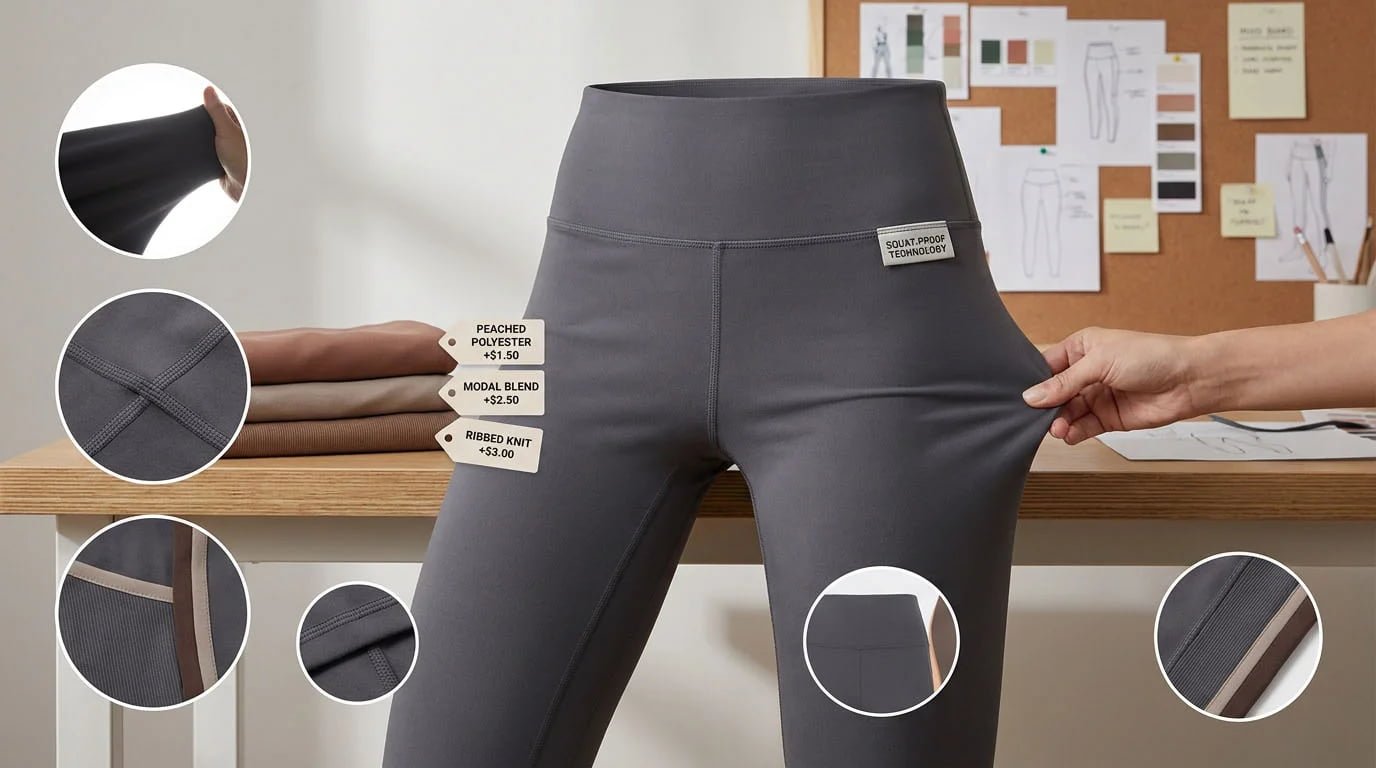
I need to explain what these fabric specs actually mean in production terms, because brand owners often specify requirements without understanding the sourcing implications.
Four-Way Stretch: Not Just Marketing
Four-way stretch means fabric stretches in both horizontal and vertical directions. This sounds simple but requires specific knitting technology:
Technical production requirements:
- Specialized knitting machines: Circular knitting with multi-feed systems
- Higher spandex content: 20-25% vs. 12-15% for two-way stretch
- Specific yarn construction: Both warp and weft directions need stretch yarns
- Quality control complexity: Must test stretch in both directions
Fabric mill minimums for four-way stretch:
- Standard two-way stretch: 300-500 meters minimum per color
- Four-way stretch: 500-800 meters minimum per color (higher setup costs)
Cost impact:
Four-way stretch fabrics cost $0.80-1.50 more per meter than two-way stretch. At 1.5-1.8 meters per legging, that's $1.20-2.70 more per unit just in fabric cost.
Why it matters for yoga wear:
Two-way stretch works for running or cycling (movement in one primary direction). Yoga requires omnidirectional movement—forward folds, twists, side bends, inversions. Four-way stretch is not optional for true yoga performance.
Stretch Recovery: The Specification Customers Miss
High stretch percentage without good recovery creates baggy, stretched-out garments. I see this mistake often:
Common customer error:
Brand: "I want 50% stretch for maximum flexibility."
Me: "What's the recovery percentage?"
Brand: "What's that?"
Recovery specification:
- Recovery percentage: How much the fabric returns to original dimensions after stretching
- Target for yoga wear: 90-95% recovery after repeated stretch cycles
- Testing standard: ASTM D2594 (stretch and recovery)
Production considerations:
| Stretch Level | Recovery | Suitable Applications | Cost Impact |
|---|---|---|---|
| 30-40% stretch, 85% recovery | Fair | Casual athleisure | Baseline |
| 40-50% stretch, 90% recovery | Good | Light yoga, daily wear | +$0.60-1.20/unit |
| 50-60% stretch, 95% recovery | Excellent | Performance yoga, dance | +$1.50-2.50/unit |
Real-world impact:
Poor recovery means customers complain about "stretched out" leggings after a few wears. This creates returns and negative reviews. Investing in better quality spandex (Lycra vs. generic elastane) adds $0.80-1.20 per unit but dramatically reduces return rates.
Squat-Proof and Opacity Requirements
"Squat-proof" is the most common specification in yoga wear orders. Here's what it actually requires:
Technical requirements for opacity:
- Minimum fabric weight: 240 GSM for light colors, 220 GSM for dark colors
- Tight knit structure: Smaller loops in fabric construction
- Double-layer options: Some brands use double-layer construction in key areas
- Proper spandex ratio: Too much spandex can increase transparency
Testing methods:
- Manual squat test: Hold fabric taut, check if skin or underwear shows through
- Light box test: Backlight fabric to check opacity
- Stretch opacity test: Check transparency at maximum stretch
Cost vs. opacity tradeoff:
Increasing fabric weight from 200 GSM to 260 GSM adds:
- 30% more fabric cost per meter
- Approximately $1.20-1.80 more per unit for leggings
- But reduces return rates by 40-50% (based on client feedback)
A brand learned this the hard way. They ordered 1,000 units of light-colored leggings at 210 GSM to save costs. Return rate was 28% for transparency issues. Their reorder specified 250 GSM, cost $1.50 more per unit, but returns dropped to 6%.
Soft Hand Feel with Performance
The "buttery soft" trend in yoga wear creates technical challenges. Soft finishes can reduce durability:
Softness treatments:
- Peached finish: Brushed surface feels soft but pills more easily
- Silicon finishes: Adds silky feel but washes out after 15-20 cycles
- Fabric composition: Modal or Tencel blends naturally softer than polyester
Durability tradeoffs:
| Softness Method | Hand Feel | Pilling Resistance | Durability | Cost Impact |
|---|---|---|---|---|
| Brushed polyester | Very soft | Poor (Grade 2) | Fair | +$0.40-0.70/unit |
| Silicon finish | Silky | Good initially, degrades | Temporary | +$0.50-0.90/unit |
| Modal blend (30%) | Naturally soft | Good (Grade 3-4) | Good | +$1.50-2.50/unit |
| High-quality poly | Moderate | Excellent (Grade 4) | Excellent | Baseline |
Client education needed:
I explain that "buttery soft" and "lasts 100+ washes" are often in conflict. Brands must choose their priority or use more expensive modal blends to get both.
Style Crossover Features
Yoga wear succeeded by borrowing from both athletic and fashion apparel:
From athletic wear:
- Moisture wicking and quick dry
- Stretch and mobility
- Secure, stay-put construction
From fashion wear:
- Aesthetic details (ribbing, color blocking)
- Style variety (crops, flares, bike shorts)
- Premium finishes and branding
Production complexity:
Combining technical performance with fashion aesthetics requires:
- Multiple fabric types in one garment (main body + ribbed waist + mesh panels)
- Color matching across fabrics (can be challenging with different constructions)
- More complex pattern making (adds $300-500 per style in development)
- Higher sampling costs (more revisions needed to balance function and fashion)
Values-Led Brands: Inclusivity, Sustainability and Identity?
Brand values are no longer optional in yoga wear and athleisure marketing. But I see a gap between stated values and actual product specifications that support those values. Values must translate into production decisions or they remain marketing claims.
Values-driven positioning in yoga wear and athleisure requires specific production choices: extended size grading for inclusivity, certified sustainable materials, and identity-affirming design features. These values add 15-40% to development costs and affect MOQs, but brands report higher customer loyalty and lower price sensitivity.
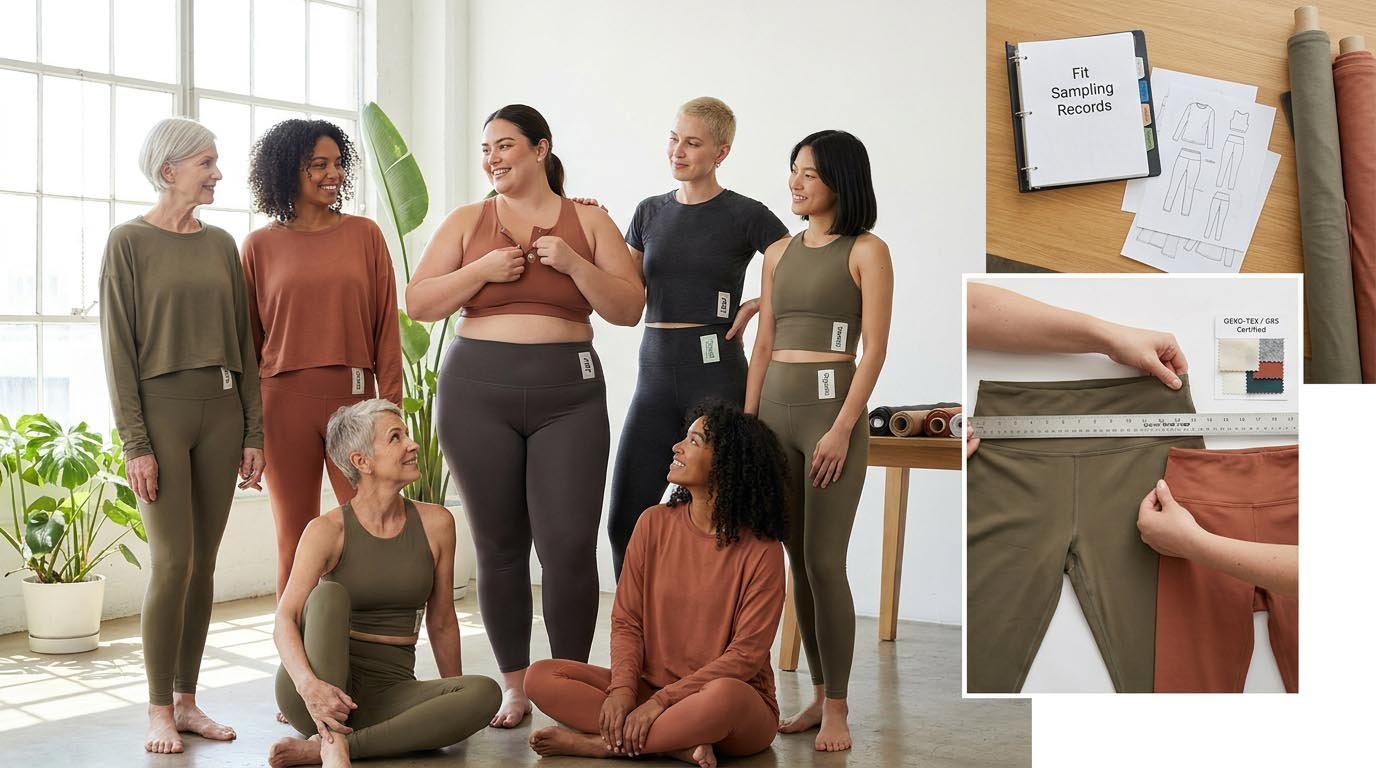
When brand owners tell me about their values, I ask: how much are you willing to invest in making those values real in the product? The answer determines feasibility.
Inclusive Sizing in Yoga Wear
Size inclusivity is now baseline expectation in yoga and athleisure. But extended sizing has real production implications:
Standard vs. inclusive size ranges:
Standard range (6 sizes): XS, S, M, L, XL, XXL
- Pattern grading: Baseline cost
- Fit sampling: 2-3 fit models needed
- Development cost: $400-600 per style
Inclusive range (10-12 sizes): XXS-4XL or size 0-24
- Pattern grading: +$300-500 per style (different body proportions)
- Fit sampling: 5-7 fit models needed
- Development cost: $800-1,200 per style
Fabric performance across sizes:
Yoga wear's high stretch requirement becomes more critical in extended sizes:
- Larger sizes need better recovery: More stress on fabric during wear
- Opacity requirements increase: Fabric must be squat-proof at higher stretch levels
- Compression levels must adjust: Same compression percentage feels tighter on larger sizes
MOQ strategy for inclusive sizing:
Brands face difficult inventory decisions:
Option 1 - Equal distribution:
- Order same quantities across all sizes
- Highest inventory risk (extreme sizes sell slower)
- Lowest per-unit cost (simpler production planning)
Option 2 - Bell curve distribution:
- Higher quantities in core 4-5 sizes (typically 6-14 or M-XL)
- Lower quantities in extended sizes
- Requires negotiation with factory on variable MOQs
- May add 10-15% to unit costs for extended sizes
Typical size distribution from client sales data:
- Core sizes (4-16 or S-XL): 65-75% of sales
- Extended sizes (0-2 and 18+ or XXS and 2XL+): 25-35% of sales
Sustainable Material Choices
Sustainability claims in yoga wear require specific material choices with production implications:
Recycled polyester (rPET):
- Cost impact: +$0.80-1.50 per unit
- MOQ impact: Similar to virgin polyester once supplier relationship established
- Certification: GRS certification adds paperwork and $300-600 in audit costs
- Performance: Identical to virgin polyester if properly sourced
Organic cotton blends:
- Cost impact: +$2-4 per unit vs. conventional cotton blends
- MOQ impact: Higher fabric minimums (800-1,000 meters vs. 500 meters)
- Certification: GOTS certification required for organic claims
- Performance: Lower stretch, not suitable for performance yoga (better for loungewear)
Tencel/Lyocell blends:
- Cost impact: +$2.50-4 per unit
- MOQ impact: Limited supplier options increase minimums
- Performance: Excellent moisture management, very soft, but lower durability
- Best applications: Yoga tops, loungewear, light training
Bio-based polyester:
- Cost impact: +$4-7 per unit (still emerging technology)
- MOQ impact: Very limited availability, high minimums
- Current reality: More marketing potential than widespread availability
Decision framework I provide:
For retail price under $50: Stick to rPET (affordable sustainability)
For retail price $50-80: rPET or Tencel blends (balanced approach)
For retail price $80+: Can explore bio-based or premium sustainable options
Material Certifications and Compliance
Sustainability requires documentation that affects timelines:
Common certifications requested:
- GRS (Global Recycled Standard): Verifies recycled content, 4-6 weeks for fabric certification
- OEKO-TEX Standard 100: Chemical safety testing, 2-3 weeks per fabric type, $400-800 per test
- Bluesign: Comprehensive supply chain approval, 8-12 weeks, significant cost
- GOTS (for organic cotton): Organic certification, 6-10 weeks
Timeline impact:
First production with certified materials adds 30-45 days to standard timelines. Subsequent orders use same certified fabric sources, returning to normal 90-120 day timelines.
Identity-Affirming Design and Representation
Yoga wear brands increasingly focus on body representation and identity:
What this means in production:
Diverse size curve development:
- Investment in multiple fit models across size range
- Multiple sampling rounds per size (adds $800-1,500 per style)
- Worth it: Reduces returns and increases customer satisfaction
Cultural considerations:
- Modest options: Longer lengths, higher necklines, covered arms
- Adaptive features: Easier dressing for mobility challenges
- Gender-inclusive designs: Avoid overtly gendered styling
Production implications:
- Modest designs often simpler construction (may reduce costs)
- Adaptive features (magnetic closures, zipper placements) add $1-2.50 per unit
- Gender-inclusive usually means relaxed fit with wider size range (inventory complexity)
A brand wanted to serve modest dressing preferences. We developed full-length, long-sleeve options with higher necklines. Construction was actually simpler than standard crops and tanks, slightly reducing per-unit costs. But they needed to educate customers on the offering since it differs from typical yoga wear aesthetics.
Go-to-Market That Scales: Creators, Omnichannel and High Repeat Rates?
Distribution and marketing approaches for yoga wear differ from traditional activewear. These differences affect order patterns, quantities, and replenishment cycles I see from clients.
Yoga wear and athleisure brands succeed with different go-to-market models than performance activewear: influencer-driven launches, omnichannel presence, and community-building that drives high repurchase rates. These models create different inventory planning requirements, favoring frequent smaller drops over seasonal bulk orders.
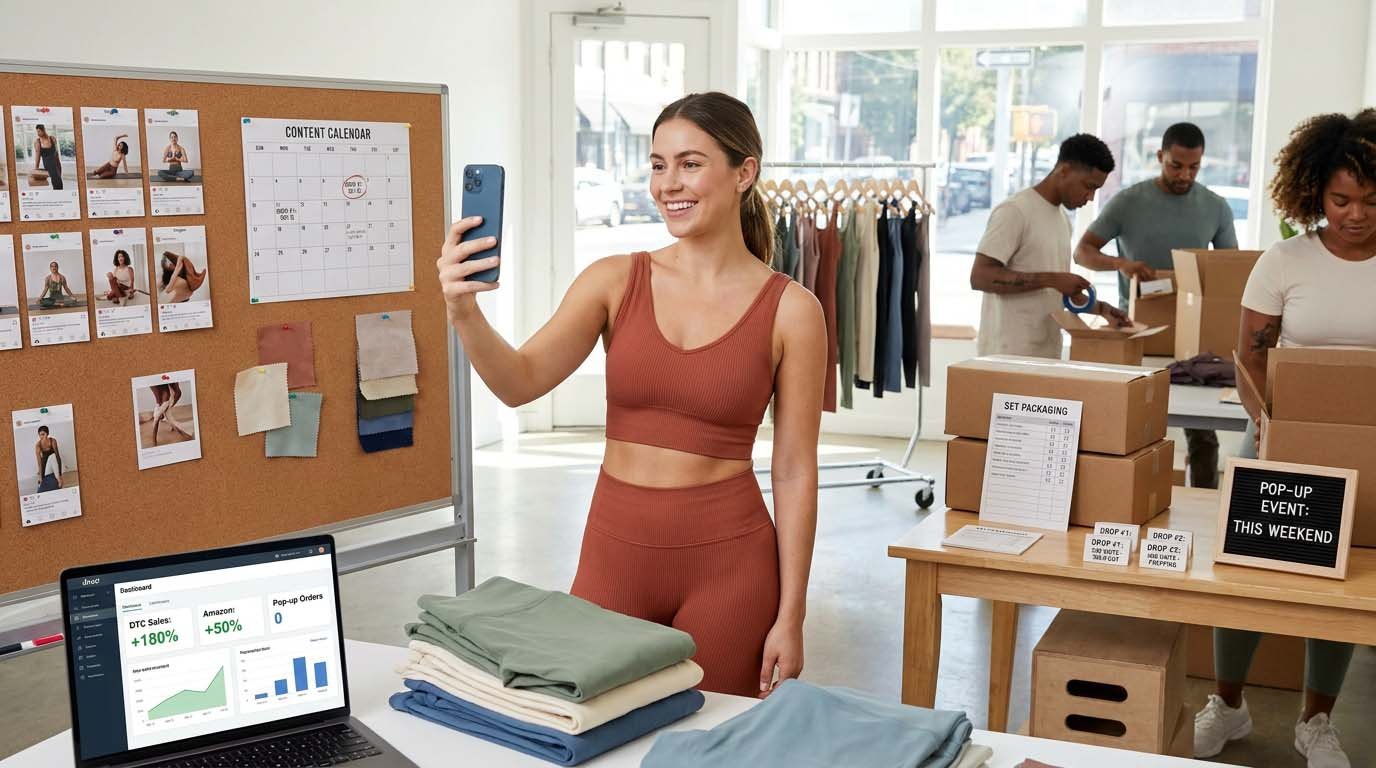
When I ask clients about their distribution strategy, the answer determines how we structure order quantities and timing.
Creator and Influencer-Led Brands
Yoga and wellness influencers launching product lines create specific order patterns:
Typical creator brand order structure:
Traditional brand:
- 2-3 seasonal collections per year
- 1,000-2,000 units per collection
- 8-12 styles per collection
- Predictable replenishment every 4-6 months
Creator brand:
- 4-6 drops per year
- 300-800 units per drop
- 3-5 styles per drop (often coordinated sets)
- Variable timing based on audience engagement
Production implications:
- Lower per-drop minimums needed (300-500 units vs. 1,000+)
- Faster turnaround expectations (creators want to capitalize on momentum)
- Higher service level expectations (direct creator involvement in development)
- Less predictable order flow for manufacturers
What works for creator brands:
- Partner with factories comfortable with smaller batches and flexible scheduling
- Use ODM base styles with customization (faster than full custom)
- Plan 60-90 days ahead even for "spontaneous" drops (production can't be rushed)
- Accept 20-30% cost premium for smaller quantities and faster service
Community-Driven Launch Models
Yoga and athleisure brands build communities before launching products:
Pre-launch community building:
- Social media engagement (Instagram, TikTok, YouTube)
- Email list building through content
- Pre-order or crowdfunding to validate demand
- Ambassador programs (community members wear and promote)
How this affects production planning:
Advantage: Validated demand before production commitment
Challenge: Community expects delivery on promised timelines
Typical timeline customers underestimate:
Brand announces drop → 3 months before
Community gets excited → Now
Brand places order → Should be 90-120 days before drop
Production and shipping → 90-120 days
Delivery and fulfillment → Drop date
Common mistake: Brand builds hype, gets pre-orders, then realizes production takes 4 months. Community frustration results from timeline mismanagement.
My recommendation:
Build community and create hype for next drop while current drop is in production. Always have production pipeline 90+ days ahead of announced drops.
Omnichannel Presence Requirements
Successful yoga wear brands sell across multiple channels:
Common channel combinations:
- DTC website (primary)
- Amazon/marketplace (volume and discovery)
- Wholesale boutiques (yoga studios, specialty retailers)
- Pop-up retail (events, festivals, yoga conferences)
Inventory allocation complexity:
| Channel | Inventory Needs | Replenishment Frequency | Return Rate |
|---|---|---|---|
| DTC website | Moderate depth | 60-90 days | 8-12% |
| Amazon | High depth (algorithm penalty for stockouts) | 45-60 days | 15-20% |
| Wholesale | Committed before season | 120+ days | 5-8% (final sale) |
| Pop-ups | Low quantity, high variety | Event-driven | Minimal |
Total inventory requirement:
Single channel (DTC only): 500-800 units might support 3-4 months
Multi-channel: 1,500-2,500 units needed for same period across channels
Production strategy:
- Higher initial orders: Omnichannel requires 2-3x inventory vs. single channel
- More frequent reorders: Can't let any channel stock out (affects all channel performance)
- Better forecasting critical: More variables in demand planning
A yoga brand launched DTC with 600 units. Success led to Amazon expansion. They needed 1,200 additional units to maintain both channels. Their next order was 2,000 units (vs. initial 600) to support two-channel operation.
High Repeat Purchase Rates
Yoga wear and athleisure have notably higher repurchase rates than traditional activewear:
Typical purchase frequency:
Traditional gym wear: Customer buys 1-2x per year
Yoga wear: Customer buys 3-5x per year
Athleisure: Customer buys 4-6x per year
Why this matters for inventory planning:
- Faster sell-through supports more frequent reorders
- Core styles become workhorses (focus inventory on proven winners)
- Limited edition drops supplement core styles
- Inventory turns are 2-3x faster than traditional activewear
Order pattern I observe:
First order: Brand tests market with 4-6 styles, 300-500 units each
Reorder 1 (60-90 days later): 2-3 best sellers, 500-800 units each, discontinue slow sellers
Reorder 2 (60-90 days later): Core 2 styles, 800-1,200 units each, plus 2 new test styles
Production advantage:
High repeat rates create predictable core style demand. This allows:
- Better fabric forward buying (order larger fabric quantities at better prices)
- Improved factory scheduling (consistent customer, better service)
- Volume discounts as relationship matures
Set Purchasing and Upsell Dynamics
Coordinated sets drive higher transaction values:
Average order value (AOV) comparison:
Individual items: Customer buys leggings, AOV $48-65
Marketed sets: Customer buys leggings + sports bra, AOV $85-120
Full outfits: Customer buys leggings + bra + jacket, AOV $140-180
Production implications:
- Coordinated color palettes across styles (requires careful dye lot management)
- Set packaging options (adds $0.80-1.50 per set in packaging costs)
- Inventory balance (must have all pieces available for sets)
Risk of sets strategy:
If one piece sells faster than others, you have unbalanced inventory:
- Example: 800 leggings and 600 sports bras ordered as set
- Sports bras sell out → can't offer complete set
- 200 leggings become harder to sell individually
Solution: Monitor sell-through rates by piece, adjust future order ratios. Many brands find 1:1 ratios work initially, then adjust to 1.2:1 or 1:1.2 based on data.
FAQ: Yoga Wear, Athleisure and Market Growth
What makes yoga wear different from regular workout clothes in production terms?
Yoga wear requires four-way stretch (vs. two-way), higher spandex content (20-25% vs. 12-15%), heavier fabric weight (240-280 GSM for opacity), and specific construction features like gusseted crotches. These requirements increase fabric costs by $1.50-3 per unit and require specialized knitting equipment, limiting supplier options.
Why are yoga wear MOQs higher than other activewear?
Four-way stretch fabrics require 500-800 meter minimums from mills vs. 300-500 meters for standard fabrics. At 1.5-1.8 meters per legging, this sets minimums at 300-500 pieces per color. Seamless construction (common in yoga tops and bras) requires specialized circular knitting machines with higher setup costs.
How long does it take to develop a yoga wear collection?
Plan 105-135 days from concept to delivery: 15-20 days for specialized fabric sourcing, 10-15 days for sampling, 7-10 days for fit revisions, 60-75 days for production, plus 15-20 days shipping. Add 30 days for first-time orders with new suppliers.
Can I start with small quantities to test the market?
300-500 pieces per style is realistic minimum for custom yoga wear. Smaller quantities (100-200) are only possible with ODM (factory-designed styles with your branding) or print-on-demand (limited style options, higher unit costs $18-28 vs. $11-16 for custom).
Why do athleisure brands have better profit margins than performance brands?
Athleisure customers prioritize style and versatility over technical performance, creating less price sensitivity. Brands can support $2-5 higher unit costs for soft fabrics, fashion details, and coordinated sets while maintaining margins. Multi-context use also drives 3-4x higher purchase frequency per customer.
What's driving the shift to coordinated sets instead of individual pieces?
Customer behavior changed from buying individual items to outfit coordination. 60%+ of yoga wear orders now include matching sets vs. 30% three years ago. Sets increase AOV from $48-65 (single item) to $85-120 (set), improving brand economics despite coordination complexity.
Should I invest in sustainable materials for my yoga wear line?
Depends on price positioning and customer expectations. Recycled polyester (rPET) adds $0.80-1.50 per unit—manageable for most brands. Bio-based materials add $4-7 per unit—only viable for $80+ retail products. Start with rPET for affordable sustainability, upgrade materials as brand grows.
Conclusion
Yoga wear and athleisure drive activewear market growth because they solve multi-context needs with specific technical solutions. Success requires understanding fabric specifications (four-way stretch, high recovery, opacity), accepting higher development costs for inclusive sizing and sustainable materials, and planning inventory for omnichannel distribution and high repurchase rates. Start with 2-3 core styles at 300-500 units each, validate demand, then scale.