.png)
A brand owner called me last month with a trend report from a major consulting firm. He wanted to add "circular design" and "bio-based materials" to his next collection. When I asked about his budget and MOQ capacity, he went silent. He had no idea these trends required different supply chains.
Market trends only create value when you translate them into supply chain decisions—fabric sourcing, production methods, MOQ commitments, and timeline planning. Following trends without understanding manufacturing constraints leads to cost overruns, missed launch windows, and unsellable inventory.
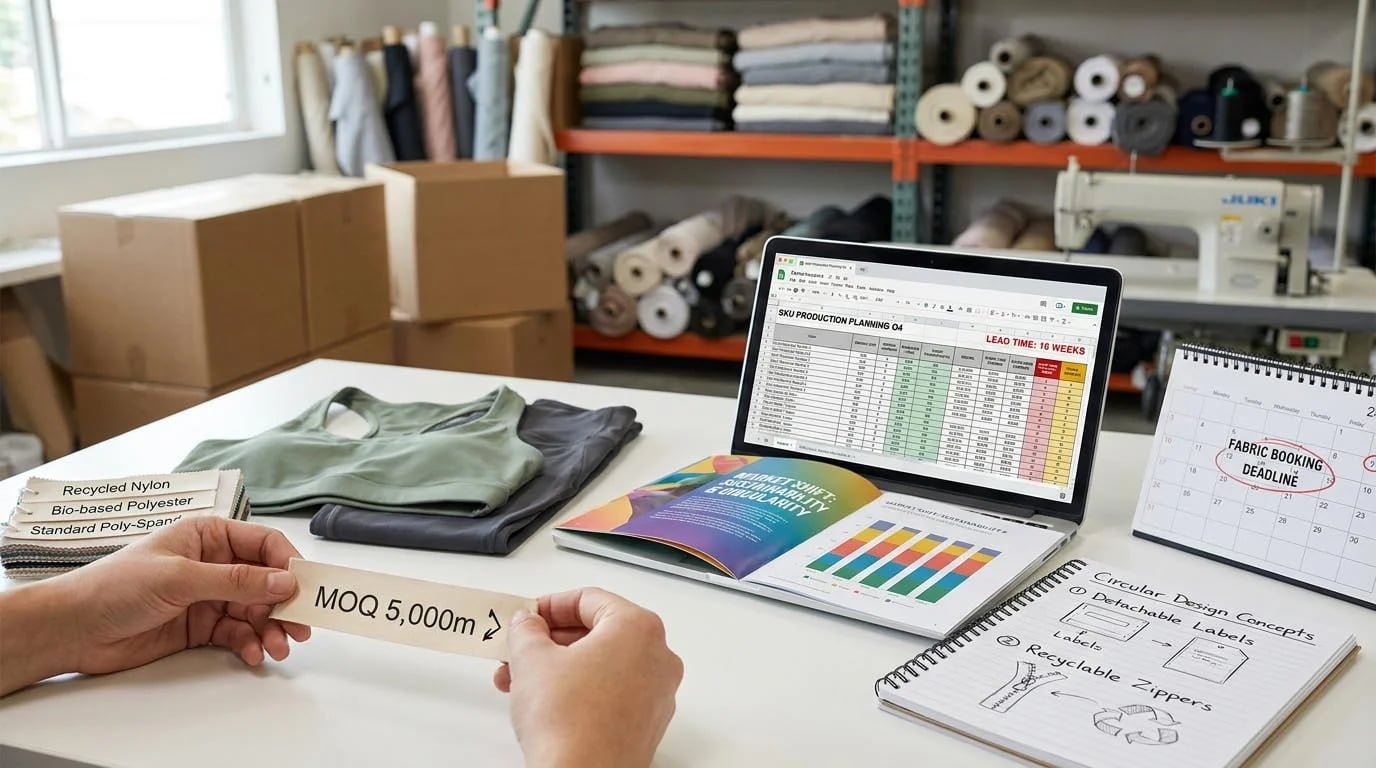
I see this pattern constantly. Brand owners read trend reports, get excited about new concepts, then realize their order volume or timeline doesn't match the production requirements. I want to show you how to evaluate trends through a supply chain lens.
Quick Answers: Activewear Market Trends
How do I know if a market trend fits my brand's supply chain capacity?
Ask three questions: Does my MOQ (300-500 pieces minimum) meet fabric supplier requirements? Does my timeline (90-120 days) accommodate new material sourcing? Does my unit price target (typically $12-18) absorb the premium for trend-specific features?
What's the cost impact of sustainability trends on production?
Recycled polyester adds $0.80-1.50 per unit vs. virgin polyester. PFAS-free DWR finishes add $0.60-1.20. Bio-based materials add $2-4 per unit. Circular design (mono-material construction) may reduce costs by simplifying assembly.
Should I follow all major trends or focus on specific ones?
Focus on 2-3 trends maximum that match your target market's priorities and your supply chain capacity. Attempting too many trends spreads budget thin and complicates production. Start with trends that require minimal supply chain changes.
How do different markets respond to the same activewear trend?
North American and European markets prioritize sustainability certifications and pay premiums. Southeast Asian markets prioritize function and price. Australian markets balance both. Adjust trend implementation based on your primary market's willingness to pay.
What timeline should I plan when adopting new trend-driven materials?
Add 30-45 days to standard production timelines for first-time trend adoption. New material sourcing, supplier vetting, and testing extend pre-production phases. Second orders reduce to normal 90-120 day timelines once supply chains are established.
Sustainability 2.0: Circularity, PFAS-Free and Bio-Based Materials?
Every week someone asks me about sustainable materials. They've read that customers demand eco-friendly activewear. Then I ask what their customers actually said about sustainability. Most admit they haven't asked.
Sustainability trends in activewear are moving beyond recycled polyester to circularity models, PFAS-free finishes, and bio-based materials. But these require different supplier networks, higher MOQs, longer lead times, and cost premiums ranging from 15-80% depending on material choice.
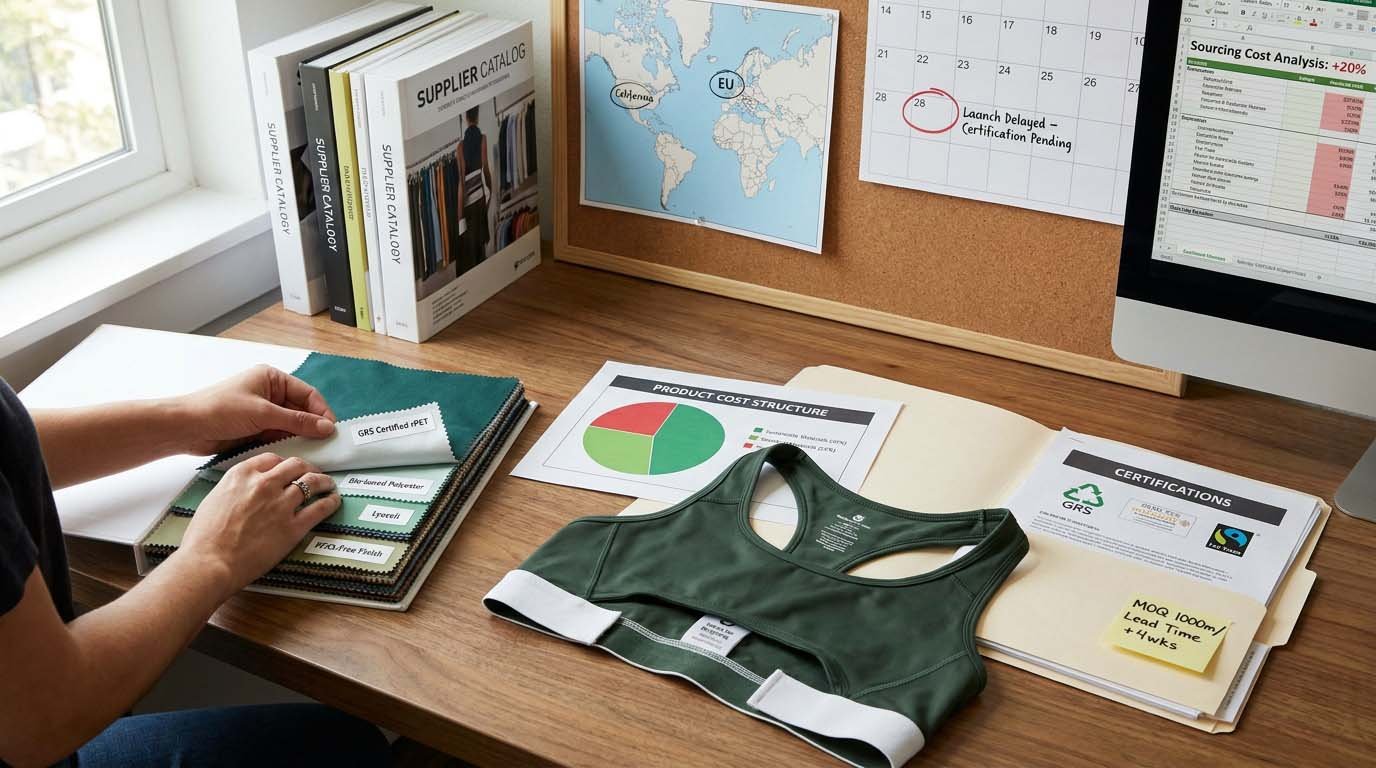
I need to show you what these sustainability concepts actually mean in production terms, because the gap between trend reports and manufacturing reality is huge.
Recycled Materials: Now Standard, But With Variations
Recycled polyester (rPET) has become baseline sustainability. Most fabric mills now offer it. But there are different grades and certifications:
GRS (Global Recycled Standard) certified rPET:
- Requires minimum 50% recycled content verified through supply chain
- Adds $0.80-1.50 per unit vs. virgin polyester
- Available MOQs: 300-500 meters per color (similar to virgin)
- Lead time: Same as virgin polyester once supplier relationship is established
Post-consumer vs. post-industrial recycled content:
- Post-consumer (from plastic bottles): Higher cost, better marketing story
- Post-industrial (factory waste): Lower cost, still counts as recycled
- Price difference: $0.30-0.60 per unit
Client scenario I see frequently:
A Shopify seller wants to add "made from recycled bottles" to product descriptions. I ask: are you willing to pay the 15-20% cost premium and commit to GRS certification paperwork? Half say yes, half realize their margin can't support it and choose uncertified recycled fabric instead.
Circularity: Design for Disassembly and Mono-Materials
Circular design means products can be recycled at end of life. This sounds simple but changes your entire product construction:
What circularity requires:
- Mono-material construction: Use only polyester (no cotton blends, no mixed fiber trims)
- Mechanical fasteners: Replace stitching with snap systems where possible
- Recyclable elastics: Standard elastics aren't recyclable; need specialty options
- Take-back programs: Infrastructure to collect used garments
Supply chain impact:
| Circular Feature | Manufacturing Change | Cost Impact | MOQ Impact |
|---|---|---|---|
| Mono-material fabrics | Limits blend options | Neutral to +$0.40/unit | Standard MOQs |
| Recyclable elastics | New trim sourcing | +$0.50-0.90/unit | Higher trim MOQs |
| Mechanical closures | Different assembly process | +$0.80-1.50/unit | May increase labor cost |
| Labeling requirements | Recycling instructions | +$0.10-0.20/unit | Minimal impact |
Reality check:
Unless you're a brand with existing take-back infrastructure, "circular design" becomes a marketing claim without actual circularity. I tell clients: if your annual volume is under 10,000 units, focus on recycled materials first. Circularity systems make sense at 50,000+ units annually where logistics become feasible.
PFAS-Free Water Repellent Finishes
PFAS (per- and polyfluoroalkyl substances) are being banned in many regions. Traditional DWR (durable water repellent) finishes often contain PFAS. This affects outdoor and all-weather activewear.
PFAS-free DWR alternatives:
- C0 DWR (zero carbon fluorinated chemistry): Most common alternative
- Wax-based treatments: Natural option but less durable
- Dendrimer technology: New generation, higher performance
Production considerations:
- PFAS-free DWR costs $0.60-1.20 more per unit than standard DWR
- Performance is 20-30% lower (water repellency lasts fewer washes)
- Testing requirements more stringent (adds 5-7 days to development)
- Not all fabric mills offer PFAS-free options yet (limits supplier choices)
Market-specific demand:
- European Union: PFAS restrictions driving mandatory adoption
- California: Following EU regulations
- Other US states and Asia: Still voluntary but growing
A outdoor training brand asked me if they needed PFAS-free finishes for US market. I asked: what percentage of your customers are in California or EU? They said less than 20%. I suggested starting with PFAS-free only for those markets, standard DWR for others, to manage costs.
Bio-Based and Plant-Derived Materials
This is where I see the biggest gap between trend excitement and supply chain reality:
Bio-based polyester (from plant sources):
- Currently 2-3x more expensive than virgin polyester
- Very limited supplier availability
- MOQs typically 1,000+ meters per color (higher than standard)
- Lead times 15-30 days longer for first orders
Lyocell/Tencel activewear blends:
- Adds $1.50-3.00 per unit vs. standard polyester
- Better hand feel and moisture management
- Lower durability than pure synthetic
- Works best for yoga, recovery wear, athleisure (not high-intensity training)
Corn-based fabrics (PLA fibers):
- Limited high-performance applications
- Not suitable for high-heat washing (fibers degrade)
- Mainly used in base layers or light training wear
Decision framework:
I ask clients: what's your retail price point? If you're targeting under $40 retail, bio-based materials will squeeze your margin to unsustainable levels. These materials make sense for $60+ premium products where customers expect and pay for sustainability features.
Certifications and Documentation Burden
Sustainability trends come with paperwork requirements that affect timelines:
Common sustainability certifications:
- GRS (Global Recycled Standard): 4-6 weeks for initial audit
- OEKO-TEX Standard 100: 2-3 weeks for testing per fabric type
- Bluesign: 8-12 weeks for facility approval
- Fair Trade: 12+ weeks for social compliance verification
Cost of certification:
- Testing per fabric: $400-800
- Annual certification fees: $1,000-5,000 depending on scope
- Audit costs: $2,000-8,000 for facility audits
These certifications affect your launch timeline. A brand wanted OEKO-TEX certification for their first collection. We had to add 6 weeks to their production schedule for fabric testing and documentation. They missed their intended launch window.
From Athleisure to All-Day Performance: Wellness, Recovery and New Sports?
Athleisure is maturing. The next phase is "performance for all activities" including wellness, recovery, and emerging sports categories. But each category requires different fabric engineering and production approaches.
The activewear market is fragmenting into specialized performance categories—recovery wear, wellness apparel, pickleball gear, outdoor yoga. Each requires different technical specifications, order volumes, and supply chain planning than traditional gym wear.
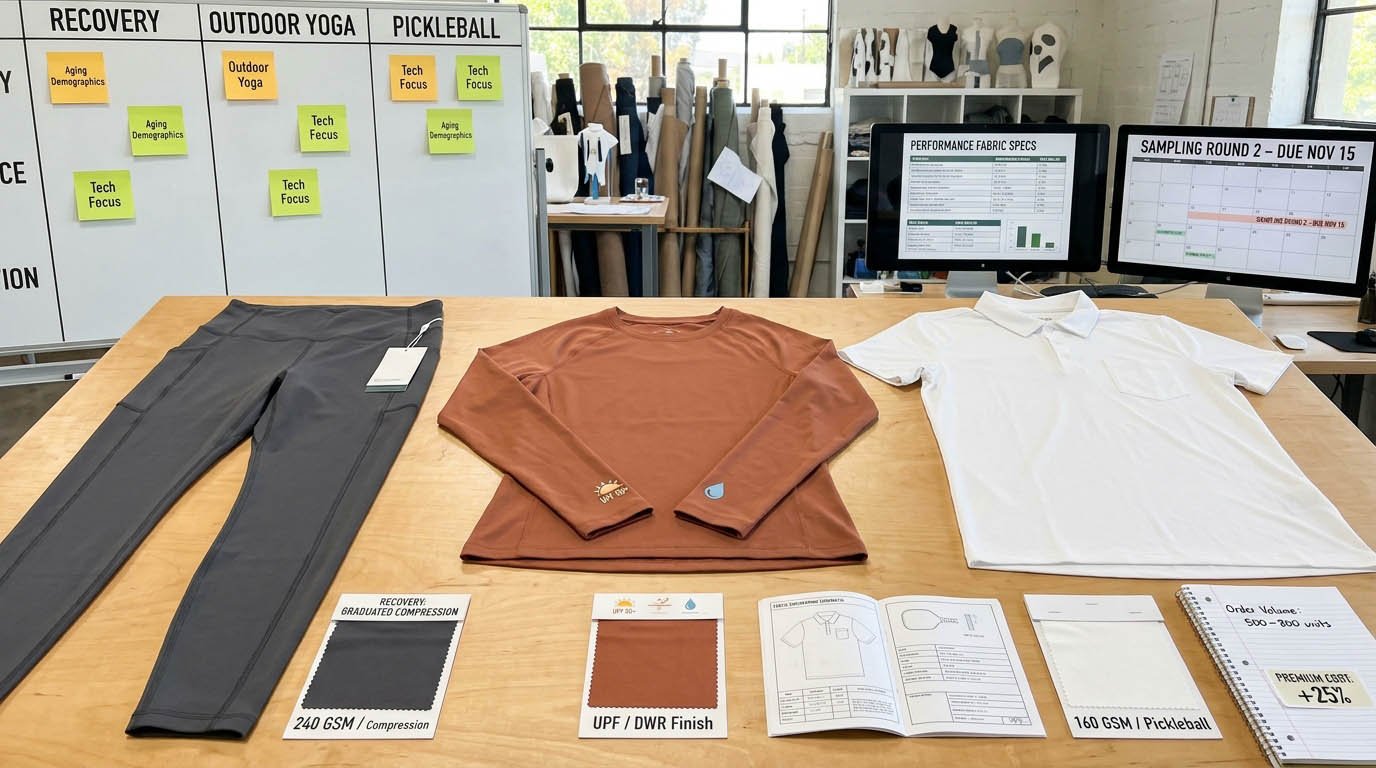
When clients ask me about these emerging categories, I need to understand: are they chasing trends or serving real customer demand? The answer determines whether the investment makes sense.
Recovery and Wellness Wear: Compression with Comfort
Recovery wear is growing but it's a specialized category with specific requirements:
Technical requirements:
- Graduated compression: Tighter at extremities, looser at core
- Softer fabrics: 240-280 GSM with higher spandex content (18-25%)
- Comfort features: Flatlock seams, no tags, extended wear comfort
- Moisture management: Still needs to handle sweat during active recovery
Supply chain challenges:
- Specialized knitting: Requires circular knitting machines with compression programming
- Higher MOQs: Compression fabrics typically require 500-800 units minimum
- Longer sampling: 3-4 rounds vs. 2-3 for standard activewear (fit more critical)
- Cost premium: $3-6 more per unit than standard training wear
Market differentiation:
A yoga brand wanted to add recovery leggings. I asked: what differentiates your recovery wear from regular leggings? They couldn't explain. I showed them that without graduated compression and specific fabric specs, they'd just be selling expensive leggings with "recovery" marketing.
Outdoor Yoga and Nature-Based Activities
This trend combines outdoor durability with yoga flexibility:
Fabric requirements:
- Sun protection: UPF ratings, often achieved through darker colors or tighter weaves
- Moisture management: Needs to handle sweat but also light rain
- Stretch and recovery: High stretch like yoga but durability like outdoor gear
- Natural aesthetics: Earth tones, texture, less "technical" appearance
Production considerations:
- Fabric costs $1.50-2.50 more per unit than standard training wear
- DWR finish adds another $0.60-1.20 per unit
- MOQs similar to standard yoga wear: 300-500 units
- Color palette matters: neutral and earth tones outsell bright colors
Regional variation:
- Australia and Western US: Strong demand, willing to pay premium
- Eastern US and Europe: Growing but more price-sensitive
- Asia: Very niche market
Emerging Sports: Pickleball, Padel, Trail Running
New sports create specialized gear demand. But market size matters for order planning:
Pickleball apparel characteristics:
- Similar to tennis wear: moisture wicking, freedom of movement
- Often lighter weight fabrics (160-180 GSM)
- Designs skew older demographic (different fit preferences)
- Price point: $30-45 retail (moderate range)
Supply chain reality:
- Pickleball-specific designs are marketing differentiation, not technical necessity
- You can use tennis or training apparel fabrics with pickleball branding
- Specialized features (paddle pockets, ball loops) add $0.40-0.80 per unit
Market size assessment:
I ask clients: what's your addressable market size? Pickleball is growing but still niche. If you're a small brand, you're taking risk serving a small slice of a niche sport. Better to create versatile training wear that pickleball players can use rather than pickleball-only gear.
Padel (popular in Europe and Latin America):
- Similar considerations to pickleball
- Even smaller market in most English-speaking countries
- Requires market research before committing to orders
Trail running:
- More established category with clear technical requirements
- Abrasion-resistant fabrics: Nylon blends preferred
- Higher durability: Reinforced areas, 200-220 GSM
- Weather protection: DWR finishes common
- Market: Well-defined customer base, easier to size orders
Crossover Performance: Office to Gym to Evening
This trend promises "wear it all day" functionality. But it requires compromising either office acceptability or gym performance:
Technical challenge:
- Office wear needs: Professional appearance, structured fit, wrinkle resistance
- Gym wear needs: Stretch, moisture wicking, quick dry
- Compromise: You get moderate performance in both contexts, excellence in neither
Fabric solutions:
- Polyester-wool blends: Professional look with some performance
- Four-way stretch wovens: Office-appropriate with mobility
- Ponte knits: Structured appearance with comfort
Cost and MOQ impact:
- These fabrics cost $2-4 more per unit than standard activewear
- Often require higher MOQs (500-1,000 meters) due to specialty nature
- Construction is more complex: adds $1-2 per unit in labor
Market positioning:
I see two approaches that work:
- Premium brands ($80+ retail): Can support cost structure and serve urban professionals
- Athleisure brands adding office-appropriate options: Serve existing customer base expanding wardrobe
What doesn't work: Small activewear brands trying to compete with Lululemon's ABC pants or similar crossover products without the brand equity or order volume to support development costs.
Inclusive Design at Scale: Size Expansion, Adaptive and Gender-Neutral?
Inclusive design is now a market expectation, not a niche. But scaling inclusive products requires different grading systems, fit testing, and order planning than standard size runs.
Size expansion, adaptive features, and gender-neutral design are moving from brand values to operational requirements. Each adds complexity to pattern grading, sampling costs, inventory planning, and minimum order quantities that must be factored into order budgets.
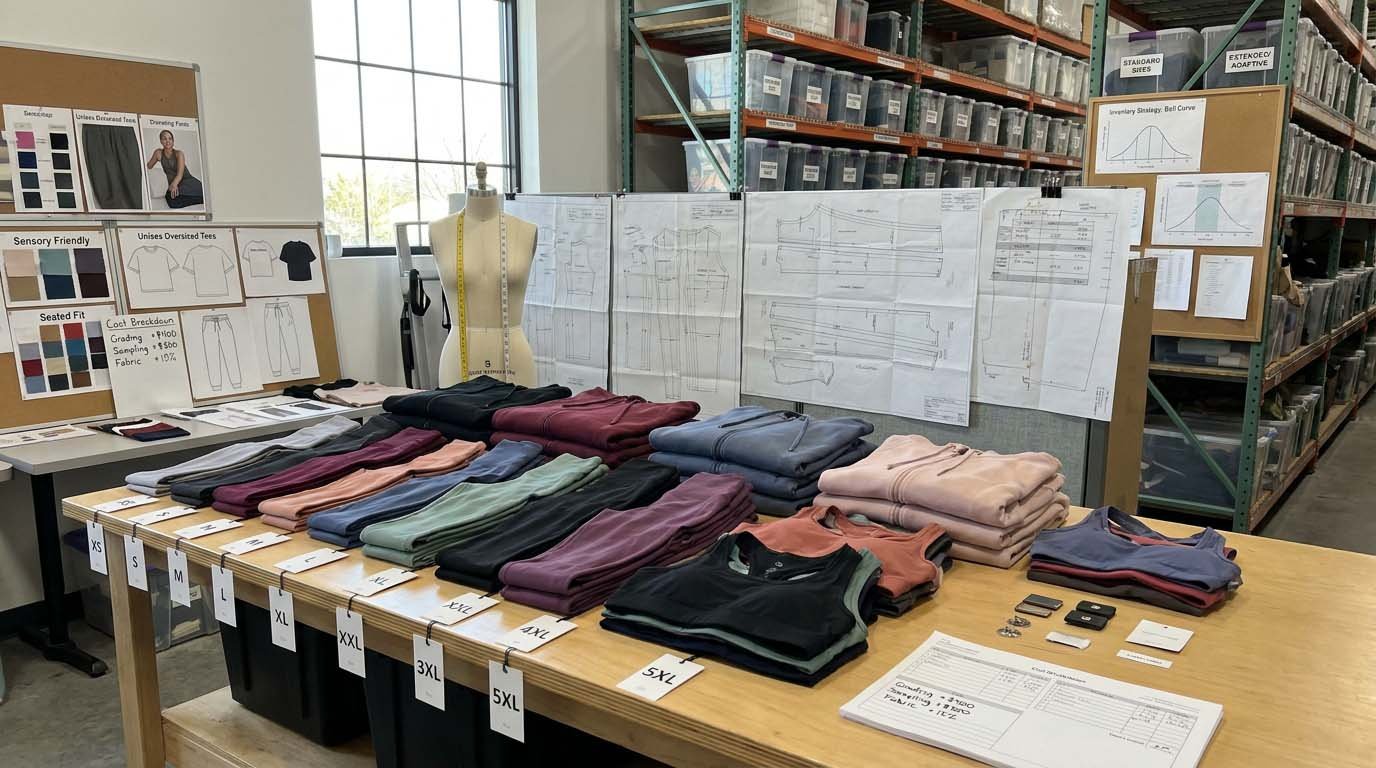
When clients ask about inclusive sizing, I need to explain: it's not just adding XXL and XXXL. It requires different fit models, grading rules, and inventory commitments.
Extended Sizing: Beyond Standard 6-Size Runs
Standard activewear sizing is XS, S, M, L, XL, XXL (six sizes). Extended sizing adds sizes on both ends:
Extended size range challenges:
| Size Range | Grading Complexity | Fit Testing Needs | Inventory Risk |
|---|---|---|---|
| Standard (XS-XXL) | Baseline | 2-3 fit models | Medium |
| Plus sizes (3XL-5XL) | Higher (different body proportions) | Additional 2-3 models | Higher (slower turnover) |
| Petite/Tall variations | Medium (length adjustments) | 1-2 models per variation | Medium-high |
| Full inclusive (XS-5XL) | Highest | 6-8 fit models required | Highest |
Production cost impact:
- Pattern grading for extended sizes: $200-400 additional per style
- Fit sampling across size range: $600-1,200 (vs. $300-500 for standard range)
- Fabric consumption increases: Plus sizes require 15-30% more fabric per unit
- MOQ strategy: Either commit to same quantities across all sizes (high inventory risk) or variable MOQs (complicates production planning)
Client scenario:
A brand wanted to launch with 8 sizes (XS-3XL) to be inclusive from day one. I showed them the numbers: with 300 units per size MOQ, they'd need $28,800 inventory investment vs. $14,400 for standard 6-size run. We restructured to launch with 6 standard sizes, add extended sizes in reorder after validating demand distribution.
Adaptive Activewear: Functional Modifications
Adaptive design serves people with disabilities through functional modifications. This is growing but requires understanding which adaptations your customer base needs:
Common adaptive features:
- Magnetic closures: Replace zippers or buttons for easier dressing
- Seated fit modifications: Different rise and inseam for wheelchair users
- Sensory-friendly options: No tags, flat seams, soft fabrics for sensory sensitivities
- Easy-access openings: Side zippers, wide neck openings
Supply chain considerations:
- Magnetic closures: Add $1.20-2.50 per unit depending on quantity and placement
- Seated fit patterns: Require separate pattern development ($400-800 per style)
- Sensory-friendly construction: Often simplifies production (fewer trims), may reduce cost
- MOQ challenges: Adaptive variations create sub-categories that need their own MOQs
Market size assessment:
I ask: what percentage of your customer base needs adaptive features? Unless you're specifically targeting this community, adaptive features are often less than 5% of total demand. Options:
- Made-to-order adaptive modifications: Higher price, longer lead time, no inventory risk
- Core adaptive styles: If market research shows 10%+ demand, justify dedicated production
- Universal design features: Design standard products with some adaptive benefits (no tags, easy closures) without creating separate categories
Gender-Neutral and Unisex Design
Gender-neutral activewear is trending but "unisex" often means "men's fit in small sizes," which doesn't serve anyone well:
Technical challenges:
- Body proportion differences: Men average broader shoulders, narrower hips. Women average narrower shoulders, wider hips
- Performance needs: Different sweat zones, compression requirements, coverage expectations
- Fit preferences: Men typically prefer looser fit, women often prefer fitted
Approaches that work:
Oversized/relaxed fit styles:
- Works for: Hoodies, sweatpants, oversized tees
- Challenges: Can look boxy on smaller frames, may not perform well for high-intensity activity
- Cost: Same as standard production
Size-inclusive single-pattern:
- Use more forgiving fabrics (higher stretch content)
- Offer wider size range to accommodate different body types
- Focus on adjustable features (drawstrings, elastic)
- Cost: Similar to standard, complexity in range management
Multiple fit options under gender-neutral branding:
- Offer "fit A" and "fit B" instead of "men's" and "women's"
- Each fit serves different body proportions
- Cost: Essentially developing two products, higher development cost ($1,200-2,000 per style)
What rarely works:
Taking men's patterns and simply sizing down. A women's XS in men's pattern typically fits poorly across shoulders, armholes, and torso length.
Inventory Strategy for Inclusive Ranges
Expanded sizing creates inventory complexity. Here's how to structure orders:
Option 1 - Equal distribution:
- Same quantities across all sizes
- Highest inventory risk (extreme sizes sell slower)
- Simplest for production planning
Option 2 - Bell curve distribution:
- Higher quantities in core sizes (M, L, XL)
- Lower quantities in extended sizes
- Requires variable MOQ negotiation with factory
Option 3 - Phased rollout:
- Launch with 4-6 core sizes, test market
- Add extended sizes in reorder based on demand data
- Lowest initial risk, slower to achieve full inclusivity
Typical size distribution from client data:
- Core sizes (S, M, L, XL): 70-75% of sales
- Extended sizes (XS, XXL+): 25-30% of sales
- Within extended sizes, XXL+ outsells XS in men's activewear markets
Digital & Agile Ops: 3D DPC, On-Demand, Nearshoring and Small Batches?
Digital production technologies promise flexibility, speed, and lower minimums. But adoption rates in activewear manufacturing are uneven. I need to explain what's actually available today versus what's still emerging.
Digital tools like 3D design, on-demand production, and nearshoring are changing activewear manufacturing economics. But each has specific applications, cost tradeoffs, and volume thresholds where they make financial sense compared to traditional offshore batch production.
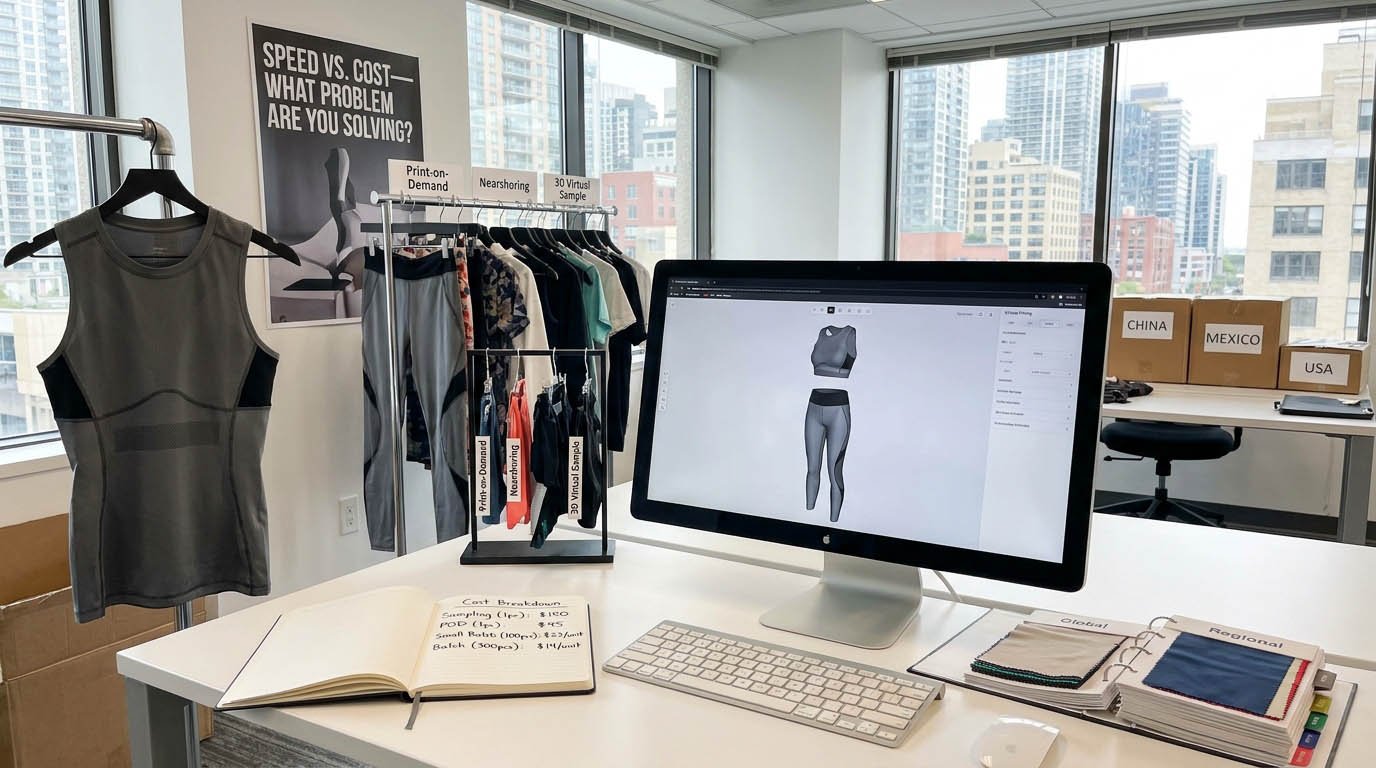
When clients ask about "agile manufacturing" or "small batch production," I clarify: what problem are you trying to solve? Speed? Lower MOQs? Reduced inventory risk? The solution depends on the specific constraint.
3D Design and Digital Product Creation (DPC)
3D design tools (CLO3D, Browzwear, Optitex) are becoming standard in larger brands. But adoption in small brand and manufacturer relationships is slower:
What 3D design actually changes:
- Virtual sampling: See garment fit and drape before physical samples
- Faster iteration: Make design changes in minutes vs. weeks waiting for samples
- Remote collaboration: Review designs without in-person meetings
- Reduced sample waste: Fewer physical prototypes needed
Reality check on adoption:
- Software cost: $3,000-6,000 annually for professional licenses
- Learning curve: 40-80 hours to become proficient
- Fabric library limitations: Not all activewear fabrics are digitized yet
- Factory adoption: Many small-to-mid factories don't use 3D tools yet
When 3D makes sense:
- Brands developing 8+ styles per season (sample cost savings justify software investment)
- International collaboration where shipping samples is slow and expensive
- Complex designs with multiple fit variations
When traditional sampling still works better:
- First-time brands with 2-4 styles (sample cost under $1,000, software cost not justified)
- Brands working with factories that don't support 3D workflows
- Products where hand feel and fabric performance matter more than visual design
A brand owner asked if 3D design would let them skip sampling entirely. No. You still need at least one physical pre-production sample to verify fabric hand feel, color accuracy, and construction quality before bulk production.
On-Demand and Print-on-Demand Production
On-demand models promise zero inventory risk by producing after orders are received. But activewear performance requirements limit applications:
Print-on-demand activewear (POD):
- Services like Printful, Printify offer decorated activewear blanks
- Lead time: 7-14 days from order to customer
- Unit cost: $18-28 (retail needs to be $45-60 for margin)
- Quality limitations: Standard blanks, limited performance features
When POD works:
- Testing designs before committing to inventory
- Niche designs with uncertain demand (under 50 units expected volume)
- Marketing samples and influencer gifting
When POD doesn't work:
- Custom fabric or construction requirements (not available in POD)
- Price-competitive markets (POD unit costs too high)
- Performance-critical products (POD blanks often use basic fabrics)
Cut-to-order manufacturing:
Some manufacturers offer cut-to-order with lower minimums (100-200 pieces) but:
- Unit cost premium: 25-40% higher than standard MOQs
- Lead time: Same as bulk orders (60-90 days), no speed advantage
- Fabric limitations: Only works with fabrics they hold in stock
Nearshoring: Cost vs. Speed Tradeoffs
Nearshoring (producing closer to end market) is growing, especially for US brands considering Mexico, Central America, or domestic production:
Cost comparison (men's training tee example):
| Location | Unit Cost | Lead Time | MOQ | Best For |
|---|---|---|---|---|
| China | $9-12 | 90-120 days | 500+ pcs | Price-sensitive, high volume |
| Vietnam/Bangladesh | $8-11 | 90-110 days | 500+ pcs | Cost optimization, scale |
| Mexico/Central America | $13-18 | 60-75 days | 300-500 pcs | Speed to market, flexibility |
| USA domestic | $18-28 | 45-60 days | 200-300 pcs | Ultra-fast, small batches |
When nearshoring makes sense:
- Frequent reorders: Shorter lead times support 6-8 orders per year vs. 3-4 from Asia
- Test-and-iterate: Faster sampling supports rapid product development
- Sustainability marketing: Lower shipping distances (though production practices vary by facility)
- Minimum order flexibility: Lower MOQs support smaller brands
When offshore still wins:
- Price-driven markets: Can't support 30-50% higher unit costs
- Large production runs: 1,000+ units where lead time matters less
- Specialized fabrics: Broader fabric supplier network in Asia
Hidden costs to consider:
Nearshoring unit costs are higher but total landed costs may be closer when factoring in:
- Lower shipping costs (save $1-2 per unit)
- Faster inventory turns (less working capital tied up)
- Reduced risk of overproduction (can reorder more frequently)
Small Batch Production: Minimum Economically Viable Quantities
"Small batch" is relative. I need to explain what quantities actually work economically:
Quantity tiers and implications:
100-200 pieces:
- Only works with factories set up for small batch (rare in activewear)
- Expect 30-50% cost premium over standard MOQs
- Lead times often same as larger orders (no speed benefit)
- Very limited fabric and trim options
300-500 pieces:
- Standard minimum for most activewear manufacturers
- Baseline pricing
- Access to wider fabric selection
- This is the realistic "small batch" threshold
1,000+ pieces:
- Unit costs drop 10-15%
- Priority scheduling, more negotiation leverage
- Can justify custom fabric orders
- Most factories prefer this volume
Client scenario:
A startup wanted to test market with 150 units total across 3 colors. I showed them the math: 50 units per color would cost $22 per unit. Minimum 300 units (100 per color) would cost $14 per unit. The higher quantity actually reduced their total investment because margin improved.
Go-to-Market Shifts: Community, Creator Brands, Marketplaces and Retail Media?
Distribution and marketing models are changing activewear brand dynamics. But these shifts affect inventory planning, production scheduling, and order quantities in ways brand owners often don't anticipate.
New go-to-market models—community-driven brands, creator-led launches, marketplace dominance, and retail media networks—create different production planning requirements around flexibility, speed-to-market, and inventory risk compared to traditional seasonal wholesale or DTC models.
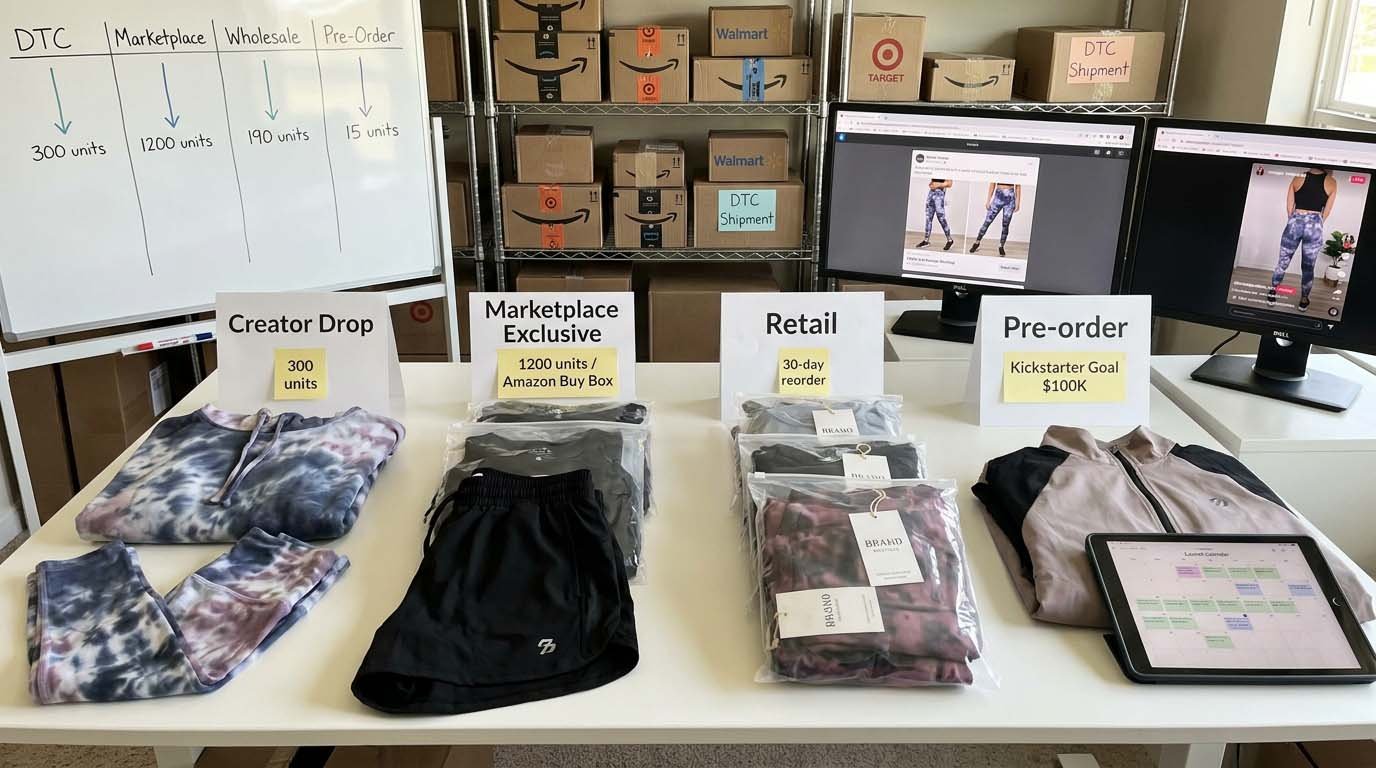
When clients tell me about their launch strategy, I ask: how does your distribution model affect how many units you need and when? The answer determines order timing and quantities.
Community-Driven and Creator Brands
Influencer and creator-driven activewear brands are growing. But production requirements differ from traditional brand models:
Production characteristics:
- Drop-based releases: Limited quantities, announced launch dates
- Faster sell-through: Community pre-loaded with demand
- Higher risk tolerance: Willing to sell out quickly vs. maintain inventory
- Authenticity requirements: "I wear this" positioning requires creator involvement in design
Order planning implications:
- Lower initial quantities: 300-800 units per drop vs. 1,000+ for traditional brands
- Faster repeat cycles: 4-6 drops per year vs. 2-3 seasonal collections
- Variable product mix: Different styles each drop vs. core + seasonal additions
- Pre-order models: Some creators pre-sell before production to eliminate inventory risk
Manufacturer perspective:
Creator brands typically have:
- Less predictable order patterns: Hard to forecast when next order arrives
- Higher service expectations: Want direct access and fast responses
- Limited production experience: Need more guidance on specs and processes
Supply chain strategy:
I tell creator brand clients: if you're doing multiple drops per year, consider:
- Working with factories that support 300-500 unit minimums
- Using similar base fabrics across drops (easier to source quickly)
- Planning 60-90 days ahead even for "spontaneous" launches
Marketplace Aggregation: Amazon, Walmart, Target+
Selling through marketplaces (Amazon, Walmart.com, Target Plus) creates different inventory and production requirements:
Marketplace demands:
- Higher inventory depth: Can't sell out without losing visibility in algorithms
- Consistent availability: Stockouts kill ranking momentum
- Return-friendly design: Higher return rates than DTC (need margin buffer)
- Competition on price: Race to lowest price within category
Production implications:
- Larger initial orders: Need 1,000-2,000 units per SKU to support marketplace velocity
- Predictable replenishment: Plan reorders every 60-90 days based on sell-through
- Cost optimization critical: Marketplace fees (8-15% of revenue) squeeze margins
Sizing strategy:
Marketplaces require different size planning than DTC. Amazon sales data typically shows:
- Top 3 sizes (typically M, L, XL) represent 60-70% of sales
- Size distribution more concentrated than DTC (where customers browse entire range)
- Strategy: Stock deep on core 3-4 sizes, light on extended sizes
Retail Media and Performance Marketing Integration
Major retailers (Amazon, Walmart, Target) now offer advertising within their platforms. This changes how brands plan product launches:
Production timing for retail media campaigns:
- Launch window coordination: Product must be in-stock when campaign starts
- Inventory depth requirements: Need 30-45 days of inventory at campaign start
- Cost structure: Must absorb 15-25% of revenue for ads + marketplace fees
Manufacturer impact:
Brands running retail media campaigns need:
- Reliable delivery dates: Missing campaign launch window wastes ad spend
- Buffer inventory: Can't risk stockouts during paid traffic surge
- Flexible reorder terms: May need rapid replenishment if campaign overperforms
A marketplace seller asked me if they could start with 500 units for Amazon launch. I asked about their ad budget. They planned $5,000 in launch ads. I showed them the math: at $2.50 CPC and 2-3% conversion rate, they'd drive ~400 orders in first month. 500 units wouldn't last two weeks. We restructured to 1,200 units with planned reorder at 30 days.
Direct-to-Consumer (DTC) vs. Hybrid Models
Traditional DTC brands are adding wholesale or marketplace channels. This creates production complexity:
Single-channel DTC inventory planning:
- Predictable: Historical data guides order quantities
- Flexible: Can adjust pricing and promotions to manage inventory
- Lower risk: Control full customer experience and returns
Hybrid channel inventory planning:
- More complex: Must allocate inventory across channels
- Less control: Wholesale and marketplace have their own pricing dynamics
- Higher minimums: Need inventory depth across multiple channels
Production strategy for hybrid brands:
| Channel Mix | Order Sizing | Replenishment Frequency | Risk Level |
|---|---|---|---|
| DTC only | 500-800 units | Every 90-120 days | Medium |
| DTC + Wholesale | 1,000-1,500 units | Every 60-90 days | Medium-high |
| DTC + Marketplace | 1,200-2,000 units | Every 45-75 days | High |
| All three channels | 2,000-3,000 units | Every 60 days | Highest |
More channels mean:
- Higher working capital requirements: More inventory tied up
- Faster replenishment cycles: Can't let any channel stock out
- Production coordination: Need to plan 3-4 orders per year vs. 2 for single channel
Pre-Order and Crowdfunding Models
Some brands use pre-orders or crowdfunding (Kickstarter, Indiegogo) to fund production and eliminate inventory risk:
How pre-order models change production:
- Customer-funded production: No inventory risk or upfront capital needed
- Longer customer patience: Buyers expect 90-120 day wait times
- All-or-nothing pressure: Must deliver on promises or damage reputation
Manufacturer considerations:
- Pre-order brands often have limited cash flow until campaigns close
- Payment terms need to accommodate campaign payout schedules
- Timeline pressures high (made public promises to backers)
Risk factors:
- Underestimating production costs (campaign pricing too low)
- Overpromising features that increase manufacturing complexity
- Timeline optimism (claiming 60 days when realistic timeline is 120 days)
I've worked with several crowdfunded activewear brands. Common mistake: campaign succeeds, raises $100,000, but production actually costs $85,000, leaving only $15,000 for shipping, fulfillment, and customer service. Always budget minimum 30% margin between campaign revenue and production costs.
FAQ: Activewear Market Trends
How do I decide which trends to follow for my activewear brand?
Start with your target customer's stated needs, not industry trend reports. Ask: Will my customers pay extra for this feature? Does my order volume (300-500 pieces typical minimum) support the trend's supply chain requirements? Can I execute within my timeline and budget? Focus on 2-3 trends maximum that align with customer needs and operational capacity.
What's the cost difference between trend-driven materials and standard options?
Recycled polyester adds $0.80-1.50 per unit. Bio-based materials add $2-4 per unit. PFAS-free finishes add $0.60-1.20 per unit. Compression fabrics add $3-6 per unit. Extended sizing increases development costs by $200-400 per style. Factor these premiums into pricing before committing to trends.
Should small brands try to compete with major brands on sustainability?
Not directly. Major brands have volume to absorb certification costs and supply chain changes. Focus on 1-2 achievable sustainability features (recycled polyester, OEKO-TEX fabrics) rather than comprehensive programs requiring $10,000+ investment. Communicate honestly about your sustainability journey vs. making broad claims.
How do I test new trend-driven products without large inventory commitments?
Options: Start with ODM modifications of existing styles (300-500 unit MOQs vs. 500-1,000 for fully custom). Use pre-order models to validate demand before production. Partner with factories offering small batch programs (expect 25-40% cost premium). Test through limited drops vs. permanent collection additions.
What timeline should I plan for trend adoption in my next collection?
Add 30-45 days to standard timelines for first-time trend implementation. New materials require supplier vetting, testing, and sampling. Standard production is 90-120 days; trend-driven development is 120-150 days. Second production runs return to normal timelines once supply chains are established.
How do different markets respond to the same activewear trends?
North American and European markets prioritize sustainability certifications and pay 15-25% premiums. Australian markets balance sustainability and performance. Southeast Asian markets prioritize function and price over trend features. Test regional response before standardizing globally.
Can I adopt multiple trends simultaneously in one product?
Technically yes, but costs compound. Combining recycled fabric (+$0.80-1.50) + PFAS-free finish (+$0.60-1.20) + extended sizing (+$200-400 development) + compression construction (+$3-6) quickly makes products uncompetitive unless you're targeting $60+ retail prices. Prioritize 1-2 trend features per product for cost control.
Conclusion
Market trends only create value when translated into actionable supply chain decisions. Before following any trend, evaluate whether your order volume, budget, and timeline support the required fabrics, production methods, and MOQs. Focus on 2-3 trends that serve your customers' actual needs and match your operational capacity. Test demand before committing to large inventories.