.png)
Choosing an activewear niche is one of the first decisions that determines whether your brand launches smoothly or burns cash too early.
To choose the right activewear niche, compare each category by startup budget, MOQ, fabric complexity, supplier availability, target customer price tolerance, and how clearly you can differentiate from existing brands. For most new brands, the best niche is not the trendiest one—it is the one you can afford to produce well and sell profitably.
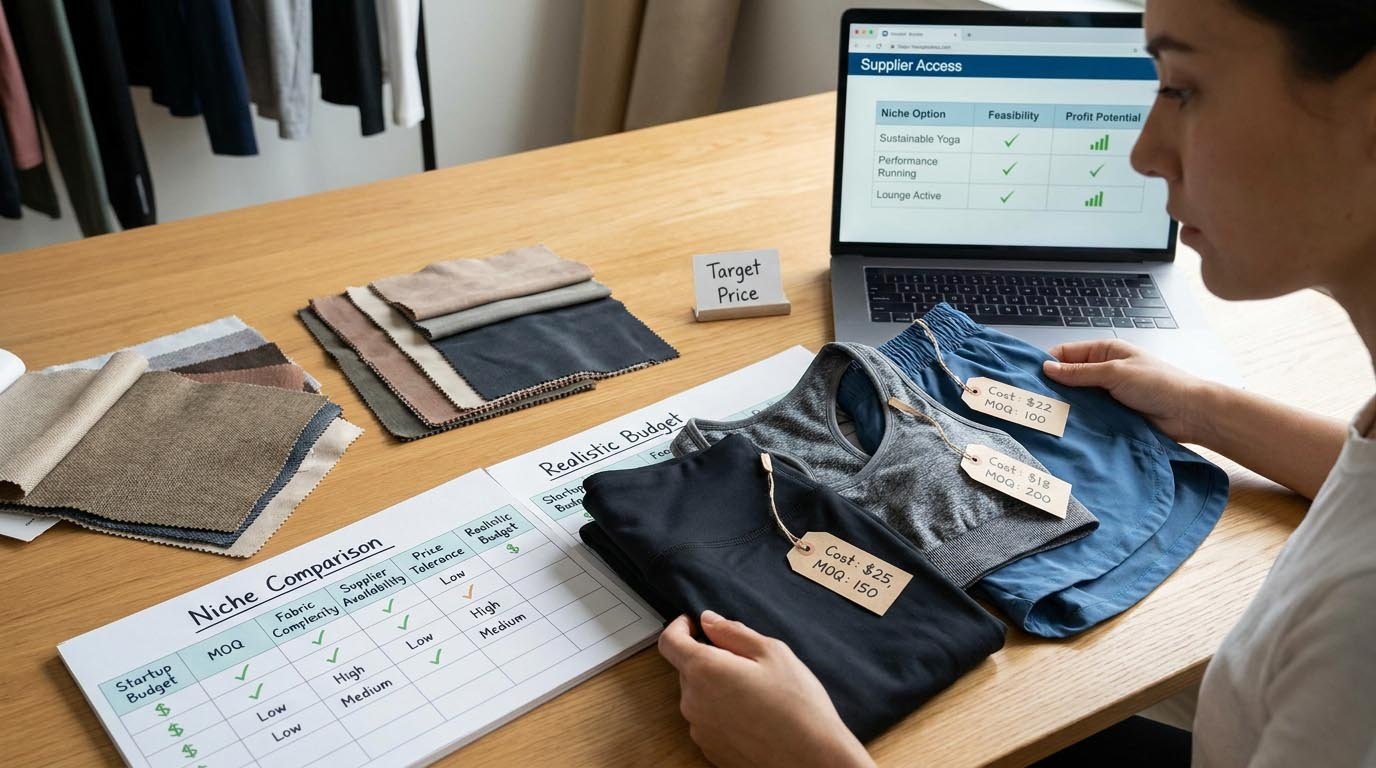
I have worked with many new brand owners through Wearzio, and I see the same pattern repeatedly. Founders often choose a niche based on personal interest or social media trends. But in activewear, niche selection is not just a branding decision. It is a product development, sourcing, and cost structure decision.
If you choose the wrong niche too early, you usually run into one of three problems:
- your MOQ is too high for your budget
- your product requires technical suppliers you cannot access
- your target customer will not pay enough to support your fabric and production cost
This guide will help you choose an activewear niche based on business reality, not guesswork.
Quick Answers: Activewear Niche Selection in 60 Seconds
1. What is the biggest mistake new activewear brands make?
They choose a trendy niche without checking MOQ, technical requirements, and total startup cost.
2. What is the best activewear niche for a new brand?
For most startups, running wear, gym t-shirts, or basic cut-and-sew activewear are easier to launch than seamless yoga wear or high-support sports bras.
3. How much should I budget for my first activewear production run?
Most new brands need at least $8,000-$15,000 for their first production run, depending on fabric type, construction complexity, and number of styles.
4. Is yoga wear a good niche for beginners?
It can be, but yoga wear often requires 4-way stretch fabrics, higher fabric quality expectations, and sometimes seamless or compression-focused construction, which increases MOQ and development cost.
5. How do I know if an activewear niche is too competitive?
If your only difference is a lower price, the niche is probably too crowded for a new brand.
Why Choosing the Right Activewear Niche Matters
Many first-time founders think they can launch with multiple products and find out later what works. In activewear, that usually creates supply chain problems before it creates sales.
Your niche affects your fabric sourcing, production method, supplier options, unit cost, MOQ, and brand positioning. If you try to launch too broadly, your budget gets split across too many fabrics, too many styles, and too many manufacturing requirements.
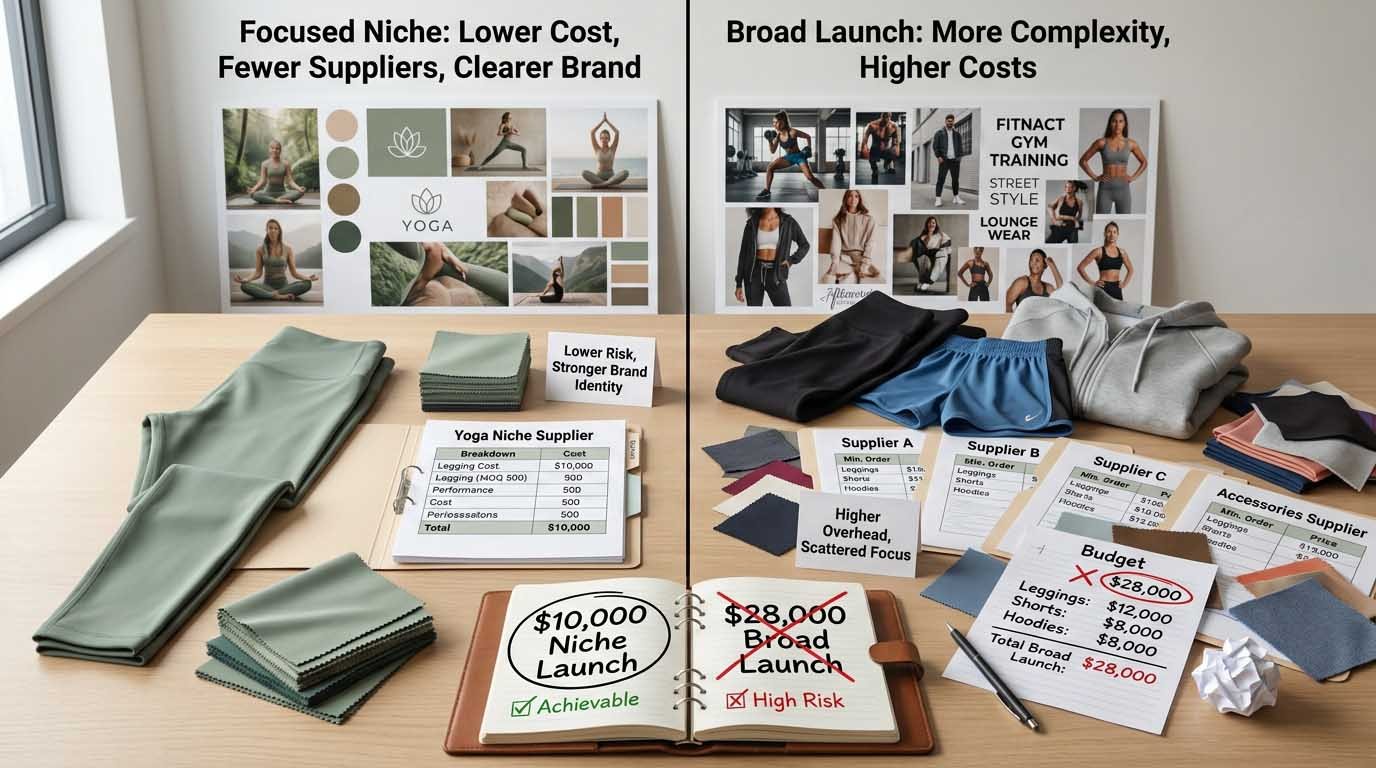
A focused niche helps you:
- keep your first order manageable
- work with fewer suppliers
- control development cost
- build a clearer brand message
- improve one product faster based on customer feedback
The Cost of Starting Too Broad
I once worked with a new founder who wanted to launch:
- yoga leggings
- running shorts
- gym hoodies
On paper, that looked like a stronger collection. In reality, it meant:
- three different fabric categories
- different supplier capabilities
- separate MOQ requirements
- more sampling rounds
- more quality risks
Her initial launch budget increased from around $10,000 to nearly $28,000, and she still had to cut quality to make the numbers work.
That is why niche focus matters so much in activewear. You are not just choosing a market. You are choosing the complexity of your launch.
What Are the Best Activewear Niches for New Brands?
Not every activewear niche is equally accessible to a startup. Some categories look attractive because they are popular, but they are expensive and technically demanding.
The best activewear niche for a new brand usually combines moderate demand, manageable MOQ, standard production methods, and clear customer pain points you can solve.
Here is a practical comparison:
| Niche | Fabric Requirement | Typical MOQ | Unit Cost Range | Technical Difficulty |
|---|---|---|---|---|
| Yoga Wear | 4-way stretch, nylon-spandex blends | 500-800 pcs | $12-$18 | High |
| Running Gear | Moisture-wicking polyester, mesh panels | 300-500 pcs | $8-$14 | Medium |
| Gym T-Shirts | Basic performance knit | 200-300 pcs | $5-$9 | Low |
| Sports Bras | High-stretch fabric, pads, support structure | 500-1,000 pcs | $10-$16 | High |
| Athleisure | Cotton-poly or brushed performance blends | 300-500 pcs | $9-$15 | Medium |
What This Means for a Startup
Yoga Wear
Yoga wear is popular, but it is not always beginner-friendly. Customers expect excellent opacity, stretch recovery, waistband comfort, and premium hand-feel. If you cannot afford strong fabric quality, this category becomes risky.
Running Wear
Running wear is often easier to enter than yoga wear because it usually uses standard cut-and-sew construction. It still requires functional fabrics, but supplier access is often better.
Gym T-Shirts
Gym t-shirts are usually the easiest category to produce, but they are also harder to differentiate. If you choose this niche, your product alone may not be enough to stand out.
Sports Bras
Sports bras look like a strong category, but support construction, fit testing, removable pads, elastic recovery, and grading make them much more complex than many founders expect.
Athleisure
Athleisure can work well if your brand is style-led, but customers often compare it to larger fashion and lifestyle brands with stronger pricing power.
For most first-time brands, running tops, running shorts, training tees, or basic gym wear are easier starting points than premium yoga leggings or technical sports bras.
How to Match an Activewear Niche to Your Budget
A niche only makes sense if you can afford to produce it properly.
Your budget should determine which activewear categories you can realistically launch, not the other way around. If your niche requires premium fabric, technical construction, and high MOQ, but your budget is limited, you will likely compromise quality before you even start selling.
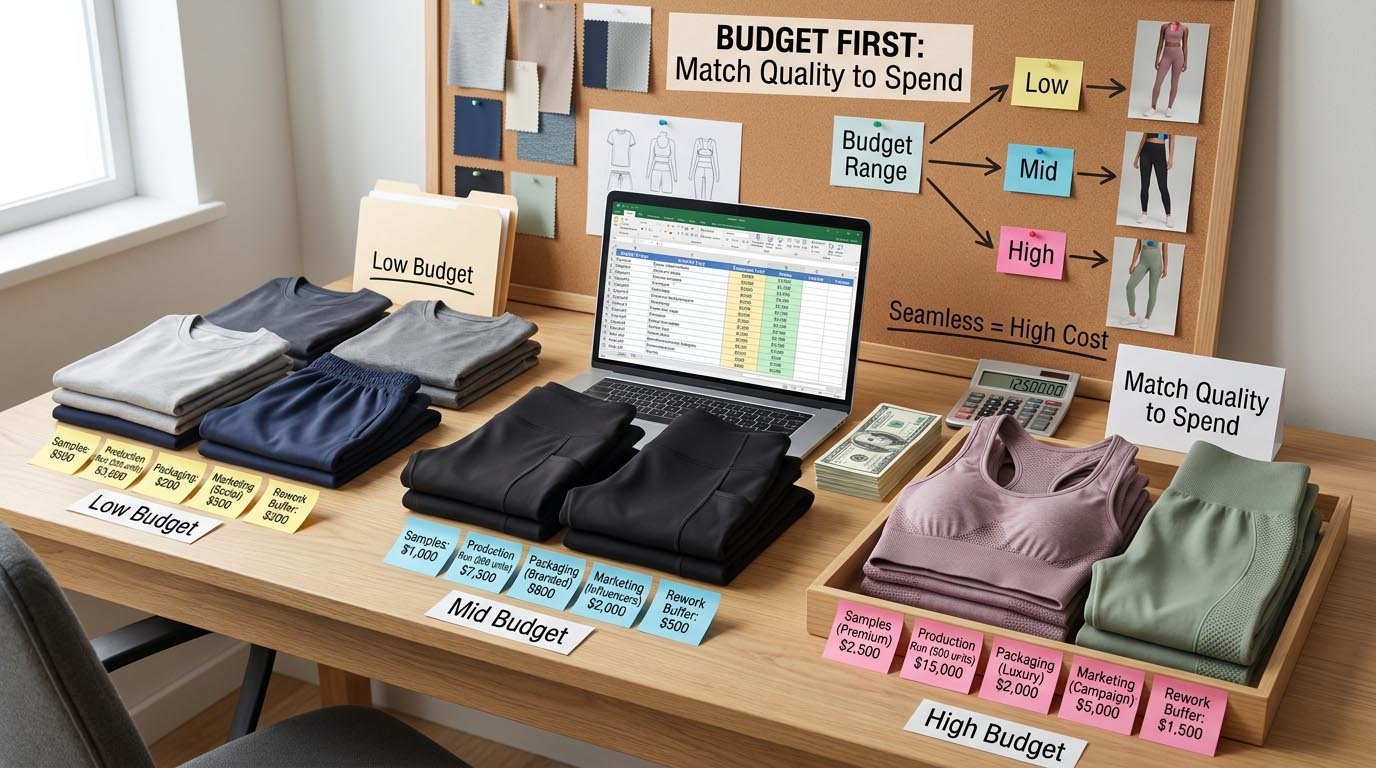
Here is a basic startup budget breakdown for a small activewear launch:
| Cost Area | Estimated Range |
|---|---|
| Sample development | $500-$800 |
| First production run | $8,000-$15,000 |
| Packaging and labels | $500-$1,500 |
| Marketing for first 3 months | $2,000-$5,000 |
| Buffer for rework or delays | $3,000-$5,000 |
Estimated total: $11,000-$27,300
If your available budget is closer to the lower end, you should usually avoid categories with:
- seamless construction
- high-compression fabric
- complex support structures
- multiple trims and accessories
- very high per-style MOQ
Budget-Based Niche Guidance
- Lower startup budget: gym tees, basic running tops, simple shorts
- Mid-range budget: running gear, athleisure sets, standard leggings
- Higher startup budget: premium yoga wear, sports bras, seamless collections
A common mistake is trying to force a premium niche into a limited budget. That usually leads to thinner fabrics, weak stitching, inconsistent fit, or poor stretch recovery.
How to Match Your Niche to Your Target Customer
You should not choose a niche only because it is feasible to produce. You also need a customer who will pay the price your product requires.
Your target customer’s willingness to pay should guide your niche selection, because fabric quality, construction details, and product features directly affect your final retail price.
Work backward from the retail price.
For example:
- planned retail price: $40
- after platform fees, discounts, or wholesale margin: $20-$24
- target product cost: $10-$12
If your chosen niche requires premium fabric and your actual cost becomes $15-$18 per unit, your retail price may need to be $60-$75 to maintain margin.
That raises an important question:
Will your customer really pay that?
Example: When Price Positioning Breaks the Niche
A founder once wanted to target budget-conscious gym customers but insisted on premium anti-bacterial treated fabric. The treatment added more than $2 per unit, which pushed the final retail price beyond what her target buyers were willing to spend.
The product was not wrong. The customer-price match was wrong.
Questions to Ask Before Choosing a Niche
- Is my target customer price-sensitive or feature-sensitive?
- Do they care more about fashion, support, comfort, or technical performance?
- Will they compare me to Lululemon, Gymshark, Amazon basics, or local boutique brands?
- Can I justify my price with clear product benefits?
If the customer budget and the required product cost do not align, the niche is not a good fit yet.
How to Research Competitors in an Activewear Niche
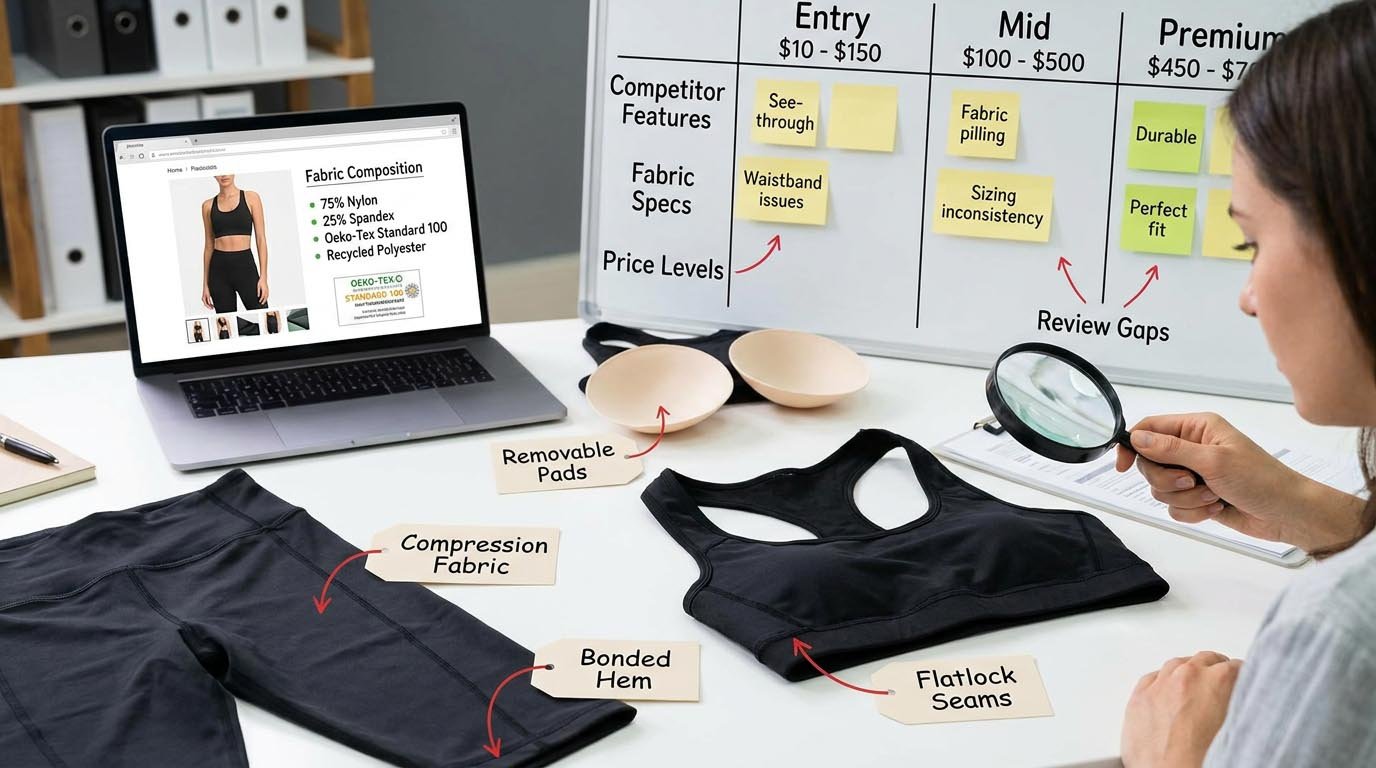
Competitor research should not stop at brand aesthetics and Instagram content. You need to understand what their products suggest about their supply chain and cost structure.
The best competitor analysis for an activewear niche looks at construction quality, fabric specifications, feature set, certifications, and pricing—not just branding.
What to Check
Product Construction
Look for signs of how much the product costs to make:
- flatlock seams vs overlock seams
- gussets in high-stress areas
- bonded hems
- double-layer waistbands
- removable pads
- mesh ventilation panels
These details can significantly change your unit cost.
Fabric Signals
Review product descriptions and care labels where available:
- nylon-spandex or polyester-spandex
- GSM or fabric thickness clues
- brushed vs smooth surface
- squat-proof or compression claims
- sustainability claims like Oeko-Tex or recycled yarn
These signals help you estimate whether you can realistically match the product with your budget.
Pricing Structure
Compare:
- entry-level price
- mid-tier price
- premium price
- bundle pricing
- discount frequency
This tells you how much room exists in the market and what price expectations customers already have.
What Customer Reviews Reveal
Competitor reviews often expose the exact gap a new brand can fill. Common complaints include:
- leggings are see-through
- waistband rolls down
- sizing is inconsistent
- pockets are missing
- fabric pills too quickly
- sports bra support is weak
These complaints are useful only if you can solve them profitably. If the fix requires a fabric or construction upgrade you cannot afford, it is not a realistic opportunity yet.
How to Evaluate Demand Before Launching an Activewear Niche
There is demand in almost every activewear category. The real question is whether you can capture enough of it with your current resources.
For a new brand, the goal is not to dominate the market. It is to prove that enough people in a clearly defined niche are willing to buy your first batch at your target price.
A Simple Validation Framework
1. Audience Size Test
Can you identify a reachable niche audience of at least 5,000-10,000 relevant people through:
- social media communities
- creator audiences
- local fitness groups
- email lists
- paid ads
2. Willingness-to-Pay Test
Survey or test 50-100 potential buyers. Show them:
- your product concept
- your target price
- your product benefits
If very few people would consider buying at that price, the niche-price match may be weak.
3. Supply Chain Feasibility Test
Confirm that at least 2-3 manufacturers can make the product at:
- your target MOQ
- your target quality level
- your target cost range
If only one supplier can make it, your niche is more fragile than it looks.
A Better Way to Test Demand
Instead of relying only on reports or trend articles, run a simple pre-launch test:
- create mockups of the product
- publish a landing page
- run small ad campaigns
- collect email signups or waiting list registrations
A niche does not need millions of buyers to work. For a first launch, you may only need 300-500 customers to validate the idea and move your first production batch.
Should You Start Broad or Focus on One Activewear Niche?
This is one of the most important decisions for a startup brand.
You should usually start with one specific activewear niche, one target customer, and one or two core products. Starting broad spreads your inventory budget, weakens your brand message, and makes it harder to learn what customers actually want.
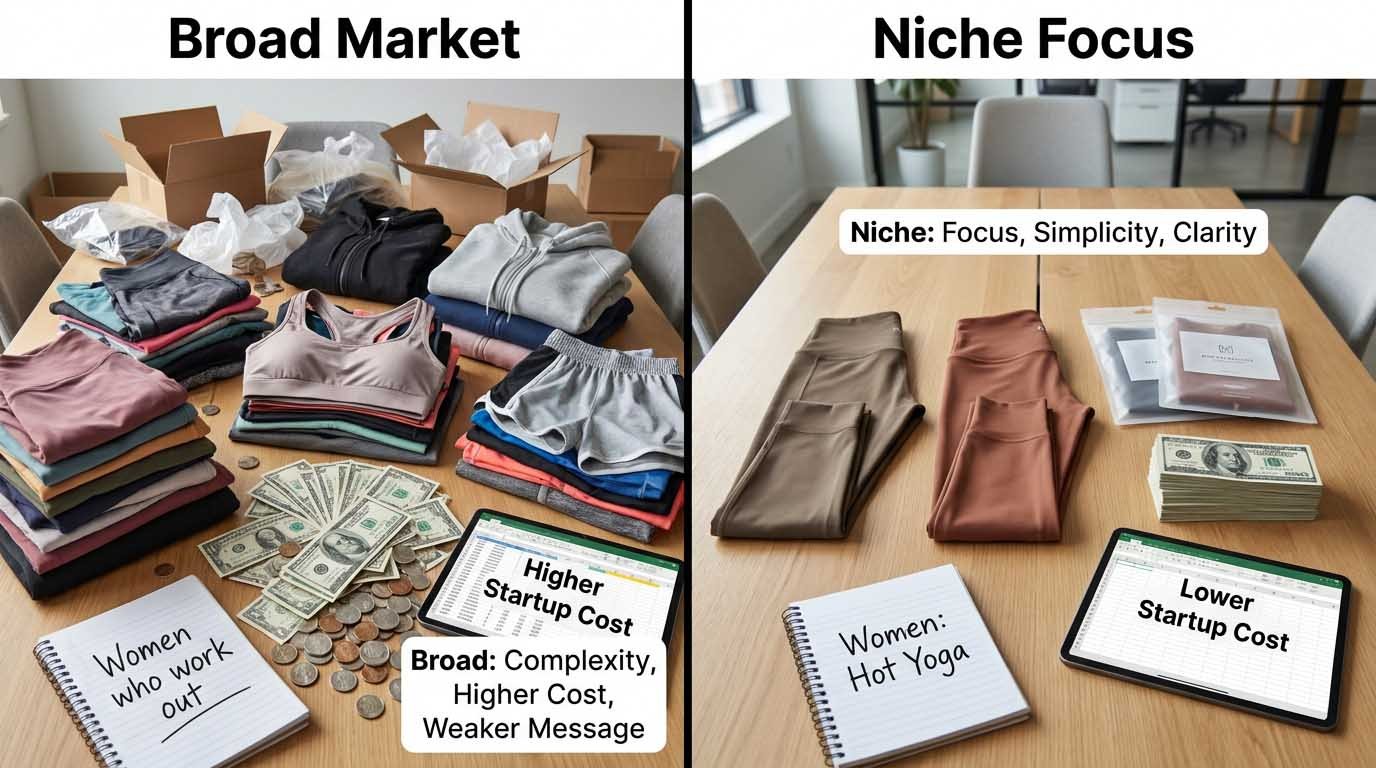
Broad Strategy vs Niche Strategy
| Approach | Broad Market | Specific Niche |
|---|---|---|
| Target customer | Women who work out | Women who practice hot yoga |
| Product range | Multiple categories | 1-2 focused products |
| Startup cost | Higher | Lower |
| Brand message | Generic | Clear and memorable |
| Inventory complexity | High | Lower |
| Customer feedback quality | Mixed | More useful |
| Reorder decisions | Harder | Easier |
A narrow niche helps you:
- build a clearer product story
- market to a more defined audience
- gather cleaner feedback
- improve faster after the first launch
- preserve cash
You can always expand later. But expansion works best after you prove one category first.
How to Test and Validate Your Activewear Niche Idea
Validation matters because it reduces the cost of being wrong.
You do not need to eliminate all risk before launching. You need to test enough that you avoid committing a full production budget to the wrong niche, wrong product, or wrong customer.
A 3-Stage Validation Process
Stage 1: Zero-Cost Validation
Spend 1-2 weeks gathering qualitative feedback.
- join communities where your target audience spends time
- observe repeated complaints and unmet needs
- note how customers describe fit, comfort, and quality issues
Stage 2: Low-Cost Validation
Test the concept before product development.
- create product mockups
- build a simple landing page
- run $200-$300 in ads
- compare click-through rate and signup rate across different concepts
Stage 3: Sample Validation
Test the product physically before committing to a large MOQ.
- order 30-50 sample pieces
- give them to 15-20 ideal customers
- collect feedback on fit, comfort, opacity, movement, and wash performance
- sell a small quantity at cost if possible to test real buying behavior
Typical Validation Budget
| Validation Step | Estimated Cost |
|---|---|
| Mockups and landing page | $100-$300 |
| Small ad tests | $200-$300 |
| Sample development | $500-$1,200 |
| Sample user testing | $300-$700 |
Estimated total: $1,100-$2,500
That is usually much cheaper than learning through a failed 500-piece production run.
How to Know If an Activewear Niche Is Profitable
A niche is only profitable if your product cost, retail price, reorder potential, and customer acquisition cost work together.
The most profitable activewear niche for a startup is usually not the biggest market segment—it is the segment where your product margin, launch cost, and differentiation are strong enough to support repeat orders.
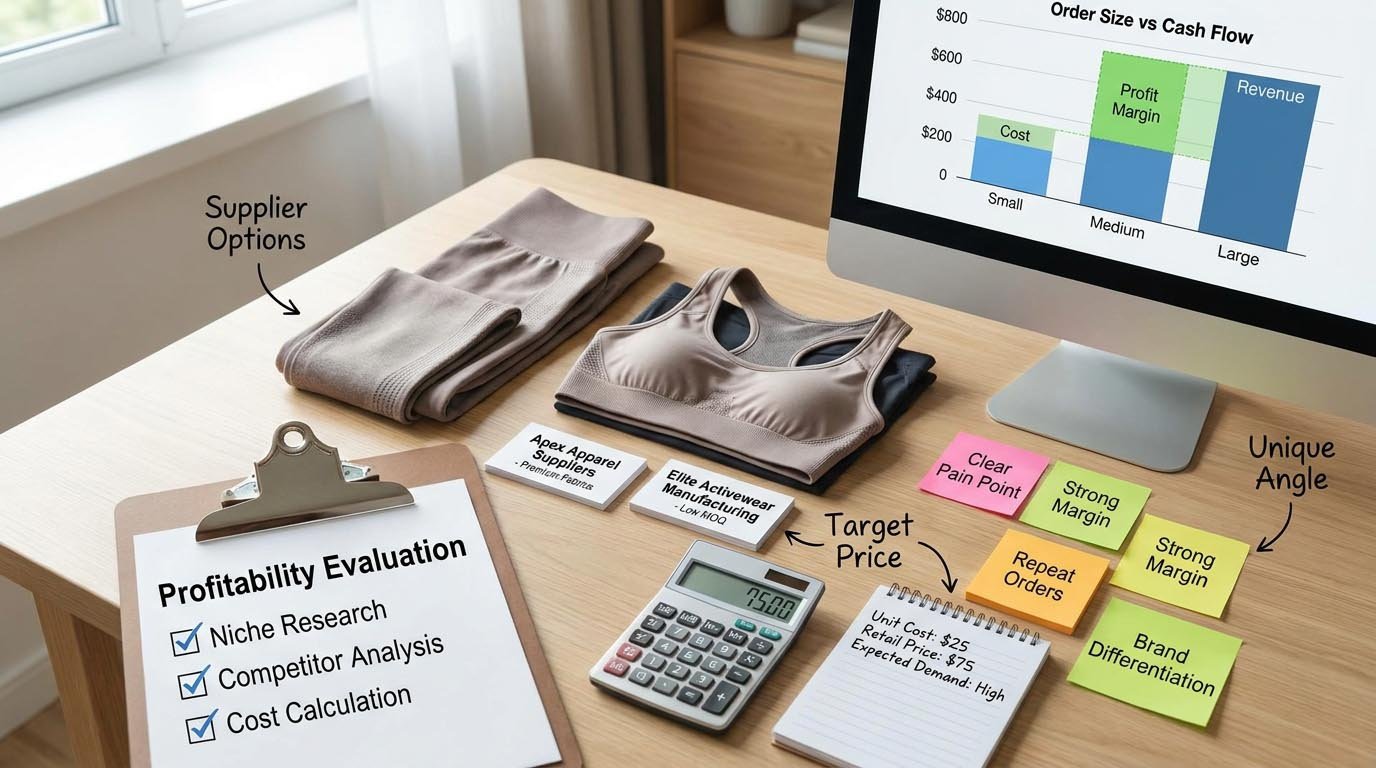
Use This Profitability Checklist
Before moving forward, confirm:
- your target customer can afford your final retail price
- your estimated unit cost leaves room for margin
- you can meet the MOQ without overextending cash flow
- at least 2 suppliers can make the product
- your niche has a clear pain point or underserved angle
- you can explain why your brand is different from larger competitors
- your first order size is realistic based on expected demand
If several of these are unclear, the niche may still be too early for your brand.
Final Checklist: Choosing the Right Activewear Niche
Before you commit to a niche, ask yourself these questions:
1. Does the niche fit my real startup budget?
Include:
- sampling
- production
- packaging
- marketing
- shipping
- contingency buffer
2. Can I find qualified suppliers for it?
You want at least 2-3 reliable manufacturers who can meet your quality and cost targets.
3. Will my customer pay the price this niche requires?
If not, you need a cheaper product structure or a different target market.
4. Is the niche too technically difficult for my first launch?
If the category needs seamless machinery, highly specialized grading, or premium performance fabric, it may not be the best place to start.
5. Can I explain my niche clearly in one sentence?
For example:
- activewear for women who train in hot climates
- high-support sports bras for fuller bust sizes
- simple running essentials for beginner runners
- maternity activewear for low-impact workouts
If your niche is too vague, your product and marketing will probably be vague too.
FAQ: Choosing an Activewear Niche
1. What is the best activewear niche for beginners?
For many new brands, gym tees, running tops, and basic cut-and-sew performance wear are easier to launch than seamless yoga wear or complex sports bras.
2. Is yoga wear a profitable activewear niche?
It can be, but it is also highly competitive and quality expectations are high. You need strong fabric, reliable fit, and good branding to compete.
3. How much does it cost to start an activewear brand in one niche?
Most small launches cost around $11,000-$27,000 when you include sample development, production, packaging, marketing, and buffer.
4. Should I start with multiple activewear products?
Usually no. Starting with one niche and one or two core products is easier to manage and less risky financially.
5. How do I know if my activewear niche idea is too broad?
If your target customer sounds like "everyone who works out," it is too broad. A good niche should describe a specific user, activity, or need.
6. How can I validate an activewear niche before placing a bulk order?
Use concept testing, landing pages, small ad campaigns, and limited sample testing with your target audience before committing to MOQ production.
Conclusion
Choosing the right activewear niche means balancing demand with production reality. The best niche for your brand is the one that fits your startup budget, supplier access, technical capability, and target customer price expectations.
If you start narrow, validate demand early, and build around a product you can afford to make well, you give your brand a much better chance to survive its first launch and grow from there.