.png)
Finding an activewear manufacturer is relatively easy. Verifying that the factory can actually deliver what your brand expects is much harder.
A professional website, competitive quotation, business license, and polished sample can all be positive signs. But none of them alone prove that a manufacturer can control stretch fabrics, maintain measurements, manage revisions, keep bulk production consistent, or solve problems after you have paid a deposit.
Before paying an activewear manufacturer, verify five things: the legal company receiving your money, the real production facility behind the quotation, the supplier's technical understanding of activewear, its sample-to-bulk quality system, and the written commercial terms that define what happens if production goes wrong.
The goal is not to find a factory that never makes mistakes.
It is to find one that can identify risks early, document changes clearly, control production, and take responsibility when something needs correcting.
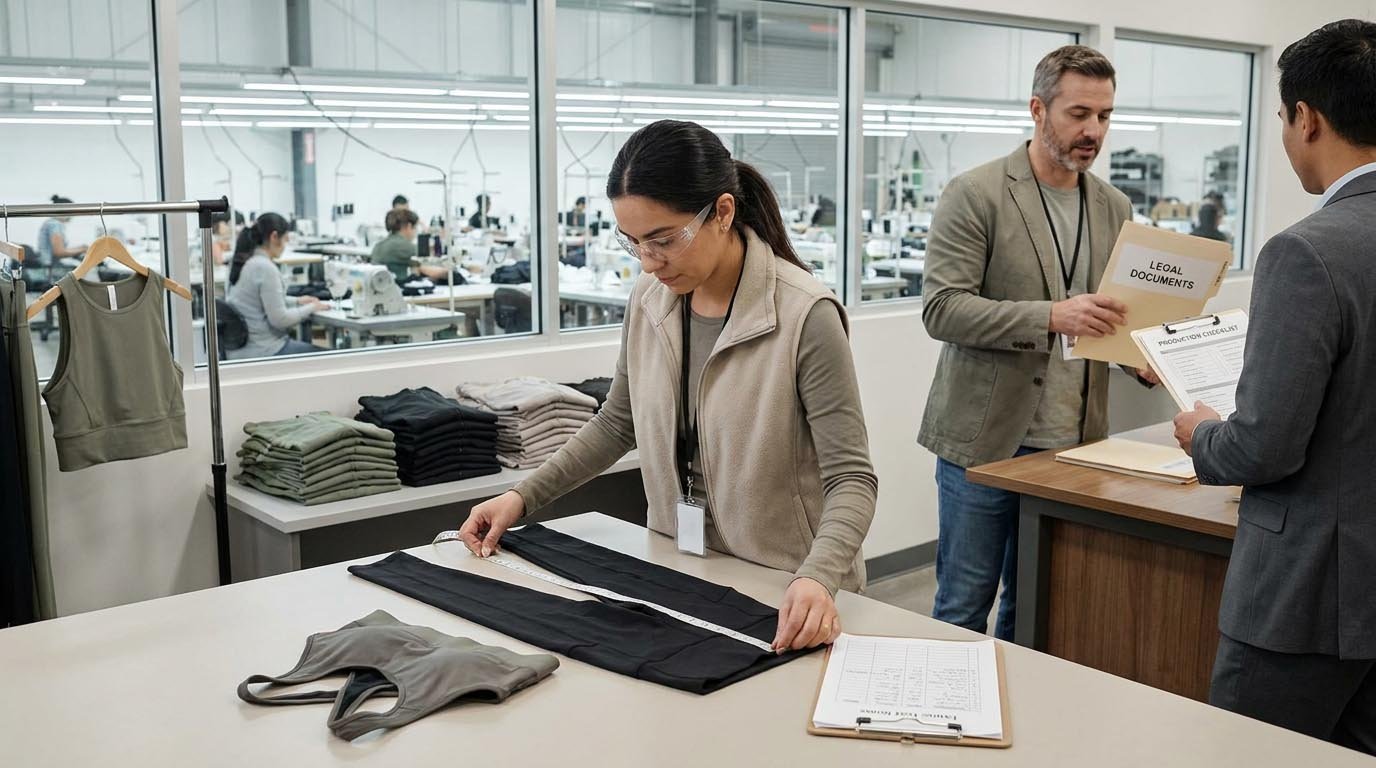
Quick Answer: How Do You Verify an Activewear Manufacturer Before Paying?
Before transferring a bulk-production deposit:
- Confirm the registered company name and business information.
- Verify that the bank beneficiary matches the contracting company or has a documented relationship with it.
- Confirm whether you are dealing with the actual manufacturer or an intermediary.
- Ask for evidence of activewear production rather than general garment production.
- Test how the supplier reviews your tech pack and questions unclear specifications.
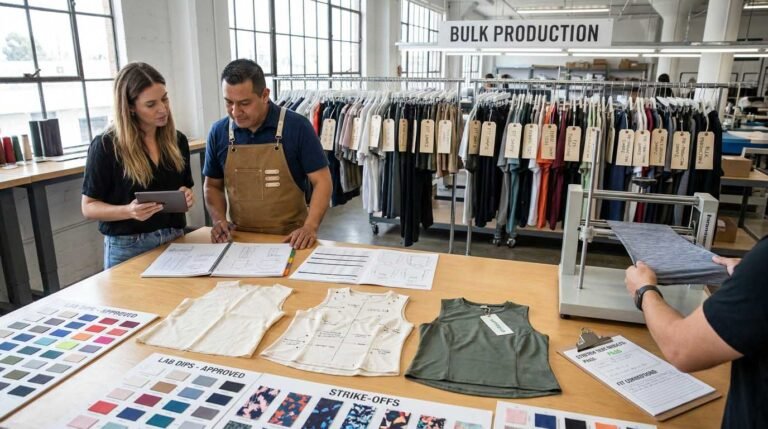
- Develop and revise a physical sample before bulk production.
- Confirm how approved sample specifications are transferred into production.
- Review the factory's in-line and final QC process.
- Put inspection, defect handling, rework, and payment terms in writing.
- Do not rely on price, certificates, factory photos, or one perfect sample alone.
Think of manufacturer verification as a stress test, not simply a paperwork audit.
A business license verifies legal existence. A factory video helps verify production presence. A sample demonstrates one product execution. A bank check helps verify payment authority. A QC system helps show how production is controlled.
No single document proves everything.
Activewear Manufacturer Verification Checklist
| Verification Area | What You Should Confirm | Warning Sign |
|---|---|---|
| Legal company | Registered company details are verifiable | Company information keeps changing |
| Bank account | Beneficiary relationship is clear | Payment requested to an unexplained account |
| Factory identity | Production facility can be demonstrated | Supplier avoids showing production |
| Activewear capability | Factory understands stretch fabrics and technical construction | Only general apparel experience is shown |
| Tech pack review | Supplier asks relevant technical questions | Immediately says everything is possible |
| Sampling | Changes are documented and corrected | Sample errors are dismissed |
| Bulk transfer | Approved sample/specs become production references | No clear pre-production approval |
| QC | In-line and final inspections are defined | QC happens only at the end |
| Commercial terms | Rework, defect and payment terms are written | Important promises remain verbal |
| Communication | Problems are discussed clearly | Supplier hides problems or gives vague answers |
Step 1: Verify the Manufacturer’s Legal Company
Factory verification should begin with the legal entity that will receive your purchase order and money.
The company marketing the garments, the company operating the factory, and the company receiving payment are not always presented under exactly the same name.
That does not automatically mean something is wrong.
Manufacturers may operate through related export companies or affiliated entities. What matters is that the relationship can be explained and documented.
Check the Basic Company Information
Ask for:
- Registered company name
- Registered address
- Business license
- Factory address
- Main contact details
- Company email domain
- Name shown on quotation or proforma invoice
- Name of the bank beneficiary
Compare the information rather than checking each document separately.
For example:
Business License → Company A
Proforma Invoice → Company A
Bank Beneficiary → Company A
This is straightforward.
If you instead see:
Business License → Company A
Invoice → Company B
Bank Beneficiary → Company C
do not automatically reject the supplier, but ask for a clear explanation before sending money.
The important question is:
Who is legally responsible for producing my order, and who is legally receiving my payment?
Step 2: Verify the Bank Beneficiary Before Paying the Deposit
Do not treat bank details as an administrative formality.
Compare the beneficiary details with the company information already provided during quotation and contracting.
What Should You Check?
Confirm:
- Beneficiary company name
- Bank country
- Currency
- Account information
- Relationship between beneficiary and contracting company
What If the Bank Beneficiary Name Is Different?
There may be legitimate reasons.
For example, a manufacturer may use an affiliated trading or export entity.
The correct response is not:
Different name = scam.
The correct response is:
Different name = verify the relationship before paying.
If bank instructions change immediately before payment, reconfirm the change through a previously verified communication channel.
Step 3: Confirm You Are Dealing With a Real Activewear Factory
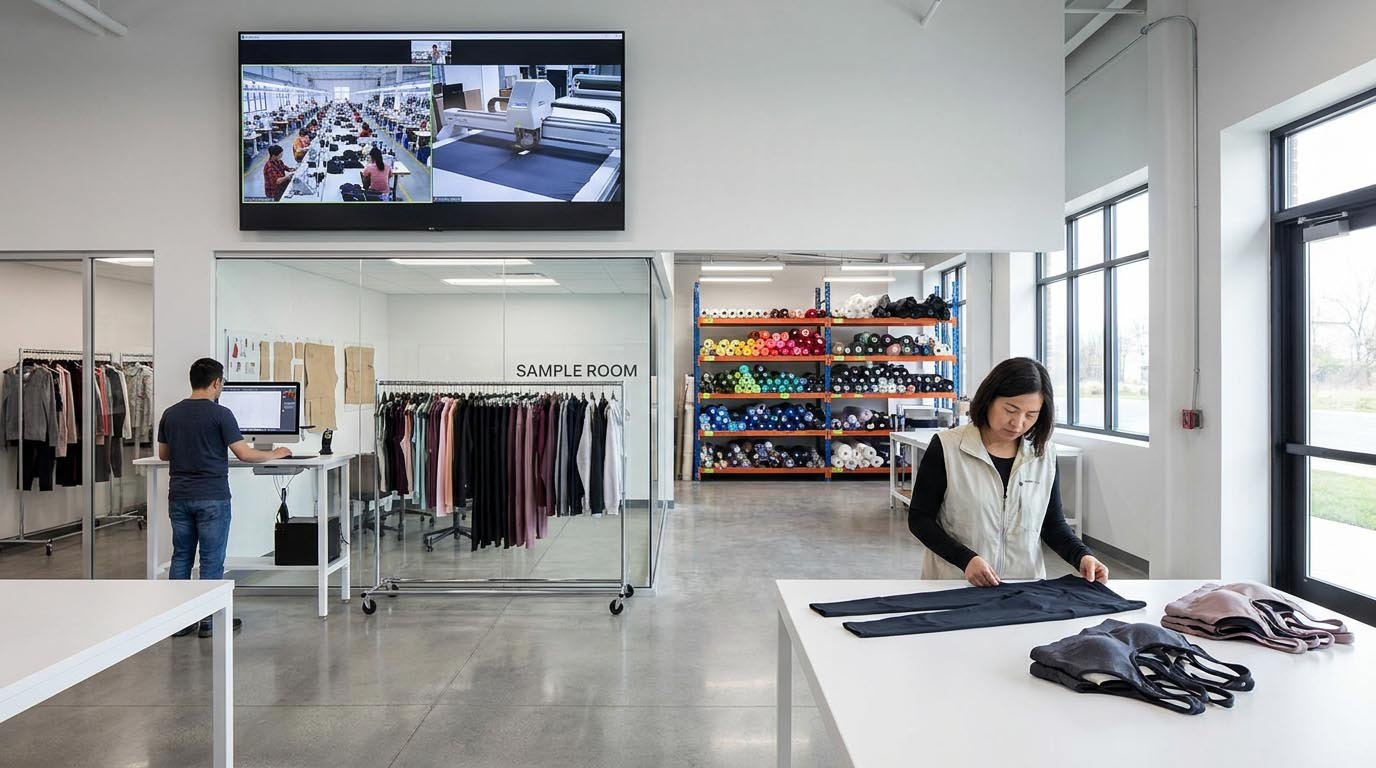
The key question is not simply:
Is this company legitimate?
It is:
Can this company actually manufacture my product?
A legally registered supplier may still outsource part of its production.
Outsourcing is not automatically a problem. What matters is transparency and production control.
Ask Who Performs Each Production Process
Ask:
- Who develops the pattern?
- Who makes the sample?
- Who cuts the fabric?
- Who sews the garment?
- Who applies branding?
- Who performs in-line QC?
- Who performs final inspection?
- Which processes are outsourced?
For brands developing fully customized products, understanding the supplier's Cut & Sew capability is especially useful because it helps reveal how much of the actual garment construction process the manufacturer controls.
Request Factory Proof Relevant to Your Order
Useful evidence may include:
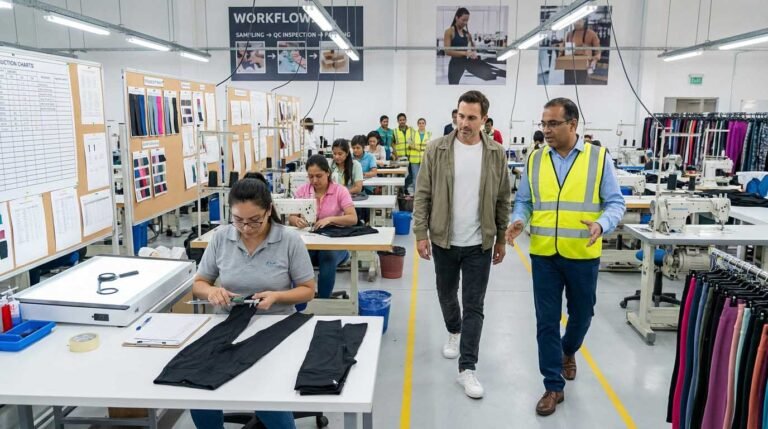
- Live factory video call
- Sewing-line footage
- Cutting department
- Sample room
- Pattern-making area
- Fabric warehouse
- QC inspection area
- Current production of similar activewear
Do not focus only on factory size.
A smaller manufacturer with strong pattern development, stretch-fabric experience, and disciplined QC may be a better fit than a much larger general-apparel factory.
Step 4: Verify Activewear-Specific Manufacturing Experience
Activewear manufacturing is not the same as producing ordinary cotton garments.
Stretch recovery, opacity, seam elasticity, compression, moisture management, fit, and repeated movement all affect product performance.
A factory that mainly produces casual T-shirts may still be a poor match for technical activewear.
Ask for Experience With Similar Products
Ask whether the supplier has produced products such as:
- Leggings
- Sports bras
- Performance shorts
- Training tops
- Compression garments
- Technical T-shirts
Also evaluate whether the factory understands the fabric side of product development.
Wearzio's Fabric Sourcing service, for example, covers the process of selecting fabrics that match stretch, hand-feel, performance, and garment requirements.
Questions to Test Technical Capability
Ask:
- What stretch fabrics do you normally use?
- How do you control measurements on elastic garments?
- How do you evaluate fabric recovery?
- How do you reduce seam cracking?
- How do you check opacity for leggings?
- How do you manage color consistency?
The quality of the answer matters more than whether the supplier simply says:
Yes, we can make it.
Step 5: Stress-Test the Manufacturer’s Technical Communication
Communication speed matters, but communication quality matters more.
There is no universal rule saying every reliable supplier must answer within a fixed number of hours.

Instead, evaluate whether communication is:
- Consistent
- Specific
- Technically informed
- Transparent
- Action-oriented
Check Whether the Supplier Challenges Unrealistic Specifications
Suppose your tech pack requests:
- High compression
- Lightweight fabric
- Strong squat-proof opacity
- Minimal seam reinforcement
An experienced manufacturer should discuss whether all requirements can realistically be achieved together.
Likewise, branding methods should be evaluated against the fabric and stretch zone.
For example, depending on the garment and artwork, a supplier may recommend Embroidery, Screen Printing, or Sublimation Printing rather than treating every decoration method as interchangeable.
Watch for the “Yes, No Problem” Red Flag
A supplier that agrees to every technical request without evaluating feasibility deserves closer scrutiny.
Sometimes the most valuable response is:
We can produce this, but this construction may create a durability risk. Here are two alternatives.
Step 6: Use Sampling to Test the Manufacturer’s Problem-Solving
Sampling is one of the strongest verification tools available to a buyer.
But do not evaluate only whether the first sample looks good.
The revision process is often more revealing.
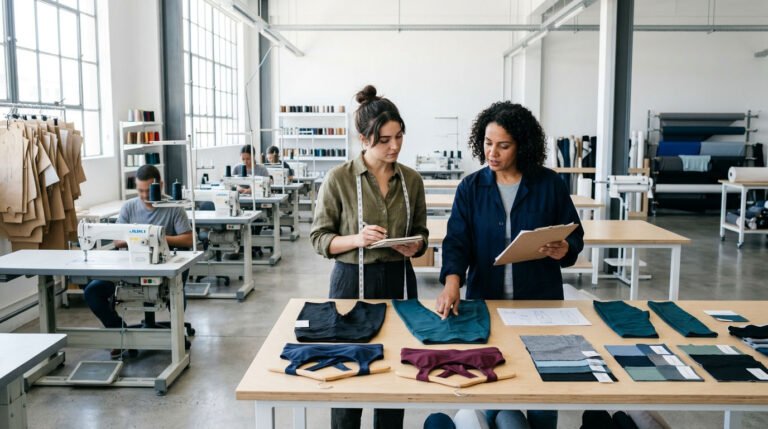
Evaluate How the Factory Handles Sample Corrections
Suppose you identify:
- Waistband too loose
- Back rise too short
- Sports bra underband lacking recovery
- Armhole too tight
- Logo position incorrect
- Fabric hand-feel different from expectation
A capable supplier should be able to:
- Understand the problem.
- Identify the likely cause.
- Explain what will change.
- Update the revision record.
- Produce the corrected version.
- Confirm the new measurements.
Warning Signs During Sample Development
Be cautious if the supplier repeatedly responds:
"It's almost the same."
"Production will be better."
"This is only a sample."
Those statements do not explain how the issue will be corrected in bulk production.
Step 7: Perform Practical Activewear Sample Checks
You do not need a laboratory to perform every initial evaluation.
Basic physical checks can reveal obvious problems.
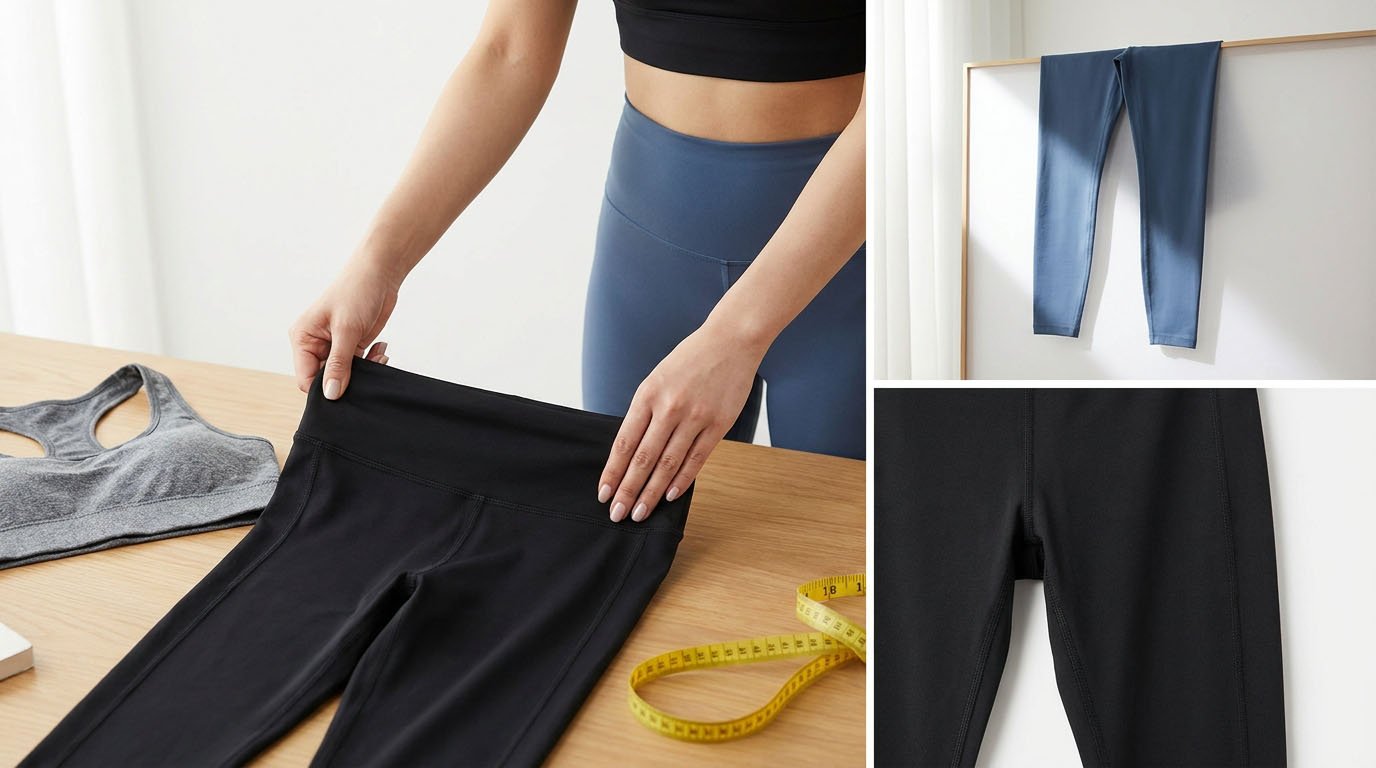
Stretch and Recovery Check
Stretch the waistband or another high-elasticity area several times.
Check whether:
- Seams remain intact
- Fabric returns toward its original shape
- Elastic stays flat
- Stitching does not visibly open
Opacity and Squat Test
For leggings and compression garments, inspect the fabric while stretched.
Perform a squat or movement test under realistic lighting.
Opacity can be affected by:
- Fabric composition
- Knit construction
- GSM
- Color
- Stretch percentage
- Garment size
Measurement Check
Compare the sample against the approved size chart.
Manufacturing tolerances should be agreed, not assumed.
Seam Construction Check
Pay particular attention to:
- Waistbands
- Crotch seams
- Underarms
- Side seams
- Sports bra underbands
- High-stress joining points
Step 8: Verify Sample-to-Bulk Consistency
This is where many buyers make an important mistake.
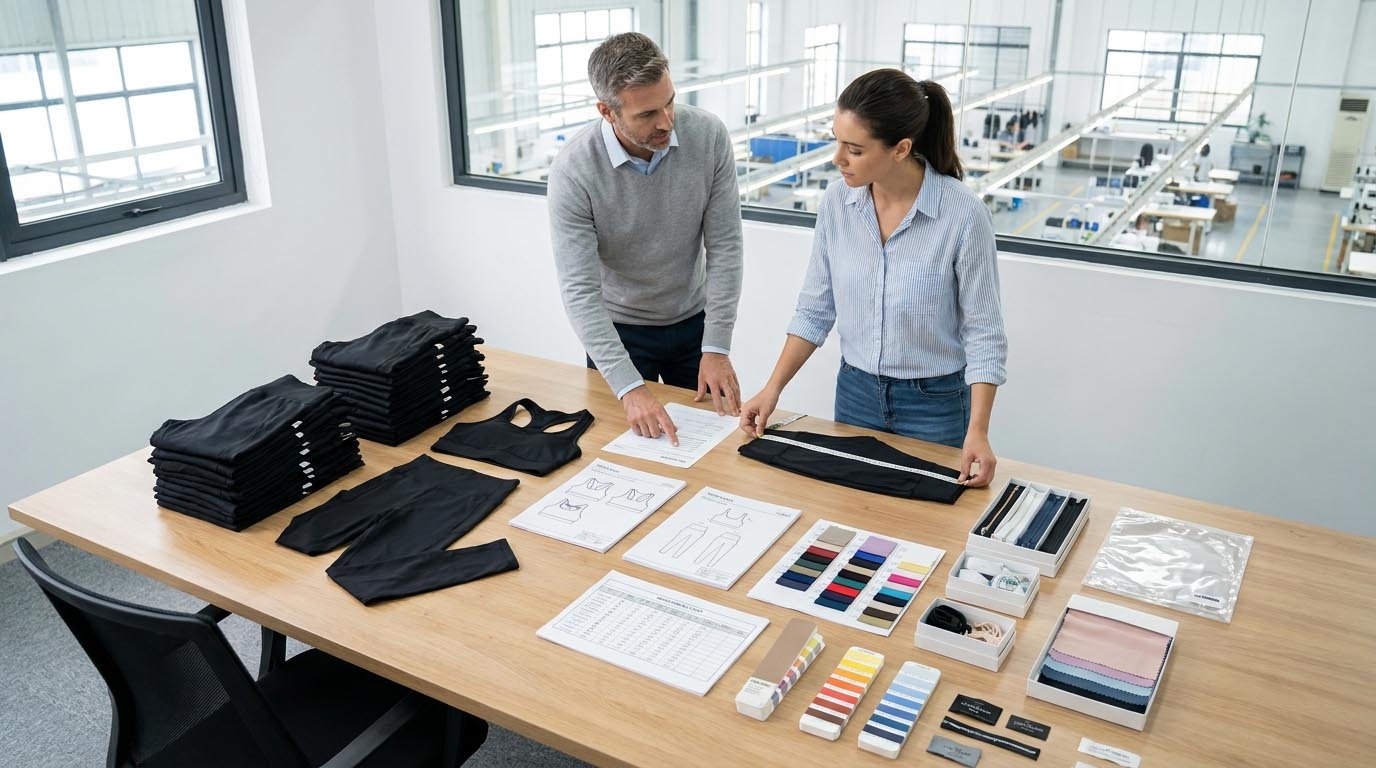
They receive one excellent sample and conclude:
The factory has passed verification.
Not yet.
Your real requirement is:
Can the factory reproduce the approved result consistently during bulk manufacturing?
Do Not Approve a Manufacturer From One Perfect Sample
A useful development path may look like:
Development Sample
↓
Revision
↓
Approved Sample
↓
Pre-Production Reference
↓
Bulk Production
↓
In-Line Inspection
↓
Final Inspection
The terminology varies between manufacturers.
What matters is whether there is a controlled handoff from development into production.
Confirm the Approved Bulk Production Reference
Before bulk cutting begins, confirm what the production team will use as its final reference.
This may include:
- Approved sample
- Final tech pack
- Measurement chart
- Fabric specification
- Color standard
- Trim specification
- Label positioning
- Logo placement
- Packaging requirements
- Revision history
One useful question is:
How do you make sure the production line follows the final approved sample rather than an earlier version?
Step 9: Review the Factory’s Quality-Control System
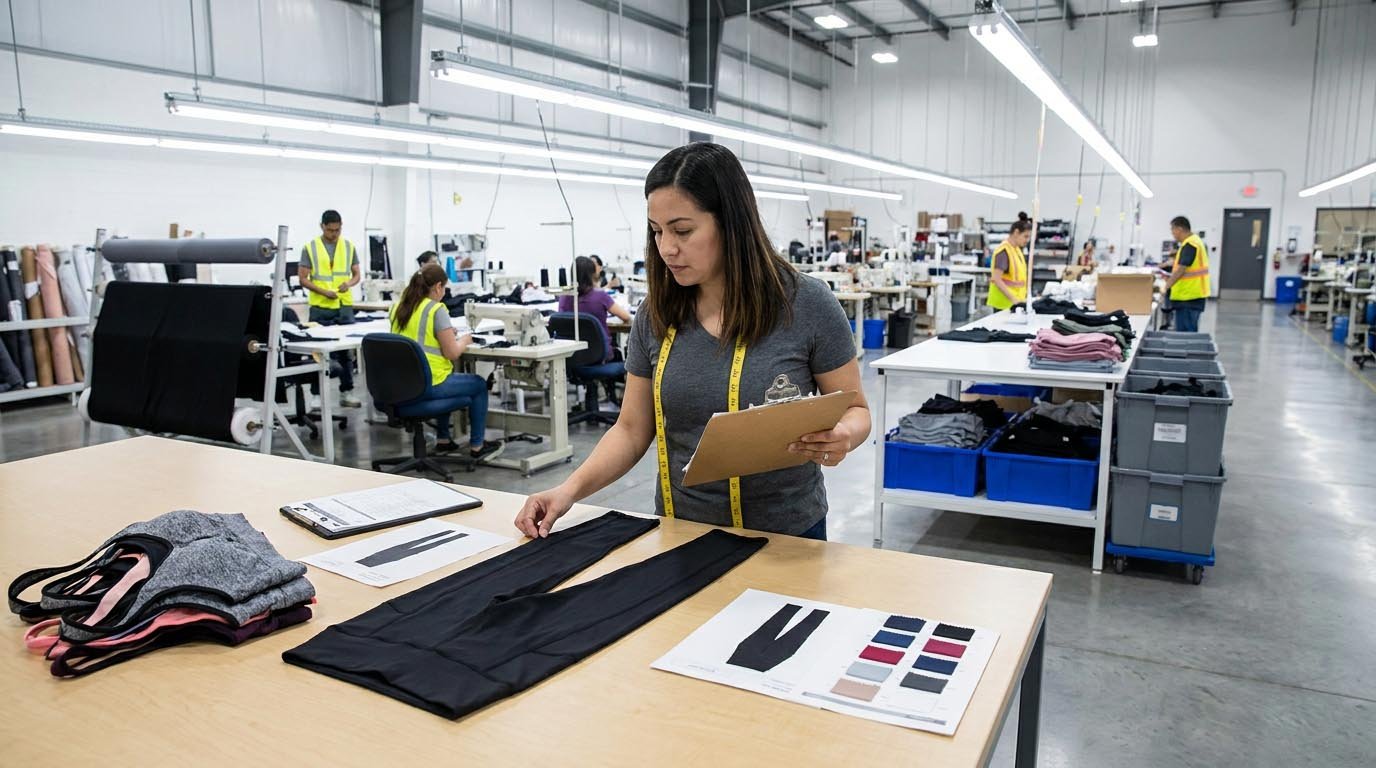
A final inspection cannot fix thousands of garments that have already been sewn incorrectly.
Quality control should happen throughout production.
Raw Material Inspection
Possible checks include:
- Fabric color
- Fabric defects
- Width
- GSM where relevant
- Shrinkage where relevant
- Trim consistency
Pre-Production Checks
Confirm:
- Approved measurements
- Approved construction
- Fabric and color
- Logo placement
- Labels
- Packaging requirements
- Final sample version
In-Line Quality Control
In-line inspections may identify:
- Skipped stitches
- Seam puckering
- Measurement drift
- Incorrect branding
- Incorrect trims
- Construction inconsistency
Final Inspection
Final inspection verifies finished goods before shipment.
Depending on the order, inspection may be performed by:
- Manufacturer's internal QC
- Buyer's QC team
- Independent inspection company
Inspection systems such as AQL can help define sampling and acceptance criteria, but AQL alone does not guarantee quality.
You and the supplier still need to agree on:
- What will be inspected
- Which specifications apply
- How defects are classified
- What happens if the goods fail inspection
Step 10: Verify Production Capacity and Commercial Terms Before Paying
The final verification stage combines production capability with commercial protection.
Verify Real Production Capacity
Instead of asking only:
What is your monthly capacity?
also ask:
Which production line will handle my order?
and:
Can you maintain quality during my required production window?
Capacity verification should answer four questions:
- Can they produce your product?
- Can they produce your quantity?
- Can they maintain quality at that quantity?
- Can they deliver within the agreed production window?
Put Product and Quality Requirements in Writing
Before paying a bulk deposit, important commercial expectations should be documented.
These may include:
- Product
- Quantity
- Size breakdown
- Color
- Material
- Unit price
- Approved specifications
- Payment terms
- Production schedule
- Inspection requirements
- Packaging
- Shipping terms
For brands using existing or customized product programs rather than building every garment from scratch, it can also be useful to understand the manufacturer's Private Label process and exactly which parts of the product are being customized.
Define Rework and Defect-Handling Terms
Where relevant, written terms may also cover:
- Rework
- Replacement
- Inspection failure
- Material substitution
- Major production delays
- Unauthorized specification changes
Do not assume every manufacturer uses exactly the same deposit structure.
The important question is:
When does each payment become due, and what production milestone does it correspond to?
10 Red Flags Before Paying an Activewear Manufacturer
Red Flag 1: They Never Ask Technical Questions
An experienced manufacturer should clarify incomplete or risky specifications.
Red Flag 2: Every Request Is Immediately Possible
Performance apparel involves technical trade-offs.
Red Flag 3: They Avoid Showing Actual Production
Marketing photos alone are weak evidence.
Red Flag 4: Company and Bank Details Cannot Be Explained Clearly
Different entities may be legitimate, but the relationship should be transparent.
Red Flag 5: They Discourage Physical Sampling
Bulk production should not become your first meaningful product test.
Red Flag 6: Sample Mistakes Are Dismissed Rather Than Documented
The correction process often predicts future problem-solving.
Red Flag 7: Specifications Remain Scattered Across Chat Messages
Important approvals should be transferred into controlled production documents.
Red Flag 8: QC Is Only Discussed at the End
Strong quality systems try to detect problems during production.
Red Flag 9: Payment Terms Are Clear but Quality Remedies Are Vague
You should understand what happens if goods do not meet agreed requirements.
Red Flag 10: Price Is Their Only Competitive Advantage
Low pricing can be legitimate, but price alone tells you little about technical capability, consistency, or quality control.
10-Point Activewear Manufacturer Verification Scorecard
| Verification Question | Checked? |
|---|---|
| 1. Have I verified the legal company I am contracting with? | ☐ |
| 2. Have I verified the beneficiary receiving my payment? | ☐ |
| 3. Can I confirm where and how my products will be manufactured? | ☐ |
| 4. Has the supplier demonstrated similar activewear experience? | ☐ |
| 5. Did the supplier review my technical specifications critically? | ☐ |
| 6. Have I evaluated a physical sample and necessary revisions? | ☐ |
| 7. Is there a clear system for transferring the approved sample into bulk production? | ☐ |
| 8. Do I understand the factory's in-line and final QC process? | ☐ |
| 9. Are payment, inspection, rework and major quality terms documented? | ☐ |
| 10. Does communication remain consistent when problems appear? | ☐ |
How to Use the Scorecard
This scorecard is not intended to create an artificial supplier ranking.
Use it to identify unanswered questions.
If several items remain unclear, go back and verify them before sending a bulk-production deposit.
Questions to Ask an Activewear Manufacturer Before Paying
A short pre-deposit verification request can include:
- What legal company will appear on our purchase documents?
- Which company will receive our payment?
- Will our garments be sewn in your own facility?
- Which production processes are outsourced?
- Have you produced similar activewear before?
- What technical concerns do you see in our tech pack?
- How do you document sample revisions?
- What becomes the final reference for bulk production?
- What inspections occur during production?
- How are defective garments handled?
- What happens if bulk differs materially from the approved specification?
A serious manufacturer should be able to answer reasonable due-diligence questions clearly.
Should You Visit the Activewear Factory?
A factory visit can be valuable, particularly for larger or technically demanding programs.
Check areas such as:
- Sewing lines
- Sample room
- Pattern department
- Fabric warehouse
- Cutting area
- QC process
- Current production
If you cannot visit personally, alternatives include:
- Live video factory tour
- Third-party factory audit
- Independent inspection
- Production photos and videos
- Verified company documentation
A factory visit is useful evidence, but it should not be your only evidence.
Should You Use a Third-Party Inspection Company?
Third-party inspection may be particularly useful when:
- The supplier is new
- Order value is significant
- Quality requirements are strict
- You cannot visit the factory
- The product is technically complex
However, inspection does not replace supplier verification.
A stronger process is:
Manufacturer Verification
↓
Sampling
↓
Production Control
↓
Final Inspection
Why Activewear Manufacturer Verification Is Different
Activewear often places greater mechanical demands on garments than ordinary casual apparel.
Products may need to perform through:
- Repeated stretching
- Sweat
- Abrasion
- Compression
- Washing
- High-movement activities
That means the manufacturer must understand both appearance and performance.
For leggings, sports bras, shorts, and technical tops, seemingly small differences in fabric, pattern, seam construction, or sizing can substantially affect the finished product.
That is why specific activewear experience matters more than a general claim of many years in garment manufacturing.
FAQ: How to Verify an Activewear Manufacturer Before Paying a Deposit
Should I Order a Sample Before Bulk Production?
For custom activewear, physical sampling is strongly recommended.
It allows you to evaluate fit, measurements, fabric, construction, branding, and revision capability before committing to bulk production.
Is a Business License Enough?
No.
A business license helps verify that a legal company exists, but it does not prove technical capability, production capacity, QC, or sample-to-bulk consistency.
How Can I Tell Whether a Supplier Is a Factory or Trading Company?
Ask who performs pattern development, sampling, cutting, sewing, QC, and packing.
Request current production evidence and ask which processes are subcontracted.
Transparency and production control matter more than labels alone.
Is a 30% Deposit Standard?
Deposit-plus-balance arrangements are common in custom apparel manufacturing, but there is no universal payment structure.
Terms vary by order size, materials, customization, relationship history, and commercial negotiation.
Should the Bank Beneficiary Match the Factory Name?
The relationship between the contracting company and payment beneficiary should be clear.
If the names differ, ask for documentation explaining the relationship before paying.
Should I Choose the Lowest Quotation?
Not necessarily.
Compare what is actually included:
- Fabric
- Construction
- Trims
- Branding
- Packaging
- Quantity
- Quality requirements
- Inspection
- Commercial terms
The objective is not to avoid low prices. It is to avoid choosing a supplier only because of price.
Final Thoughts: Verify the System, Not the Sales Pitch
The safest way to evaluate an activewear manufacturer before paying a deposit is not to look for one perfect certificate, factory photo, or sample.
Verify the system.
Legal Entity
↓
Payment Beneficiary
↓
Real Production Capability
↓
Activewear Technical Understanding
↓
Sampling and Revision
↓
Sample-to-Bulk Transfer
↓
Production QC
↓
Final Inspection
↓
Written Commercial Terms
A reliable manufacturer should be willing to make this process transparent.
The goal is not to eliminate every possible production risk.
The goal is to identify the important risks before your money, materials, and launch schedule are committed to bulk production.