Finding a reliable activewear manufacturer in China involves more than searching Alibaba or comparing factory quotations. A supplier may offer competitive prices and attractive product photos but lack the technical experience to produce consistent leggings, sports bras, or performance apparel.
To find a reliable activewear manufacturer in China, define your product requirements, search through suitable sourcing channels, verify the actual production facility, evaluate activewear-specific capabilities, and confirm sample quality and commercial terms before bulk production.
The goal is to find a manufacturing partner that can consistently reproduce your approved products—not just create one impressive sample.
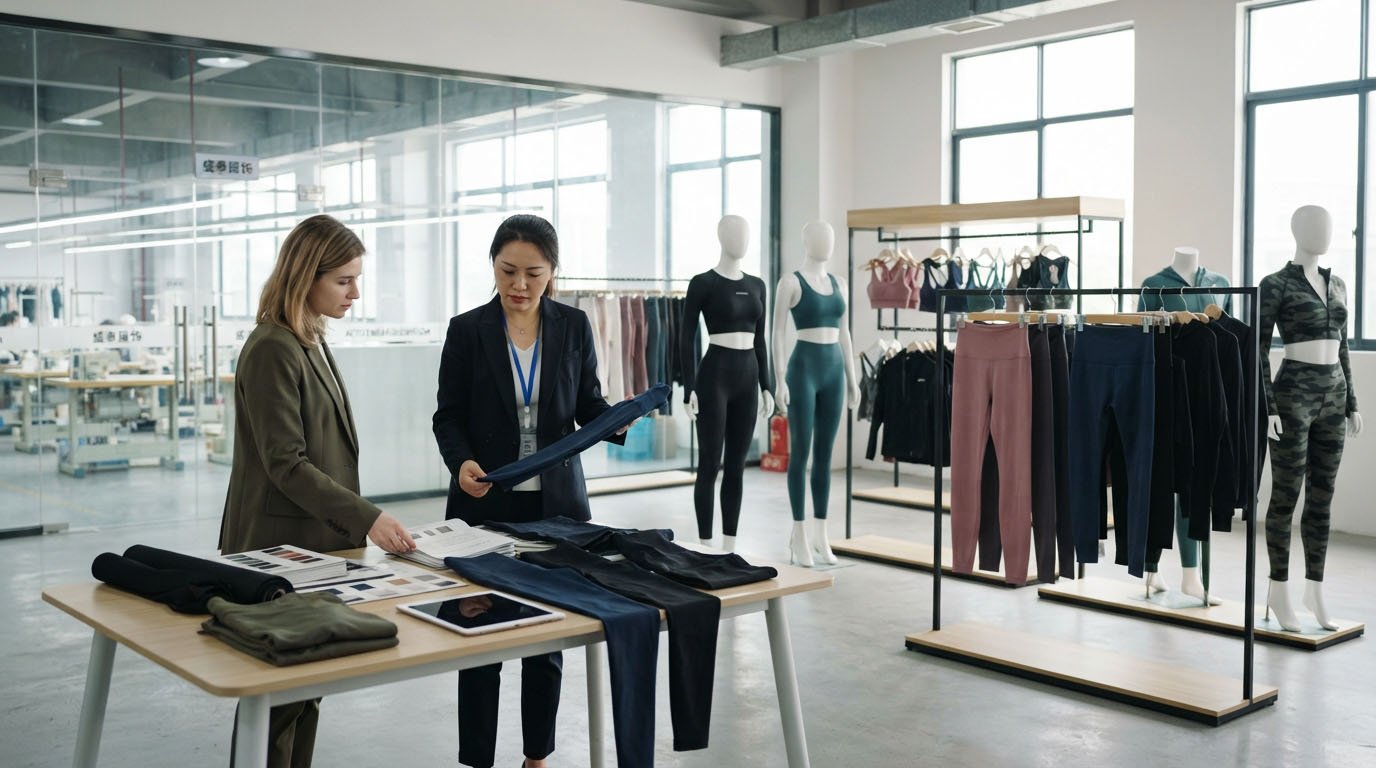
Quick Answer: How Do You Find a Reliable Activewear Factory in China?
Follow these eight steps to identify and qualify potential manufacturing partners.
| Step | Action | What to Confirm |
|---|---|---|
| 1 | Define product requirements | Fabric, fit, specifications, quantity |
| 2 | Find manufacturers | Google, sourcing platforms, trade shows |
| 3 | Verify supplier identity | Business registration and production site |
| 4 | Evaluate technical capabilities | Activewear experience and machinery |
| 5 | Check fabric quality | Material specifications and performance |
| 6 | Test samples and QC | Approved standards and inspection procedures |
| 7 | Compare commercial terms | MOQ, pricing, lead times, payment |
| 8 | Qualify the supplier | Evidence, risk assessment, written agreement |
Key principle: Never select a manufacturer based solely on price, certifications, or showroom samples. Look for evidence that the factory can produce your specific garments reliably.
Step 1. Define Your Activewear Product Requirements
Before contacting Chinese manufacturers, prepare a clear product brief.
Vague requests such as "premium yoga leggings" or "high-quality gym clothing" make it difficult to compare quotations or evaluate manufacturing capabilities.
Your brief should include:
- Product category: Leggings, sports bras, running shorts, or training tops.
- Target market: USA, Europe, Australia, or another destination.
- Fabric: Preferred composition, weight (GSM), stretch, and finish.
- Performance: Opacity, moisture management, support, or stretch recovery.
- Construction: Flatlock seams, gussets, waistbands, or special stitching.
- Sizing: Size charts, measurement points, and proposed tolerances.
- Order details: Estimated quantities, colors, branding, and delivery requirements.
For example, compression leggings require different fabric recovery and construction techniques from relaxed-fit training shirts.
A qualified manufacturer should recognize these differences and clarify technical requirements before offering a firm quotation.
Choose the Right Manufacturing Model
Your development needs influence which suppliers are suitable.
- OEM: Manufacturing garments based on your custom designs and specifications.
- ODM: Selecting or adapting manufacturer-developed designs.
- Private Label: Applying your branding to existing or lightly customized products.
For brands launching with established styles, private label activewear manufacturing may reduce initial development complexity.
Fully custom products generally require more pattern development, sampling, and technical coordination.
Step 2. Where Can You Find Activewear Manufacturers in China?
China has an extensive apparel manufacturing network, but different suppliers specialize in different products, fabrics, and production methods.
The most effective approach is to use several sourcing channels, understand the main manufacturing regions, and build a shortlist before requesting samples.
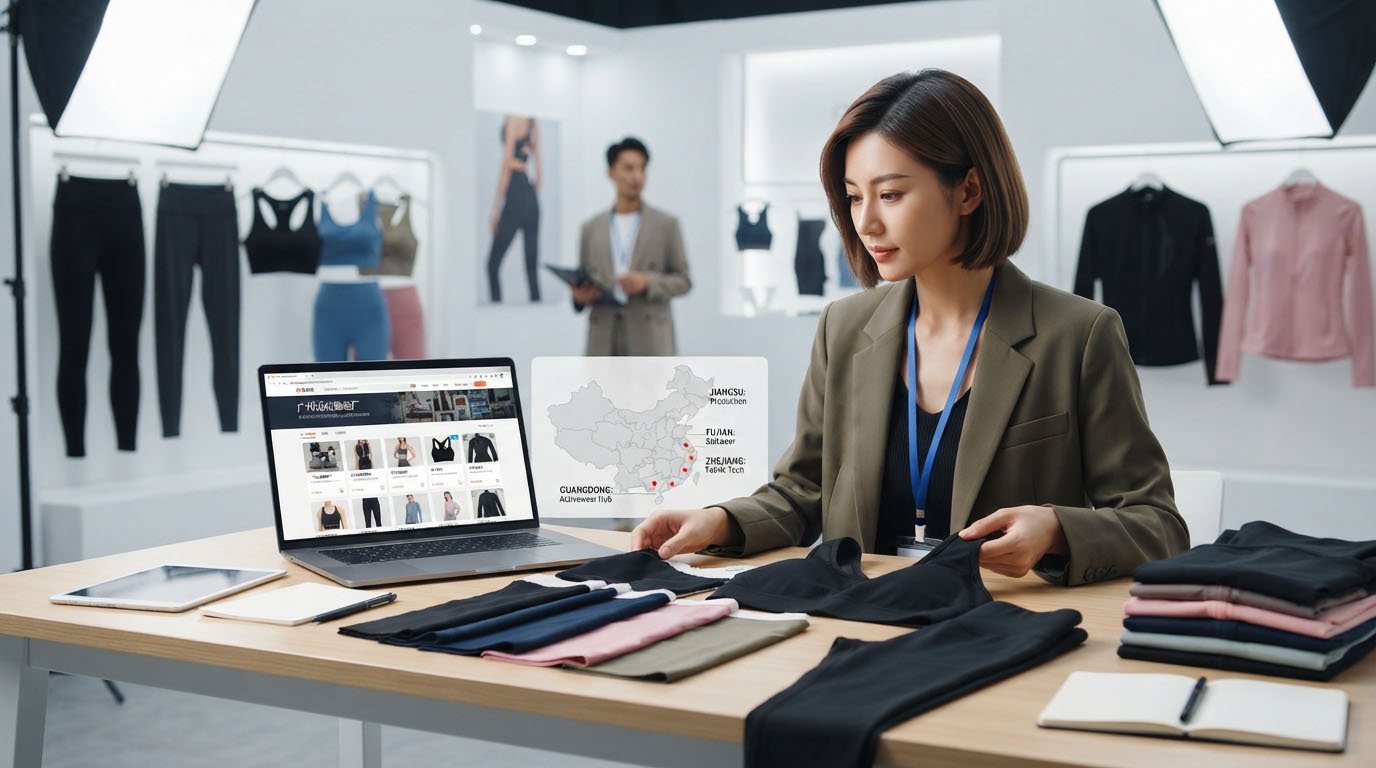
Search Google and Manufacturer Websites
Google can help identify manufacturers with dedicated websites, product information, and export services.
Useful searches include:
- activewear manufacturer China OEM
- custom leggings manufacturer China
- private label sports bra manufacturer China
- cut and sew activewear factory China
- yoga clothing manufacturer China
Review each manufacturer's product categories, production processes, sampling capabilities, and experience with overseas brands.
Look for detailed manufacturing information rather than generic promises such as "best quality" or "lowest price."
A professional website is useful, but it does not prove that the company owns the production facility shown.
Use Alibaba and Made-in-China
B2B platforms help buyers identify suppliers and compare initial quotations.
Review:
- Product specialization and customization options.
- Advertised MOQ and order requirements.
- Factory information and verification documents.
- Available production examples.
- Communication quality and technical responses.
Platform badges and supplier ratings can support initial screening, but they should not replace independent verification.
A supplier offering many unrelated product categories may use external manufacturers. This is not necessarily a problem, provided production responsibilities are transparent.
Explore China's Activewear Manufacturing Regions
Several Chinese regions have established apparel and textile supply chains.
Guangdong — Guangzhou and Dongguan
These areas have garment manufacturing, fabric sourcing, decoration, and export-service networks. They can be useful starting points for custom cut-and-sew activewear.
Fujian — Quanzhou and Jinjiang
Fujian has a well-developed sportswear and related textile manufacturing industry. Buyers sourcing performance sportswear and functional garments may find relevant suppliers here.
Zhejiang — Yiwu, Haining, and Keqiao
Parts of Zhejiang are known for knitting, seamless apparel production, and textile trading. This region may be relevant when sourcing seamless products or specialized fabrics.
Jiangsu — Suzhou and Surrounding Textile Areas
Jiangsu has an established textile manufacturing and processing network, making it another region worth considering for fabric sourcing and custom development.
These regional descriptions are sourcing starting points, not guarantees of factory quality. Individual supplier capability matters more than location alone.
Use Trade Shows and Industry Referrals
The Canton Fair and relevant textile or apparel exhibitions provide opportunities to meet suppliers and discuss manufacturing requirements directly.
Referrals from other apparel businesses may also help identify specialized factories that are less visible through online directories.
Regardless of how you discover a supplier, apply the same verification standards.
What Should You Ask in Your First Factory Inquiry?
Your first message should provide enough information for a manufacturer to evaluate your project.
Include:
- Product type and target market.
- Reference photos, sketches, or a tech pack.
- Preferred fabric and performance requirements.
- Estimated quantity per style and color.
- Custom labels, logos, or packaging requirements.
- Target sampling and delivery schedule.
Also ask three initial questions:
- Have you manufactured similar activewear products?
- What are your MOQ and sample development requirements?
- Which production processes are handled in-house?
A supplier that responds with relevant technical questions is generally more useful than one that immediately provides a generic price.
Build a Shortlist Before Ordering Samples
A practical initial process is to identify approximately 10–15 potential suppliers, narrow the list to 3–5 qualified candidates, and request comparable quotations and samples.
These figures are suggested screening targets rather than fixed industry requirements.
The objective is not to contact as many factories as possible. It is to identify suppliers that genuinely match your product and production needs.
Step 3. Verify the Manufacturer Before You Commit
Finding a supplier does not automatically mean you have verified its production operations.
Some companies manufacture products in their own facilities, while others coordinate production through partner factories or subcontractors.
Either arrangement can work, but you must understand who actually produces your garments.
Verify the Supplier's Identity and Production Site
Request evidence covering:
- Business registration: Confirm the legal company name and registration details.
- Production address: Identify where your garments will actually be made.
- Live factory walkthrough: Ask to see cutting, sewing, finishing, and QC areas.
- Relevant production examples: Review similar activewear products.
- Subcontracting disclosure: Confirm which processes are outsourced.
- Commercial documents: Check that contracts and payment details are consistent with the agreed business arrangement.
A live video walkthrough can provide useful evidence, but it does not replace an independent factory audit.
For larger or higher-risk orders, consider an on-site assessment.
Direct Factory vs. Trading Company
A direct manufacturer typically controls its own production operations. A trading company coordinates manufacturing through other factories.
The critical questions are:
- Who manufactures the garments?
- Who approves fabric and production standards?
- Who manages quality inspections?
- Who is responsible for defects or delays?
Warning sign: A supplier repeatedly refuses to identify its production facility or explain manufacturing responsibilities.
The goal is transparency and accountability, not automatically rejecting every trading company.
Step 4. Evaluate Activewear-Specific Manufacturing Capabilities
Technical activewear requires different expertise from basic casualwear.
Four-way stretch fabrics, compression fits, supportive waistbands, and high-movement seams require appropriate production methods and experienced operators.
A factory making excellent cotton T-shirts may not have the same capabilities in compression leggings or sports bras.
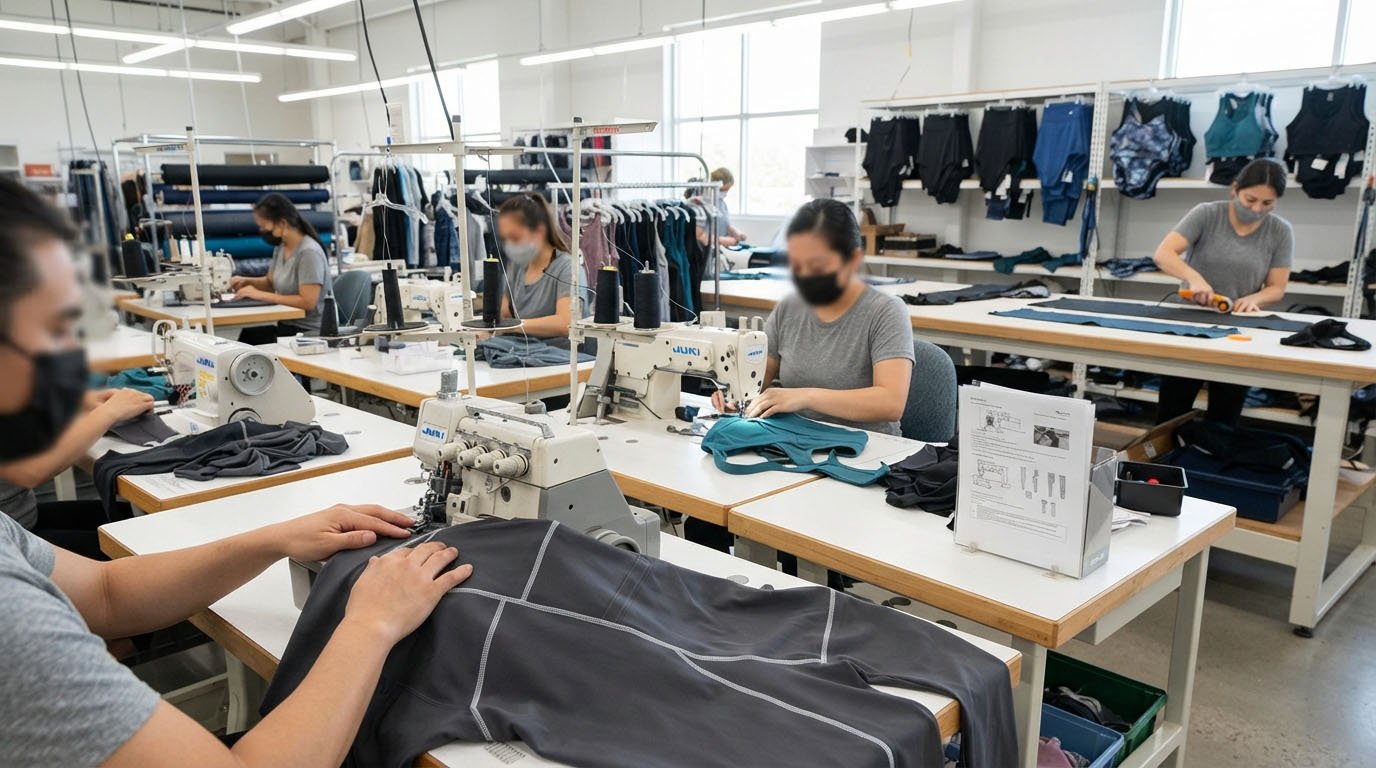
Match Factory Capabilities to Your Product
| Activewear Product | Important Manufacturing Capabilities |
|---|---|
| Yoga leggings | Stretch seams, gussets, waistband construction |
| Sports bras | Elastic handling, support structure, fit consistency |
| Running tops | Lightweight stretch fabric, comfortable seams |
| Training shorts | Movement allowance, reinforced construction |
| Compression wear | Fabric recovery, controlled garment tension |
Relevant equipment may include overlock, flatlock, and coverstitch machines, depending on garment construction.
Not every factory needs every specialized machine. What matters is whether its equipment and operators can handle your exact requirements.
Check Fabric Handling and Cutting
Stretch fabrics may change dimensions during spreading, cutting, sewing, and finishing.
Ask how the factory controls fabric tension, cutting accuracy, sewing-machine feed, and elastic consistency.
For custom designs, the manufacturer's cut and sew capabilities should match your fabric properties, patterns, and production volume.
Request Technical Evidence
Instead of asking, "Can you manufacture high-quality activewear?" ask:
"Can you show a similar garment and explain how you control its seam construction, fabric handling, and fit during production?"
A capable manufacturer should provide product-specific explanations rather than relying entirely on showroom samples.
Step 5. Verify Fabric Quality and Material Sourcing
Fabric quality directly influences activewear performance, durability, and customer satisfaction.
A garment may look attractive during sampling but develop pilling, opacity problems, or poor stretch recovery after repeated wear.
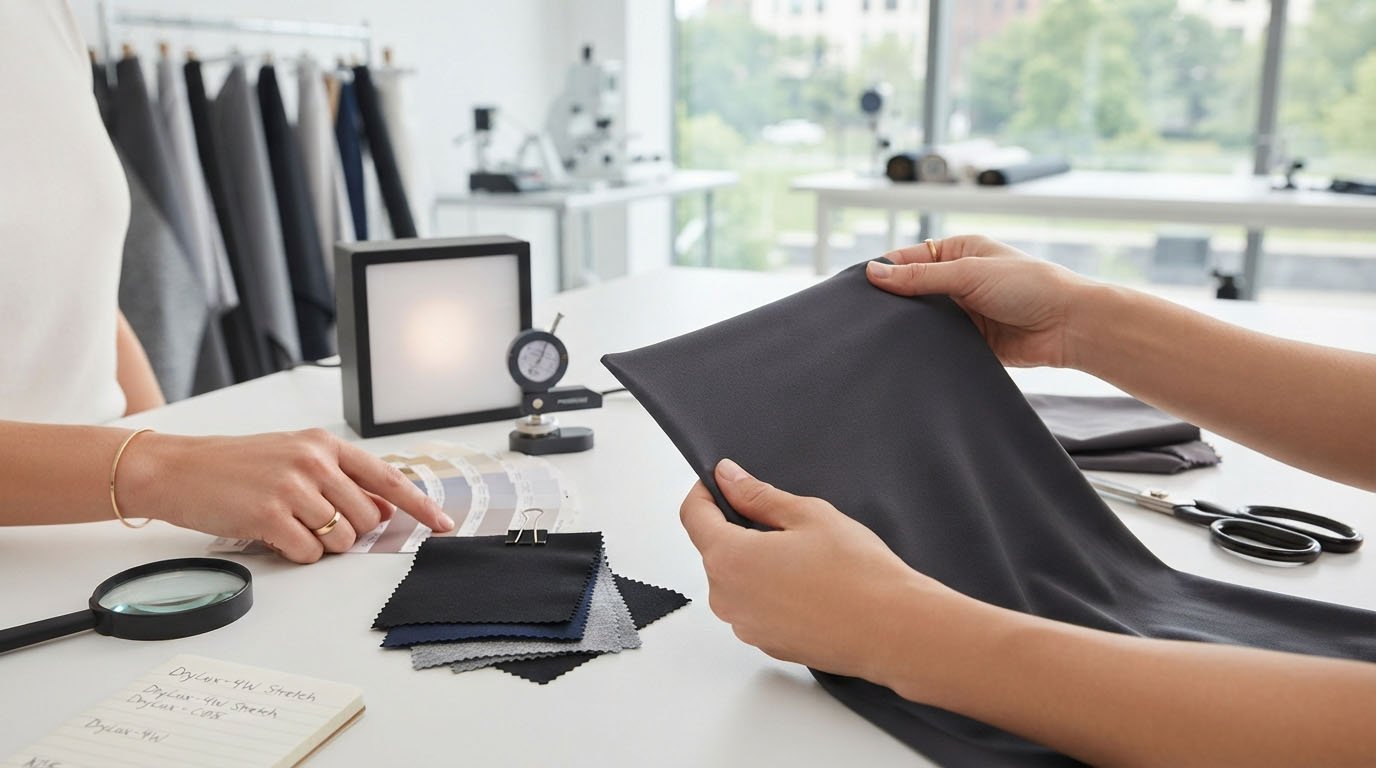
Which Fabric Properties Matter?
Check specifications relevant to the intended product:
- Composition and GSM: Affect fabric weight, feel, and coverage.
- Stretch and recovery: Influence fit retention.
- Opacity: Particularly important for leggings.
- Colorfastness: Helps evaluate fading and color transfer.
- Pilling resistance: Indicates surface durability.
- Dimensional stability: Helps control size changes after washing.
Testing requirements should match the product and its intended use.
For example, leggings may require opacity testing under stretch, while running garments may prioritize moisture management.
Prevent Fabric Substitution During Bulk Production
To maintain consistency between approved samples and finished goods:
- Record the approved fabric specifications.
- Retain fabric and color references.
- Confirm applicable test requirements.
- Inspect incoming materials against approved standards.
- Require written approval before substitutions.
Where performance materials are involved, fabric sourcing support can help coordinate material selection and production consistency.
Step 6. Evaluate Samples and Quality Control Before Bulk Production
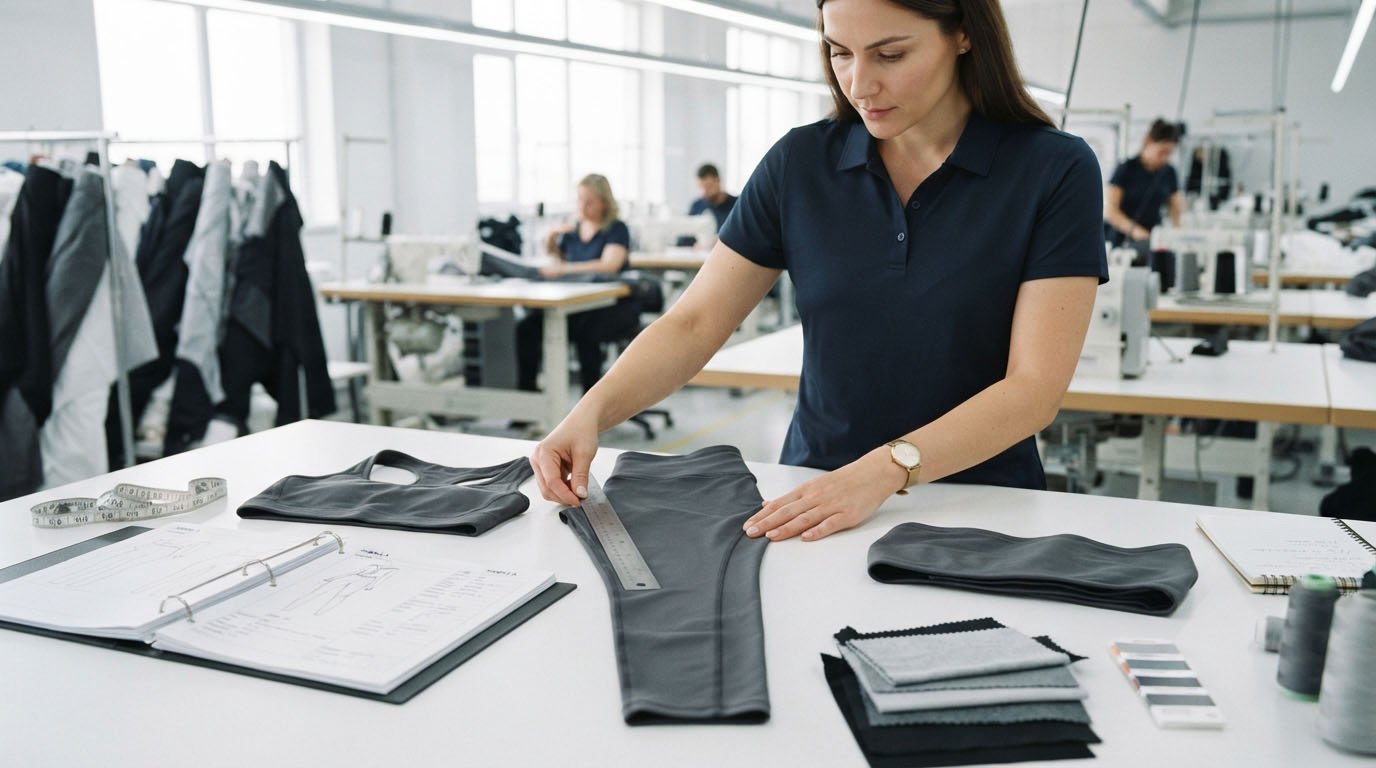
An approved sample shows that a design can be manufactured. It does not guarantee consistent bulk production.
Bulk orders involve different operators, fabric rolls, cutting batches, and production conditions.
A reliable manufacturer must transfer approved sample requirements into repeatable production standards.
Establish Approved Production References
Before bulk manufacturing, finalize:
- Approved physical sample.
- Tech pack and graded size specifications.
- Measurement points and agreed tolerances.
- Fabric, trims, and construction details.
- Logo placement and color references.
- Performance and workmanship requirements.
These documents should guide production and quality inspections.
Confirm the Main QC Stages
Incoming Material Inspection: Check fabric and trim quality before cutting.
Pre-Production Review: Confirm approved samples, construction methods, and production instructions.
In-Line Inspection: Identify recurring sewing, fit, and measurement problems before they affect the entire order.
Final Inspection: Review finished garments against approved specifications and agreed acceptance criteria.
An AQL sampling plan may be used for final inspections, with defect classifications and acceptance criteria established for the project.
Focus on Activewear-Specific Defects
Particular risks include:
- Waistbands twisting or rolling.
- Seams breaking under stretch.
- Excessive transparency in leggings.
- Incorrect gusset positioning.
- Uneven sports bra elastic tension.
- Fabric shade variations.
For high-risk styles, consider a pilot run or early production review before completing the full order.
The key question is whether the factory can reproduce approved sample quality consistently—not simply whether the initial sample looks good.
Step 7. Compare MOQ, Pricing, and Production Lead Times
The lowest quotation does not always represent the lowest total sourcing cost.
Factories may use different fabrics, construction methods, testing requirements, or shipping arrangements.
Understand Activewear MOQ Requirements
MOQ depends on factors such as:
- Stock versus custom-developed fabrics.
- Fabric dyeing minimums.
- Quantity per style and color.
- Size and color combinations.
- Construction and customization complexity.
Stock materials and established designs may allow smaller orders, while custom materials can require higher commitments.
Always ask:
"Does your MOQ apply per style, per color, per fabric, or across the entire order?"
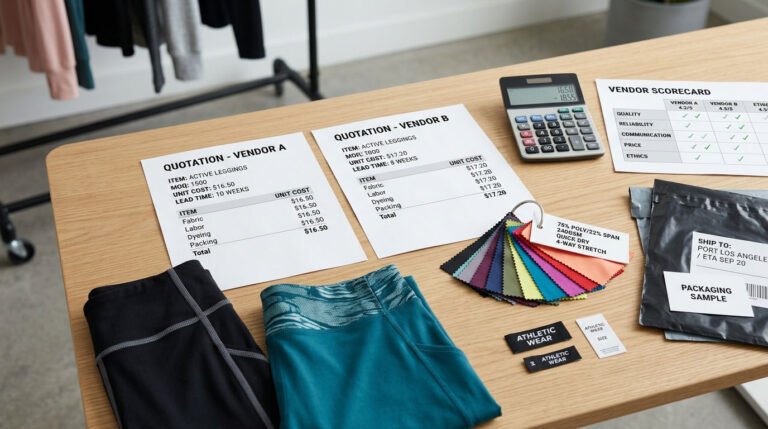
Compare Quotations on the Same Basis
A clear quotation should identify:
- Fabric and material specifications.
- Cutting, sewing, and finishing.
- Sampling and development charges.
- Logos, labels, and packaging.
- Testing requirements.
- Shipping terms and included costs.
Confirm whether pricing is based on EXW, FOB, or another agreed Incoterm.
Check Lead Times and Payment Terms
A realistic production schedule should account for:
- Material sourcing or development.
- Sampling and approval.
- Production preparation.
- Cutting and sewing.
- Inspection, packing, and shipment.
Lead times vary depending on material availability, design complexity, factory capacity, and order size.
Before paying a deposit, confirm the payment schedule, inspection rights, defect remedies, and responsibilities for production delays.
Avoid accepting unusually fast delivery promises without a credible production plan.
Step 8. Select the Manufacturer and Protect Your First Bulk Order
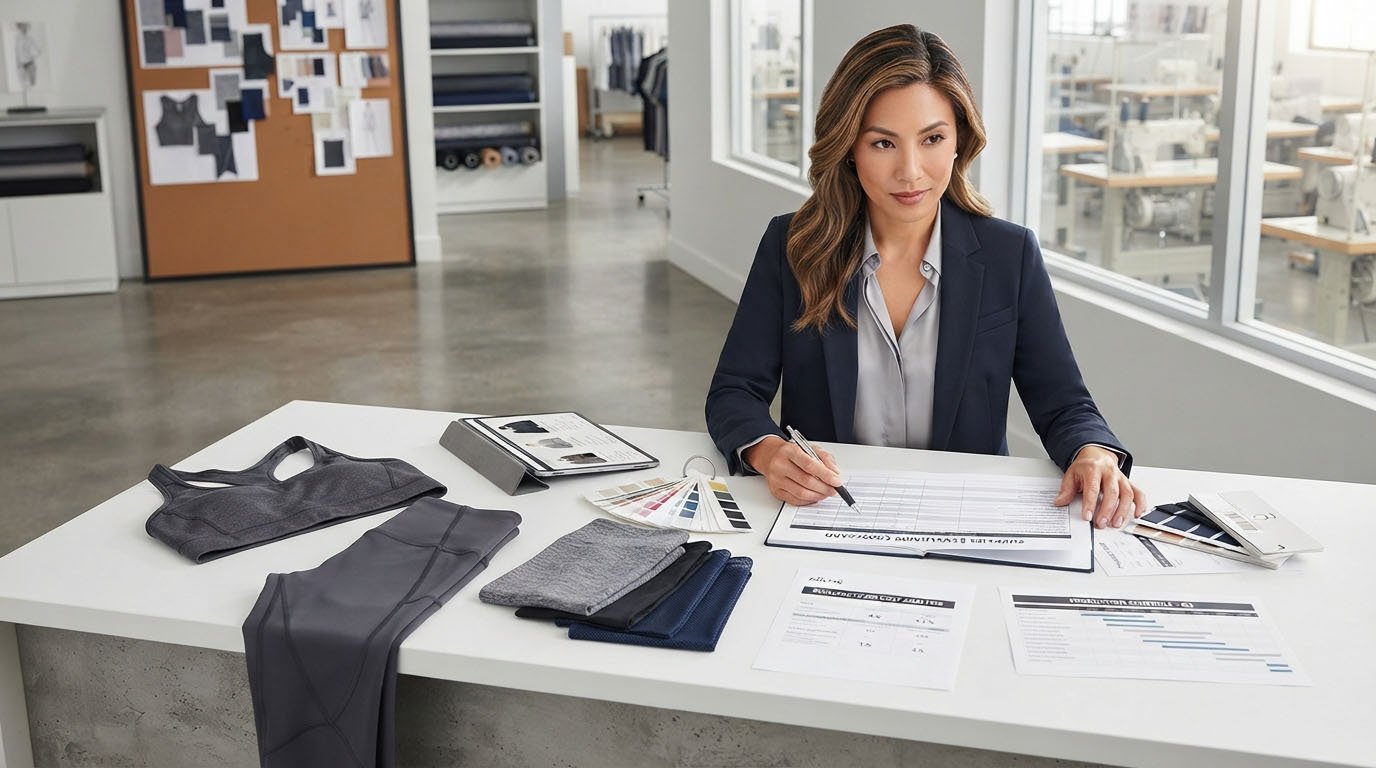
Once you have reviewed supplier identity, technical capabilities, fabric quality, samples, and commercial terms, compare your shortlisted manufacturers using consistent criteria.
Activewear Manufacturer Evaluation Scorecard
| Evaluation Area | Evidence to Review | Priority |
|---|---|---|
| Supplier verification | Registration and production-site evidence | High |
| Product specialization | Similar garments and technical processes | High |
| Fabric management | Specifications and testing evidence | High |
| Sample quality | Fit, construction, performance | High |
| Quality control | Inspection procedures and records | High |
| Commercial terms | MOQ, total cost, delivery conditions | High |
| Communication | Technical clarity and issue resolution | Medium |
Use this scorecard to compare evidence rather than promotional claims.
A factory with a slightly higher quotation may provide better overall value if it offers stronger quality control, clearer communication, and more predictable manufacturing.
Final Checks Before Paying a Deposit
Your purchase order or manufacturing agreement should establish:
- Approved product specifications and samples.
- Quantities, colors, and size breakdowns.
- Material and construction requirements.
- Production milestones and delivery conditions.
- Inspection rights and acceptance criteria.
- Payment schedule.
- Remedies for defective or nonconforming goods.
- Procedures for approving production changes.
The agreement should reflect your project and applicable legal requirements.
Red Flags That Should Delay Your Order
Reconsider proceeding if the supplier:
- Cannot demonstrate relevant production capabilities.
- Changes material specifications without approval.
- Refuses reasonable production inspections.
- Provides inconsistent MOQ or pricing information.
- Pressures you to pay before key terms are agreed.
- Cannot explain subcontracting responsibilities.
Unresolved risks should be addressed before bulk production begins.
For a broader discussion of manufacturer evaluation criteria, read our guide to choosing a reliable activewear manufacturer.
Frequently Asked Questions
How Can I Find a Direct Activewear Factory in China?
Start with Google, B2B sourcing platforms, trade shows, and industry referrals. Verify the supplier's business registration, actual production facility, relevant machinery, and manufacturing experience. Consider an independent audit for additional assurance.
What Is the MOQ for Custom Activewear Manufacturers in China?
There is no universal MOQ. Requirements vary by garment type, fabric availability, color, and customization. Existing designs and stock materials may allow smaller orders than fully custom production.
How Do I Know Whether an Activewear Manufacturer Is Reliable?
Look for consistent evidence across supplier identity, product specialization, fabric quality, sample development, production controls, and commercial transparency. A reliable supplier should explain technical limitations and potential risks clearly.
Which Certifications Should I Check When Sourcing Activewear?
Depending on product and market requirements, relevant evidence may include ISO 9001 quality management certification, applicable OEKO-TEX certification, social compliance assessments, and chemical testing documentation.
Verify each document's validity, issuing organization, covered products, and facility scope. Certification alone does not guarantee manufacturing quality.
Conclusion: Find a Manufacturing Partner, Not Just a Low Quote
Finding a reliable activewear manufacturer in China requires a structured sourcing and qualification process.
Start with clear product requirements, search through multiple channels, verify the actual production facility, and evaluate technical capabilities before approving samples and commercial terms.
The right manufacturing partner should match your product requirements, communicate risks transparently, and maintain consistent quality from initial samples through repeat orders.
Looking for an Activewear Manufacturing Partner in China?
At Wearzio, we support startup brands, established activewear labels, and wholesale buyers through OEM/ODM manufacturing, custom garment development, fabric sourcing, and private label services.
With over 10 years of activewear manufacturing experience, our team helps brands develop leggings, sports bras, workout tops, and other performance apparel.
Contact Wearzio to discuss your designs, fabric requirements, order quantities, and production plans.