.png)
You have a launch date, a budget, and product ideas—but you're stuck on one decision: Private Label, ODM, or OEM.
Most articles explain the definitions. Very few explain what those models mean for your cash flow, MOQ, launch speed, design control, and risk of getting stuck with unsold stock.
Private Label means buying ready-made activewear with your branding. ODM means choosing a manufacturer's existing design and making limited modifications. OEM means you provide the design and tech pack, and the factory produces it for you. The right model depends on your budget, timeline, and how much product differentiation you actually need at your current stage.
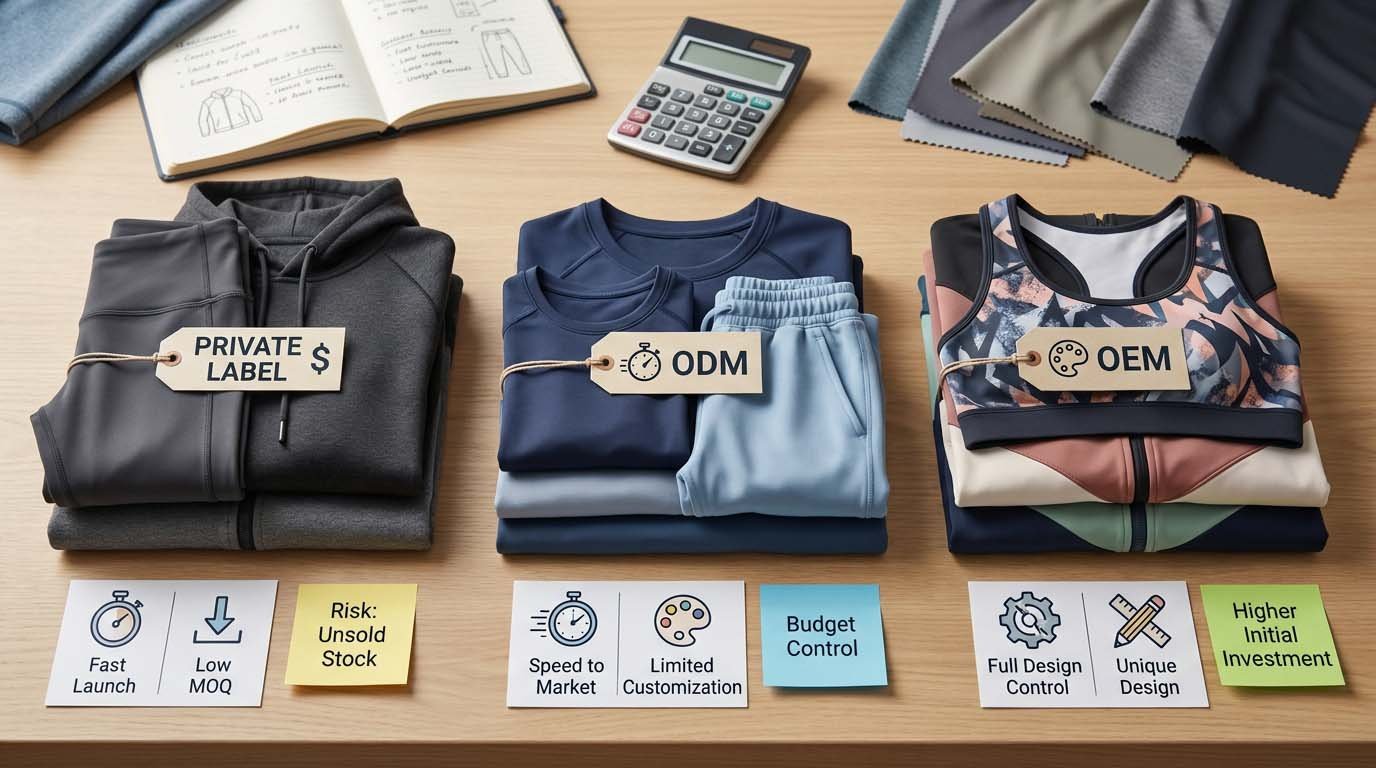
At Wearzio, we have worked with new and growing activewear brands for more than 10 years. The biggest mistake we see is not choosing the “wrong” model in theory. It is choosing a model that does not match the brand's real constraints. A founder wants uniqueness, chooses OEM, and burns budget on development before launch. Another wants the lowest MOQ, chooses Private Label, and later realizes the higher unit cost crushes margins.
This guide is built to help you avoid that. It explains:
- what each model actually means in production
- how MOQ, lead time, and pricing really work
- where hidden costs show up
- who should use each model at each stage
- what to clarify in contracts before you pay deposits
Quick Answer: Private Label, ODM, or OEM?
If you need the short version first, here it is.
Private Label is best for fast market testing with low MOQ. ODM is best for brands that want better margins and moderate customization without full design development. OEM is best for brands with stronger budgets, clear product direction, and complete design specifications.
One-Minute Comparison
| Model | Best For | Typical MOQ | Unit Cost | Lead Time | Design Control |
|---|---|---|---|---|---|
| Private Label | Testing fast with low capital | 50–100 pcs | $18–25 | 2–4 weeks | Low |
| ODM | Semi-custom launch with better margins | 300–500 pcs | $12–16 | 8–12 weeks | Medium |
| OEM | Full custom product and exclusivity | 500–1,000+ pcs | $10–14 | 12–16+ weeks | High |
The 5 Fast Answers Most Founders Need
1. Which model has the lowest starting cost?
Private Label has the lowest total entry cost because the MOQ is small. But it usually has the highest cost per piece.
2. Which model launches fastest?
Private Label, because the product already exists and only branding is added.
3. Which model gives me the most customization?
OEM, but only if you have a complete tech pack or budget to create one.
4. Which model is best for startups?
Usually Private Label first, then ODM, then OEM as the brand grows.
5. Which model gives me the best margins long term?
Usually ODM or OEM, because the per-unit cost is lower and the product is less commoditized.
Simple rule:
- Need stock in 3 weeks? → Private Label
- Need better margins and some customization? → ODM
- Need your own design and can wait 3+ months? → OEM
What Private Label, ODM, and OEM Actually Mean
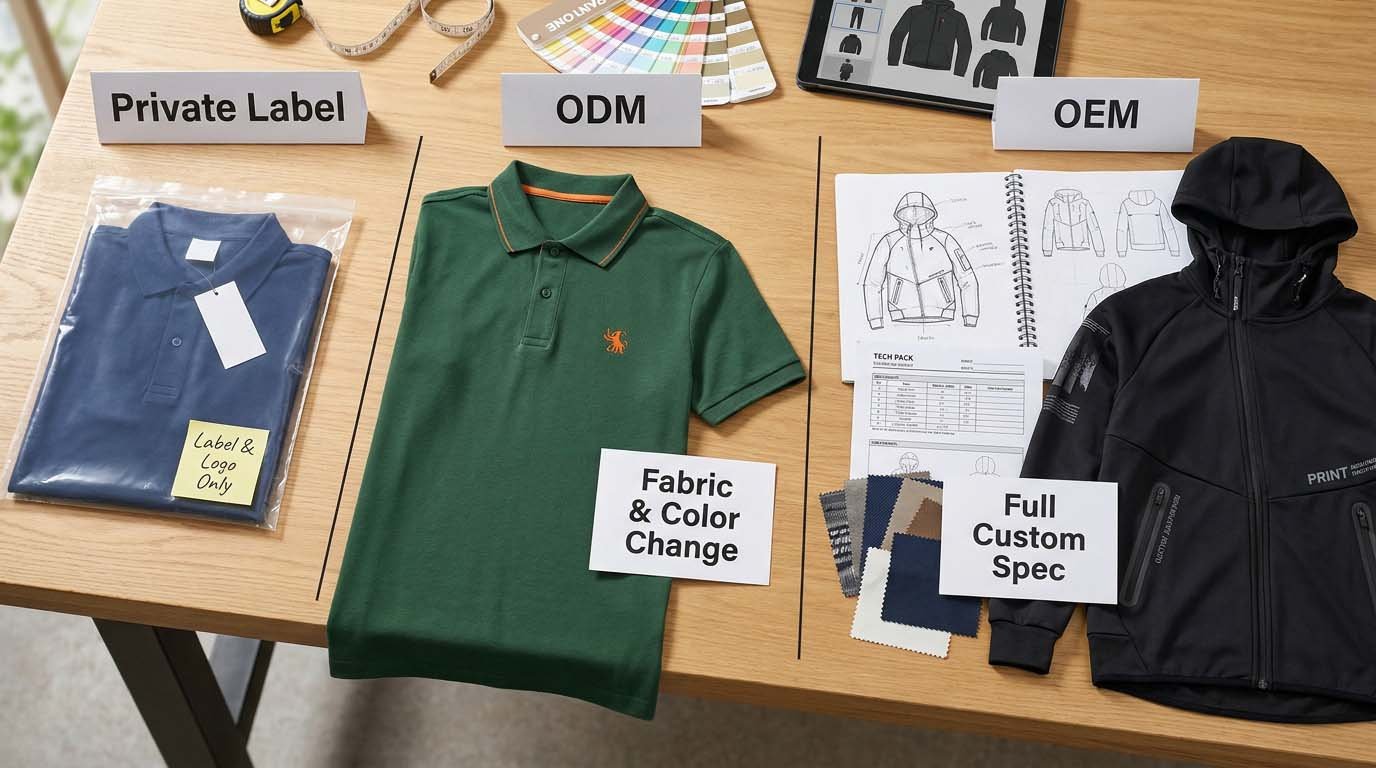
A lot of confusion comes from how different suppliers use the terms. Some factories call almost everything “OEM.” Others call semi-custom work “ODM” even when it involves new development.
Here is the practical way to understand it:
Private Label
Private Label means the manufacturer already has the design, pattern, and often finished stock or ready production setup. You select from existing products and add your brand label, logo, packaging, or hang tags.
What usually changes:
- neck label
- care label
- logo print or embroidery
- packaging and hangtags
What usually does not change:
- fit
- pattern
- construction
- core fabric structure
- silhouette
Best for:
- first product test
- low-budget startups
- quick launches
- event or seasonal deadlines
Trade-off:
You launch fast, but other brands may sell the same or very similar product.
ODM
ODM stands for Original Design Manufacturer. The manufacturer provides the base design and pattern. You customize certain elements without fully developing a new style from scratch.
Typical ODM modifications:
- fabric option changes
- color changes
- logo placement
- label and packaging
- trim color adjustments
- minor functional details if already built into the pattern system
Best for:
- brands that want some differentiation
- founders without a full design team
- businesses ready to commit to 300–500 pieces
- reorders after a successful Private Label test
Trade-off:
You get better pricing and more branding control than Private Label, but you do not fully own the base pattern.
OEM
OEM stands for Original Equipment Manufacturer. You provide the design, and the factory manufactures it according to your specifications.
That usually means:
- tech pack
- measurement chart
- fabric specification
- construction details
- trim details
- artwork placements
- grading or fit direction
Best for:
- brands with clear product direction
- brands that need exclusivity
- scaling businesses with working capital
- teams that already have designers or developed samples
Trade-off:
You get the most control, but you also take the most development risk.
Private Label vs ODM vs OEM: Side-by-Side Comparison
| Factor | Private Label | ODM | OEM |
|---|---|---|---|
| Design source | Manufacturer stock design | Manufacturer base design | Your design |
| Pattern ownership | Manufacturer | Usually manufacturer | Usually customer |
| MOQ | Lowest | Medium | Highest |
| Unit cost | Highest | Medium | Lowest at scale |
| Lead time | Fastest | Medium | Longest |
| Customization | Very limited | Moderate | Full |
| Sampling required | Usually no or optional | Yes | Yes |
| Best for | Testing | Growing | Scaling / differentiation |
| Risk type | Weak differentiation | Scope creep | Development + inventory risk |
Pros and Cons of Each Model
Choosing the right model is about trade-offs. You are always exchanging one thing for another: lower MOQ for higher cost, faster launch for less differentiation, or exclusivity for more upfront investment.
Private Label: Pros and Cons
Pros
- fastest launch
- lowest entry MOQ
- no designer required
- lower upfront cash than ODM/OEM
- good for testing product category and audience
Cons
- highest unit cost
- lowest differentiation
- no real pattern ownership
- stock availability can change
- reorders may not match the first batch exactly
Best used when:
You need to validate demand before investing more deeply.
ODM: Pros and Cons
Pros
- lower unit cost than Private Label
- better branding flexibility
- faster than OEM
- no full tech pack needed for basic changes
- manufacturer has already tested the base fit and construction
Cons
- higher MOQ than Private Label
- limited customization boundaries
- repeated sample changes can add cost and delay
- base design is still not fully yours unless specifically negotiated
Best used when:
You have some sales confidence and want better margins without going fully custom.
OEM: Pros and Cons
Pros
- full design control
- strongest differentiation
- best long-term brand building
- strongest IP position if contract is written correctly
- lower unit economics at scale
Cons
- highest MOQ
- longest timeline
- tech pack/design cost
- more sample rounds
- higher risk if your first design misses the market
Best used when:
You already know what sells—or you have enough capital to absorb development risk.
Hidden Costs Most Brands Miss
Many founders compare only MOQ and unit price. That is not enough.
Hidden Cost in Private Label
The problem is often not the first order. It is what happens after a successful launch.
You may launch quickly with 50–100 pieces, but:
- the product may not be reorderable in the same color/fabric
- your margin may be too thin to scale ads
- another brand may sell nearly the same item
Private Label can be cheap to start, but expensive to scale.
Hidden Cost in ODM
The hidden cost is usually revision creep.
A founder says:
- “Can we make the waistband a bit higher?”
- “Can we move the pocket?”
- “Can we soften the hand feel?”
- “Can we change the fit slightly?”
One or two of these may still fit ODM. Too many, and the project starts behaving like OEM:
- more sample rounds
- development charges
- longer timeline
- misaligned expectations
Hidden Cost in OEM
The biggest hidden cost is design development before production even starts.
Typical first-order OEM extras:
- tech pack development: $500–2,000 per style
- sample rounds: $200–500 each
- pattern development / grading: often additional if not supplied
- fabric sourcing for specific performance requirements
- longer launch delay if revisions stack up
OEM is often not too expensive per piece. It is expensive before the first bulk unit exists.
ODM Customization: What Is Usually Included vs What Triggers OEM
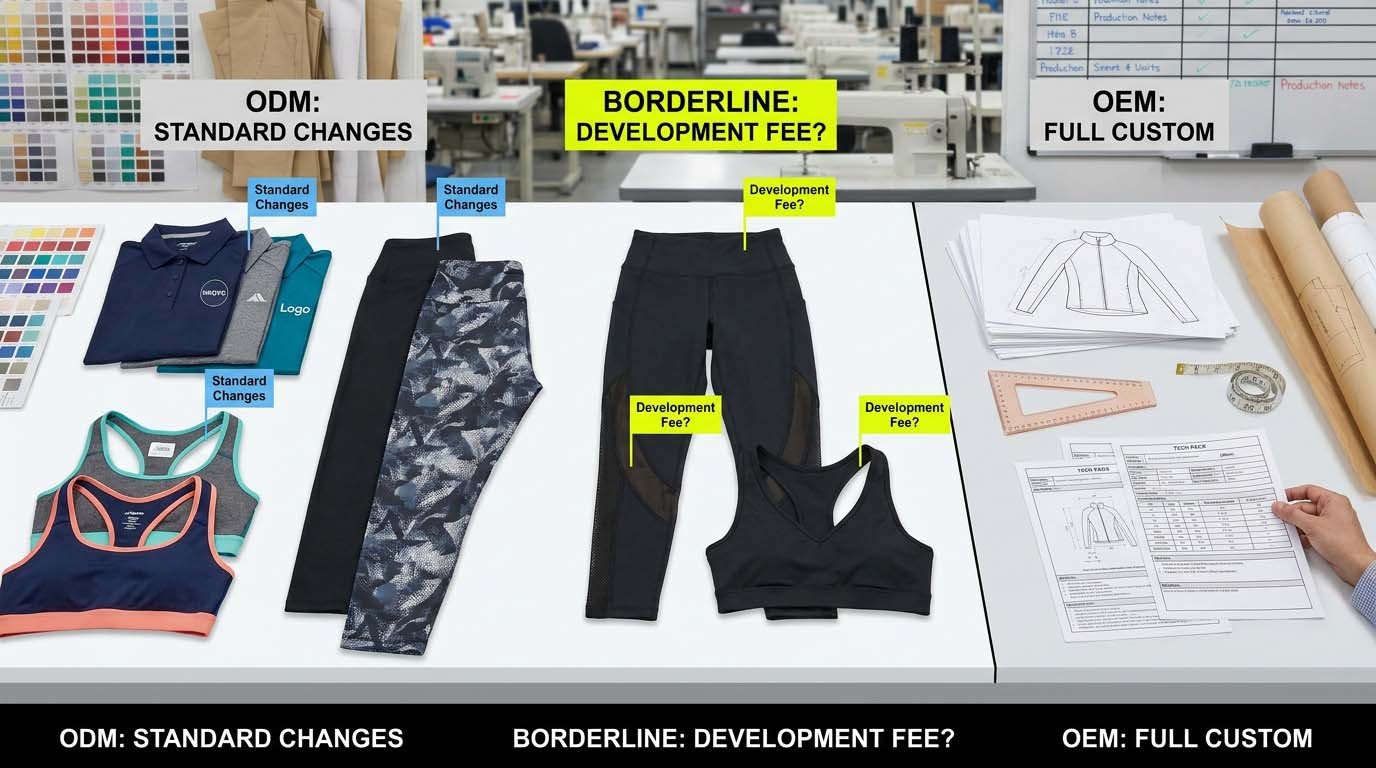
This is where many projects go wrong.
A lot of buyers hear “ODM” and assume it means semi-custom without limits. In reality, ODM has boundaries.
Usually Standard in ODM
These changes are commonly possible without full redevelopment:
- changing body color
- choosing from approved fabric options
- changing logo placement
- changing labels, tags, packaging
- adjusting trim colors
- using an existing pocket option already built into the style family
Often Extra or Borderline
These changes may add development fees depending on the factory:
- waistband height changes beyond standard range
- leg length adjustment outside standard grading
- adding/removing mesh panels
- moving pockets to new placement
- changing neckline shape
- changing support structure in bras
Usually Triggers OEM or Re-Patterning
These changes usually require a new pattern or significant redevelopment:
- changing rise from high-waist to mid-rise
- changing the entire fit block
- changing seam architecture
- building a new silhouette
- changing construction logic
- creating a signature design that is not in the existing library
Good supplier question to ask:
“Which modifications are included in your ODM process, and which ones require new pattern development?”
That one question can save weeks of confusion.
How the Workflow Actually Runs
Definitions are easy. Workflow is where brands lose time.
Private Label Workflow
- Choose from stock catalog
- Confirm available colors and sizes
- Approve branding artwork
- Add labels / hangtags / packaging
- Final check and ship
Typical timeline: 2–4 weeks
Sampling: optional or stock sample only
ODM Workflow
- Select base style
- Confirm modifications
- Approve quotation and sample plan
- Review first sample
- Make revisions if needed
- Approve final sample
- Bulk production
- QC and shipment
Typical timeline: 8–12 weeks
Sampling: usually 1–3 rounds
OEM Workflow
- Submit tech pack
- Factory reviews for feasibility
- Material sourcing
- Prototype sample
- Fit comments / revision round
- Pre-production sample approval
- Bulk production
- QC and shipment
Typical timeline: 12–16+ weeks
Sampling: usually 2–5 rounds
Real Lead Times: What Founders Underestimate
Most timelines online are too optimistic because they ignore approvals and revisions.
Private Label
Factory timeline: 2–4 weeks
Real delivered timeline with shipping: 3–6 weeks
ODM
Factory timeline: 8–12 weeks
Real delivered timeline with shipping: 11–16 weeks
OEM
Factory timeline: 12–16+ weeks
Real delivered timeline with shipping: 16–24 weeks
Why do real timelines run longer?
- sample approval takes longer than expected
- buyer wants another revision
- custom fabric takes longer
- branding trims arrive late
- payment timing delays production release
- shipping adds 1–4+ weeks depending on method
Rule of thumb:
If this is your first order, add 20–30% extra time to the ideal quote.
MOQ and Budget Reality Check
This is the part most founders need to see clearly.
Typical Investment by Model
| Model | MOQ | Unit Cost | Typical First Order Spend |
|---|---|---|---|
| Private Label | 50–100 pcs | $18–25 | $1,000–2,500 |
| ODM | 300–500 pcs | $12–16 | $3,600–8,000 |
| OEM | 500–1,000+ pcs | $10–14 | $5,000–14,000+ |
What This Means in Practice
If your first-order budget is:
Under $2,000
→ Private Label is the realistic path
$3,000–6,000
→ Private Label or a focused ODM launch
$6,000–15,000
→ ODM is usually the strongest option; OEM may work for one simple core style
Above $15,000
→ You have room to choose based on strategy, not just constraints
One Important Truth
Low MOQ does not always mean low total long-term cost.
A founder may spend:
- $1,500 on a small Private Label test
- then reorder another $2,000
- then another $2,000
At that point, they may have spent more than a single better-planned ODM order would have cost—while still having weaker margins.
How to Choose the Right Model
Do not start with brand vision. Start with hard constraints.
The 3-Question Filter
1. What is your actual first-order budget?
Not your dream budget. Your real available cash for inventory.
2. When do you need finished goods in hand?
Not “when do I want to launch?”
When do you need stock delivered and ready?
3. Do you already have a complete tech pack?
If not, OEM is probably not your best first move.
Stage-Based Recommendation
Stage 1: Pre-Launch, No Sales Yet
You are still testing product-market fit.
Best fit: Private Label
Why: lower risk, faster launch, cheaper way to validate demand
Stage 2: Early Sales, First Proof of Demand
You have traction and want better margins and better brand identity.
Best fit: ODM
Why: stronger economics, moderate differentiation, manageable complexity
Stage 3: Scaling Brand
You know your customer, your hero products, and your positioning.
Best fit: OEM
Why: now exclusivity, fit control, and IP matter enough to justify development cost
Which Model Fits Your Situation?
Choose Private Label if:
- your budget is under $2,000–3,000
- you need stock fast
- you do not have a designer
- you are testing before investing
- your first goal is sales validation, not exclusivity
Choose ODM if:
- you have $4,000–10,000 to invest
- you want better margins than Private Label
- you want custom colors/fabrics/branding
- you can wait 2–3 months
- you do not yet need full custom patterns
Choose OEM if:
- you already have a strong product concept
- you have a complete tech pack or design team
- you can absorb development time and sample costs
- you want real design ownership
- you are building long-term differentiation, not just launching fast
Contracts, IP, Exclusivity, and Pattern Ownership
This is where many buyers make expensive assumptions.
Private Label IP Reality
Usually:
- the factory owns the design
- the factory can sell the same product to other brands
- you own only your branding
ODM IP Reality
Usually:
- the factory owns the base pattern
- your modifications may or may not be exclusive
- exclusivity must be negotiated clearly
- color/fabric exclusivity is easier than full pattern exclusivity
OEM IP Reality
Usually:
- you can own the design if the contract says so
- ownership of patterns, specs, and production use rights must be stated in writing
- without a written agreement, enforcement becomes much harder in cross-border production
Safer wording to include in OEM contracts:
- customer owns approved design files and brand-specific technical specifications
- manufacturer may not produce the same design for third parties
- any use outside the customer order requires written permission
Important Note on Exclusivity
Exclusivity is never “free.”
If you ask a supplier to stop selling a design to other buyers, they lose future revenue. That usually means one of these:
- higher MOQ
- exclusivity fee
- higher unit price
- annual commitment
If exclusivity matters to your brand, discuss it before sampling—not after approval.
Pricing and Payment Terms to Clarify Before You Pay
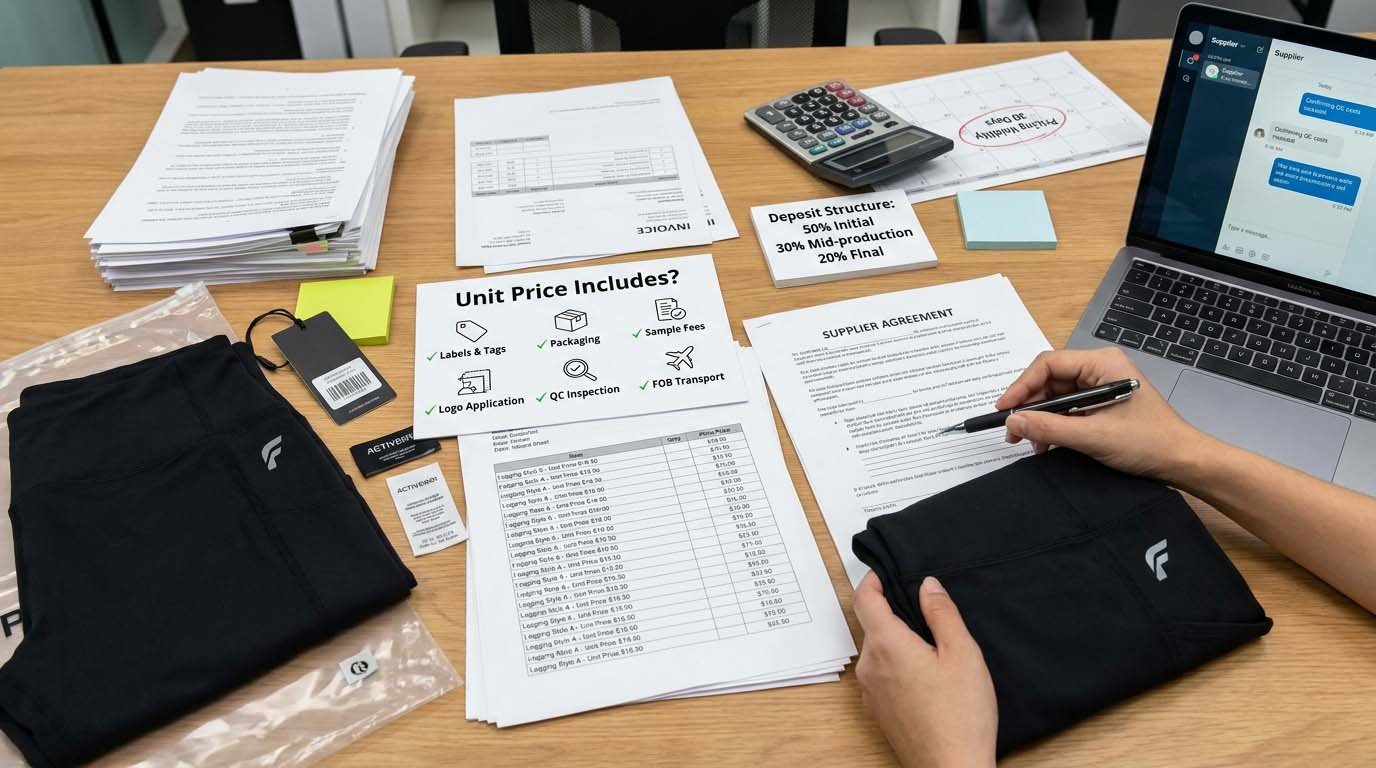
Ask every supplier these questions clearly:
1. What is included in the unit price?
Does it include:
- labels
- hangtags
- polybags
- cartons
- logo application
- sample deductions
- QC
- local transport
2. What is the sample policy?
Ask:
- sample cost
- number of included revisions
- whether sample fees are refundable or deductible
3. What deposit structure applies?
Typical ranges:
- Private Label: 50% deposit
- ODM: 30–50% deposit
- OEM: 30% deposit, sometimes with staged payments depending on development
4. How long is pricing valid?
Especially for ODM and OEM, ask how long pricing is locked and what happens if raw material prices move.
Quality Control and Compliance Basics
A good factory should be able to explain their QC process simply.
Minimum QC Questions to Ask
- Do you inspect during production or only at the end?
- What measurement tolerance do you allow?
- How do you verify color consistency?
- Can I get pre-shipment inspection photos or reports?
- Can I use a third-party inspector?
QC by Model
Private Label: stock inspection and branding check
ODM: sample match + in-line + final inspection
OEM: pre-production sample + in-line + final inspection, ideally with third-party check for first order
Compliance Reminders
Requirements depend on your market. Common basics:
- fiber content labels
- care labels
- country of origin
- proper size labeling
- chemical compliance where required
- retailer-specific requirements if selling wholesale
If you plan to market claims like:
- recycled
- organic
- OEKO-TEX
- GOTS
- compression performance
- squat-proof
- UV protection
…ask what test reports or certifications support those claims.
FAQ: Private Label, ODM, and OEM Activewear
Can I start with Private Label and switch to ODM later?
Yes. This is one of the most practical growth paths for new brands.
Can I start with ODM and move to OEM later?
Yes. Many brands use ODM to learn what customers like, then build OEM versions based on real feedback.
Do I need a tech pack for ODM?
Usually not for standard modifications. Yes if your changes go beyond the supplier's normal ODM range.
If I have sketches, is that enough for OEM?
Usually no. Sketches help, but they are not the same as a production-ready tech pack.
Can I negotiate MOQ lower?
Sometimes, but only within real material and production limits. If fabric minimums are the issue, paying more per unit may not solve it.
Can I get exclusivity in ODM?
Sometimes, but it usually applies to a version, colorway, or region—not automatic full pattern ownership.
What if I approve a sample and later dislike the bulk order?
If the bulk matches the approved sample and agreed tolerances, the order is usually considered acceptable. Sample approval matters.
Should I work with a sourcing agent or directly with the factory?
If you are ordering one style family from one factory, direct is often simpler. If you are coordinating multiple suppliers, an agent may help.
Final Recommendation
If you are a new activewear brand, the smartest path is usually not to start with maximum customization. It is to start with the model that gives you the best learning at the lowest manageable risk.
- Private Label helps you test quickly
- ODM helps you improve margins and branding
- OEM helps you build defensible product differentiation
The wrong model is not the one with the highest MOQ or the longest timeline.
The wrong model is the one that burns your budget before your market is proven.
Need Help Choosing the Right Model?
If you are not sure which path fits your brand, send us:
- your target product
- your budget range
- your ideal quantity
- your launch deadline
- whether you already have a tech pack
We can tell you whether Private Label, ODM, or OEM makes the most sense for your first order—and where the hidden costs are likely to show up.