.png)
Starting a men’s gym wear line means planning your niche, fabric choice, fit testing, sample rounds, MOQ, and launch costs before you place bulk production. For most new brands, the biggest mistake is not paying too much per unit. It is wasting time and money on the wrong fabric, the wrong fit, and too many sample revisions.
If you want to launch a men’s activewear brand, men’s fitness clothing line, or private label gym wear collection, this guide explains what you need to budget, how many samples you may need, how OEM and ODM differ, what MOQ to expect, and how to launch without burning your budget.
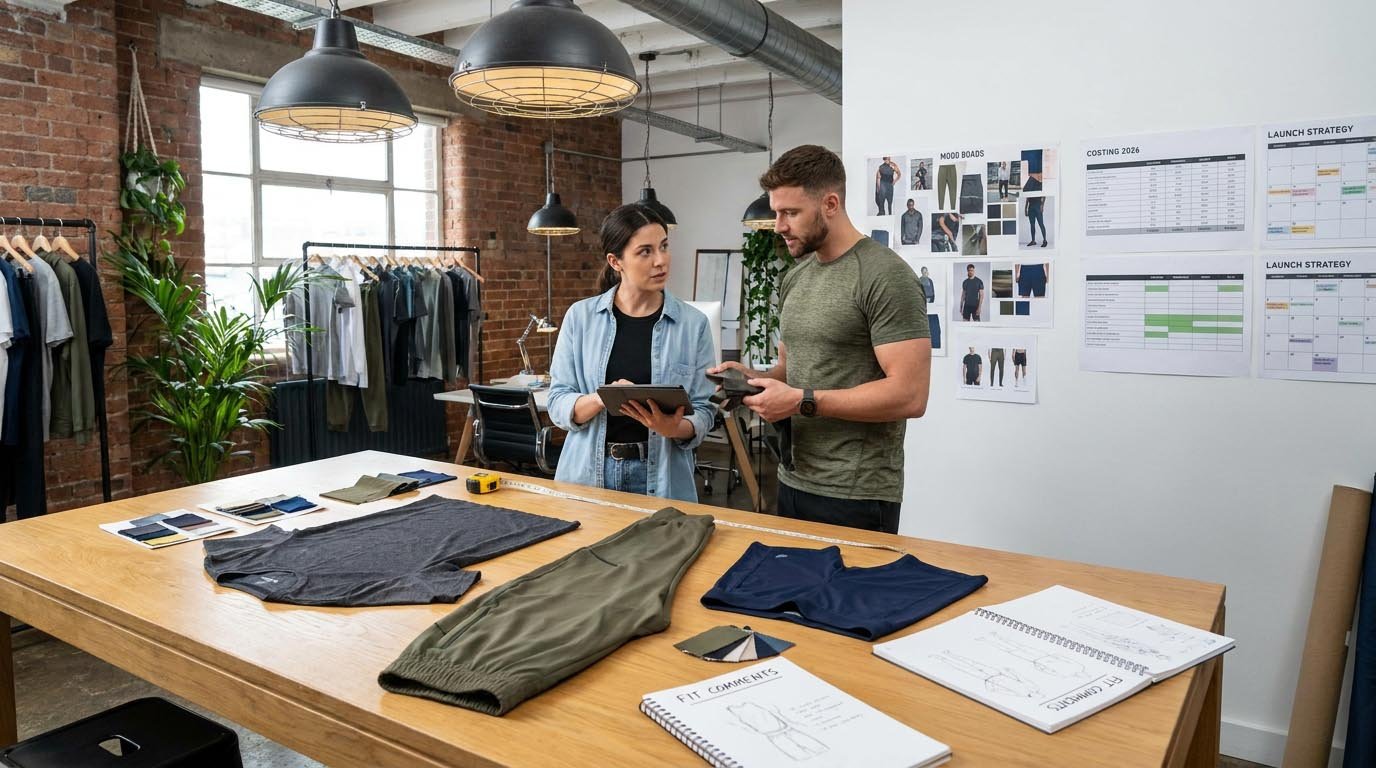
Quick Answer: How Much Does It Cost to Start a Men’s Gym Wear Line?
For most small brands, a realistic starting budget is $8,000 to $12,000.
That usually includes:
- $1,250-2,050 for tech packs, sampling, fit revisions, and pre-production approval
- $4,000-6,000 for a first production order of around 300-500 pieces
- $1,200-2,000 for shipping, customs, compliance, and labels
- $1,500-3,000 for launch content, influencer seeding, and early promotion
If you try to launch for much less, you usually cut corners in the areas that matter most: fabric quality, fit testing, sample validation, or launch preparation.
Men’s Gym Wear Startup Guide at a Glance
| Area | What to Expect |
|---|---|
| Startup budget | $8,000-12,000 |
| Sampling budget | $1,250-2,050 |
| MOQ for ODM | 300-500 pieces |
| MOQ for OEM | 800-1,200+ pieces |
| [Typical launch timeline | 4-5 months](https://www.printful.com/blog/sell-activewear-online)[^1] |
| Best first products | 1 top + 1 bottom |
| Biggest cost mistake | Choosing the wrong fabric for the training use case |
| Best low-risk starting point | Stock fabric + standard fit + ODM pattern |
Who This Guide Is For
This guide is useful for:
- founders starting a men’s activewear brand
- sellers building a private label gym wear line
- Amazon or Shopify sellers testing men’s fitness apparel
- gym owners and coaches launching branded apparel
- sourcing teams comparing OEM vs ODM activewear manufacturing
If you are still deciding whether to launch a clothing brand at all, this guide may feel detailed. But if you are already thinking about samples, fabrics, and suppliers, this is the stage where most budgets get wasted or protected.
How to Define Your Men’s Gym Wear Niche
Before contacting a gym wear manufacturer, define who the product is for. “Men who go to the gym” is too broad. Your customer type directly affects fabric specs, fit tolerance, sample count, and MOQ risk.
A men’s gym wear line for powerlifting, CrossFit, or casual training should not use the same fabric and fit assumptions. Each niche creates different product development costs.
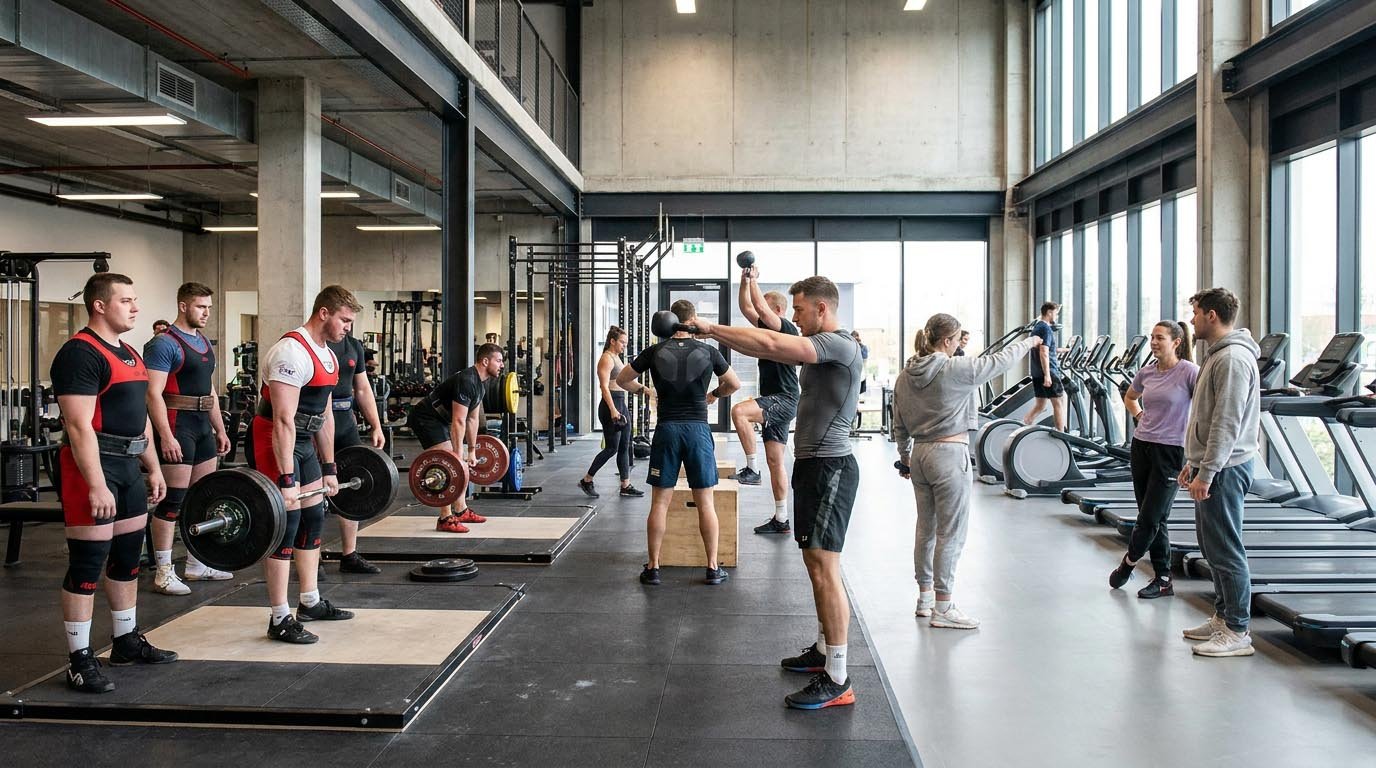
Men’s gym wear for strength training
If your customer is focused on:
- powerlifting
- bodybuilding
- heavy lower-body training
- deep squat and deadlift movements
Then the product usually needs:
- stronger opacity under stretch
- higher recovery after repeated load
- more room in thigh and glute areas
- stable waistband performance
This often means higher GSM and more controlled stretch, which increases fabric cost and usually requires more fit testing.
Men’s gym wear for functional fitness
If your customer does:
- HIIT
- CrossFit
- circuits
- hybrid training
Then the product usually needs:
- abrasion resistance
- sweat management
- secure fit during jumps and floor work
- lighter, faster-dry construction
This often requires movement-based wear testing across multiple body types.
Men’s gym wear for casual gym-goers
If your target customer is training a few times per week and values comfort over intense performance demands, you can usually start with:
- standard performance fabric
- moderate stretch
- simpler fit tolerances
- fewer sample revisions
This is often the easiest segment for a first launch.
Choose one main differentiation point
Many new brands want to stand out with multiple features at once. That usually increases development cost too early.
Common features that add cost or time:
- seamless construction
- reflective trims
- hidden pockets
- antimicrobial treatments
- bonded seams
- custom waistband structures
For a first launch, pick one main differentiation point and keep the rest simple.
What Products Should You Launch First?
A common question is whether to launch a full collection or start with just a few items.
Most new men’s gym wear brands should start with two core products: one top and one bottom. This keeps development simpler and reduces fabric risk.
Best first products for a new men’s activewear brand
A practical starting point is:
- training tee + training short
- tank top + short
- performance tee + jogger
Why two core pieces work best
Starting with two products helps you:
- test customer preference by category
- reduce fabric complexity
- simplify sizing and grading decisions
- lower the number of sample rounds
- avoid splitting budget across too many weak SKUs
Use the same fabric base where possible
If your first top and bottom can share the same or similar fabric base, you reduce:
- fabric MOQ pressure
- dye lot complexity
- testing costs
- sourcing risk
That makes it easier to reorder if one category starts selling faster than expected.
How to Choose Fabrics for Men’s Gym Wear
Fabric is where many new brands make the most expensive early mistake. The wrong fabric can look acceptable on paper and still fail in real training use.
The best fabric for men’s gym wear depends on the workout type, not just softness, stretch, or unit price.[^2] A fabric that works well for yoga-inspired apparel may fail during heavy squats, deadlifts, or repeated high-intensity movement.
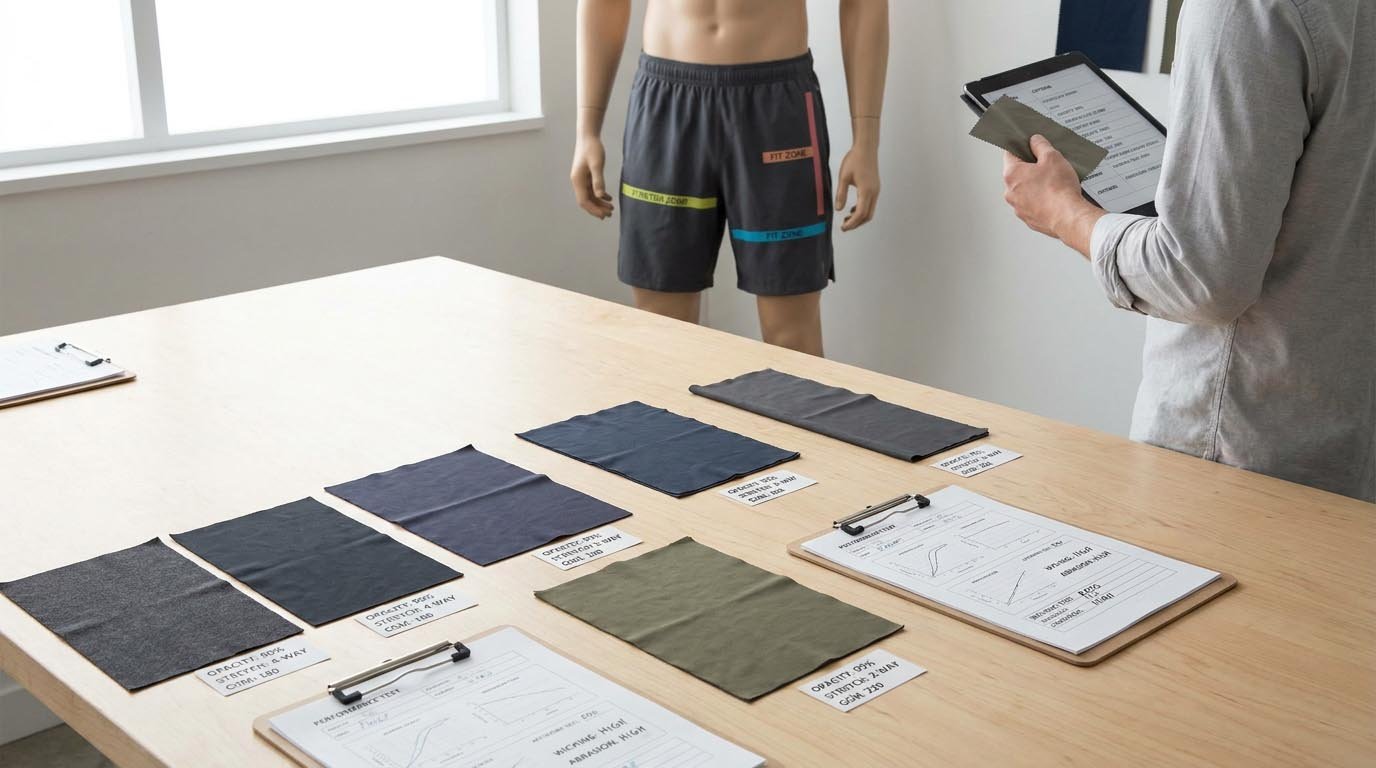
Why use case matters more than fabric price
New sellers often compare fabrics like this:
- price per meter
- GSM
- stretch percentage
- hand feel
Those are important, but they are not enough. You also need to ask:
- Will it stay opaque under deep stretch?
- Will it recover after heavy movement?
- Will it handle sweat and repeated washing?
- Will it stay in place during the target training style?
Common fabric mistake: yoga fabric for strength training
A common example is using a softer, thinner, highly stretchy fabric inspired by women’s yoga wear for men’s lifting shorts or tights.
That often causes:
- transparency under squat load
- poor shape retention
- waistband roll
- seam stress at the crotch or hip
- higher return rates
Better starting point for first-time brands
If you are launching men’s training basics, a safer path is usually:
- stock performance fabric
- medium-to-high opacity
- controlled stretch
- stable recovery after movement
- proven supplier material already used in gym wear production
Questions to ask your supplier about fabric
Before sampling, ask:
- What training use case is this fabric best for?
- Has this fabric been used for men’s shorts, tights, or training tops before?
- What is the shrinkage after wash?
- How does the fabric perform under stretch?
- Is the fabric stock or custom order?
- What is the MOQ by color?
How Many Samples Do You Need Before Production?
Most new brands underestimate sample costs because they assume one sample is enough. In reality, samples only test the decisions you already made. If your starting assumptions are wrong, you need more rounds.
Most men’s gym wear lines need 2 to 3 sample stages before bulk production is safe.[^3]
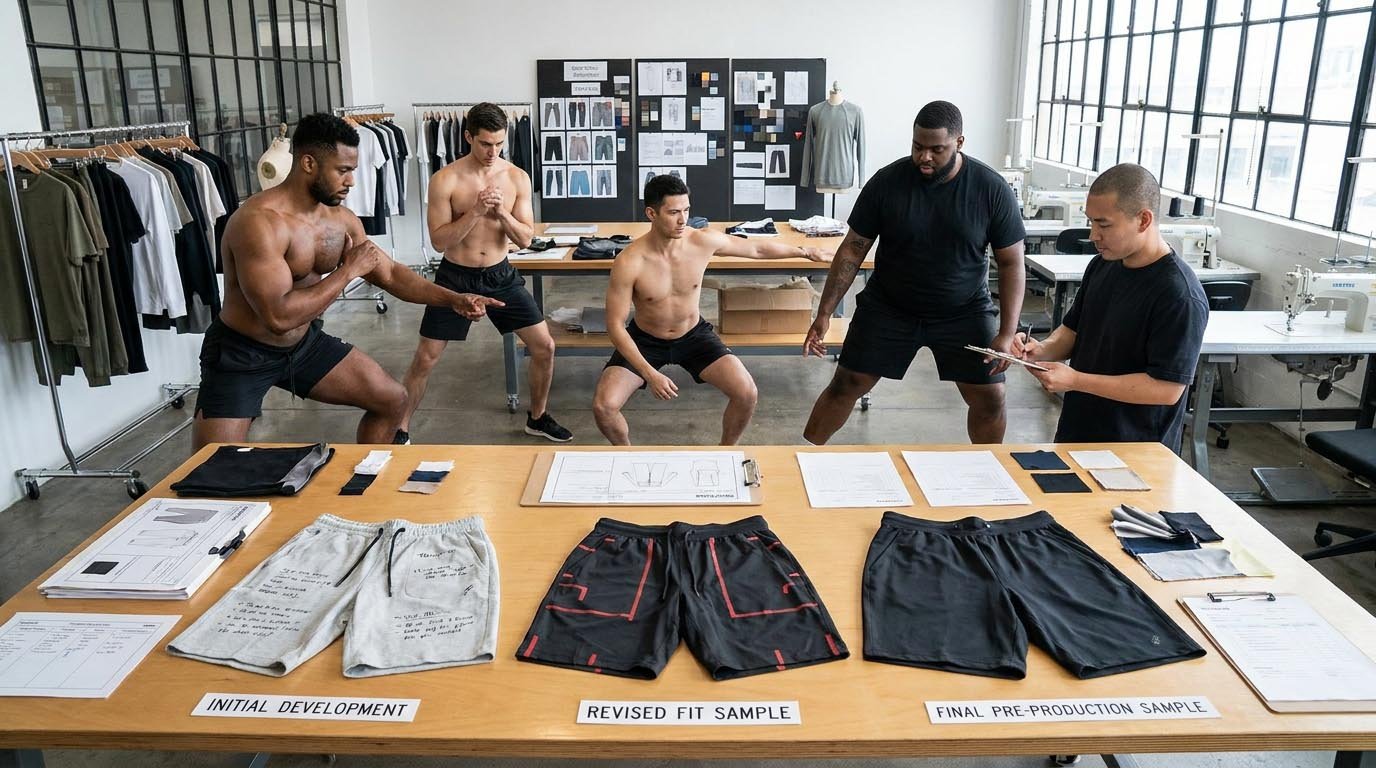
Typical sample stages
A standard process looks like this:
-
Development sample
Tests initial fabric, construction, and general silhouette -
Fit or revision sample
Corrects fit issues, seam behavior, waistband tension, or length -
Pre-production sample
Final approval sample before bulk manufacturing
Why men’s gym wear often needs more fit revision
Men’s activewear fit has to account for:
- shoulder-to-waist drop
- larger thighs and glutes on trained bodies
- hem movement during exercise
- sleeve or inseam behavior under motion
This is why casual wear grading often fails for gym wear.
Who should test your samples
Do not test on one person only. Use 3 to 5 testers with different body types if possible.
Look for variation in:
- height
- waist size
- shoulder width
- thigh development
- training style
What to test during sampling
Ask testers to check:
- comfort during squats, deadlifts, presses, jumps, or runs
- opacity under stretch
- waistband stability
- seam pressure points
- length and overall silhouette
- post-wash shrinkage and recovery
Men’s Gym Wear Sampling Cost Breakdown
Here is a realistic budget range for product development before your first production order.
| Item | Typical Cost |
|---|---|
| Tech pack development | $200-400 |
| First sample set | $400-600 |
| Wash and shrinkage testing | $150-250 |
| Revision sample round | $300-500 |
| Pre-production sample | $200-300 |
| Total likely sampling budget | $1,250-2,050 |
What makes sampling costs increase
Sampling gets more expensive when you add:
- custom fabric development
- unusual fit requirements
- seamless construction
- custom trims or pockets
- too many style changes between sample rounds
How to reduce sample waste
To reduce cost:
- define the workout use case clearly
- keep first styles simple
- avoid too many custom features
- test with standard stock fabric first if possible
- make one decision at a time between rounds
OEM vs ODM for Men’s Gym Wear Brands
Many founders ask whether they should use OEM or ODM for their first men’s activewear launch.
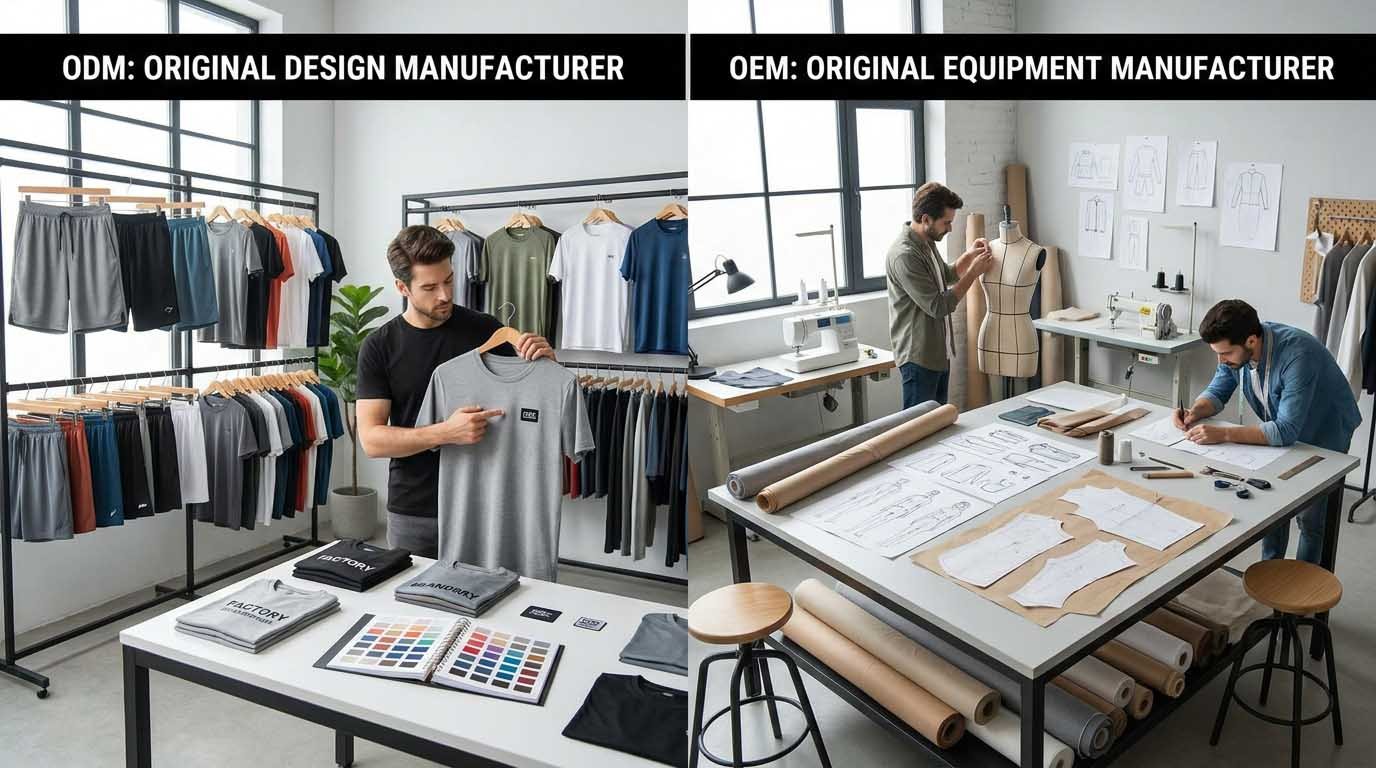
ODM is usually the better starting point for new brands because it lowers development cost and reduces MOQ. OEM is better once you have validated demand and want more custom construction.
What is ODM in gym wear manufacturing?
ODM means the factory already has:
- existing patterns
- proven fits
- established construction methods
- stock or standard fabric options
You customize branding, colors, and some details, but the product base is not fully built from zero.
Best for:
- low-risk launches
- smaller MOQ
- faster timeline
- testing demand
What is OEM in activewear manufacturing?
OEM means the product is developed to your specific requirements.
This may include:
- custom pattern development
- new fit blocks
- custom pockets or seams
- unique waistband construction
- fully custom trims or fabric programs
Best for:
- established brands
- larger orders
- higher customization
- products with validated market demand
MOQ difference between OEM and ODM
A typical starting point is:
| Model | Typical MOQ |
|---|---|
| ODM | 300-500 pieces |
| OEM | 800-1,200+ pieces |
Best option for first-time brands
If this is your first launch, ODM is often the safer choice. You can test:
- category demand
- fit acceptance
- price tolerance
- reorder potential
Then move to OEM after you learn what customers actually buy.
What MOQ Should You Expect for Men’s Activewear?
MOQ depends on how much you customize and whether the fabric is stock or custom.
Typical MOQ ranges
- 300-500 pieces for ODM with stock fabrics
- 500-800 pieces for semi-custom styles
- 800-1,200+ pieces for fully custom OEM programs
- higher if you need custom knit, seamless, or exclusive fabric development
Why low MOQ is not always cheaper
A low MOQ may reduce initial cash risk, but it often increases:
- unit cost
- shipping cost per piece
- pressure to restock quickly
- stockout risk if the launch works
Best MOQ strategy for a new men’s gym wear line
A practical starting strategy is:
- launch with 300-500 pieces
- monitor sales and fit feedback
- place the second order when the first batch is 40-50% sold
- increase the second order size if the sell-through is healthy
This gives you enough data without committing too early to a large inventory position.
How to Build a Men’s Gym Wear Product That Customers Will Keep
Low unit cost does not mean strong product performance. If the product feels cheap, shifts during movement, or fails after washing, return rates will erase any savings.
Areas where cheap construction usually fails
- fabric too thin under stretch
- weak waistband elastic
- poor recovery after wash
- seam failure at stress points
- low-quality drawcords or labels
- inconsistent grading across sizes
Construction details that matter
For men’s training apparel, pay attention to:
- stitch type
- seam reinforcement
- waistband stability
- pocket construction
- crotch gusset design if applicable
- labeling and finish consistency
Ask suppliers these quality questions
- What stitch type is used for stress areas?
- Has this style been tested in active use?
- What is the allowable tolerance by size?
- Can you provide shrinkage data?
- Is there a pre-production sample approval stage?
- How is bulk quality controlled before shipment?
Men’s Gym Wear Pricing and Margin Breakdown
Many new brands calculate only unit cost and freight. That is not enough. To price profitably, you need to account for returns, marketing, platform fees, and fulfillment.
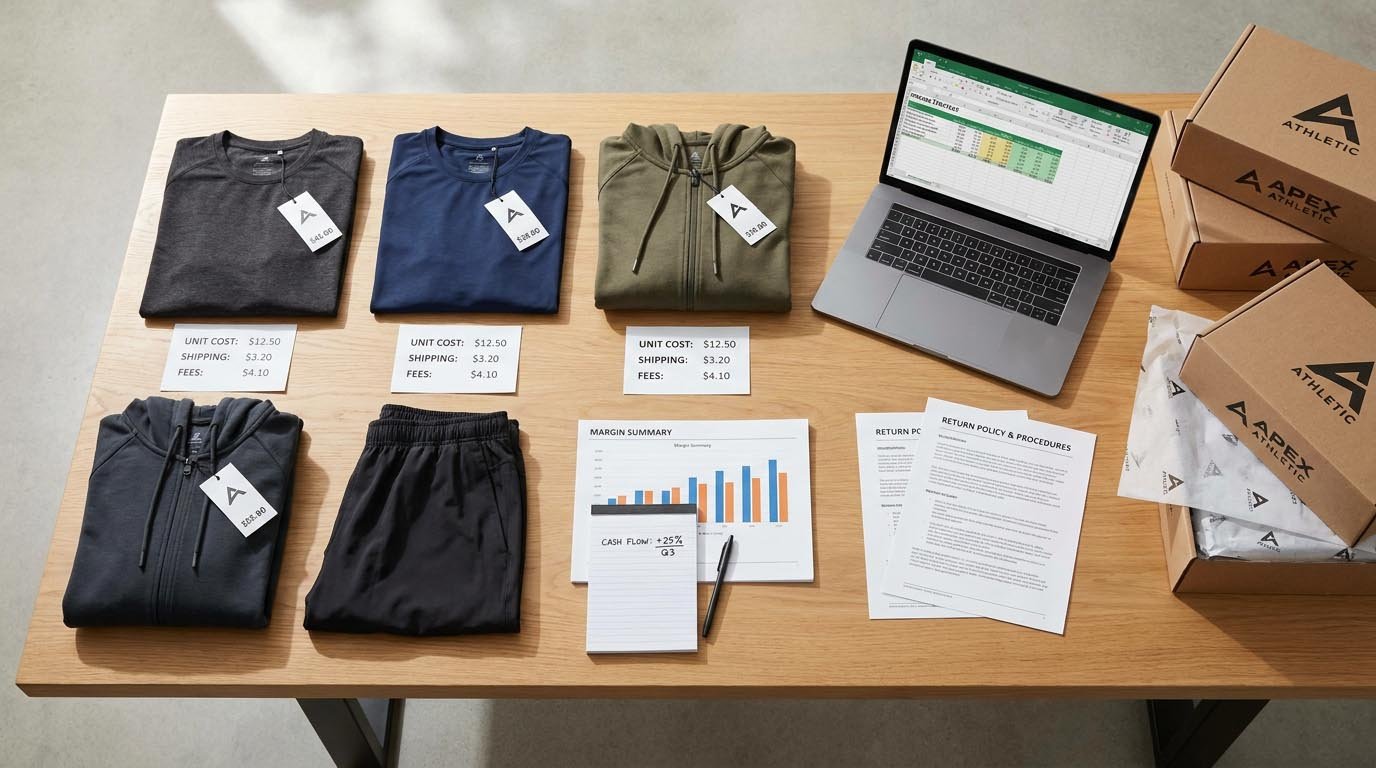
A men’s gym wear product with a landed cost around $14 to $15 often needs a retail price around $42 to $55 to leave healthy margin room.
Example pricing model
If you order a product at:
- unit cost: $12.00
- shipping per piece: $2.50
- landed cost: $14.50
And sell at $45, your costs may include:
- payment processing
- packaging
- return allowance
- ad spend
- replacement or customer service overhead
This is why many first-time founders underprice. They compare themselves to competitors without understanding whether those brands have better scale, lower acquisition cost, or larger reorder volume.
Why underpricing is dangerous
If you price too low:
- you cannot absorb
[^1]: "How to Start a Fitness Clothing Line", https://www.printful.com/blog/sell-activewear-online. Industry timelines for launching a new apparel line, including sampling, production, and shipping, are commonly estimated at 4-5 months for small brands. Evidence role: statistic; source type: education. Supports: Typical launch timeline for a men’s gym wear line is 4-5 months.. Scope note: Timelines may vary based on supplier responsiveness and shipping conditions.
[^2]: "Advancements in functional smart and wearable textiles for sportswear ...", https://pmc.ncbi.nlm.nih.gov/articles/PMC12716241/. Sports science and textile studies confirm that optimal fabric selection for gym wear depends on the intended workout type, as different activities place varying demands on stretch, moisture management, and durability. Evidence role: mechanism; source type: research. Supports: The best fabric for men’s gym wear depends on the workout type, not just softness, stretch, or unit price.. Scope note: General principle; specific fabric choices may vary.
[^3]: "Gym Wear Production Cost Breakdown What Startups Actually ...", https://www.spftex.com/news/gym-wear-production-cost-breakdown-what-startups-actually-need-to-know/. Apparel development guides and industry experts recommend 2 to 3 sample rounds—including development, fit, and pre-production samples—before proceeding to bulk production for new activewear lines. Evidence role: expert_consensus; source type: education. Supports: Most men’s gym wear lines need 2 to 3 sample stages before bulk production is safe.. Scope note: Some products may require more or fewer sample rounds depending on complexity.