.png)
A brand owner called me last week frustrated. She ordered 500 high-support sports bras for her yoga studio customers. Return rate hit 35% within two months. Complaints: "too tight," "can't breathe during flow." I asked what her customers actually do. She said vinyasa and yin yoga—mostly stretching and controlled movement. I explained she chose high-impact structure for low-impact activity. The support level wasn't wrong in isolation—it was mismatched to user need.
Sports bra support levels—high, medium, low—represent different structural approaches to distributing impact force, controlling movement displacement, and balancing comfort. The real challenge for brands is not memorizing which level fits which sport, but building a repeatable framework to translate end-user activity patterns and feedback into the correct structural choice and explaining that choice downstream.
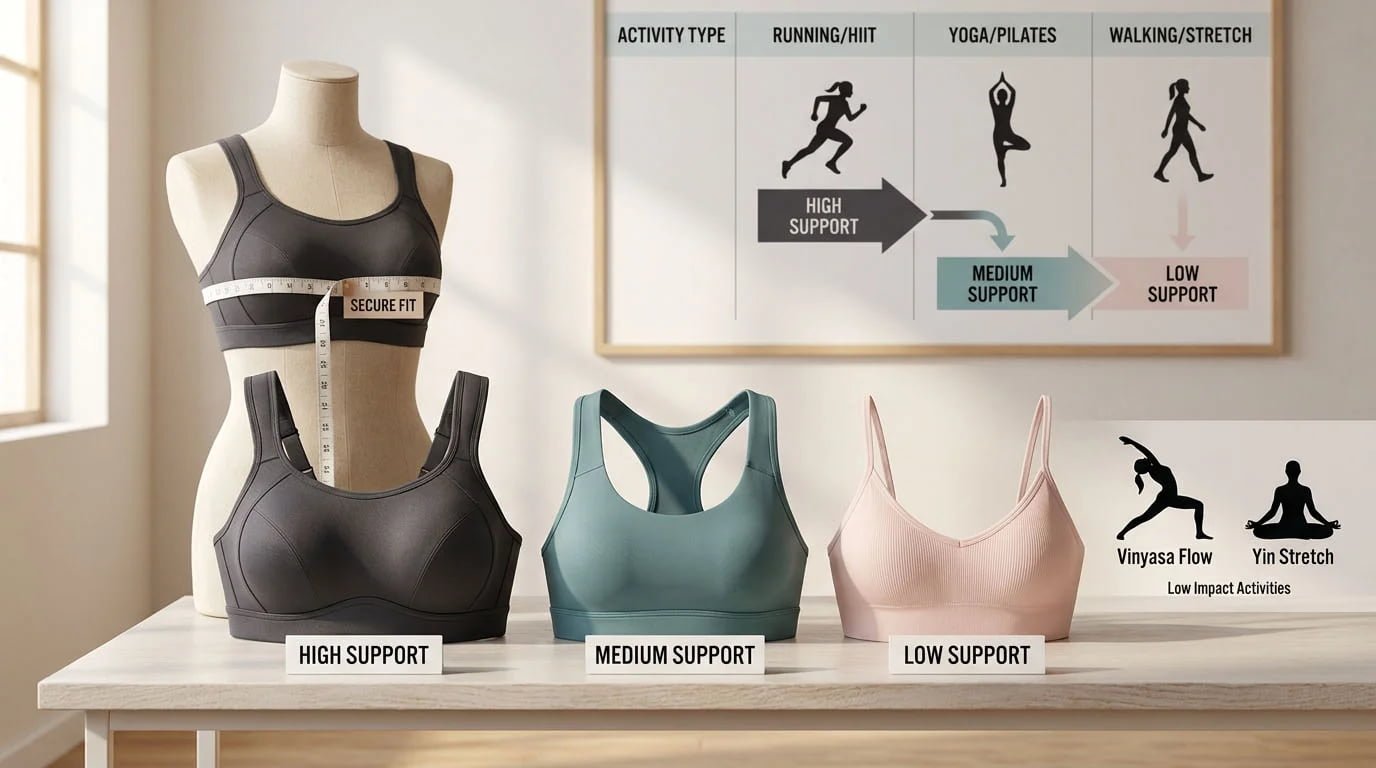
I see this mismatch pattern weekly. Brands choose support level by guessing or copying competitors, then face returns because they cannot explain to customers why this specific structure fits their specific need. Let me show you how support levels actually work and how to match them to real scenarios.
Quick Answers: Sports Bra Support Levels
Q: What’s the real difference between high, medium, and low support—beyond just “tightness”?
It’s how the bra handles movement impact:
- High support: Wide straps, reinforced underband, separate cups, hook closure—distributes force for jumping/running; $8–12/unit.
- Medium support: Elastic/crossback straps, moderate compression—controls movement while allowing breathability; $5–8/unit.
- Low support: Thin straps, pullover, minimal structure—prioritizes comfort for gentle activities; $3–5/unit.
Key: It’s about where and how impact is absorbed—not just how snug it feels.
Q: Should customers use high-support bras for every workout “just in case”?
No—leads to comfort complaints and returns (25–40% in yoga audience).
High-support features (compression, lots of structure) are unnecessary for low-impact exercise and cause discomfort: hard to breathe, shoulder pressure, overheating.
Match the support to the activity, not just “more is better.”
Q: How should support levels be explained to customers (without jargon)?
Use activity language:
- “For running & jumping” (high)
- “For gym & cycling” (medium)
- “For yoga & stretching” (low)
Describe what it solves: “Stays in place during movement,” not “encapsulation/underband.”
*Focus on activity, not construction.*
Q: Do most sports bra returns happen because of size or support mismatch?
60–70% are support mismatch—not wrong size.
Wrong size is obvious and gets exchanged. Wrong support level feels “wrong” but not always clear why, so it’s returned instead.
Getting support matched to activity reduces returns more than chasing perfect size.
Q: Do bigger cup sizes always need more support?
No—activity matters more than cup size.
D-cup for yoga might want low support, A-cup for HIIT may need high support. 30–40% of larger-cup customers prioritize comfort for low-impact, not max restriction.
Pick support for the activity; adjust fit for cup size.
Support Levels Explained: High, Medium and Low Impact?
A brand owner sent me a comparison chart last month: "High support = D+ cups, Medium = B-C cups, Low = A-B cups." I asked where she got this. She said it made sense to her. I explained she was confusing cup size with support structure. Two days later, she called back—customers with C cups doing CrossFit complained about bounce in her "medium support" bras. Support level is not about cup size. It is about impact management.
Support levels represent different structural approaches to handling impact force during movement. High support distributes stress across wide bands and multiple anchor points for vertical impact control. Medium support balances movement restriction with flexibility for multi-directional activities. Low support prioritizes freedom and breathability for minimal-impact scenarios. These are engineering choices, not cup size categories.
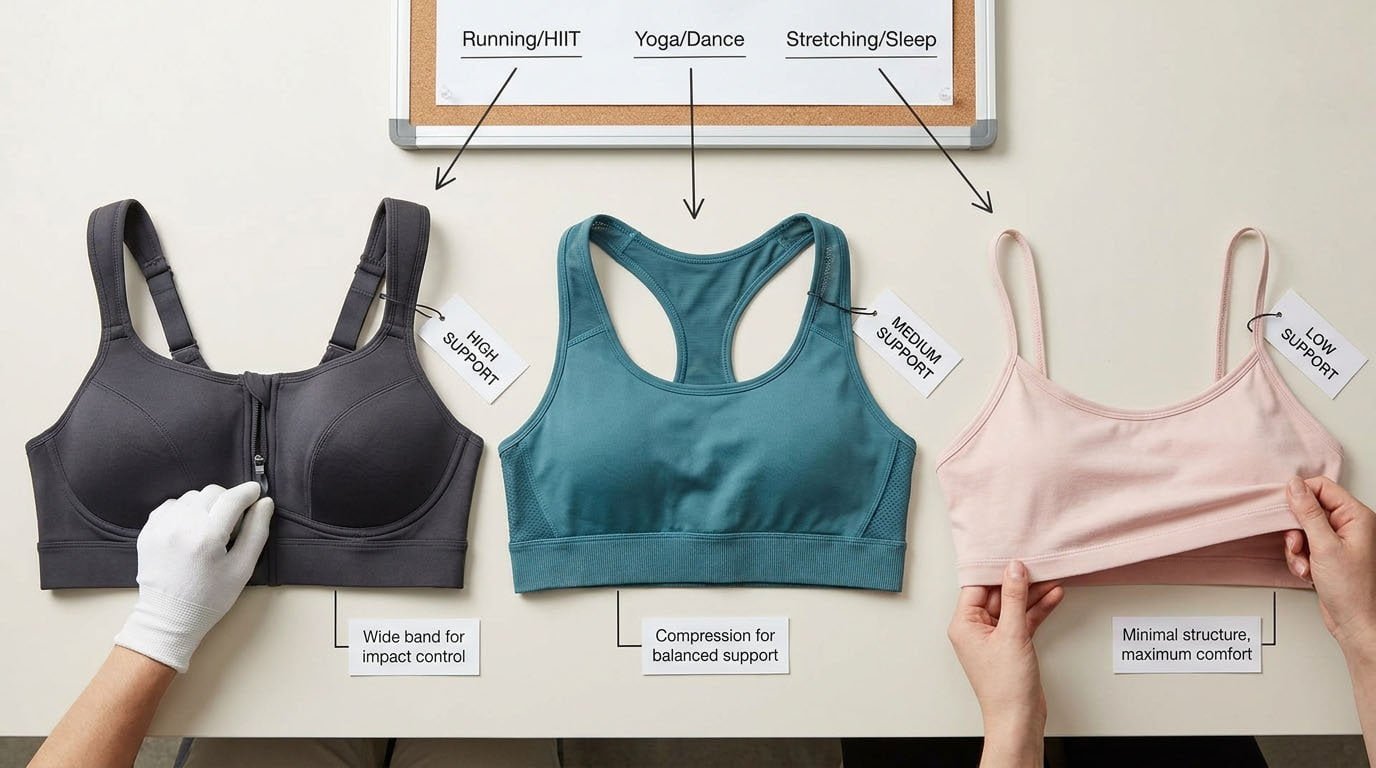
Let me break down what each support level actually does and where brands typically misunderstand the differences.
High Support: Maximum Impact Control Structure
What high support actually does:
Manages vertical bounce during high-impact activities (running, jumping, plyometrics) by distributing impact force across multiple structural elements instead of fabric elasticity alone.
Structural characteristics:
- Function: Primary anchor point, prevents upward shift
- Why it matters: Narrow bands cut into skin under stress, wide bands distribute pressure
- Cost impact: +$0.80-1.50 vs. standard band (more fabric, reinforcement)
Wide straps (2-4 cm):
- Function: Distributes shoulder load, prevents digging
- Why it matters: Thin straps concentrate pressure on small shoulder area during bounce
- Adjustability: Often adjustable length for personalized fit
- Cost impact: +$0.40-0.80 (more material, hardware)
Encapsulation cups (individual cup structure):
- Function: Each breast held separately, reduces inter-breast movement
- Why it matters: Compression alone pushes breasts together, encapsulation controls each independently
- Construction: Molded cups or sewn cup panels with separation
- Cost impact: +$1.20-2.00 (complex pattern, more sewing)
Hook-and-eye closure or front zip:
- Function: Adjustable fit, easier on/off without over-stretching
- Why it matters: Pullover high-support bras difficult to put on (compression + sweat = struggle)
- Cost impact: +$0.60-1.20 (hardware, extra stitching)
Reinforced construction:
- Multiple fabric layers at stress points (underband, side panels)
- Power mesh backing for structure
- Flatlock or reinforced seams to handle tension
Real client scenario:
Brand targeting CrossFit market ordered medium-support design with thin straps and pullover style to save cost ($5.50 per unit vs. $8.50 for proper high support). Customer complaints within 30 days: "straps dig into shoulders," "bounces too much during box jumps," "can't get it off when sweaty." They reordered with correct high-support structure—wider straps, encapsulation, front zip. Complaints dropped 75%. The $3 per unit cost increase prevented 30%+ return rate.
High support tradeoffs:
Advantages:
- Maximum bounce control (minimal vertical displacement)
- Suitable for all cup sizes with proper fit
- Reduces breast tissue stress during impact
- Professional/serious athlete perception
Disadvantages:
- Higher cost ($8-12 per unit)
- Less breathable (more layers, compression)
- Restrictive feel (not comfortable for low-intensity)
- Harder to put on/take off (tight compression)
When brands need high support:
- Target customers do running, HIIT, jumping activities
- Complaints about "too much bounce" or "breasts hurt after workout"
- Positioning as performance/serious training gear
- Customers willing to pay $40-70 retail
Medium Support: Balanced Control and Flexibility
What medium support actually does:
Balances movement control with breathability and flexibility for activities combining impact with range of motion (dance, cycling, hiking, moderate aerobics).
Structural characteristics:
Moderate underband (2-3 cm):
- Function: Provides anchor without excessive compression
- More elastic than high support (allows torso expansion during breathing)
Medium-width straps (1.5-2.5 cm):
- Often racerback or crossback design
- Function: Distributes load while allowing shoulder mobility
- Some adjustability or fixed length depending on price point
Compression-based or light encapsulation:
- Compression panels (flattens breasts against chest)
- Or light encapsulation without heavy molding
- Function: Reduces bounce through fabric tension, not rigid structure
Pullover design (most common):
- Easier on/off than high support
- Stretchy fabrics allow passage over head
- No hooks (cost savings, comfort)
- More breathable than high support
- Mesh panels often integrated for ventilation
- Quick-dry important for moderate-intensity sweat
Real production comparison:
We produce for two brands—one targets studio fitness (barre, Pilates, light cardio), other targets outdoor training (trail running, bootcamp).
Studio brand specs:
- Medium support, compression-based
- Thin racerback straps
- Lightweight fabric (180-220 GSM)
- Cost: $5.50 per unit
- Return rate: 12% (mostly fit issues, rarely support complaints)
Outdoor brand initially used same specs:
- Customers complained: "not enough support for running," "bounces during sprints"
- Return rate: 28%
Outdoor brand switched to high support:
- Wider straps, reinforced underband, encapsulation
- Cost: $8.20 per unit
- Return rate dropped to 9%
Same support level, different activity intensity—mismatched results.
Medium support tradeoffs:
Advantages:
- Balanced cost ($5-8 per unit)
- Comfortable for extended wear (less compression than high)
- Good breathability (lighter construction)
- Versatile (works for many moderate activities)
Disadvantages:
- Insufficient for high impact (complaints from runners/jumpers)
- May not work for larger cups during intense movement
- Less adjustability (usually pullover, fixed straps)
When brands need medium support:
- Target customers do yoga with cardio bursts, cycling, hiking, dance
- Activities involve movement but not continuous jumping
- Customers want versatility (gym to errands)
- Price point $25-45 retail
Low Support: Comfort-First Minimal Structure
What low support actually does:
Provides light coverage and shape with minimal restriction for low-impact activities (yoga, stretching, walking, recovery, sleep).
Structural characteristics:
Thin underband (1-2 cm) or none:
- Just fabric hem with elastic thread
- Function: Keeps bra in place, not primary support
- Very stretchy for comfort
Thin straps (0.8-1.5 cm):
- Often spaghetti or T-back style
- Fixed length (no adjusters—cost savings)
- Decorative as much as functional
Single-layer construction:
- No cups, no padding (or removable light padding)
- One fabric layer for coverage
- Compression is fabric elasticity only, not structure
Pullover design (always):
- Seamless or minimal seams
- No closures (lowest cost)
- Easy on/off (low compression)
Soft, breathable fabrics:
- Lightweight (140-180 GSM)
- Smooth finish (no technical features needed)
- Comfort prioritized over performance
Real client learning curve:
Brand started with yoga focus, ordered low-support bralettes ($3.20 per unit). Customer feedback: "love them for yin and restorative," "perfect for lounging," but "not enough for vinyasa flow" (more dynamic yoga).
Brand added medium-support option for "active yoga" ($5.80 per unit). Now customers can choose based on class type. Low support became their recovery/lounge line ($22-28 retail), medium became active yoga ($35-42 retail). Both sell well because they match distinct use cases.
Low support tradeoffs:
Advantages:
- Lowest cost ($3-5 per unit)
- Maximum comfort (no restriction)
- Breathable, lightweight
- Easy to manufacture (simple construction)
Disadvantages:
- No bounce control (unsuitable for any impact)
- Limited support for larger cups (even in low-impact activities)
- Customers may feel "not sporty enough" (looks more like lounge wear)
When brands need low support:
- Target customers do gentle yoga, Pilates, stretching, recovery
- Positioning as wellness/lifestyle rather than performance
- Customers prioritize comfort over function
- Price point $18-30 retail (or loungewear crossover)
The Mismatch Problem: Why Support Level Matters More Than Brands Think
Common brand assumptions:
❌ "Medium support works for most customers" (safe middle ground)
✅ Reality: Medium support disappoints both ends—too much for low-impact users, too little for high-impact users
❌ "Customers can just size down for more support"
✅ Reality: Sizing down creates tightness, not structural support—causes discomfort without solving bounce
❌ "High support is only for large cup sizes"
✅ Reality: Small cups doing high-impact need same structural support to prevent tissue damage
Return rate data from our clients:
| Support Mismatch Scenario | Typical Return Rate | Common Complaints |
|---|---|---|
| High support sold to low-impact users | 30-40% | "Too tight," "can't breathe," "uncomfortable" |
| Low support sold to high-impact users | 35-45% | "Doesn't work," "bounces too much," "not supportive" |
| Medium support to high-impact users | 20-30% | "Not enough support," "bounces during jumps" |
| Correctly matched support level | 8-15% | Fit issues (size/shape), not support complaints |
Key takeaway:
Support level is not a spectrum where "more is better." It is structural design matched to force type and intensity. Brands must identify target activity first, then choose support structure—not guess at middle ground.
Match Support to Your Workout: Running, HIIT, Cycling, Studio and Recovery?
A brand owner asked me yesterday: "Can you send me a chart showing which sports need which support?" I said no. She was surprised. I explained that a 60-minute slow jog and a 20-minute sprint interval session are both "running" but have completely different impact profiles. A chart would mislead her. What she needs is a framework to ask the right questions about her customers' actual activity patterns.
Activity-to-support matching requires understanding impact intensity (how much force), movement direction (vertical, lateral, multi-directional), and duration. The same sport can require different support levels depending on these variables. Brands need a decision framework, not a static lookup table.
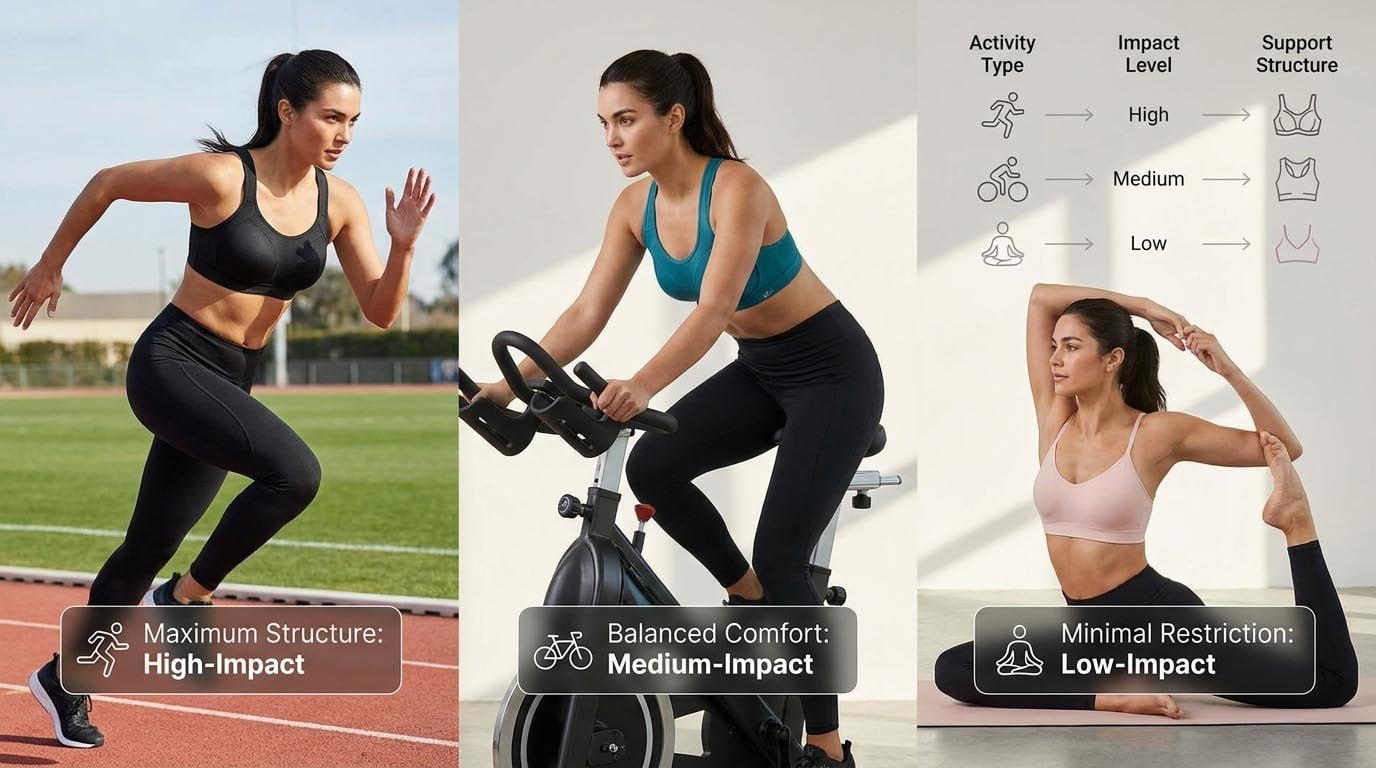
Let me show you how to think through activity matching based on real customer scenarios, not generalized sport categories.
High-Impact Activities: When Structure Is Non-Negotiable
What defines high-impact:
Vertical force repeated frequently:
- Running: Continuous bounce with each stride
- Jumping activities: Plyometrics, jump rope, box jumps
- HIIT with jumping: Burpees, jumping jacks, high knees
- Impact aerobics: Step aerobics, dance fitness with jumps
Why high support required:
During running, breasts move in figure-8 pattern (up-down, side-to-side, forward-back) with each stride. Without proper support:
- Breast tissue stress (Cooper's ligaments stretch, cause sagging over time)
- Discomfort or pain during activity
- Skin chafing from excessive movement
- Distraction (adjusting bra mid-workout)
Real complaint pattern:
Brands selling medium support to runners see consistent feedback:
- "Had to hold my chest while running" (support failed)
- "Bouncing was distracting"
- "Breast soreness after long runs"
- "Straps slipped during workout" (insufficient structure)
These complaints disappear with proper high-support structure.
High-impact customer profile questions:
When brands ask me about high support, I ask them:
- What's the primary activity? (Running, CrossFit, bootcamp?)
- What's typical session intensity? (Steady pace or interval sprints?)
- How long are sessions? (30 minutes or 90 minutes?)
- Indoor or outdoor? (Temperature affects breathability need)
- What cup size range? (Affects encapsulation vs. compression choice)
Example decision:
Brand A: Targets marathon runners, 60-90 minute runs
- Need: Maximum support + breathability (long duration)
- Solution: High support with mesh panels ($9.50 per unit)
- Wide straps, encapsulation, moisture-wicking
Brand B: Targets CrossFit, 20-30 minute WODs
- Need: Maximum support + durability (high intensity, shorter duration)
- Solution: High support with reinforced seams ($10.20 per unit)
- Front zip for easy on/off, power mesh backing
Both high support, different design priorities based on activity nuance.
Medium-Impact Activities: The Versatility Zone
What defines medium-impact:
Intermittent impact or lower intensity:
- Power walking/hiking: Ground contact but less bounce than running
- Cycling: Pedaling motion, torso leans forward (different stress pattern)
- Dance fitness (low-jump): Cardio barre, Zumba without high jumps
- Rowing: Pulling motion, minimal vertical impact
- Moderate-intensity yoga: Vinyasa flow, power yoga (dynamic but controlled)
Why medium support fits:
These activities involve movement and sweat but not continuous high-impact force. Users need:
- Some bounce control (more than daily bra, less than running bra)
- Breathability (sessions often 45-60 minutes)
- Flexibility (range of motion important)
- Comfort (less restrictive than high support)
Real client scenario:
Brand selling to cycling studios initially ordered high support thinking "intense workout = high support." Customer complaints:
- "Too tight when leaning forward on bike" (compression restricts breathing in cycling position)
- "Overheating" (heavy structure traps heat in spin studio)
- "Doesn't fit under cycling jersey" (bulky)
Switched to medium support with:
- Racerback for posture
- Thin, breathable fabric
- Compression-based (flatter profile)
- Complaints dropped significantly
The cycling lesson:
Intensity ≠ impact. Cycling is intense cardio but low vertical impact. Brands confusing "hard workout" with "needs maximum support" mismatch structure to need.
Medium-impact customer profile questions:
- Does activity involve jumping? (If yes frequently, reconsider high support)
- What's the torso position? (Upright or bent forward?)
- How much sweating expected? (Affects breathability priority)
- Is flexibility important? (Stretching mixed with cardio?)
- Wearing duration? (Longer = comfort more important)
When medium support works best:
Activities where movement control matters but flexibility and breathability can't be sacrificed. The "active lifestyle" category—customers doing varied activities, not specialized training.
Low-Impact Activities: When Comfort Wins
What defines low-impact:
Minimal force, controlled movement:
- Gentle yoga: Hatha, yin, restorative (holding poses, stretching)
- Pilates: Mat or reformer, controlled core work
- Barre (no cardio): Isometric holds, small movements
- Walking: Casual pace, minimal bounce
- Stretching/mobility: Foam rolling, flexibility work
- Recovery/rest: Post-workout, sleep, lounging
Why low support fits:
These activities prioritize:
- Range of motion (deep stretches, twists)
- Breathwork (yoga breathing requires chest expansion)
- Comfort (long holds, minimal distraction)
- Light coverage (not daily bra, but minimal structure)
The support paradox:
Brands sometimes think "even yoga needs support" and offer medium support to yoga customers. Result: comfort complaints.
Real client example:
Brand targeting yoga studios ordered medium-compression design thinking it was "safe choice." Customer feedback:
- "Too tight during twists" (compression restricts torso rotation)
- "Can't take deep breaths in savasana" (band pressure)
- "Prefer going braless" (defeats the purpose)
Switched to low-support design:
- Thin, soft straps
- Minimal underband
- Single-layer, stretchy fabric
- Customers happy—"feels like wearing nothing," "perfect for yoga"
Low-impact customer profile questions:
- What's the pace? (Slow, controlled or dynamic?)
- Is deep breathing important? (Yoga vs. Pilates difference)
- How much coverage needed? (Modesty vs. performance?)
- Wearing for activity only or lifestyle? (Lounge appeal?)
- Price sensitivity? (Low support = lower cost, appeals to budget-conscious)
When low support is strategic:
Not just for low-intensity users—also for:
- Recovery line (post-workout comfort wear for serious athletes)
- Lifestyle crossover (yoga to coffee, activewear trend)
- Sleep bras (comfortable support for nighttime)
The Gray Areas: When Activity Doesn't Dictate Support
Variables that override activity type:
1. Personal preference:
- Some customers prefer more compression for "held-in feeling" regardless of activity
- Others prefer minimal support even in moderate activity
2. Body sensitivity:
- Larger cup sizes may need higher support even in lower-impact activities (comfort during movement)
- Smaller cup sizes may prefer lower support for breathability even in moderate impact
3. Experience level:
- Beginners often prefer less compression (intimidated by tight fit)
- Experienced athletes may demand maximum support regardless of activity (trust in structure)
4. Temperature and climate:
- Hot yoga, outdoor summer training: Breathability trumps maximum support
- Cold weather training: Can tolerate more layers and compression
Real multi-variable example:
Customer: Does hot yoga (low-impact) but D-cup, sweats heavily
Wrong solution: Low support (activity-based choice)
Result: "Feels unsupported during forward folds," "fabric soaked, no structure"
Right solution: Medium support with moisture-wicking, wide underband for lift
Result: Comfort + sufficient support for body type + breathability
The framework brands need:
Not a chart. A questioning process:
- What's the primary activity? (Starting point)
- What's the intensity and duration? (Refine activity understanding)
- What's the customer's body type range? (Cup size distribution)
- What have customers complained about previously? (Real feedback beats assumptions)
- What's the price point and positioning? (Premium allows better materials, more options)
Then match to support structure, test with samples, gather feedback, iterate.
Fit Fundamentals: Band/Cup Measurements, Sister Sizes and Adjustments?
A brand owner sent me fit specs last month: "Please make size M to fit 34B." I asked for her full size chart. She said that was it—one size per band/cup combo. I explained that 34B customer and 36A customer have similar volume needs but different band sizes (sister sizing). Her "one size = one cup" approach would fit half her customers poorly. She was designing activewear bras like fashion bras.
Sports bra fit requires understanding band measurement (ribcage circumference), cup volume (breast tissue amount), and sister sizing relationships. Brands assuming each size corresponds to one cup/band combo create fit issues for 40-50% of customers. Activewear bra sizing must account for compression and activity-specific fit needs.
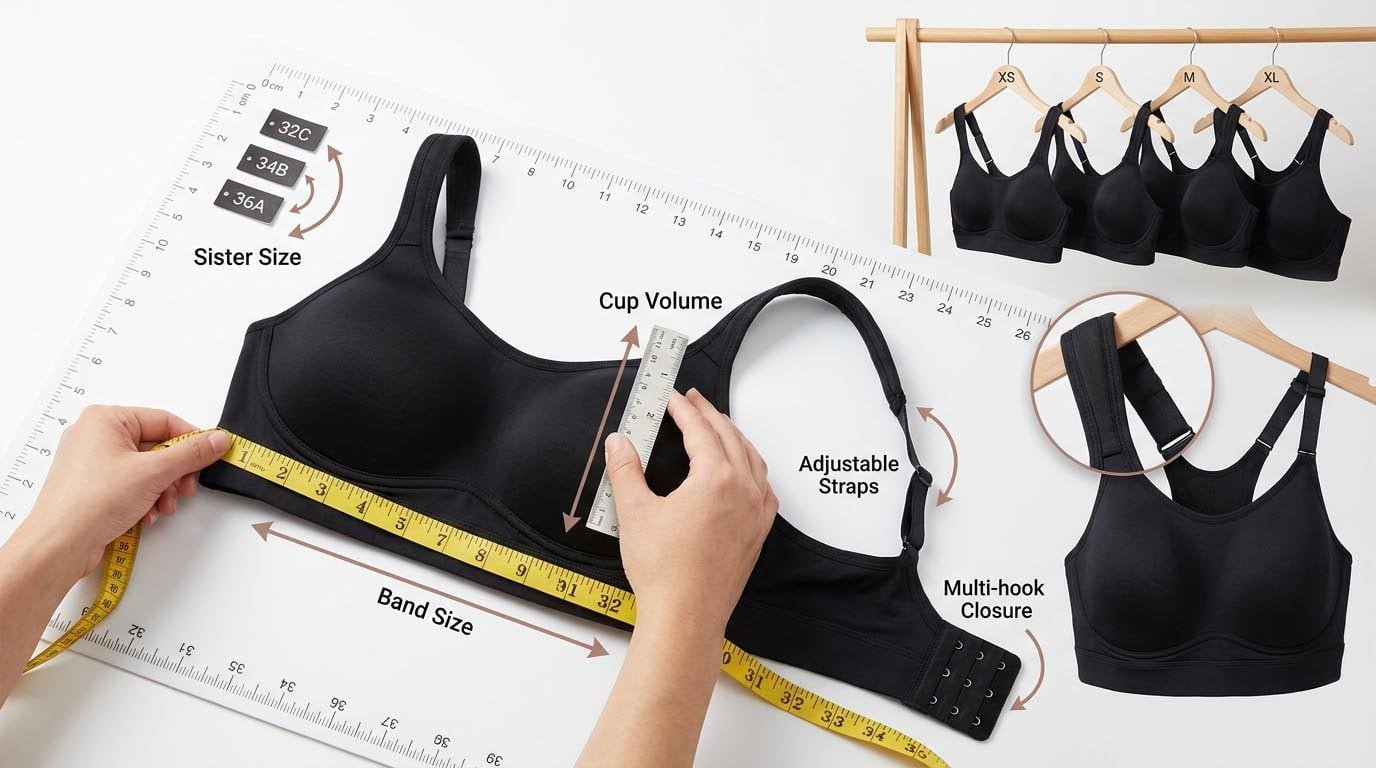
Let me show you how fit actually works in sports bras and where brands typically get sizing wrong.
Band and Cup Measurement Basics
What band size actually measures:
Ribcage circumference just under the bust. In activewear, this is your primary anchor point.
Standard band measurements:
- 32 band: 68-72 cm ribcage
- 34 band: 73-77 cm ribcage
- 36 band: 78-82 cm ribcage
- 38 band: 83-87 cm ribcage
Sports bra band fitting differences:
Unlike everyday bras, sports bras need tighter band fit:
- Everyday bra: Band should be snug but comfortable for all-day wear
- Sports bra: Band should be firmer to prevent riding up during activity
This means: Many customers size down in band for sports bras (wear 34 everyday, prefer 32 for sports).
What cup size actually measures:
Difference between bust measurement and band measurement.
Cup size scale:
- A cup: 10-12 cm difference
- B cup: 12-14 cm difference
- C cup: 14-16 cm difference
- D cup: 16-18 cm difference
- DD/E cup: 18-20 cm difference
Sports bra cup fitting differences:
Compression-based sports bras (medium/low support) often use generic sizing (S/M/L) that compresses breasts regardless of cup—works for smaller cups, problematic for larger.
Encapsulation-based sports bras (high support) need cup sizing to properly separate and support each breast.
Sister Sizing: The Fit Relationship Brands Miss
What sister sizing means:
Different band/cup combinations that hold similar breast volume but fit different ribcage sizes.
Example sister size chain:
All four combinations have approximately same cup volume (breast tissue amount) but different band sizes (ribcage circumference).
Why this matters for sports bras:
Scenario: Brand offers sports bra in size M designed for "34B".
Who might need this size?
- 34B customer (exact match)
- 32C customer (sister size down—smaller band, larger cup)
- 36A customer (sister size up—larger band, smaller cup)
If brand only thinks "M = 34B," they miss 30-40% of potential customers who are sister sizes.
Real client sizing mistake:
Brand designed 5 sizes: XS, S, M, L, XL with cup assumptions:
- XS = 32A
- S = 34A
- M = 34B
- L = 36B
- XL = 38C
Customer complaints:
- "I'm 32C, which size do I order?" (Should be M per sister sizing, not offered)
- "I'm 36C, XL too big in band, L too small in cup" (Gap in sizing)
Better approach: Design with sister sizing in mind:
- XS fits: 30B, 32A
- S fits: 30C, 32B, 34A
- M fits: 32C, 34B, 36A
- L fits: 32D, 34C, 36B, 38A
- XL fits: 34D, 36C, 38B, 40A
Now each size accommodates multiple cup/band combos, reducing fit failures.
S/M/L Sizing vs. Bra Sizing: When Each Works
S/M/L (generic sizing):
When it works:
- Low support (minimal structure, one size can fit range)
- Compression-based medium support (flattens breasts, less cup-specific)
- Smaller cup range (A-C cups mostly)
- Stretchy fabrics (accommodates size variation)
When it fails:
- High support (encapsulation needs cup accuracy)
- Larger cup range (D+ cups need specific sizing)
- Rigid structure (less fabric give)
Bra sizing (32A, 34B, etc.):
When it works:
- High support with encapsulation (individual cup structure)
- Larger cup range (D+ cups need precision)
- Adjustable features (straps, closures)
When it fails:
- Complex to communicate (customers confused by sister sizing)
- Higher inventory (more SKUs)
- Small brands (can't stock every combination)
Hybrid approach many brands use:
S/M/L base sizing + Cup options within each:
- Small (A-B cups)
- Medium (B-C cups)
- Large (C-D cups)
Example: Medium B-C fits customers who need medium band with B or C cup volume.
Real client evolution:
Brand started with simple S/M/L (low cost, easy inventory). Customer complaints:
- "I'm between sizes" (fit not precise enough)
- "Too tight in cup, loose in band" (sister sizing mismatch)
Added cup options: S-A, S-B, M-B, M-C, etc.
Result: Fit complaints dropped 40%, but inventory complexity increased. They kept simple S/M/L for low support line (works fine), used cup sizing for high support (needs precision).
Trade-off decision:
Simple sizing = Easy for customer, easy for inventory, but fit issues for 20-30%
Precise sizing = Better fit, but confusing for customer, complex inventory
Brand must choose based on support level, target market sophistication, price point.
Adjustability Features and Fit Flexibility
Why adjustability matters:
Bodies vary even within same measurement range. Adjustable features let one size fit more people.
Common adjustable features:
1. Adjustable straps:
- Function: Shortens/lengthens straps for torso height differences
- Cost: +$0.30-0.60 per unit (hardware, assembly time)
- Fit benefit: Accommodates 5-8 cm height variation
2. Multi-hook back closure:
- Function: 2-3 hook positions for band size flexibility
- Cost: +$0.50-0.90 per unit
- Fit benefit: One bra fits 2-3 band sizes (Example: 34-36-38)
3. Convertible straps:
- Function: Straps can be worn traditional, racerback, or crossback
- Cost: +$0.40-0.80 per unit
- Fit benefit: Adjusts for activity and preference
Real cost-benefit analysis:
Option A: Non-adjustable design, 8 sizes to cover range
Cost: $6.50 per unit × 8 sizes = $52 per style minimum inventory
Option B: Adjustable straps + multi-hook, 5 sizes to cover range
Cost: $7.80 per unit × 5 sizes = $39 per style minimum inventory
Option B costs $1.30 more per unit but reduces inventory by 3 sizes ($13 savings) and reduces fit returns (adjustability accommodates more body types).
Many brands choose Option B.
Common Fit Issues and Solutions
Issue 1: Band rides up during activity
Cause: Band too loose or not enough underband structure
Customer complaint: "Bra shifts during workout"
Solution:
- Size down in band (if using S/M/L, try smaller size)
- Choose design with wider underband (3-5 cm)
- Add non-slip gripper on band interior (+$0.40-0.60)
Issue 2: Straps dig into shoulders
Cause: Straps too narrow for support level, or wrong adjustment
Customer complaint: "Painful red marks on shoulders"
Solution:
- Use wider straps (minimum 2 cm for high support)
- Add padding to strap (+$0.30-0.50)
- Ensure adjustability so customer can loosen
Issue 3: Spillage (breast tissue escapes cup)
Cause: Cup too small for breast volume
Customer complaint: "Doesn't contain everything"
Solution:
- Size up (or add cup size option)
- For high support, ensure encapsulation not compression (compression pushes up/out)
- Check underband positioning (should sit below breast tissue)
Issue 4: Gaping (cup doesn't fill)
Cause: Cup too large for breast volume
Customer complaint: "Looks baggy"
Solution:
- Size down
- For low support, avoid molded cups (use soft, form-fitting fabric)
- Consider removable padding (customers adjust as needed)
Issue 5: Uncomfortable during breathing
Cause: Too much compression for activity level
Customer complaint: "Can't breathe deeply"
Solution:
- Lower support level (high to medium, or medium to low)
- Choose more elastic fabrics
- Avoid designs with rigid underband for low-impact activities
The fit testing framework:
Before bulk production, brands should:
- Test on 5-10 bodies per size (different heights, shapes)
- Test during actual activity (not just standing in mirror)
- Test after washing (some fabrics relax, others tighten)
- Ask specific questions: "Does band stay in place?" "Any digging?" "Can you breathe comfortably?"
- Document feedback by measurement (not just "feels good")
Design Details That Matter: Encapsulation, Compression, Straps, Closures and Fabrics?
A brand owner showed me competitor samples last week: "Make it exactly like this." I asked which specific design elements she wanted—the encapsulation cups, the crossback straps, the front zip, or the fabric weight? She said everything. I explained those features serve different functions with different costs. Copying everything without understanding purpose means paying for features her customers might not need.
Sports bra design elements—encapsulation vs. compression, strap configurations, closure types, fabric choices—each solve specific support or comfort problems. Brands selecting features by copying competitors or aesthetics alone end up with cost overruns or functionality mismatches. Every design choice should trace to a customer need.
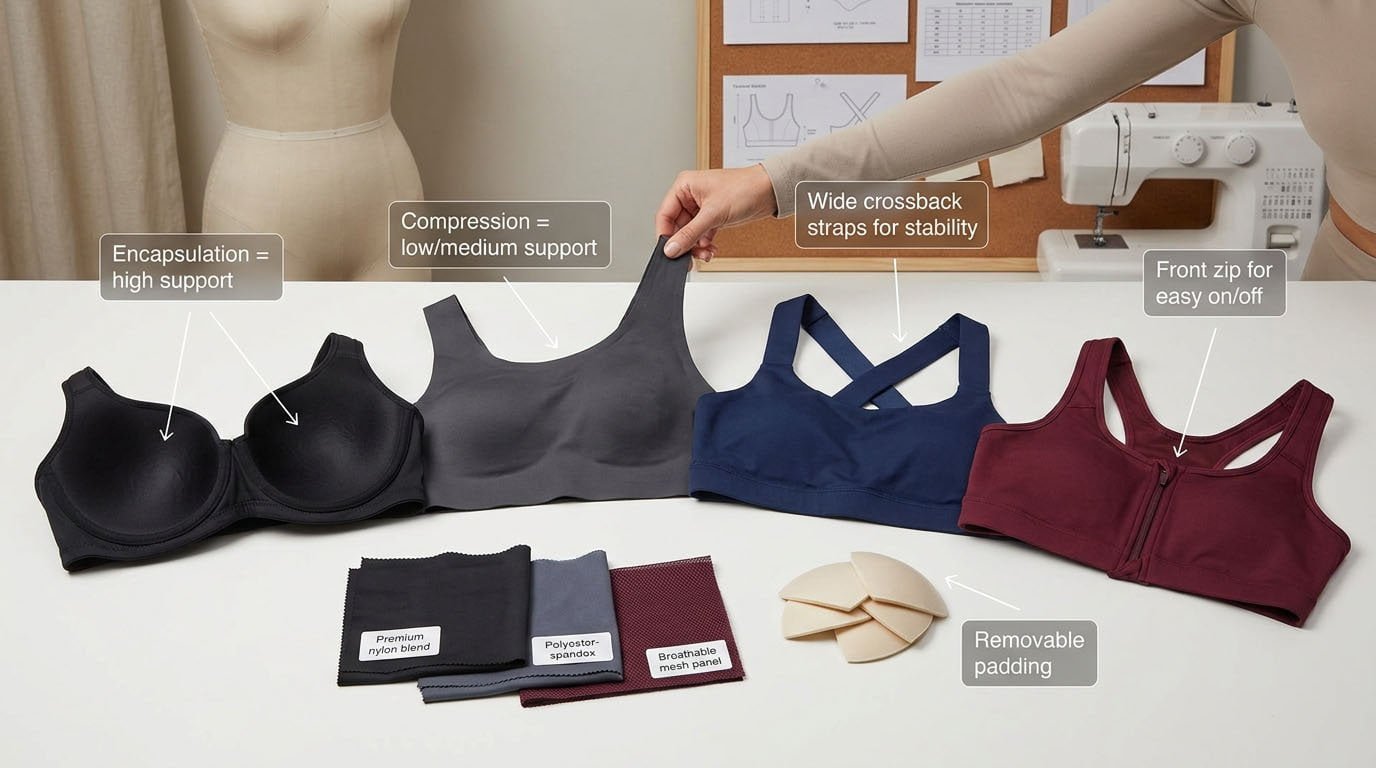
Let me break down which design elements actually matter for function and where brands can make cost-effective choices.
Encapsulation vs. Compression: Structural Philosophy
Two fundamental approaches to breast support:
Compression (pressing breasts against chest):
How it works:
- Single-layer elastic fabric compresses breasts flat against torso
- Reduces movement by minimizing projection
- Works by friction and pressure, not structure
Visual: Think sports bra that squashes, not separates.
Best for:
- Smaller cup sizes (A-C cups)—less tissue to control
- Medium to low support needs
- Minimalist aesthetic (no visible cup lines)
- Lower cost ($4-7 per unit)
Limitations:
- Uncomfortable for larger cups (excessive flattening, uniboob effect)
- Less effective at high impact (compression alone can't prevent all bounce)
- Breathing restriction (chest expansion limited)
Encapsulation (individual cups for each breast):
How it works:
- Separate cups (molded or sewn) hold each breast independently
- Controls movement by containing, not compressing
- Distributes force through cup structure and underband
Visual: Think sports bra with defined cups, like everyday bra structure but stronger.
Best for:
- Larger cup sizes (C+ cups)—needs individual control
- High support needs (maximum bounce control)
- Customers wanting shape (not flattened look)
- Higher cost ($7-12 per unit—complex construction)
Limitations:
- More expensive (molded cups, extra sewing)
- Bulkier (more visible under clothes)
- Less minimalist aesthetic (defined cups show through)
Hybrid approach (compression + encapsulation):
Many high-support bras use both:
- Encapsulation cups separate breasts
- Compression panel over cups adds extra control
Cost: $9-14 per unit (combines both methods)
Real client decision:
Brand targeting yoga + light cardio (medium support):
Option A: Compression-only ($5.20 per unit)
Option B: Light encapsulation ($7.50 per unit)
Customer feedback on Option A:
- A-B cup customers: "Perfect, comfortable"
- C-D cup customers: "Not enough support," "uniboob effect"
They kept Option A for smaller cup sizing (S-M with A-B), added Option B for larger cups (M-L with C-D). Different structures for different body types within same activity range.
Strap Configurations: Load Distribution
Common strap designs and their functions:
1. Traditional straps (over-shoulder):
Function: Classic load distribution
Best for: Everyday wear, adjustability needed
Cost: Baseline
Pros: Familiar, easy to adjust
Cons: Can slip off shoulders during movement
2. Racerback (straps join between shoulder blades):
Function: Keeps straps on shoulders, opens upper back
Best for: Running, upper body movement
Cost: +$0.20-0.40 (extra stitching to join)
Pros: Straps don't slip, allows shoulder blade movement
Cons: Can't adjust strap length independently
3. Crossback/X-back (straps cross at mid-back):
Function: Distributes load across broader back area
Best for: High support, heavy lifting
Cost: +$0.30-0.60 (more complex pattern)
Pros: Even load distribution, secure fit
Cons: Less adjustability
4. T-back (single center back strap):
Function: Minimalist, allows full back movement
Best for: Low support, yoga, dance
Cost: +$0.10-0.30 (simple but unique construction)
Pros: Unrestricted back movement, looks sleek
Cons: Less load distribution (unsuitable for high impact)
5. Halter (straps tie or hook behind neck):
Function: Front support without over-shoulder straps
Best for: Specific postures (inverted poses), fashion
Cost: +$0.40-0.80 (hardware or tie construction)
Pros: Unique look, neck support
Cons: Neck strain in high-impact, not for extended wear
Strap width matters as much as configuration:
- Thin straps (<1.5 cm): Low support, decorative, cost-effective
- Medium straps (1.5-2.5 cm): Medium support, balance of load and aesthetics
- Wide straps (>2.5 cm): High support, maximum load distribution, costs more
Real feedback pattern:
High-support bras with thin straps generate consistent complaints:
- "Straps dig in"
- "Shoulder pain after running"
- "Red marks"
Switching to wider straps (2.5-4 cm) solves this but adds $0.60-1.00 per unit. Many brands resist the cost increase until complaints prove the necessity.
Closure Types: Access and Adjustability
Common closure methods:
1. Pullover (no closure):
Function: Simplest construction, pull over head
Cost: Lowest (no hardware)
Best for: Low to medium support (easier to get on/off)
Pros: No pressure points from hooks, sleek look, lowest cost
Cons: Difficult for high-support bras (too tight to pull over head), especially when sweaty
2. Hook-and-eye back closure:
Function: Adjustable band fit, easier on/off
Cost: +$0.50-0.90 per unit (hardware, stitching)
Best for: High support, larger cup sizes
Pros: Adjustable (2-3 hook positions), easy to remove when sweaty
Cons: Hooks can snag, feels bulky under clothes
3. Front zip:
Function: Full front opening, easiest on/off
Cost: +$0.80-1.50 per unit (zipper quality matters)
Best for: High support, post-surgery, limited mobility
Pros: Easiest to put on/take off, looks sporty
Cons: Zipper can chafe if not covered, can break
4. Front hook/clasp:
Function: Clips together at center front
Cost: +$0.60-1.20 per unit
Best for: Medium to high support
Pros: Easy access, adjustable, decorative
Cons: Can pop open during high movement if weak
Real cost-benefit scenario:
Brand selling high-support bras as pullover ($8.20 per unit):
Customer complaints:
- "Can't get it off when sweaty"
- "Too tight to pull over head"
- "Hurts shoulders getting on"
Return rate: 22%
Added front zip option ($9.50 per unit):
- Complaints dropped significantly
- Return rate: 9%
The $1.30 extra cost prevented 13% returns (much more expensive than closure hardware).
When to use which closure:
- Low support: Pullover (sufficient, saves cost)
- Medium support: Pullover for smaller cups, back closure for larger cups
- High support: Front zip or back closure (pullover too difficult)
Fabric Selection: Performance vs. Cost
Key fabric properties for sports bras:
1. Stretch and recovery:
- Four-way stretch essential for sports bras (stretches both directions)
- Recovery (returns to shape after stretching)—80%+ recovery needed
- Poor recovery causes sagging after few wears
2. Compression level:
- High compression: Thick, dense fabrics (260-320 GSM)
- Medium compression: Moderate density (220-260 GSM)
- Low compression: Lightweight (180-220 GSM)
3. Moisture management:
- Wicking: Pulls sweat from skin to surface
- Quick-dry: Evaporates moisture fast
- Nylon generally better than polyester for both
4. Breathability:
- Mesh panels for ventilation
- Open knit structures
- Thinner fabrics breathe better but may sacrifice support
Common fabric choices:
Nylon-spandex blend (80-90% nylon, 10-20% spandex):
- Cost: Higher ($1.50-3.00 more per unit than polyester)
- Feel: Softer, smoother, more premium
- Performance: Better wicking, less odor retention, less pilling
- Best for: Premium positioning, high-support needs
Polyester-spandex blend (80-90% polyester, 10-20% spandex):
- Cost: Lower (baseline pricing)
- Feel: Slightly rougher (can be improved with finishes)
- Performance: Adequate wicking, holds odor more, pills faster
- Best for: Budget positioning, disposable activewear approach
Power mesh (nylon or polyester):
- Cost: Medium (used as panels, not whole garment)
- Function: High breathability, structure, lightweight
- Best for: Lining, side panels, back panels in high-sweat areas
Real fabric trade-off:
Brand A (premium): Nylon blend, 280 GSM, high support, $11.50 per unit, retails $65-75
Brand B (value): Polyester blend, 240 GSM, medium support, $6.20 per unit, retails $28-35
Both have markets. Brand A has lower return rate (8%), higher repeat purchase. Brand B has higher return rate (18%), lower repeat, but sells 3x volume (price-sensitive customers).
Neither is wrong—different strategies for different markets.
Padding and Liners: Coverage and Shape
Types of padding:
1. Removable pads:
- Function: Customer chooses coverage level
- Cost: +$0.30-0.60 per unit
- Pros: Flexibility, easy to wash separately
- Cons: Can shift, get lost in laundry, add bulk
2. Sewn-in light padding:
- Function: Modesty (nipple coverage), light shaping
- Cost: +$0.40-0.80 per unit
- Pros: Stays in place, smooth appearance
- Cons: Can't remove, may be too warm for some
3. Molded cups:
- Function: Structure, shape, encapsulation
- Cost: +$1.00-2.00 per unit (molding process)
- Pros: Maximum shape and support
- Cons: Bulky, less breathable, one-size-fits-all shape
4. No padding:
- Function: Minimalist, breathable
- Cost: Baseline (no extra)
- Pros: Lightest, most breathable, lowest cost
- Cons: Visible nipples (some customers uncomfortable)
Real customer preference data:
In our clients' experience:
- 30-40% of customers prefer removable pads (flexibility)
- 20-30% prefer no padding (comfort, breathability)
- 20-25% prefer sewn-in light padding (convenience, modesty)
- 10-15% prefer molded cups (shaping, support)
Offering removable pads satisfies largest segment plus allows no-padding preference (remove pads). Most cost-effective approach for brands unsure.
Comfort and Longevity: Chafe Prevention, Care and Replacement Timing?
A brand owner complained to me last month: "Customers love our bras initially but after three months, complaints start—straps stretch out, fabric pills, band loses tension." I asked about her care labels. She said machine wash warm, tumble dry. I explained that care instructions directly affect product lifespan. Poor care kills sports bras fast, but unrealistic care requirements (hand wash only) mean customers won't follow them.
Sports bra longevity depends on construction quality, fabric durability, and care practices. Brands must balance designing for durability with realistic care expectations—customers will machine wash and tumble dry regardless of labels. The goal is maximizing lifespan under real-world use, not lab-condition use.
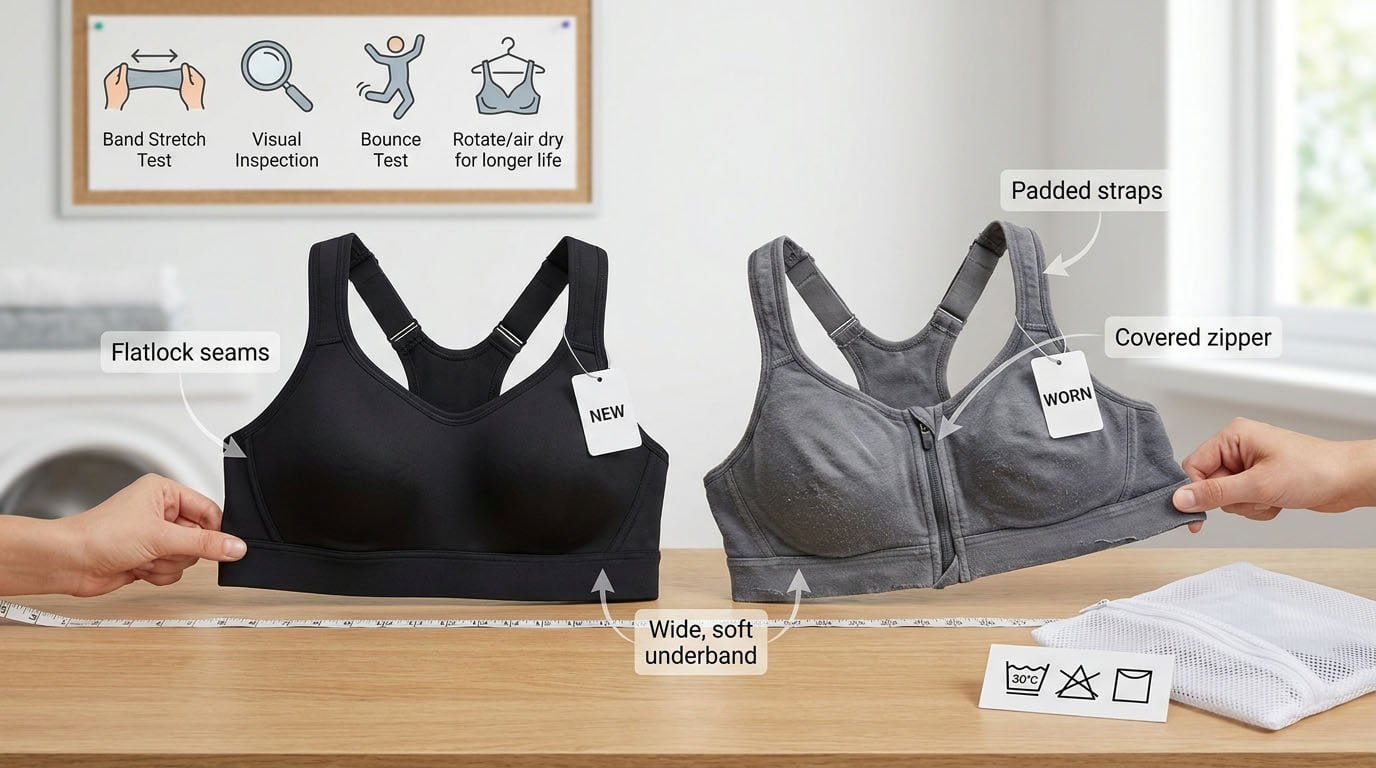
Let me show you what actually causes sports bra failures and how brands can improve longevity without unrealistic customer compliance expectations.
Chafe Prevention: Design for Skin Comfort
Common chafe points in sports bras:
1. Underband seam (bottom edge):
Cause: Seam rubs against ribcage during movement
Prevention:
- Flatlock seams instead of overlock (+$0.40-0.80 per unit)
- Soft elastic with fabric covering (no raw edges)
- Wide underband distributes pressure (reduces concentrated friction)
2. Strap edges:
Cause: Narrow straps cut into shoulders, raw edges rub
Prevention:
- Bind or turn edges (no raw elastic)
- Padding on straps for high-support (+$0.30-0.50)
- Wider straps (minimum 2 cm for high impact)
3. Closures (hooks, zippers):
Cause: Metal or plastic directly against skin
Prevention:
- Fabric covering over zipper pull
- Hook protector flap on back closures
- Soft fabric backing at all hardware contact points
4. Seams at center front or underarms:
Cause: High-friction areas during arm movement
Prevention:
- Flatlock seams in all body-contact zones
- Seamless construction (expensive but eliminates issue)
- Test samples during actual activity, not just standing
Real client quality upgrade:
Brand received 15% return rate for "causes irritation" complaints. Investigation found:
- Overlock seams at underband (raised, rough)
- Thin straps with raw edges
- Back closure hooks exposed against skin
Upgrades made:
- Flatlock seams at underband and sides (+$0.60 per unit)
- Bound strap edges (+$0.20)
- Hook protector flap (+$0.30)
Total cost increase: $1.10 per unit
Return rate dropped to: 6%
The $1.10 investment prevented 9% returns (returns cost $5-8 per unit to process), positive ROI.
Care Instructions: Reality vs. Ideal
Ideal care for maximum lifespan:
- Hand wash cold
- Air dry flat
- No fabric softener
- Wash after every use
Customer reality:
- Machine wash (don't have time to hand wash)
- Tumble dry medium/high (need it dry quickly)
- Use fabric softener (habit, don't read labels)
- Wear 2-3 times between washes (reduce laundry frequency)
The care instruction dilemma:
Too strict (hand wash only): Customers ignore it, bras fail, they blame product
Too lenient (machine wash hot, tumble dry): Shortens lifespan, customers expect longer durability
Realistic middle ground:
"Machine wash cold, tumble dry low or air dry"
This instruction:
- Customers will follow (machine wash acceptable)
- Protects elastane (cold water doesn't degrade spandex as fast)
- Low heat drying is compromise (some will use medium, but recommendation is low)
Fabric choices that tolerate real-world care:
Nylon-spandex: Withstands machine wash/dry better than polyester
Higher GSM (260+ GSM): More durable than thin fabrics
Quality elastane (Lycra brand): Survives 50+ wash cycles at 90%+ recovery
Flatlock seams: Don't pucker after washing like overlock can
Real durability testing:
Before bulk production, we recommend clients:
- Wash samples 20-30 times in machine (cold wash, low tumble dry)
- Check after every 10 washes: Measurements, elasticity, seam integrity, fabric pilling
- Compare to new sample: How much has it degraded?
If sample fails before 30 washes, it won't last 6 months of customer use (average 2-3 wears per week = 25-35 washes over 6 months).
Expected Lifespan: Setting Realistic Expectations
Typical sports bra lifespan by support level and quality:
Low support, budget construction ($3-5 per unit):
- 20-30 washes before noticeable degradation
- 3-4 months at 2x per week use
- Acceptable for: Fast fashion, disposable activewear approach
Medium support, mid-quality ($5-8 per unit):
- 40-60 washes before noticeable degradation
- 6-9 months at 2x per week use
- Acceptable for: Most activewear brands, standard expectations
High support, premium construction ($8-12 per unit):
- 60-100+ washes before noticeable degradation
- 12-18 months at 2x per week use
- Acceptable for: Premium brands, athlete-focused
What "degradation" means:
Not total failure, but performance decline:
- Band loses 10-15% tension (rides up more)
- Straps stretch (need adjustment or no longer adjustable)
- Fabric pills at high-friction areas
- Support feeling reduces (more bounce than when new)
Customer expectations vs. reality:
Customer expectation: "Sports bra should last 2-3 years"
Reality: High-use sports bra rarely lasts beyond 12-18 months under real conditions
Brand communication challenge:
Can't tell customers "this will only last 6 months"—sounds like poor quality. But expecting 3+ years from high-use sports bra is unrealistic.
Solution: Educate on replacement timing without setting specific duration:
"Replace your sports bra when you notice:
- Band feels looser (rides up during activity)
- Straps have stretched (can't adjust tighter)
- More bounce than when new
- Fabric looks worn (pilling, thinning)"
This shifts focus from "how long it lasts" to "when it's time to replace" (functional approach, not time-based).
Signs It's Time to Replace
Objective indicators brands can communicate to customers:
1. Band test:
- Put on bra, hook on loosest setting
- Pull band away from body—should stretch only 2-3 cm
- If stretches 5+ cm: Band tension gone, time to replace
2. Bounce test:
- Wear bra during typical activity
- Compare to when new (if possible)
- More bounce than remembered: Support declined, replace
3. Visual inspection:
- Pilling at inner band, underarms, or high-friction zones: Fabric breaking down
- Straps frayed or stretched thin: Structural failure
- Seams puckering: Elastic in seams degraded
- Fabric thinning (holds to light, more transparent): Worn out
4. Comfort change:
- Straps digging in more than before: Stretched out, concentrating pressure
- Band riding up constantly: Lost tension
- Underwire poking (if applicable): Structure failure
Replacement frequency by use intensity:
| Use Frequency | Typical Replacement Timing |
|---|---|
| Daily (5-7x per week) | Every 4-6 months |
| Regular (3-4x per week) | Every 6-9 months |
| Moderate (2x per week) | Every 9-12 months |
| Occasional (<1x per week) | Every 12-18 months |
Note: Assumes washing after every wear and machine wash/dry. Hand wash/air dry extends lifespan 20-30%.
Extending Sports Bra Lifespan: Tips Brands Can Share
Care practices that actually make a difference:
1. Rotate multiple bras:
- Don't wear same bra back-to-back
- Elastic needs 24 hours to recover between uses
- Owning 3-4 bras and rotating extends each bra's life 30-40%
2. Wash in mesh bag:
- Prevents hooks from snagging other garments or bra itself
- Reduces agitation damage
- Costs $2-3, customers will do this
3. Avoid fabric softener:
- Coats elastic fibers, reduces stretch/recovery
- Breaks down moisture-wicking properties
- Use detergent only
4. Air dry when possible:
- Heat kills elastane (spandex degrades in high heat)
- If must tumble dry: Use low heat
- Air dry extends life 30-40%
5. Store properly:
- Don't fold cups (creases molded cups permanently)
- Stack flat or hang
- Avoid direct sunlight (UV degrades elastic)
Real longevity comparison:
Customer A: Machine wash cold, air dry, rotates 4 bras, no fabric softener
Sports bra lifespan: 80-100 washes, 12-15 months
Customer B: Machine wash warm, tumble dry high, uses same bra daily, uses fabric softener
Sports bra lifespan: 30-40 washes, 4-6 months
Same bra, dramatically different longevity based solely on care practices.
Brand strategy:
Include care card or email guide with purchase:
- "Make Your Sports Bra Last: 5 Simple Tips"
- Increases perceived value
- Reduces premature failure complaints
- Builds brand authority
FAQ: Choosing and Fitting Sports Bras by Support Level
My customers do multiple activity types—should I recommend one versatile support level?
Medium support is the "versatile" option but still has limits. Works well for customers mixing yoga + light cardio + cycling (varied low-to-moderate impact). Doesn't work for customers mixing running + yoga (high + low impact)—they need two bras. Instead of forcing one-size-fits-all, help customers understand "activity-specific" approach: high support for high-impact days, low/medium for other days. Brands offering 2-3 support levels see lower returns than brands pushing "one perfect bra."
How do I explain why high-support bras cost more without sounding defensive?
Focus on construction differences, not justifying price: "High-support bras use wider straps, reinforced underbands, and encapsulation cups to distribute impact force—these design elements require more material and specialized construction." Compare visible features customers can see: "Notice the 3 cm straps vs. 1 cm in low support, the 4 cm underband vs. 2 cm, the individual cup structure." Avoid phrases like "you're paying for quality" (sounds defensive). Explain what the extra cost builds (specific functional elements).
Can customers wear high-support bras even for low-impact activities?
Physically yes, comfort-wise usually no. High-support structure (compression, reinforcement) feels restrictive during low-impact activities where flexibility matters. Customer feedback pattern: "Too tight for yoga," "can't breathe during stretching," "feels suffocating." Exception: Some customers prefer compression feeling even during gentle activity—personal preference exists. Recommendation: Let customers try but warn about potential comfort tradeoffs. Don't assume "more support = better for everyone".
What's the minimum number of support levels I should offer as a new brand?
Start with 2 support levels matching your primary customer activity split. Example 1: Yoga brand offers low support (gentle yoga) + medium support (power yoga). Example 2: Running brand offers medium support (jogging) + high support (racing/HIIT). Starting with 3+ levels creates inventory complexity, customer confusion, and higher development costs ($800-2,000 per support level for sampling). Expand to 3rd level once you have sales data showing demand gap.
How do I reduce returns when offering multiple support levels?
Clearer product descriptions on support level purpose: Instead of "high support," say "high support for running, HIIT, and high-impact training." Instead of "medium support," say "medium support for yoga, cycling, and studio classes." Use activity-based language, not technical terms. Add "Not sure? Email us" with responsive customer service—helping 1 customer choose correctly prevents 1 return (much cheaper than processing return). Offer support level guide as popup or page link—"Which support level do I need?"
Do sports bras stretch out over time or is that a quality issue?
All sports bras stretch out over time—elastane (spandex) naturally degrades with use and washing. Quality difference is how fast it happens: Low-quality elastane loses 30-40% recovery after 20-30 washes. Premium elastane maintains 90%+ recovery through 50-80 washes. Can't eliminate stretch-out, but can slow it significantly with better elastane, proper construction, and customer care education. Customer expectation: Sports bras are consumable items (like running shoes), not forever purchases—need replacement every 6-18 months depending on use.
Should I offer different support levels within same size range or separate products?
Separate products (different SKUs per support level) is clearer for customers and easier for inventory. Combined approach (one product, customer chooses support level at checkout) confuses customers—they see same product image, don't understand differences. Exception: If using S/M/L sizing, you could offer "M-Low Support" and "M-High Support" as variants within same product listing—works if product photos clearly show construction differences. Recommendation: Separate product pages with distinct names ("Everyday Comfort Bra" for low, "Training Performance Bra" for high) reduces confusion.
Conclusion
Sports bra support levels—high, medium, low—represent different structural approaches to managing impact force, not just "tightness" or "intensity." Brands must match support level to actual customer activity patterns using decision frameworks, not generic activity charts. High support uses wide straps (2-4 cm), reinforced underbands, encapsulation for vertical impact control ($8-12 per unit). Medium support balances control and breathability for varied activities ($5-8 per unit). Low support prioritizes comfort and flexibility for minimal-impact use ($3-5 per unit). Choosing wrong support level causes 25-40% return rates—matching correctly reduces returns to 8-15%. Test support structures during actual activities, gather real customer feedback, iterate based on complaints and fit issues.