.png)
Choosing an activewear manufacturer is not simply a matter of finding the lowest MOQ or cheapest unit price.
The right factory should match your order size, fabric requirements, customization level, quality expectations, target cost, and delivery plan. A supplier that works well for one brand may be a poor fit for another.
For activewear brands, the decision becomes even more important because performance garments depend heavily on fabric stretch, recovery, fit, seam construction, color consistency, and repeatable bulk production.
The best activewear manufacturer is therefore not necessarily the cheapest factory. It is the factory whose production system fits your product and can consistently turn an approved sample into reliable bulk production.
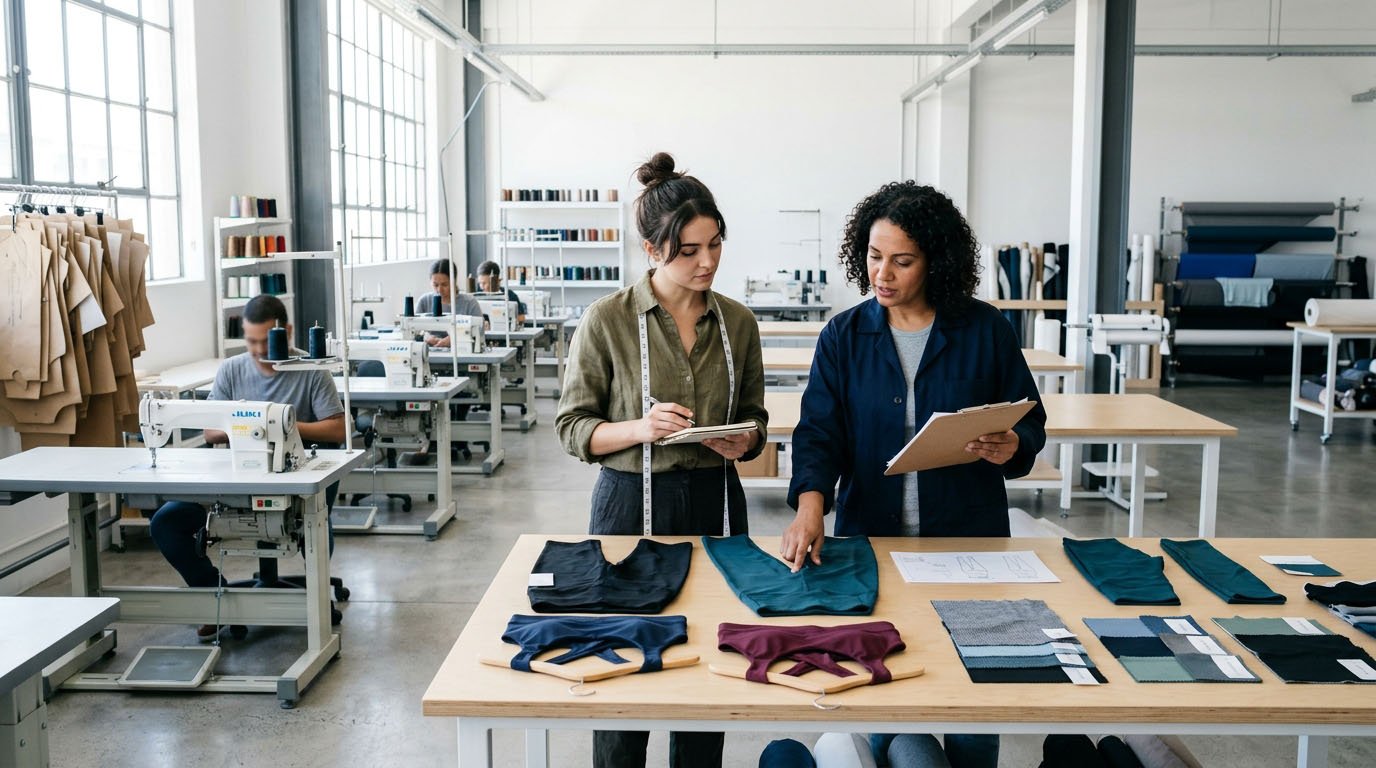
Quick Answer: How Do You Choose an Activewear Manufacturer?
Before comparing factories, define exactly what you intend to produce.
At minimum, clarify:
- Styles
- Quantity per style
- Colors
- Size range
- Fabric requirements
- Branding requirements
- Packaging
- Target cost
- Required delivery date
Then evaluate manufacturers across five areas:
- Production fit — Can the factory efficiently handle your type and volume of order?
- Fabric and development capability — Can it source or develop the materials your product requires?
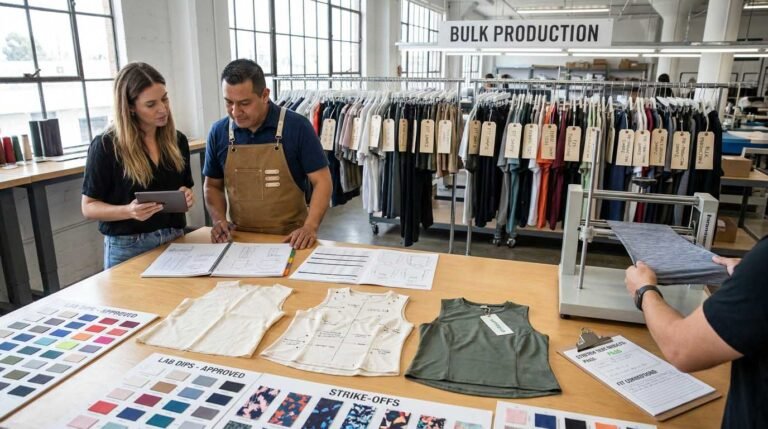
- Sampling and customization — Can it accurately translate your design into a production-ready garment?
- Quality control — Is there a clear system connecting the approved sample to bulk production?
- Commercial transparency — Are MOQ, pricing, lead time, and additional costs explained clearly?
Do not evaluate a factory based only on attractive photos, a low quote, or a single good sample.
The key question is whether its system can repeatedly deliver your specification in bulk.
Who Is This Activewear Manufacturer Guide For?
This guide is primarily designed for:
- Startup activewear brands preparing their first collection
- Growing DTC sportswear brands looking for a more reliable factory
- Private label buyers comparing different production models
- Wholesalers and distributors sourcing custom activewear
- E-commerce sellers moving from ready stock into custom production
- Sourcing managers evaluating new activewear suppliers
If you already have a clear product concept but need to compare factories on MOQ, fabric, sampling, customization, quality control, production capability, and commercial risk, this framework can help you make a more structured decision.
Step 1: Define Your Order Before Contacting Activewear Manufacturers
One of the most common sourcing mistakes is contacting factories with a vague inquiry such as:
“How much for 300 leggings?”
That is rarely enough information for an accurate quotation.
A better approach is to prepare a basic order matrix.
| Item | Example Information to Prepare |
|---|---|
| Product | Leggings / sports bra / shorts |
| Styles | Number of different designs |
| Colors | Colors per style |
| Sizes | XS–XL or your required range |
| Quantity | Units per style and color |
| Fabric | Stock or custom-developed |
| Branding | Logo, labels, hangtags |
| Packaging | Standard or customized |
| Target market | US / EU / Australia etc. |
| Delivery target | Planned launch date |
The objective is not to create a complicated procurement document.
It is simply to make sure both you and the manufacturer are discussing the same order structure.
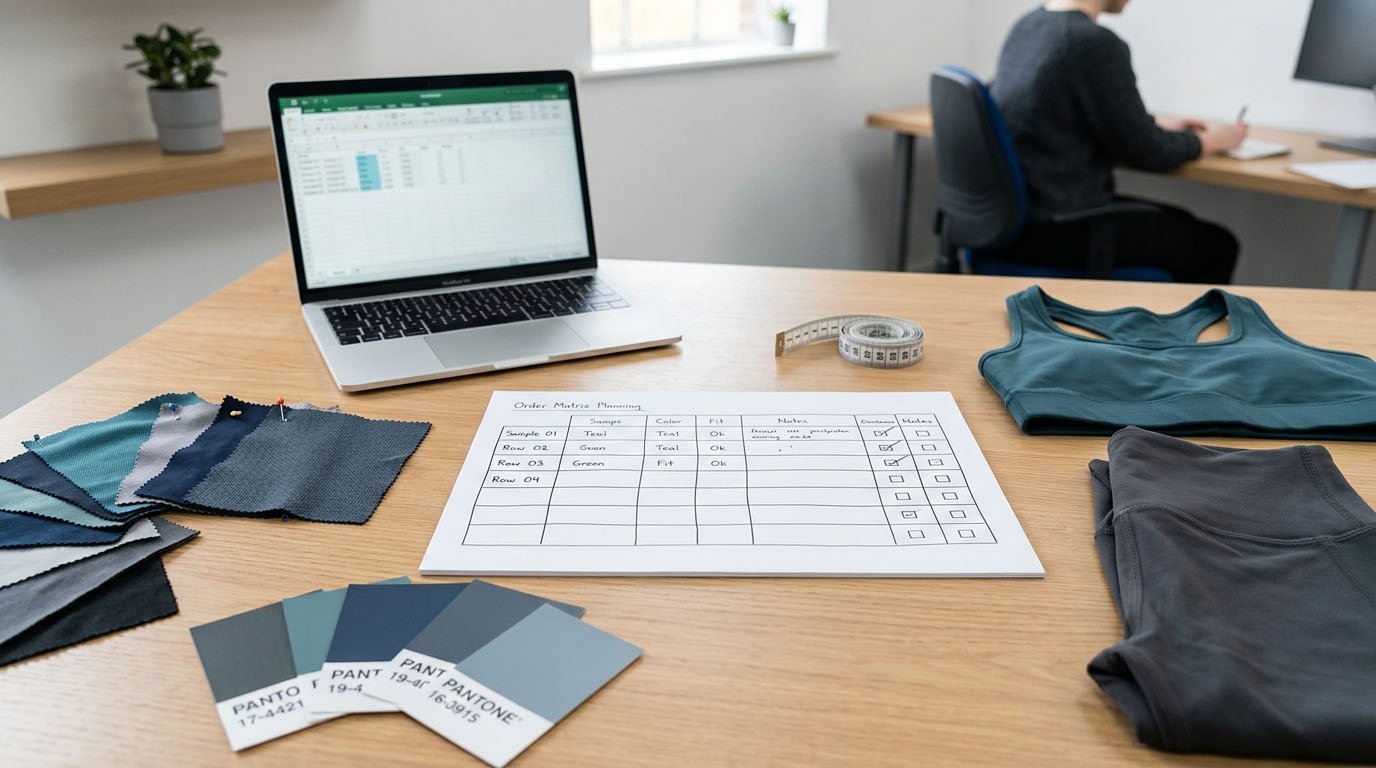
Why SKU Structure Matters
Consider two orders that both contain 300 garments.
Order A
- 1 style
- 3 colors
- 100 pieces per color
Order B
- 3 styles
- 3 colors
- roughly 33 pieces per style-color combination
The total garment quantity is similar, but the production complexity is very different.
Every additional style and color can affect:
- Pattern preparation
- Cutting
- Fabric allocation
- Sewing setup
- Labels
- QC
- Packing
- Production scheduling
For this reason, ask for MOQ at the style and color level, not only at the total-order level.
Step 2: Match Your Order to the Factory's Production Model
Not every clothing factory is designed for the same type of customer.
Some suppliers specialize in development and small runs. Others operate highly standardized production lines designed for larger repeat orders.
Instead of asking:
“Is this a good factory?”
ask:
“Is this factory's production system suitable for my order?”
What Startups Usually Need
A startup testing its first collection may prioritize:
- Flexible development
- Stock fabrics
- Lower production commitments
- Easy logo customization
- Responsive sampling
What Growing Brands Usually Need
A mature or growing activewear brand may prioritize:
- Higher capacity
- Repeat-order consistency
- Custom fabric development
- Detailed QC documentation
- Stable production scheduling
Wearzio supports activewear brands through product development, sampling, smaller test orders, and scaled bulk production rather than treating every order as the same production program.
The factory you select should fit both your current volume and your likely next stage of growth.
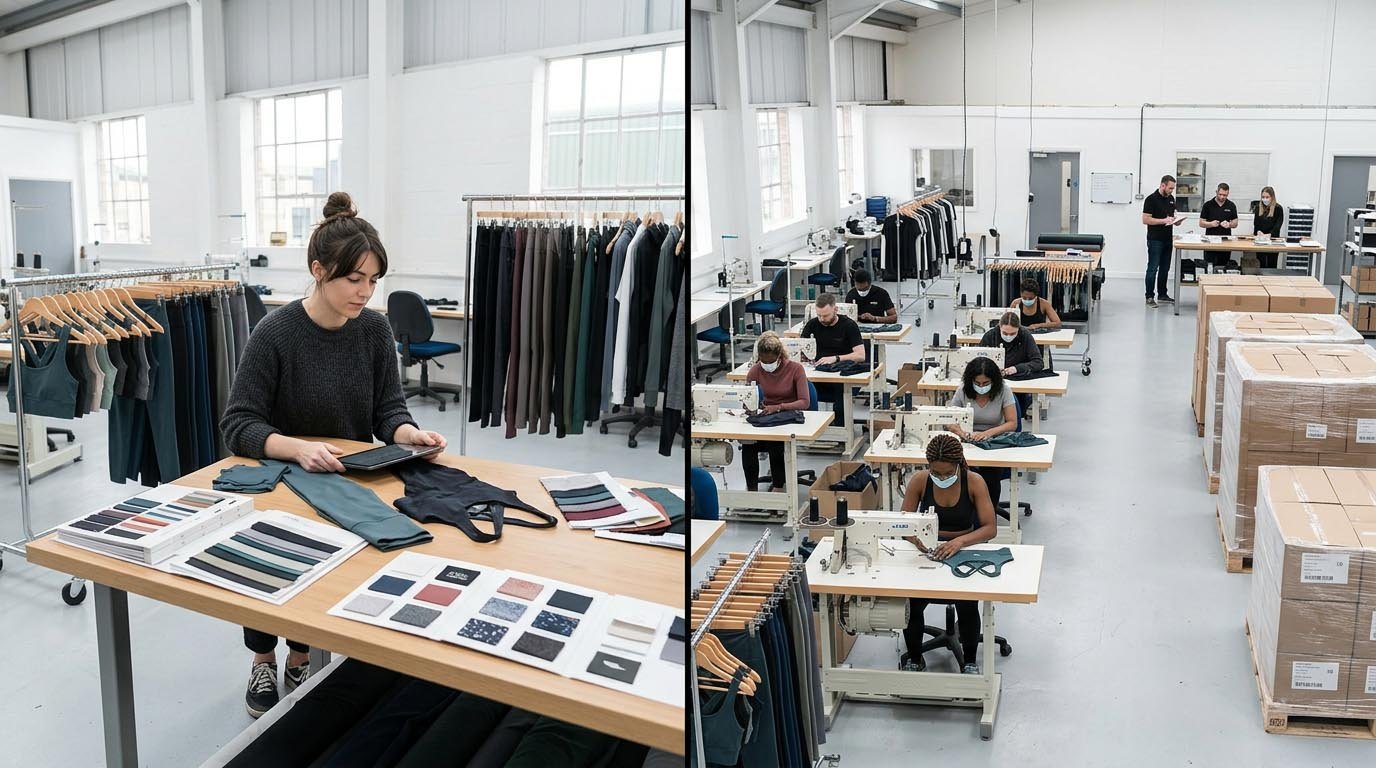
Step 3: Understand Garment MOQ vs Fabric MOQ
This is one of the most important concepts in activewear sourcing.
A factory's sewing MOQ is not necessarily the same as the MOQ imposed by its fabric supplier.
A manufacturer may be capable of producing a relatively small garment run, while a custom fabric construction, special color, or custom finishing process may require a significantly larger material commitment.
What Determines Garment MOQ?
Garment MOQ may depend on:
- Number of styles
- Number of colors
- Sewing complexity
- Production-line setup
- Branding requirements
What Determines Fabric MOQ?
Fabric MOQ may depend on:
- Stock vs custom fabric
- Fiber composition
- GSM
- Knitting construction
- Color
- Dyeing method
- Brushing or other finishing
- Textile mill requirements
This is why a quote such as:
“MOQ 100 pcs”
does not automatically mean every fabric, color, and trim is available at that volume.
When evaluating a factory, ask:
Is this MOQ for garment assembly, or does it also include my requested fabric and color?
For new brands, using proven in-stock functional fabrics can sometimes make smaller production programs easier to execute than developing a completely new textile from the beginning.
Wearzio's Fabric Sourcing service covers materials such as nylon, polyester, Lycra, modal, and Tencel, as well as performance requirements such as four-way stretch, moisture management, and UPF options.
Step 4: Evaluate Quality, MOQ, Price and Lead Time Together
These four factors should never be evaluated independently.
A low MOQ may sound attractive until you discover high development or customization costs.
A very low price may become expensive after:
- Sample revisions
- Branding setup
- Inspection
- Freight
- Rework
A very short production lead time is also meaningless if the manufacturer has not included:
- Fabric sourcing
- Sampling
- Approval
- Production scheduling
Use a combined comparison.
| Factor | What to Ask |
|---|---|
| MOQ | Is it per style, color, or total order? |
| Price | What is included and excluded? |
| Sampling | How many stages are required? |
| Fabric | Stock or specially sourced? |
| Lead time | When does the clock actually start? |
| Branding | Which items have separate minimums? |
| Quality | How is bulk matched to the approved sample? |
This gives you a much more realistic basis for comparing factories.
Step 5: Assess Fabric Sourcing and Sampling Capability
Activewear depends heavily on fabric performance.
A garment may look good on a hanger but fail in use because of poor:
- Stretch recovery
- Opacity
- Moisture management
- Abrasion resistance
- Colorfastness
- Hand feel
Therefore, ask how the manufacturer evaluates and sources fabrics.
Questions to Ask About Fabric Sourcing
Useful questions include:
- Does the factory maintain stock performance fabrics?
- Can it source custom compositions?
- Can it provide swatches before sampling?
- How are color and GSM checked?
- What testing is available?
- What happens if the requested fabric is unavailable?
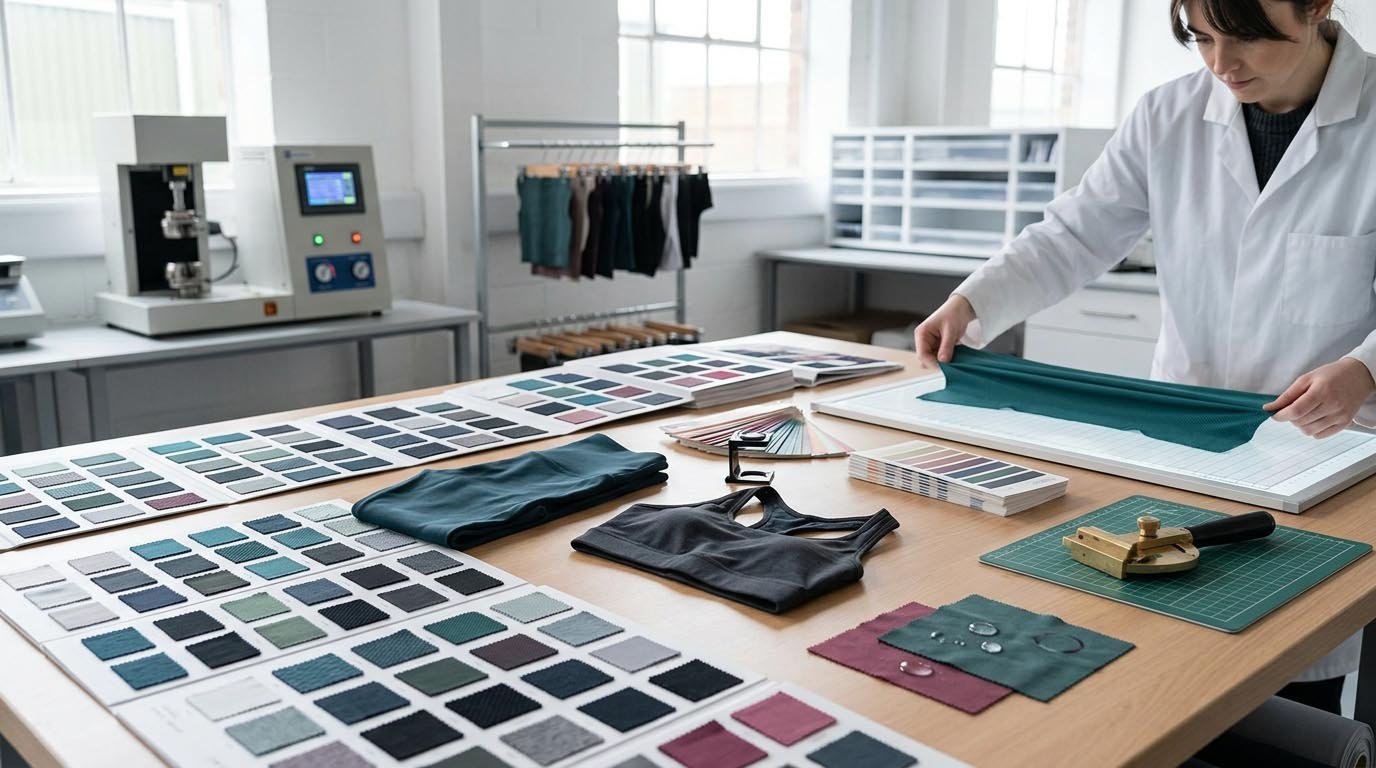
Sampling Is More Than Making One Prototype
Sampling should progressively remove production risk.
A typical development path may include:
Design / Tech Pack → Prototype → Fit Review → Revision → Pre-Production Approval → Bulk
The exact sequence varies by product and project.
The important point is that you should know:
- What each sample is intended to confirm
- What materials will be used
- What can still change after approval
- Which sample becomes the bulk reference
A good sample is not merely a sales demonstration.
It should eventually become a production control reference.
For custom construction, pattern development, and garment assembly, Wearzio's Cut & Sew service is especially relevant.
Step 6: Evaluate Private Label and Customization Capability Separately
“Private label” is often treated as one service.
Operationally, however, it can contain many different components:
- Heat-transfer logo
- Screen print
- Embroidery
- Woven label
- Care label
- Hangtag
- Custom packaging
- Special trims
- Reflective branding
- Custom hardware
Each component can have its own:
- Supplier
- Tooling requirement
- MOQ
- Cost
- Lead time
Therefore, instead of asking:
“Do you offer private label?”
ask:
“Which customization components are included in my garment MOQ, and which have separate requirements?”
Essential Branding at Launch
For many first collections, the essentials may include:
- Brand logo
- Size information
- Care information
- Basic packaging
Branding Upgrades as the Brand Scales
Additional features can be introduced later:
- Special hardware
- Bespoke packaging
- Custom molded trims
- Complex decorative components
This prevents branding extras from consuming too much working capital before the product itself has been validated.
Wearzio provides Private Label production as well as Embroidery, Screen Printing, and Sublimation Printing options.
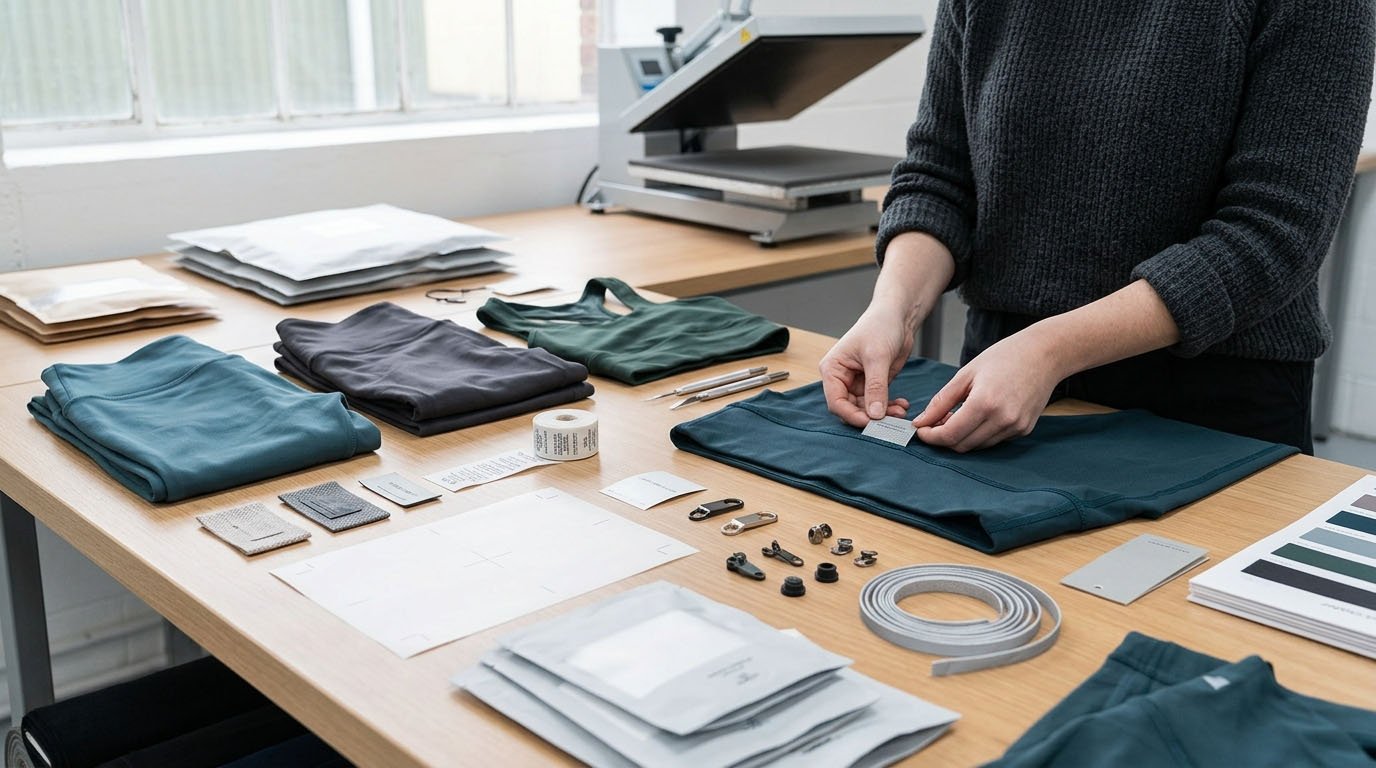
Step 7: Calculate Total Sourcing Cost, Not Just Unit Price
The cheapest factory quote is not automatically the cheapest sourcing option.
A more useful comparison considers the total cost required to place finished goods in your warehouse.
Total Sourcing Cost Framework
A simple framework is:
Garment Production
-
Development & Sampling
-
Branding / Trims
-
Inspection
-
Packaging
-
Freight
-
Applicable Duties / Clearance
= Total Delivered Cost
Then divide this by the number of usable delivered units.
The purpose is not to predict freight or duties months in advance with false precision.
It is to make sure two suppliers are being compared using the same cost basis.
Why the Lowest Factory Quote Can Cost More
Factory A may quote a lower garment price but require:
- More sample rounds
- More expensive trim minimums
- Higher rework risk
Factory B may quote slightly more but provide cleaner development and more repeatable bulk quality.
The second program may ultimately be commercially safer.
Step 8: Verify That Sample Quality Can Be Repeated in Bulk
This is one of the most important factory-selection questions:
How does one approved sample become hundreds or thousands of consistent garments?
A sample can be produced carefully by an experienced sample technician.
Bulk production is different.
It requires:
- Controlled cutting
- Standardized stitching
- Operator instructions
- In-line inspection
- Measurement controls
- Shade management
- Final inspection
Questions to Ask About Sample-to-Bulk Consistency
Ask the manufacturer:
- Is there a pre-production sample?
- What document defines the approved measurements?
- How are fabric and trim approvals recorded?
- How are operators instructed?
- How are measurements checked during production?
- How are defects corrected?
- What happens if final goods fail inspection?
The objective is not just to see whether a factory can produce one good garment.
You need evidence that its process can reproduce that garment consistently.
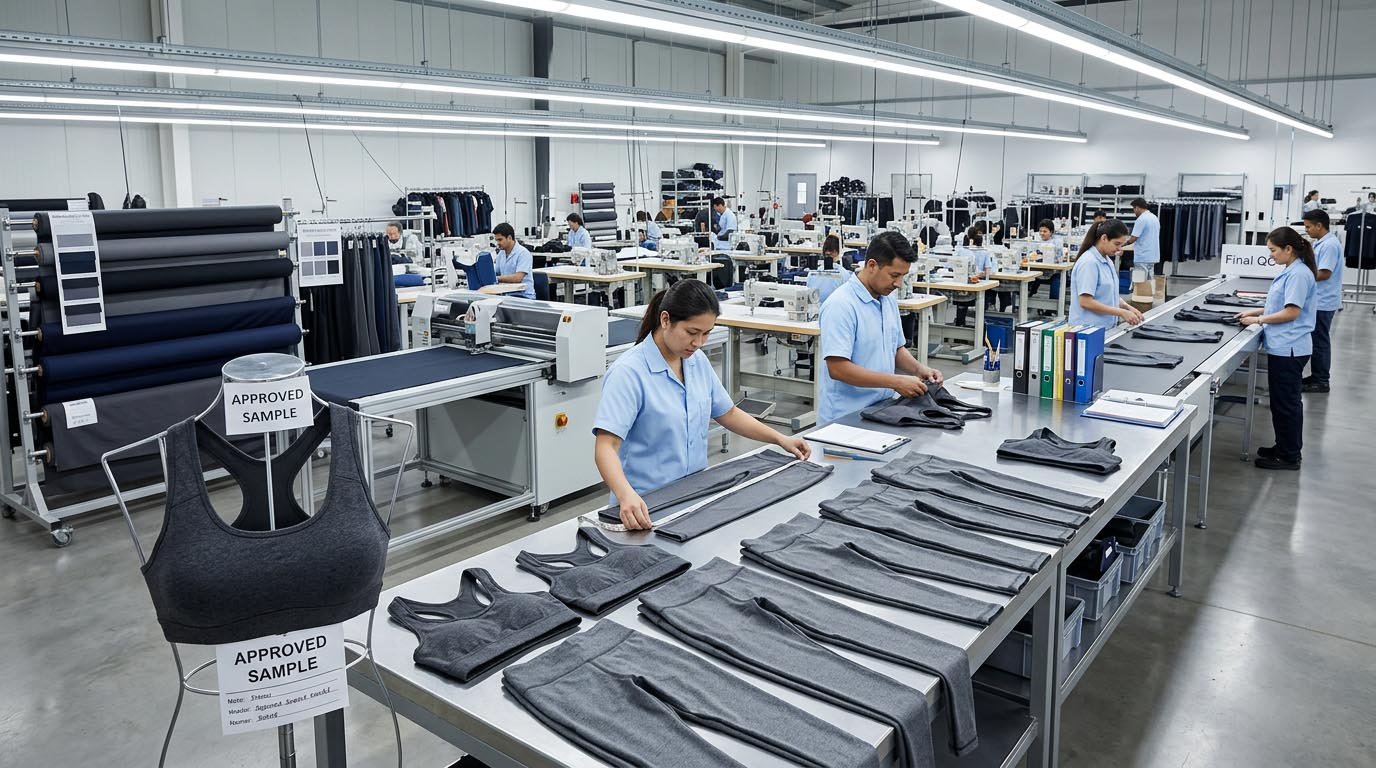
Step 9: Check Activewear-Specific Production Capability
Activewear is technically different from basic casual clothing.
Stretch fabrics require suitable machinery, seam construction, and operator experience.
Depending on the garment, relevant manufacturing capabilities may include:
- Automatic or precision cutting
- Four-needle six-thread construction
- Flat seams
- Stretch-compatible stitching
- Heat-transfer application
- Reflective logo application
- Laser cutting
- Technical panel assembly
Why Activewear Machinery Matters
Leggings and sports bras must perform under repeated stretch.
Poor seam selection can cause:
- Broken stitches
- Restricted movement
- Chafing
- Seam deformation
The manufacturer should therefore understand not only how the garment looks, but how it behaves during use.
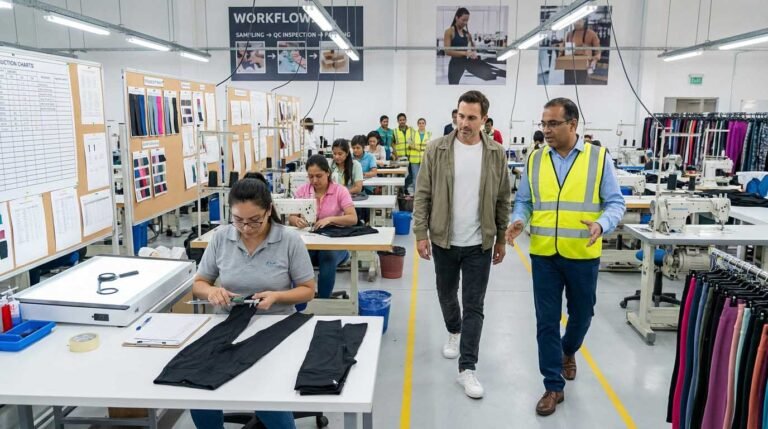
Wearzio operates five activewear production lines and uses technologies including automatic cutting, four-needle six-thread sewing, heat transfer, printing, embroidery, and laser cutting.
Step 10: Verify Quality Control and Compliance
Certificates can be useful evidence, but they should not replace order-level quality control.
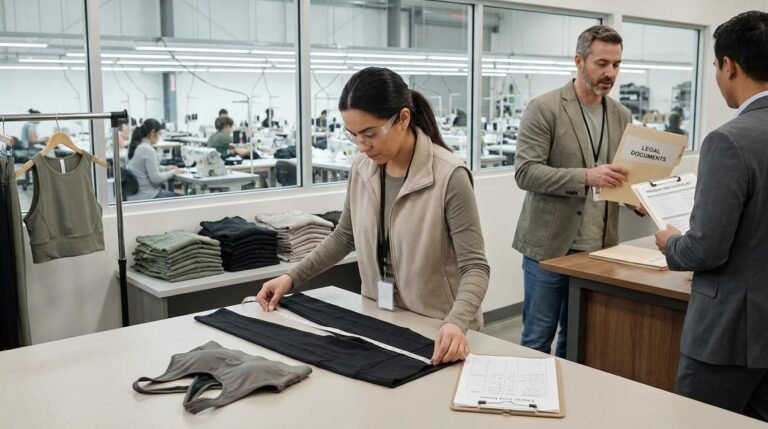
A practical QC system generally needs controls at several stages.
Incoming Material Inspection
Check items such as:
- Fabric appearance
- Shade consistency
- GSM where relevant
- Colorfastness requirements
- Trim quality
In-Line Production Inspection
Monitor:
- Stitch quality
- Seam construction
- Measurement
- Placement
- Workmanship problems
This allows defects to be detected before an entire order is completed.
Final Garment Inspection
Check:
- Measurements
- Appearance
- Stitching
- Logo placement
- Labels
- Packaging
- Overall workmanship
Wearzio uses fabric inspection, production-stage inspection, and final garment QC, with performance testing available for relevant products such as leggings and tight-fitting activewear.
Depending on the destination market and product, brands may also need to consider requirements associated with standards or testing frameworks such as OEKO-TEX, REACH, or SGS-based testing.
The correct question is not:
“Does this factory have certificates?”
It is:
“Which requirements apply to my product and market, and what evidence can the factory provide?”
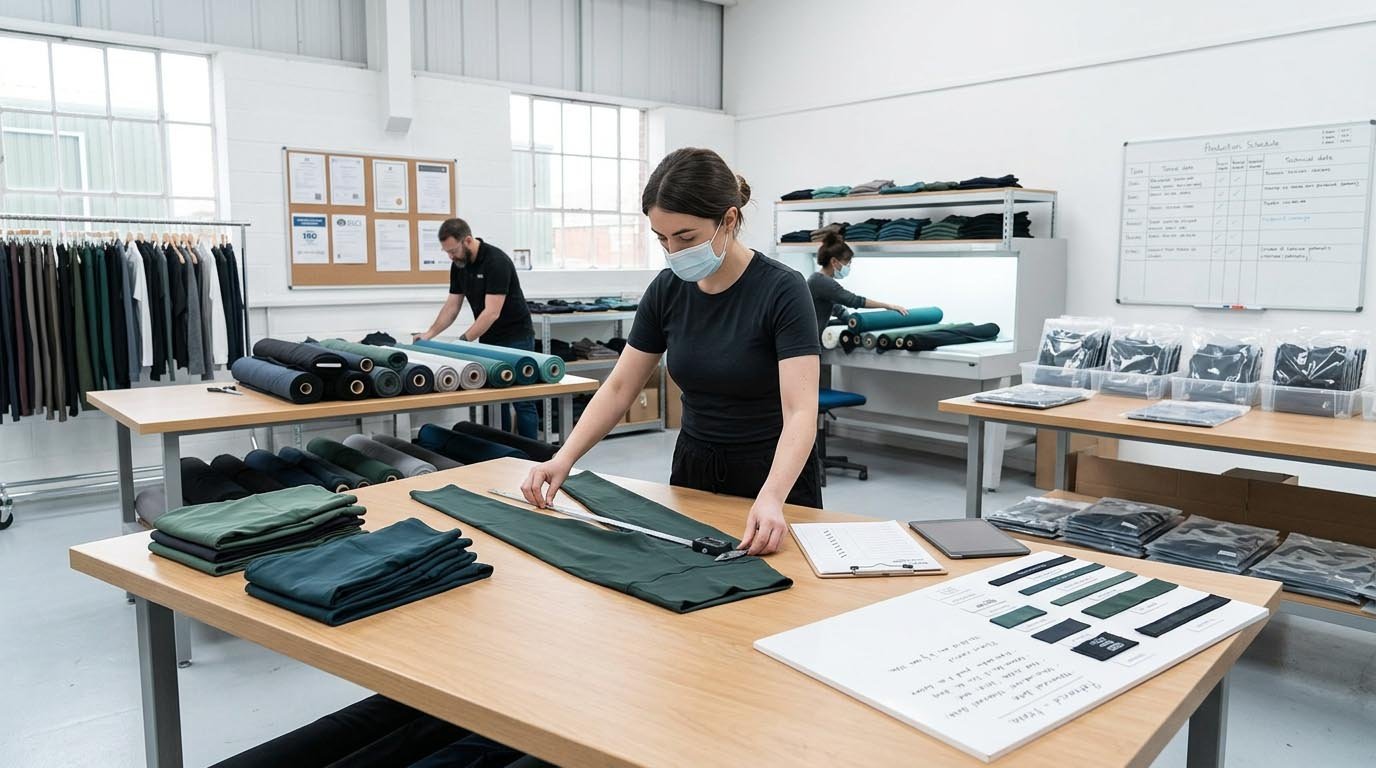
Activewear Manufacturer Verification Matrix: What to Ask and What Evidence to Request
Before paying a deposit, use a structured verification process.
| Area | What to Ask | Evidence to Request |
|---|---|---|
| Product experience | What activewear products do you regularly make? | Relevant samples / production evidence |
| Fabric | Stock or custom sourced? | Swatches / specification |
| MOQ | Per style, color, or total? | Written quotation |
| Sampling | What are the stages? | Sample plan |
| Fit | How are measurements approved? | Specification sheet |
| Branding | Separate MOQ or setup? | Branding quotation |
| Production | How will my order be scheduled? | Production timeline |
| QC | How is bulk matched to sample? | QC workflow |
| Testing | Which tests are available? | Relevant reports |
| Compliance | What applies to my market? | Current documentation |
| Bulk approval | Is a PP sample used? | Approved sample record |
| Final inspection | What happens before shipment? | Inspection procedure |
The goal is not simply to collect documents.
The goal is to confirm that the manufacturer's verbal promises are connected to a repeatable production process.
A factory does not need a perfect answer to every question immediately.
But its answers should be:
specific, internally consistent, and supported by evidence.
That is much more useful than generic claims such as:
“Best quality.”
or:
“No problem.”
Red Flags When Choosing an Activewear Manufacturer
Some warning signs should trigger further verification.
1. An Unusually Low Quote With No Explanation
A lower price is not automatically suspicious.
But the supplier should be able to explain what is included and why the cost differs from comparable quotes.
2. MOQ Terms Keep Changing
If MOQ changes every time you discuss colors, trims, or fabrics without a clear explanation, request a written breakdown.
3. The Factory Cannot Explain Sample-to-Bulk Control
A good prototype means little if there is no system for reproducing it.
4. Fabric Information Is Vague
The supplier should understand composition, weight, stretch, recovery, and relevant performance requirements.
5. QC Is Described Only as “100% Inspection”
Ask what is actually inspected, when it is inspected, and against which specification or approval standard.
6. Lead Times Sound Unrealistically Simple
Fabric sourcing, approvals, customization, and production all take time.
The timeline should reflect the real project.
7. Pressure to Pay Before Specifications Are Clear
Your order structure, fabric, customization, price, and major production conditions should be documented before production begins.
Questions to Ask Before Paying a Deposit
Before committing to a factory, ask these questions.
Questions About MOQ
- Is MOQ calculated per style, color, or total order?
- Do fabrics have separate minimums?
- Which trims or packaging items have separate minimums?
Questions About Sampling
- What sample stages do you recommend?
- Which sample becomes the production reference?
- What happens if the fit needs revision?
Questions About Fabric
- Is the selected fabric in stock?
- Can I review swatches first?
- What performance tests are available?
Questions About Production
- When does bulk lead time start?
- How is my order scheduled?
- What happens if a material is delayed?
Questions About Quality Control
- What checks happen during production?
- How are measurements controlled?
- How do you prevent shade variation?
- What happens when pieces fail final inspection?
Questions About Commercial Terms
- What exactly is included in the quotation?
- What additional setup or development costs may apply?
- What are the payment milestones?
Clear answers at this stage reduce disputes later.
Final Activewear Factory Selection Checklist
Before confirming your manufacturing partner, run through one final checklist.
- [ ] Product specialization confirmed
- [ ] Order structure and SKU breakdown confirmed
- [ ] Garment MOQ confirmed
- [ ] Fabric MOQ and availability confirmed
- [ ] Fabric swatches or specifications reviewed
- [ ] Sampling stages agreed
- [ ] Pre-production approval process confirmed
- [ ] Branding and customization requirements confirmed
- [ ] Total sourcing cost compared
- [ ] Production lead time documented
- [ ] QC workflow reviewed
- [ ] Compliance documents reviewed where relevant
- [ ] Sample-to-bulk control process confirmed
- [ ] Final inspection process confirmed
- [ ] Payment terms documented
If several of these points remain unclear, it is usually better to resolve them before paying a deposit rather than after bulk production has started.
FAQ: Choosing an Activewear Manufacturer
What Is a Reasonable MOQ for Activewear?
There is no universal activewear MOQ.
It depends on the factory, product construction, fabric, colors, branding, and order structure.
Always ask whether the quoted MOQ applies per style, per color, or across the total order.
Should I Choose the Factory With the Lowest MOQ?
Not necessarily.
MOQ should be considered together with unit cost, fabric availability, customization, sampling quality, and the factory's ability to support future reorders.
What Is the Difference Between OEM, ODM and Private Label?
In general, OEM involves manufacturing from a buyer's product specifications, while ODM provides more manufacturer-led product development.
Private label commonly involves applying a buyer's branding to existing or adapted products.
If deciding between these models is your main question, treat it as a separate sourcing decision rather than making it the central topic of factory selection.
How Do I Know Whether an Activewear Sample Will Match Bulk Production?
Ask what process connects the approved sample to production.
Look for documented specifications, fabric approval, pre-production confirmation, in-line checks, and final QC rather than relying only on the visual quality of one sample.
What Should I Verify Before Paying a Deposit?
Confirm:
- Product specification
- Fabric
- MOQ structure
- Branding
- Sampling approval
- Price
- Lead time
- QC process
- Payment terms
Keep these details in written production documentation.
Conclusion: Choose the Factory That Can Reliably Execute Your Order
Choosing the right activewear manufacturer is ultimately an exercise in matching your product to the right production system.
Do not begin with:
“Who has the cheapest price?”
Begin with:
“Who can reliably execute this exact order?”
Define your styles, colors, sizes, fabric, and customization first.
Then compare:
MOQ + Fabric Capability + Sampling + Total Cost + Production Capability + Quality Control + Delivery Risk
The strongest supplier relationship is not created by one impressive sample or one attractive quotation.
It is built when a manufacturer has a clear process for turning an approved specification into repeatable bulk production.
Wearzio has more than 10 years of OEM/ODM sportswear manufacturing experience, five production lines, dedicated QC support, and end-to-end capabilities covering fabric sourcing, development, sampling, custom branding, and bulk production.
You can learn more about Wearzio, explore our Fabric Sourcing and Private Label capabilities, or contact Wearzio to discuss your next activewear collection.