.png)
Last month a brand owner asked me to quote all three categories at once. When I asked which she wanted to test first, she said "all of them—they're all trending." I explained that each requires different fabric suppliers and testing budgets. She had $8,000 for inventory. That's barely enough for one category done right.
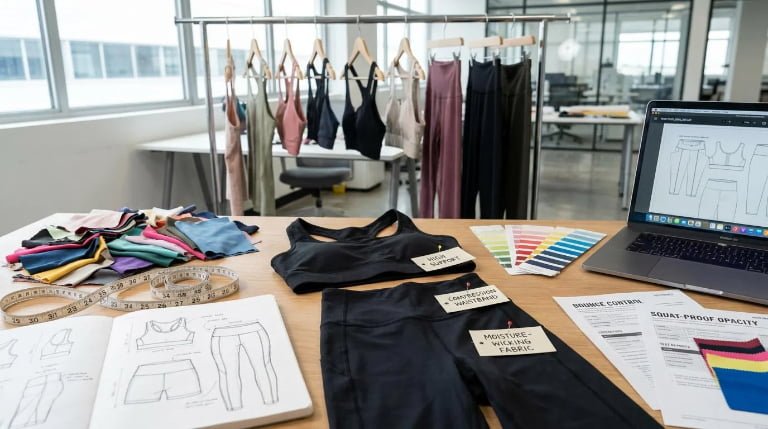
Sports bras, yoga sets, and wide-leg pants are trending because they serve multi-scenario wear, but each requires completely different technical specifications, fabric sourcing, and minimum order quantities. Successful market entry means choosing one category first based on your target market's preferences and your production budget constraints.
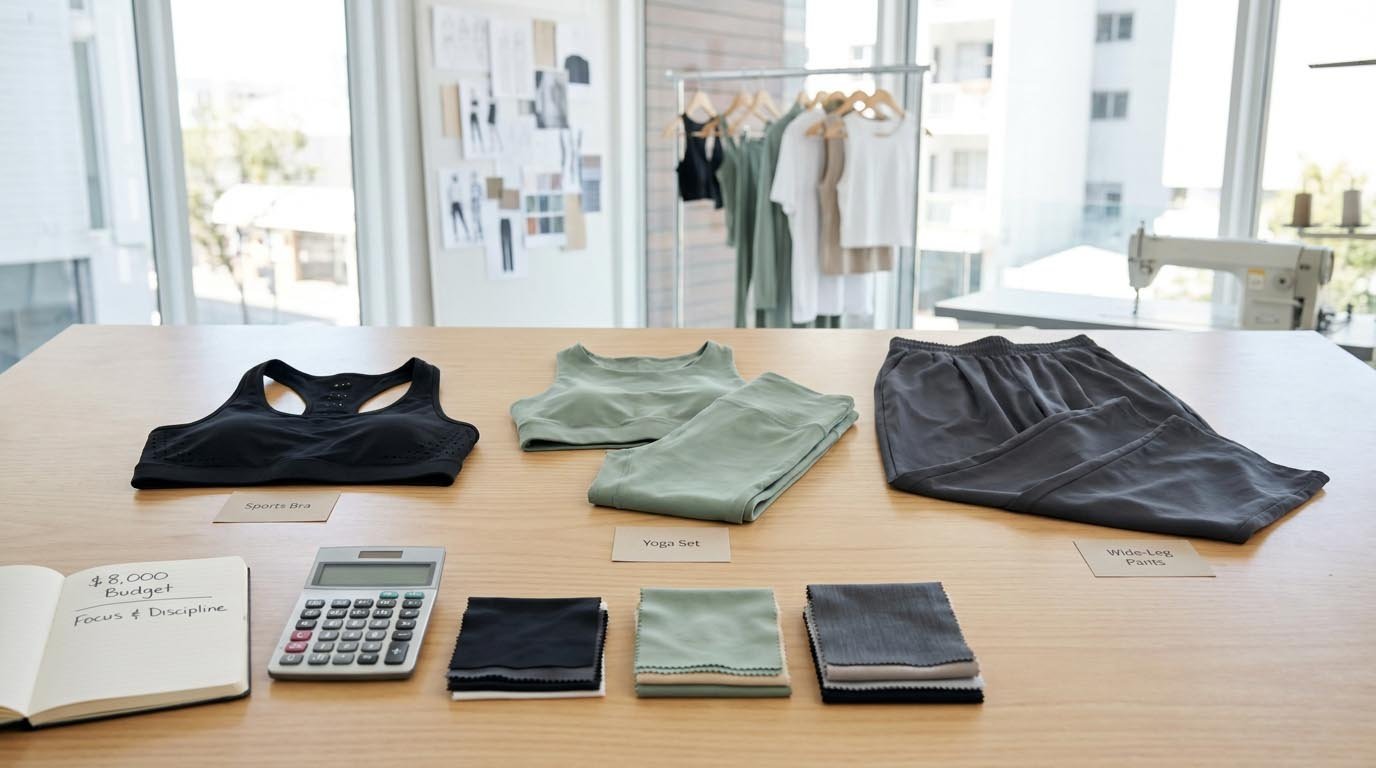
I see this pattern weekly. Brand owners read trend reports listing these three categories together. They assume ordering all three spreads risk. Actually, it multiplies risk because each category has different failure points and requires separate technical expertise.
Quick Answers: Sports Bras, Yoga Sets and Wide-Leg Pants
Q: Which category is easiest (and safest) to test first as a new activewear brand?
Yoga sets.
Nylon-spandex blends are widely available, low minimums (300–500 units), simple construction, and fast sampling. Sports bras need precise fit/testing, wide-leg pants demand precision cutting and pricier fabrics.
Q: Why are sports bras much more expensive to manufacture?
Specialized elastics, multi-layer support, cup-specific grading—adds $2–4 materials + $1.50–2.50 labor per unit compared to tops.
Typical high-support bra: $12–18/unit; tank top: $7–10/unit.
Q: What’s the MOQ for yoga sets vs. bras vs. pants?
Yoga sets: 300–500/style
Sports bras: 500–800/style (special components)
Wide-leg pants: 300–500/style (fabric costs 20–35% more than leggings)
Q: Can I use the same fabric for yoga sets and wide-leg pants?
No.
Yoga sets need stretchy, close-to-body (4-way stretch, 240–280 GSM, 20–25% spandex).
Wide-leg pants need low-stretch/woven (200–240 GSM, 5–10% spandex or none) for proper drape—stretch fabric creates cling and ruins silhouette.
Q: Which category gets fastest repeat purchases?
Yoga sets.
Repeat rates: 3–4 sets/year per customer. Sports bras: 1–2/year (unless damaged). Wide-leg pants: slower adoption, less predictable sell-through.
Comfort Meets Confidence: Why These Silhouettes Fit Today's Lifestyle?
A yoga brand owner told me she wanted to add sports bras because "customers keep asking." When I asked what support level they wanted, she didn't know. We spent thirty minutes clarifying that her yoga customers wanted light-support, wear-as-a-top bras, not high-impact gym bras. Different customer need, different product spec.
These three categories succeed because they bridge workout functionality with all-day wearability, but each solves a different comfort-confidence equation. Sports bras offer support without constriction, yoga sets eliminate outfit planning, and wide-leg pants provide coverage with movement freedom. Understanding which problem your customers prioritize determines which category to enter first.
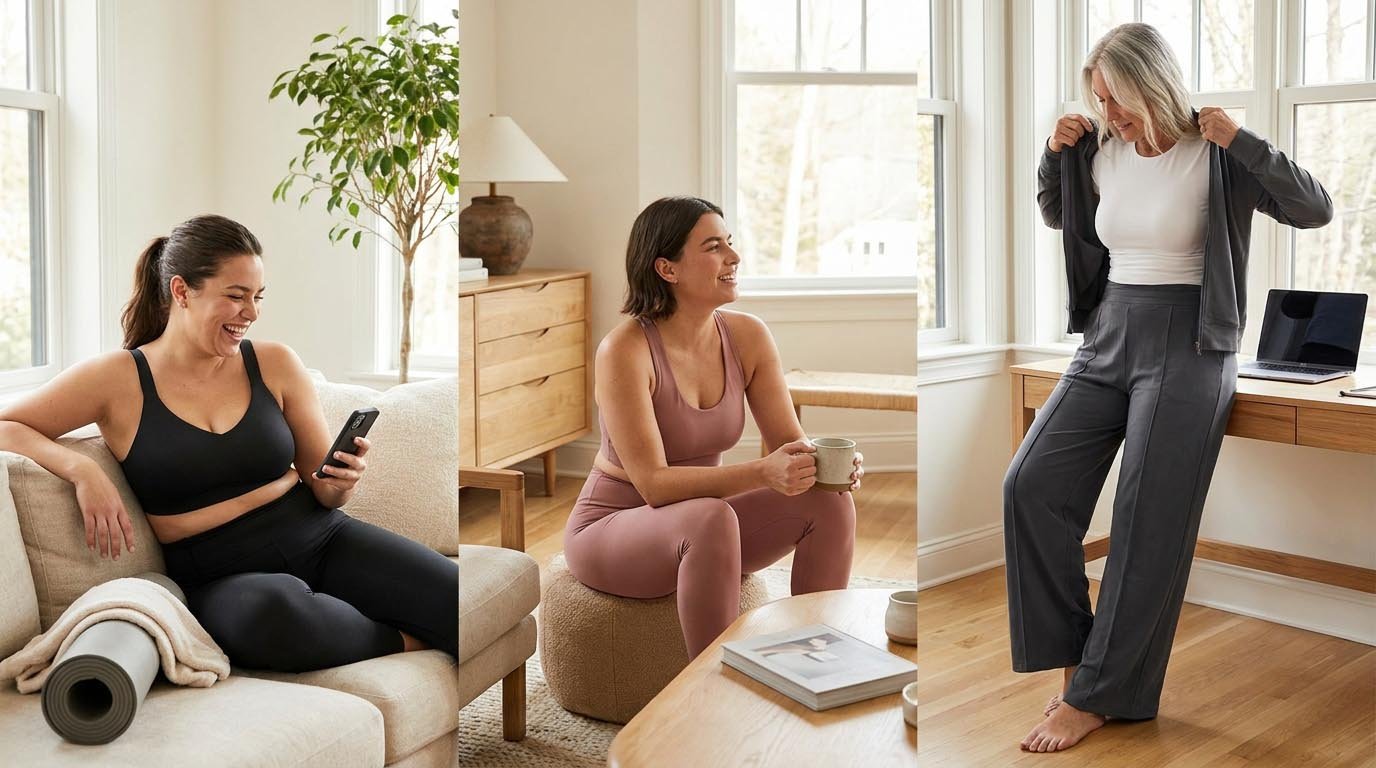
I need to explain how each category's appeal translates into specific technical requirements. Brand owners see fashion trends. I see fabric specifications and construction methods.
The Multi-Scenario Wear Shift
Traditional activewear stayed in the gym. These categories live outside it:
Sports bras as outerwear:
- Worn alone (not under clothes) for workout, casual, even going out
- Requires: Better finish quality, decorative details, coverage confidence
- Technical impact: Higher fabric weight (180-220 GSM vs. 140-160 GSM for under-layer bras)
Yoga sets as complete outfits:
- Customers wear to class, then continue daily activities without changing
- Requires: Fabric that doesn't look "too athletic", colors that work in non-gym contexts
- Technical impact: Softer hand feel, better drape, often modal or nylon blends over pure polyester
Wide-leg pants as office-casual:
- Replaces leggings for situations needing more "polish"
- Requires: Structure that holds shape, fabric that doesn't cling or wrinkle
- Technical impact: Lower stretch content, heavier weight, often woven or ponte constructions
Market-Specific Demand Patterns
Different regions show different category preferences:
North America and Europe:
- Strong demand for high-support sports bras (fitness culture emphasis)
- Yoga sets popular but competition is intense
- Wide-leg pants growing adoption but still emerging
Australia:
- Outdoor lifestyle drives sports bra demand (beach, hiking, casual)
- Yoga sets very popular (laid-back culture)
- Wide-leg pants slower adoption (climate stays warm, prefers shorts)
Southeast Asia:
- Light-support bras preferred (modesty considerations, less high-impact fitness)
- Yoga sets growing but price sensitivity high
- Wide-leg pants strong potential (professional dress codes + comfort trend)
Decision framework I provide:
Where are you selling primarily? If North America/Europe, sports bras are proven category but crowded. If Australia, yoga sets have established market. If Southeast Asia, wide-leg pants might be differentiated entry point.
Confidence Through Fit and Coverage
All three categories address body confidence differently:
Sports bras solve:
- Support without squeezing (compression vs. encapsulation)
- Staying in place during movement
- Looking intentional (not like underwear showing)
Yoga sets solve:
- No waistband gap or mismatch between top and bottom
- Coordinated look without styling effort
- Full coverage during bending and stretching
Wide-leg pants solve:
- Coverage for those uncomfortable in leggings
- Flattering drape that skims rather than clings
- Professional appearance while maintaining comfort
Production consideration:
Each solution requires different sampling approaches. Sports bras need fit testing on actual bodies (not dress forms). Yoga sets need color matching verification (tops and bottoms dyed together). Wide-leg pants need drape testing on moving bodies (static photos don't show fit issues).
Sports Bras Evolved: Support Tech, Adjustability and Outfit Versatility?
Every few weeks someone requests "basic sports bras." I ask what support level and for what activities. Half the time they can't answer. I explain that "basic" sports bras don't exist anymore—customers expect specific support technology matched to their activity intensity.
Sports bras now segment into three distinct support levels—light, medium, high—each requiring different fabric specifications, construction methods, and component sourcing. Light-support bras can use single-layer construction with standard minimums (300-500 units), while high-support bras need multi-layer builds, molded cups, and specialized elastics (500-800 unit minimums).
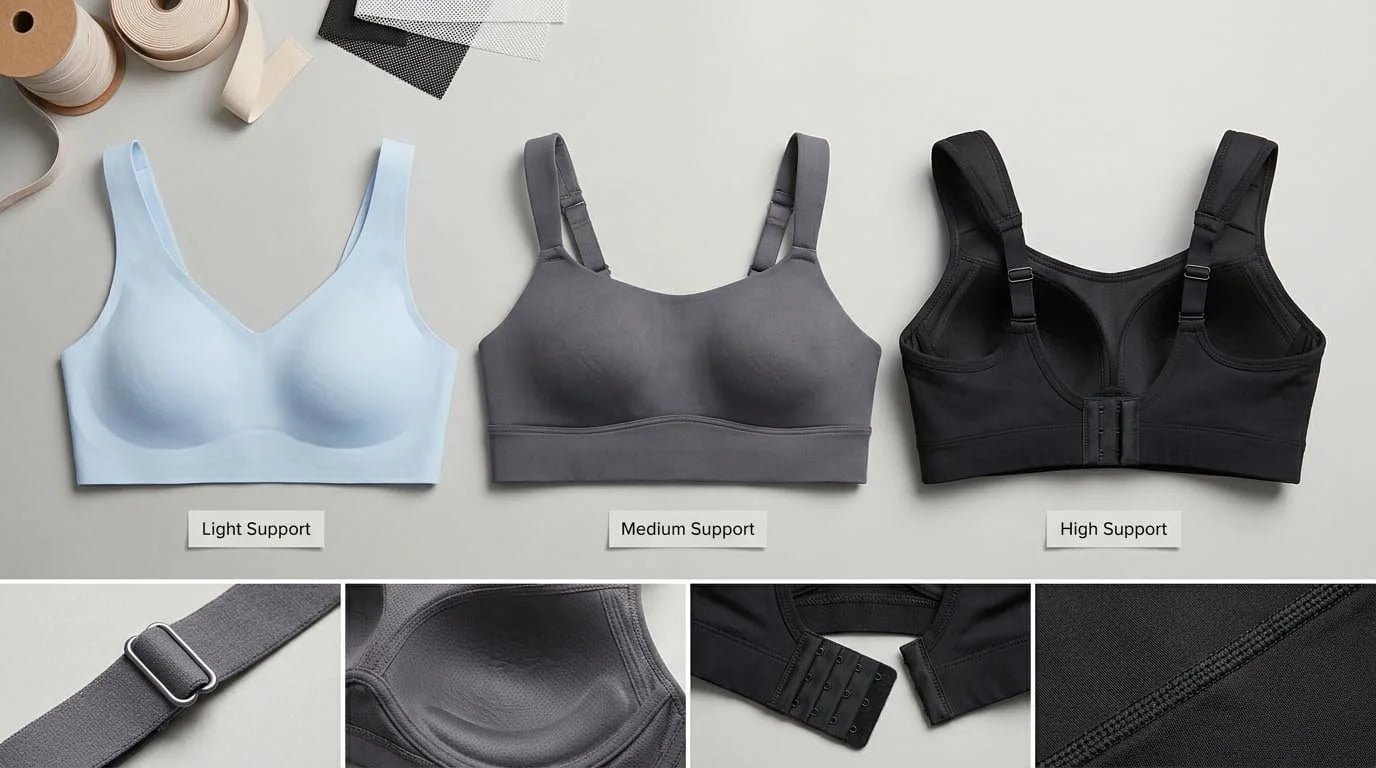
When clients want to add sports bras, I walk through a decision tree. Support level determines everything else about the product and the order.
Support Level Specifications
Here's how support levels translate to production specs:
Light support (yoga, walking, casual wear):
- Fabric: Single-layer construction, 180-200 GSM, 85/15 nylon-spandex
- Components: Simple elastic band, 1-2 cm width, removable cup pockets
- Construction: Flatlock seams, 6-8 pattern pieces
- MOQ: 300-500 units (standard elastic minimums)
- Unit cost: $7-10
Medium support (gym training, light running, cycling):
- Fabric: Double-layer construction or thicker single layer, 220-240 GSM, 82/18 or 80/20 ratio
- Components: Wide underband (3-4 cm), adjustable straps, molded cups optional
- Construction: Reinforced seams, 10-12 pattern pieces
- MOQ: 500-700 units (wider elastics have higher minimums)
- Unit cost: $10-14
High support (running, HIIT, high-impact sports):
- Fabric: Multi-layer construction, 240-260 GSM, often compression mesh + power mesh
- Components: Extra-wide underband (4-6 cm), adjustable straps and back closures, molded or sewn-in cups
- Construction: Encapsulation design with separate cup structures, 14-18 pattern pieces
- MOQ: 500-800 units (molded cups and specialized elastics)
- Unit cost: $12-18
Client scenario:
A startup wanted to launch with high-support bras because "that's what serious athletes need." Her budget was $5,000 total. At $15 per unit production cost, she could afford 333 units. That's barely 65-70 units per size across 5 sizes—not enough inventory depth. I suggested starting with medium-support bras at $11 per unit for 450 units, providing 90 units per size.
Adjustability and Customization Features
Modern sports bras include adjustability that affects production complexity:
Adjustable strap features:
- Slider adjustments: Add $0.40-0.70 per unit in hardware and assembly
- Multiple hook positions: Add $0.30-0.50 per unit
- Racerback clips: Add $0.50-0.80 per unit (small hardware, fiddly assembly)
Back closure options:
- Hook-and-eye closures (like traditional bras): Add $0.60-1.20 per unit, require precise alignment
- Front zippers: Add $0.80-1.50 per unit, easier donning/doffing
- Clasp-free compression: No added cost but limits customer base (harder to get on/off)
Cup options:
- Removable cup pockets: Baseline feature, adds $0.20-0.30 per unit
- Molded cups: Add $1.20-2.00 per unit, require 500+ unit minimums per size
- Sewn-in cups: Add $0.60-1.00 per unit, better support than removable
Sizing Complexity in Sports Bras
Sports bras are more complex to size than other activewear:
Standard activewear sizing: XS, S, M, L, XL (body size only)
Sports bra sizing options:
- Standard sizes (XS-XL): Simplest, covers band sizes 30-38 roughly
- Numeric sizing (32, 34, 36, 38, 40): More precise band fit
- Cup-size variants (32B, 34C, 36D): Maximum fit precision
Production implications:
| Sizing System | SKU Count | Grading Complexity | Sampling Cost | Best For |
|---|---|---|---|---|
| Standard (XS-XL) | 5 SKUs | Low | $300-500 | Light support, startup brands |
| Numeric (32-40) | 5 SKUs | Medium | $400-600 | Medium support, broader fit |
| Cup sizes (32A-38D) | 15-25 SKUs | High | $800-1,500 | High support, established brands |
Inventory risk assessment:
A brand wanted cup-specific sizing for her first collection. At 300 units per SKU and 20 SKUs (5 band sizes × 4 cup sizes), she'd need 6,000 units minimum and $72,000-90,000 inventory investment. We scaled back to 5 standard sizes (1,500 units, $10,500-15,000) for market testing.
Wearing as Outerwear Requirements
Sports bras worn as tops need different specifications:
Coverage considerations:
- Higher necklines: Front must cover cleavage appropriately for public wear
- Back coverage: Racerback or cross-back designs provide more coverage than traditional sports bra backs
- Side coverage: Wider side panels prevent "spillage" or exposure
Finish quality expectations:
- Clean interior seams: Exposed seams must be flatlock or bound, not raw edges
- No visible bra construction elements: Underwires, obvious cup lines look inappropriate as outerwear
- Decorative details: Mesh inserts, strappy backs, color blocking justify outerwear pricing
Cost implications:
Outerwear-quality sports bras cost $1.50-3.00 more per unit than standard sports bras due to better finishing, more complex designs, and higher fabric quality expectations.
Yoga Sets Win on Coordination: Outfit Efficiency and Social Appeal?
Six months ago I noticed order shift. Brands stopped ordering just leggings or just tops. They wanted matching sets in coordinated colors. When I asked why, they said customers buy complete outfits, not individual pieces anymore.
Yoga sets succeed because they eliminate outfit coordination effort while delivering social media-ready appearance. But producing sets requires color matching across different fabric constructions (leggings use compression knits, tops use lighter weights), increasing sampling rounds from 2-3 to 3-4 and adding $300-600 in development costs per set.
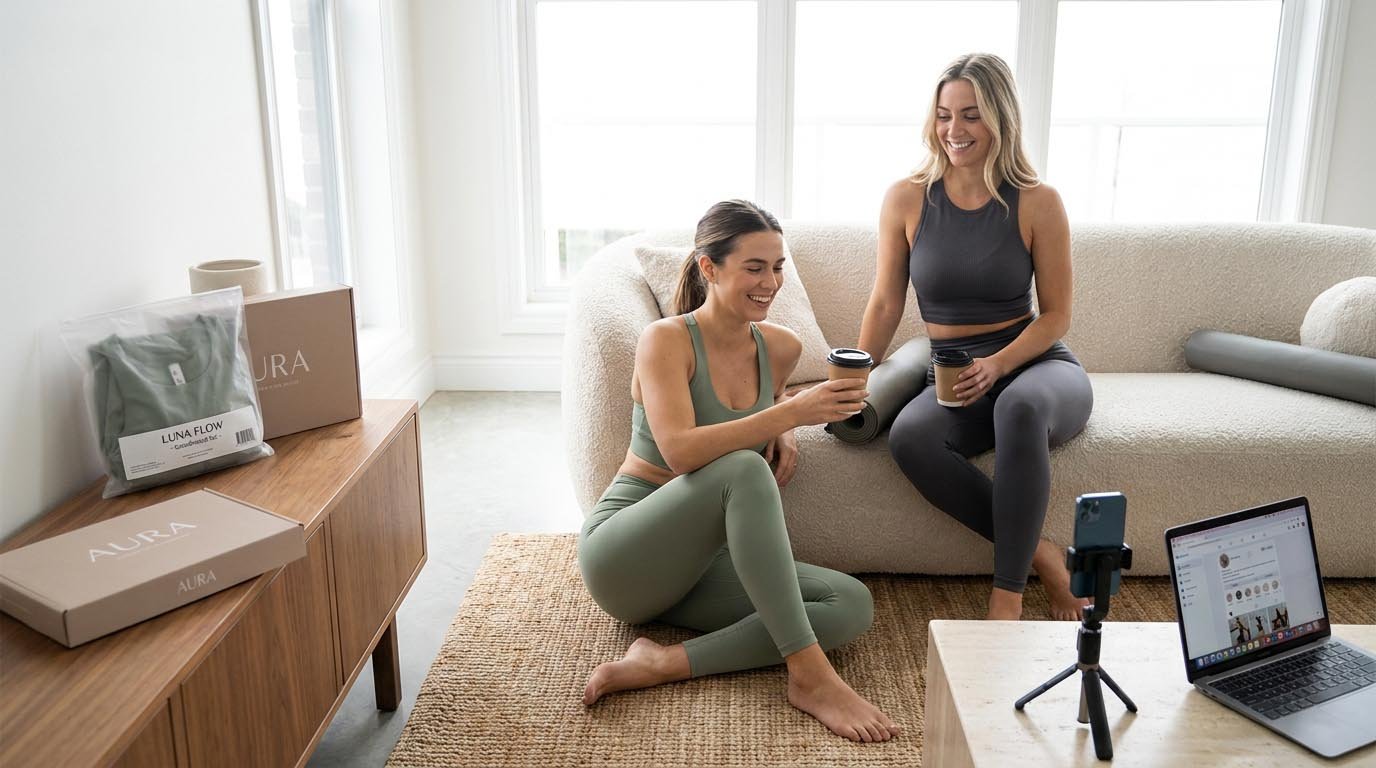
When clients order yoga sets, I need to confirm: are these designed as sets from the start, or are they mixing existing pieces? The answer changes the production approach completely.
Color Matching Challenges
The biggest technical challenge in yoga sets is color consistency:
Why color matching is difficult:
- Leggings fabric: 260-280 GSM, tight knit, 80/20 or 85/15 nylon-spandex
- Sports bra fabric: 200-220 GSM, different knit structure, 82/18 ratio
- Crop top fabric: 180-200 GSM, lightest weight, may include mesh
Same dye lot behaves differently:
- Heavier fabric absorbs more dye (appears darker)
- Different knit structures reflect light differently
- Spandex percentage affects dye uptake
Production solutions:
Option 1 - Same fabric for all pieces:
- Advantage: Perfect color match guaranteed
- Disadvantage: Tops may be too heavy, bras may lack support
- When it works: Loose-fit sets, loungewear-style yoga sets
Option 2 - Separate fabrics with dye testing:
- Advantage: Each piece uses optimal fabric
- Disadvantage: Requires lab dip testing and color adjustment, adds 2-3 weeks to timeline
- Additional cost: $150-300 per colorway for dye testing
- When it works: Performance-focused sets, premium brands
Option 3 - Strategic color choices:
- Use heathered or melanged colors: Natural variation makes slight differences less noticeable
- Use black, navy, or very dark colors: Small variations invisible to eye
- Avoid: Pastels, bright colors, light grays (show every slight difference)
Set Composition Options
Not all yoga sets are leggings + sports bra. I see various combinations:
Most common sets:
Set 1 - Classic yoga set:
- High-waisted leggings + sports bra
- Best for: Yoga, gym, activewear market
- Cost: $16-24 per set to produce
Set 2 - Modest coverage set:
- High-waisted leggings + crop top with more coverage
- Best for: Markets preferring less skin showing
- Cost: $15-22 per set (crop top simpler than bra)
Set 3 - Three-piece set:
- Leggings + sports bra + oversized hoodie or jacket
- Best for: Premium positioning, higher AOV
- Cost: $24-35 per set (jacket adds significantly)
Set 4 - Shorts variation:
- Bike shorts or regular shorts + sports bra
- Best for: Summer collections, hot climate markets
- Cost: $13-20 per set (shorts use less fabric)
Set 5 - Loungewear crossover:
- Wide-leg pants + matching oversized top
- Best for: Athleisure, recovery wear
- Cost: $18-26 per set
MOQ Strategy for Sets
Sets create inventory complexity:
Challenge: Each piece of the set needs separate production allocation
Example: 500-unit order of leggings + bra sets
Option A - Equal quantities:
- 500 leggings + 500 bras = 500 sets
- Risk: What if bras sell faster than leggings as individual items?
- What if customers want to mix and match?
Option B - Overage on one piece:
- 500 leggings + 600 bras = 500 sets + 100 extra bras
- Allows for individual bra sales
- But requires 600-unit minimum on bras (may push past MOQ threshold)
Option C - Separate individual and set inventory:
- 300 sets (matched pairs) + 200 individual leggings + 200 individual bras
- Total: 500 leggings, 500 bras
- Maximum flexibility but complex inventory management
My recommendation:
Start with equal quantities for first order. Use sales data to adjust ratios in reorders. Most brands find 1:1 works initially, then shift to 1:1.2 or 1.2:1 based on which piece sells faster individually.
Packaging and Presentation
Sets often require different packaging:
Individual piece packaging:
- Standard poly bags or hang tags
- Cost: $0.15-0.30 per piece
Set packaging options:
Option 1 - Bundled together:
- Both pieces in one poly bag with set label
- Cost: $0.20-0.40 per set
- Advantage: Clear set presentation
- Disadvantage: Hard to break apart for individual sales
Option 2 - Coordinated packaging:
- Separate bags but matching labels or hang tags indicating set
- Cost: $0.25-0.50 per set
- Advantage: Flexibility to sell individually
- Disadvantage: May not look like unified set
Option 3 - Box or gift packaging:
- Premium presentation in branded box
- Cost: $1.50-3.50 per set
- Advantage: Justifies premium pricing
- When it makes sense: $80+ retail price points
Social Media and Visual Coordination
Brands tell me sets sell better because they photograph well:
Instagram/TikTok factors:
- Coordinated outfits look more intentional than mixed pieces
- Easier content creation: Less styling needed
- Higher engagement: Complete looks perform better than individual items
Production impact:
Visual appeal drives specific color and design choices:
- Monochromatic sets (same color top and bottom) trending over contrast
- Subtle texture variation (ribbed top, smooth leggings) adds interest without breaking coordination
- Strategic cutouts or mesh make sets distinctive for social content
But: Don't design for photos only. I remind clients that products must perform during actual use, not just look good in static images.
Wide-Leg Pants Rise: Comfort, Drape and Studio-to-Street Polish?
Last year wide-leg pants were rare inquiries. This year I get 3-4 requests per week. But most clients don't understand that wide-leg pants are not "looser leggings." They're fundamentally different products requiring different fabric types and construction methods.
Wide-leg activewear pants succeed by providing coverage and polish that leggings can't offer, but they require low-stretch or woven fabrics (vs. high-stretch knits), precise cut and drape engineering, and often cost 20-35% more per unit than leggings due to fabric type and complexity.
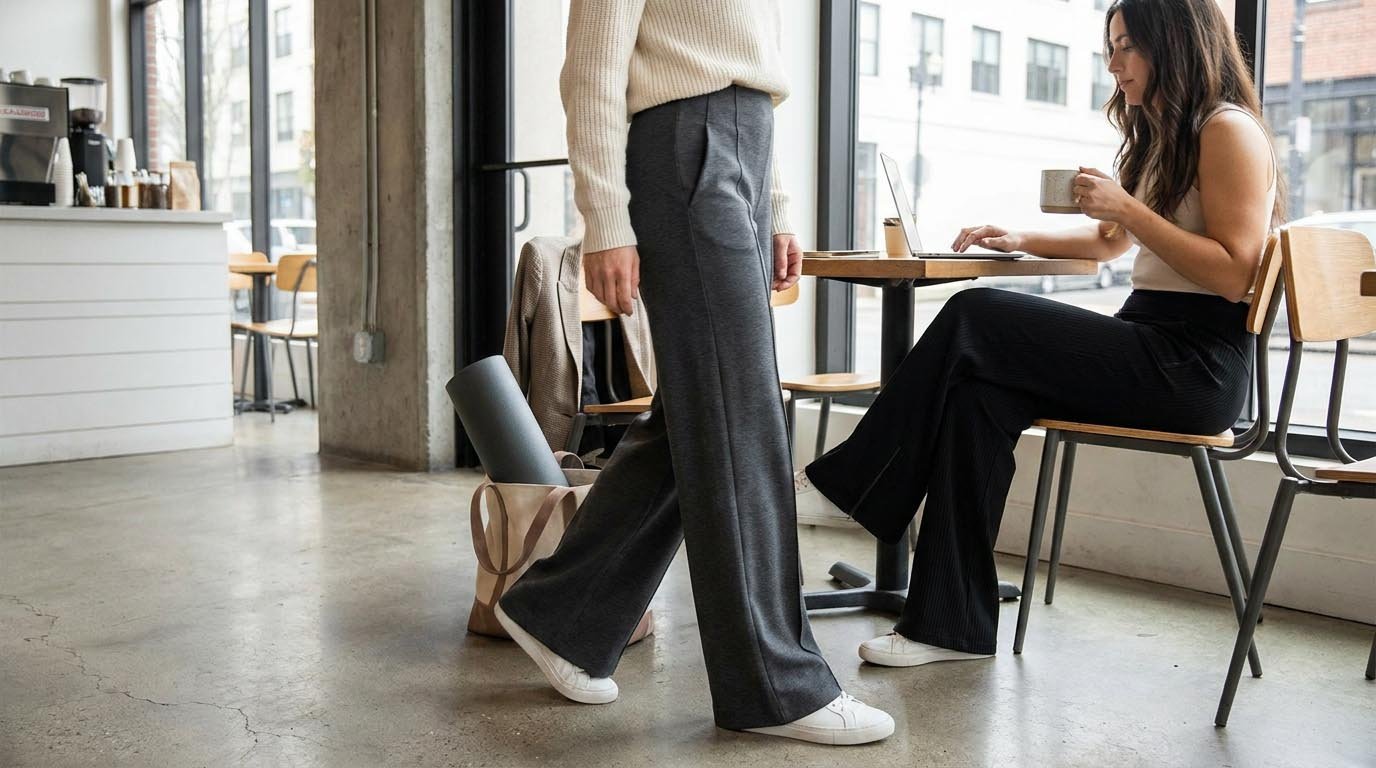
When someone asks for wide-leg pants, my first question is: what fabric drape do you want? That determines everything about production feasibility and cost.
Fabric Requirements for Drape
Wide-leg pants need fabric that hangs and flows rather than clings:
Wrong fabric choice - high-stretch knits:
- Using standard 85/15 nylon-spandex legging fabric
- Problem: Fabric clings to legs, creates unflattering bunching
- Result: Looks like baggy leggings, not intentional wide-leg design
Correct fabric options:
Option 1 - Low-stretch jersey:
- Composition: 95/5 or 92/8 polyester-spandex (minimal stretch)
- Weight: 200-240 GSM
- Characteristics: Soft drape, slight stretch for comfort, maintains shape
- Cost: Similar to standard jersey, $4-6 per meter
- Best for: Casual wide-leg pants, loungewear crossover
Option 2 - Ponte knit:
- Composition: 95/5 polyester-spandex or 70/25/5 poly-rayon-spandex
- Weight: 280-320 GSM
- Characteristics: Structured feel, holds shape, professional appearance
- Cost: 20-30% more than standard jersey, $6-8 per meter
- Best for: Office-casual wide-leg pants, studio-to-street
Option 3 - Woven fabrics:
- Composition: Polyester or poly-blend wovens, minimal or no stretch
- Weight: 180-220 GSM
- Characteristics: Crisp drape, most polished appearance, may wrinkle
- Cost: $5-7 per meter
- Best for: Premium wide-leg pants, dressy athleisure
Option 4 - Ribbed knits:
- Composition: 92/8 or 90/10 with vertical rib texture
- Weight: 240-280 GSM
- Characteristics: Texture adds visual interest, moderate drape
- Cost: 15-25% more than smooth knits, $5-7 per meter
- Best for: Fashion-forward wide-leg pants, younger markets
Construction Differences from Leggings
Wide-leg pants require different pattern and construction approach:
Pattern complexity:
- Leggings: Simple pattern, fitted through entire leg
- Wide-leg pants: Fitted through hip and thigh, flares from knee or higher
- Grading challenge: Width of leg opening must scale proportionally with size
Seam considerations:
- Leggings: Flatlock seams acceptable (stretch fabric forgives minor alignment issues)
- Wide-leg pants: Seams must be precise (less stretch means errors show clearly)
Waistband options:
For leggings:
- High-stretch waistband, 5-8 cm wide
- Compression hold essential
For wide-leg pants:
- Elastic waistband: Comfortable but may look too casual (3-5 cm elastic inside casing)
- Fitted waistband with zipper: More polished but adds $1.20-2.00 per unit
- Drawstring waistband: Casual aesthetic, adjustable fit, low cost addition ($0.30-0.50)
Hem finishes:
- Leggings: Often raw edge with coverstitch (stretch fabric doesn't fray)
- Wide-leg pants: Clean hem essential—folded and stitched or bound (adds $0.20-0.40 per unit)
Length and Proportion Challenges
Wide-leg pants are more length-sensitive than leggings:
Length options:
Full-length:
- Should just touch or slightly break on shoes
- Challenge: What shoe height to design for?
- Solution: Offer regular and tall lengths, or design 7/8 length that works on more heights
7/8 or ankle length:
- Intentionally cropped, shows ankle
- Advantage: Less length variation issues
- Current trend: More popular than full-length
Cropped or capri:
- Ends mid-calf
- Risk: Can look dated depending on cut
Inseam considerations:
For full-length wide-leg pants:
- Petite (under 5'4"): 28-29 inch inseam
- Regular (5'4"-5'8"): 30-31 inch inseam
- Tall (over 5'8"): 32-34 inch inseam
Production decision:
Offering multiple lengths means:
- Separate cutting for each length (more complex production planning)
- Separate SKUs for inventory management
- $0.15-0.30 per unit additional cost for length variations
Many brands start with one length only (usually 7/8) to simplify first production.
Studio-to-Street Versatility
Wide-leg pants bridge workout and casual wear:
What makes them work for multiple contexts:
- Comfortable waistband: Suitable for all-day wear
- Movement freedom: Yoga, Pilates, stretching possible
- Professional appearance: Can wear to casual office, lunch, errands
- Coverage: Appeals to customers who don't like legging exposure
Fabric performance across contexts:
Must handle:
- Sweat management: Light to moderate activity
- Wrinkle resistance: Sitting, movement throughout day
- Durability: More wear frequency than gym-only items
- Easy care: Machine washable, quick-dry helpful
Testing checklist I provide:
- Does fabric wrinkle during extended sitting?
- Does it show sweat marks?
- Does it lose shape after a full day of wear?
- Can it go through 30+ washes without significant pilling or fading?
Merchandising Momentum: Bundles, Creators and Better Fit Guidance?
Last month a brand asked why her sports bras weren't selling despite good quality. I looked at her website. The product photos showed bras on hangers. No fit information. No size chart with actual measurements. No guidance on support level. No wonder customers hesitated.
These three categories sell better when supported by strong merchandising: bundle discounts that encourage set purchasing, creator content showing real fit and movement, and detailed fit guidance addressing size/support questions. Poor merchandising creates hesitation even with quality products, increasing return rates and reducing conversion.
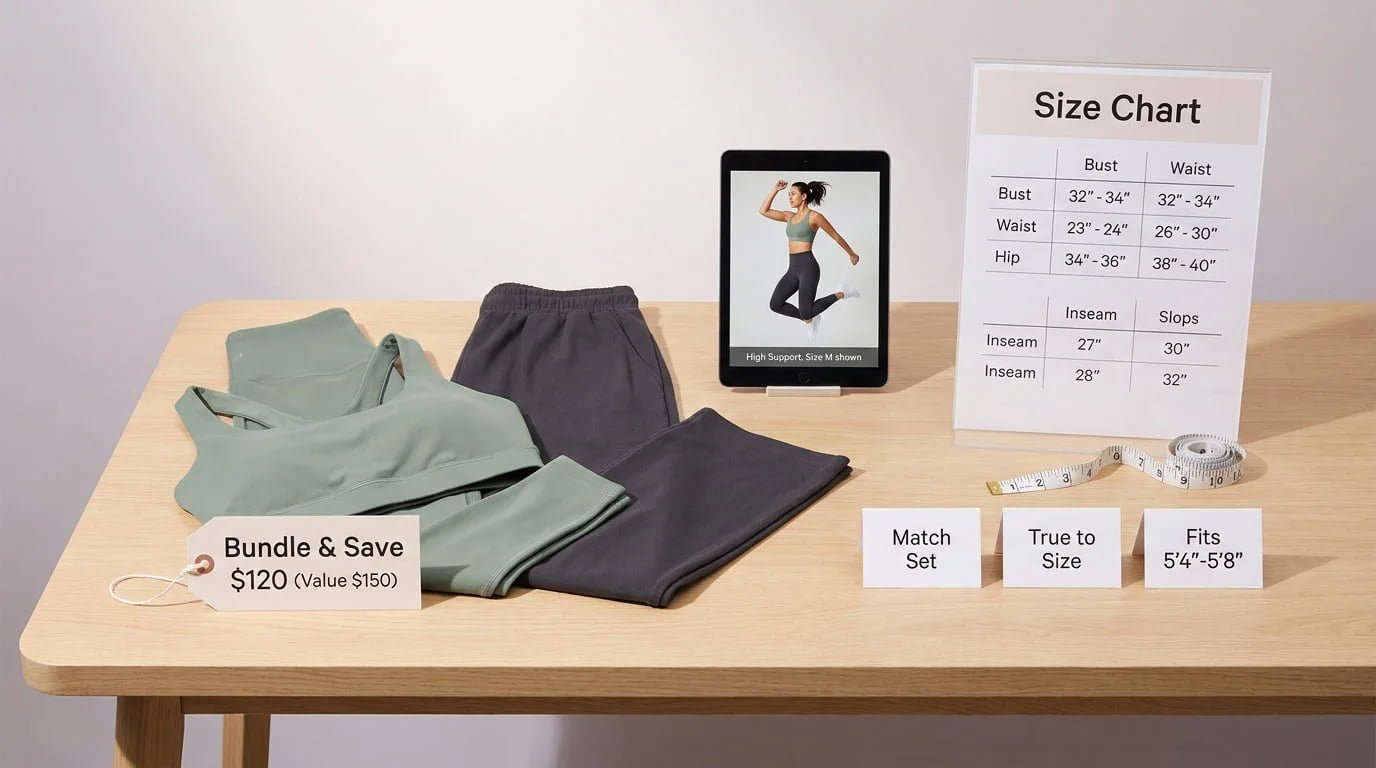
Merchandising isn't my core expertise, but I see clear patterns in which clients succeed with these categories. The products are only half the equation.
Bundle and Set Pricing Strategy
Brands using bundle pricing see measurably better performance:
Pricing approaches I observe working:
Sports bra bundles:
- Buy 2, save 10-15%
- Buy 3, save 15-20%
- Rationale: Customers need multiple bras for regular workout rotation
Yoga set discounts:
- Buy matching set, save $8-12 vs. individual prices
- Rationale: Encourages complete outfit purchase, increases AOV
Mix-and-match programs:
- Pick any 3 items (bras, leggings, wide-leg pants), get discount
- Rationale: Helps clear varied inventory while building customer wardrobe
Production planning impact:
Bundle strategies affect order quantities:
- Need inventory depth across styles for bundling to work
- Better to have 3 styles at 500 units each than 5 styles at 300 units each
- Bundles can move slower sellers when paired with popular items
Creator and Influencer Content
Brands working with creators report better category performance:
What creator content provides:
For sports bras:
- Movement testing: Showing jump test, run test, workout demonstration
- Fit transparency: Honest feedback on support level, comfort, stay-in-place performance
- Size comparison: Showing how bra fits on different body types
For yoga sets:
- Outfit coordination: Demonstrating how pieces work together
- Squat test: Proving opacity and fit during movement
- Styling versatility: Showing multiple ways to wear pieces
For wide-leg pants:
- Movement demonstration: Walking, sitting, stretching to show drape
- Styling context: Showing pants in different settings (studio, street, casual)
- Height considerations: How length works on different heights
Why this matters to manufacturing:
When clients show me creator content from their marketing, I can see what fit or quality issues emerge. Common problems:
- Waistband rolling (need different elastic or wider band)
- Straps slipping (need adjustment mechanisms)
- Fabric pilling visible in content (need better fabric quality)
- Transparency issues during movement (need heavier weight)
This feedback loop helps improve next production order.
Fit Guidance and Size Charts
Detailed fit information reduces returns dramatically:
Essential information for sports bras:
Size chart must include:
- Band measurement (underbust circumference)
- Cup coverage description
- Support level clearly stated
- Activity recommendations
Additional helpful content:
- Fit model's measurements and what size she wears
- Comparison to other brands (if applicable)
- Video or photos showing fit on different body types
Essential information for yoga sets:
Size chart must include:
- Waist and hip measurements for bottoms
- Chest and torso length for tops
- Inseam length for pants
- Rise measurement (low, mid, high)
Additional helpful content:
- Compression level description
- Squat-proof confirmation (if applicable)
- Length on different heights (if possible)
Essential information for wide-leg pants:
Size chart must include:
- Waist and hip measurements
- Inseam length
- Leg opening width
- Rise measurement
Additional helpful content:
- Intended drape and flow description
- Fabric content and care
- Recommended height range or length variations available
Customer Education on Category Differences
Many customers don't understand these categories' technical differences:
Common customer confusion I hear about from clients:
Sports bra confusion:
- "Why is this bra more expensive than my regular bra?"
- "I ordered medium in sports bras before, why doesn't this fit?"
- "Is this enough support for running?"
Solution: Clear support level labeling, activity recommendations, size guide referencing band/cup size not just S/M/L.
Yoga set confusion:
- "Will these pieces match exactly?"
- "Can I buy them separately?"
- "Is the fabric the same for both pieces?"
Solution: Clear set designation, individual piece availability information, fabric descriptions for each piece.
Wide-leg pants confusion:
- "Are these see-through like leggings can be?"
- "Will these stay up during yoga?"
- "What length are these on someone 5'6"?"
Solution: Opacity information, waistband description, length guidance for different heights.
Manufacturing perspective:
When clients ask me how to reduce returns, I always ask: what information are you providing customers? Often the product is fine but information is inadequate. Better merchandising reduces returns as effectively as better products.
Photography and Presentation Standards
Product photography standards are rising:
Minimum photo requirements clients need:
For all categories:
- Front view on model
- Back view on model
- Detail shots (waistband, seams, fabric texture)
- At least one photo showing movement or in-use context
Sports bra specifics:
- Show from multiple angles (support details visible)
- Show how straps adjust or how closure works
- Show on different body types if possible
Yoga set specifics:
- Show both pieces together on model
- Show movement (stretch, bend, squat)
- Show pieces separately if sold individually
Wide-leg pants specifics:
- Show full-length view (how pants drape from waist to hem)
- Show sitting or moving (drape in different positions)
- Show with different top styles (outfit coordination ideas)
Production connection:
Good photography often reveals issues we should address in next production: pilling visible in close-ups, seams puckering, colors not matching between pieces, waistbands rolling. I encourage clients to share high-res photos before reorders so we can address any quality concerns.
FAQ: Sports Bras, Yoga Sets and Wide-Leg Pants
Should I launch all three categories at once or focus on one first?
Start with one category unless you have $15,000+ inventory budget. Yoga sets are easiest first choice—established market demand, straightforward production (300-500 unit MOQs), standard fabric availability. Sports bras need more technical development. Wide-leg pants are still emerging category with less predictable demand.
What's the minimum budget needed to test each category?
Yoga sets: $4,500-6,500 for 300-400 units (leggings + tops). Sports bras: $3,500-5,000 for 500-700 units (single support level, 5 sizes). Wide-leg pants: $4,000-6,000 for 300-400 units (higher fabric costs). Add $800-1,500 per category for sampling and development.
Can I use ODM/existing styles to reduce initial investment?
Yes for yoga sets and sports bras—many factories offer stock styles you can brand. Wide-leg pants have fewer ready-made options due to recent trend emergence. ODM reduces cost by 20-30% and eliminates development timeline but limits differentiation. Good starting point for market testing.
How do MOQs differ across these categories?
Yoga sets: 300-500 pieces per style (standard for most activewear). Sports bras: 500-800 pieces (specialized elastics and components have higher minimums). Wide-leg pants: 300-500 pieces but fabric costs 20-35% more, requiring larger budget for same quantity. Plan accordingly.
Which category has the fastest production timeline?
Yoga sets using standard nylon-spandex blends: 90-105 days. Sports bras: 105-120 days (need extra time for elastic sourcing and fit sampling). Wide-leg pants: 105-120 days (fabric sourcing and cut precision requirements). Add 30 days for first-time orders with new suppliers.
What's the biggest mistake brands make with these categories?
Underestimating technical requirements. Brands see trend, order "sports bras" or "yoga sets" without specifying support levels, fabric weights, or construction details. This leads to products that don't meet customer expectations. Work with manufacturer to specify technical requirements before ordering.
How do these categories differ between markets (US, Europe, Asia)?
Sports bras: US/Europe demand higher support levels, Australia prefers light support for lifestyle wear, Asia markets show modesty considerations (more coverage styles). Yoga sets: Universal appeal but price sensitivity varies—Southeast Asia needs lower price points. Wide-leg pants: Strongest in Asia markets currently, growing in Western markets.
Conclusion
Sports bras, yoga sets, and wide-leg pants each require distinct technical specifications and production approaches. Choose one category based on your target market and budget. Specify support levels for bras, confirm color matching for sets, and select appropriate low-stretch fabrics for wide-leg pants. Start with 300-500 units, validate demand, then scale production.