.png)
You ordered activewear samples with "high stretch," but half came back baggy after three washes. The fabric specs looked identical on paper. You lost time, money, and trust with your first retail partner.
Spandex is a synthetic elastic fiber made from segmented polyurethane polymers. It's manufactured through solution dry‑spinning and almost always blended with nylon or polyester at 5–40% to create stretchy, recoverable fabrics for sportswear, swimwear, and performance apparel.
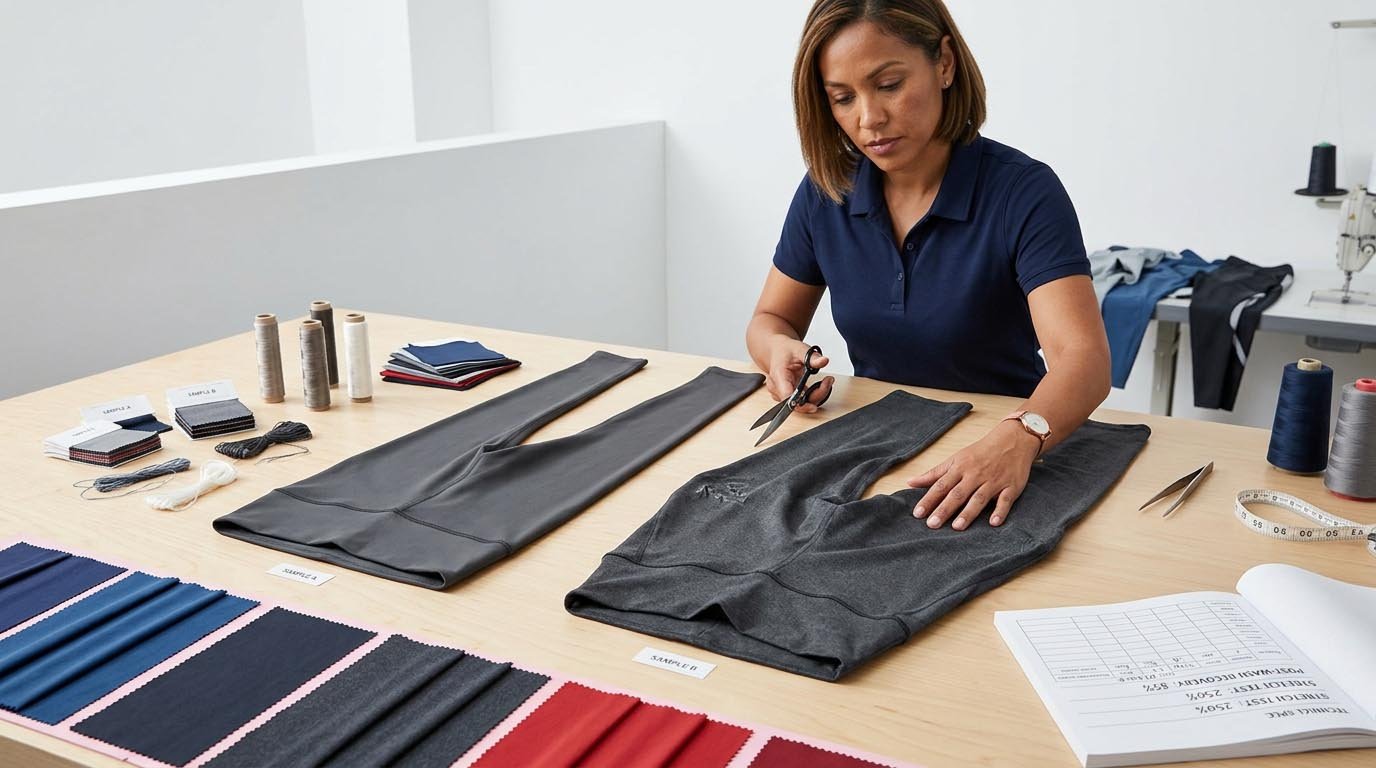
I have seen this pattern repeat dozens of times in our factory. Brands choose fabric based on GSM or "percentage of spandex" alone, then face returns when garments sag, show through, or yellow after a few gym sessions. The real performance comes from the spandex system—base fiber choice, blend ratio, covering method, denier grade, and heat‑setting protocol. In this guide, I will walk you through what spandex actually is, how we make it work in production, and which decisions protect your brand from costly surprises.
Quick Answers: What Is Spandex Made Of and Why It Matters?
What is spandex made from?
Spandex (also called elastane) is made from segmented polyurethane—a long‑chain synthetic polymer with alternating rigid and flexible segments. The flexible segments let it stretch; the rigid segments snap it back. Producers polymerize these segments, dissolve them in solvent, then spin them into fine elastic filaments.
Is LYCRA the same as spandex?
No. LYCRA is a brand name owned by The LYCRA Company. Spandex and elastane are the generic fiber names. Many suppliers produce spandex under different trademarks. Saying "LYCRA fabric" can confuse pricing and performance benchmarks—always specify "spandex blend" or "elastane content" in tech packs.
Can you make fabric from 100% spandex?
Technically yes, but you should not. Pure spandex fabric is sticky, transparent, and extremely fragile. All commercial activewear uses spandex blended with nylon or polyester at 5–40% to balance stretch, opacity, strength, and cost. The base fiber (nylon or polyester) forms the structure; spandex adds recovery.
Why does some spandex fabric lose stretch after washing?
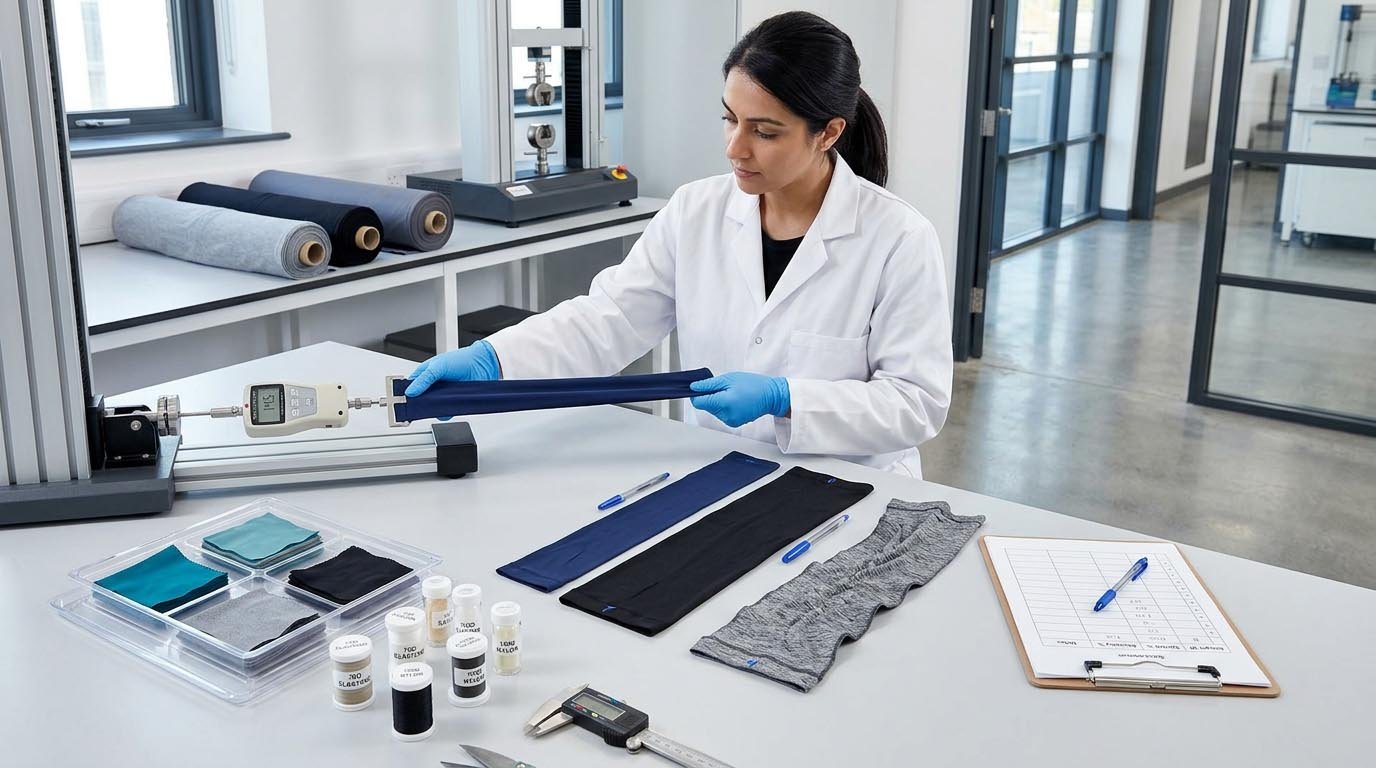
Stretch loss usually happens when heat‑setting temperature exceeds the spandex grade's tolerance (commonly above 185–195°C), or when cyclic fatigue breaks molecular chains over repeated stretch cycles. We validate every batch with stretch/recovery tests at 50% and 100% extension before and after five wash cycles to catch this early.
How do I choose the right spandex content for my activewear line?
Match spandex percentage to your product's job: 5–15% for comfort stretch in tees and shorts, 15–25% for yoga pants and training tops, 25–40% for compression leggings and high‑support bras. Then confirm with actual stretch/recovery and opacity tests on strike‑offs—not just fabric weight.
What Is Spandex and What Is It Made Of?
Buyers often use "spandex," "elastane," and "LYCRA" interchangeably. This creates confusion in specs, pricing, and quality expectations. Let me clarify what spandex actually is and what it is not.
Spandex (or elastane outside North America) is a manufactured fiber composed of at least 85% segmented polyurethane by weight. It is not a blend, not a fabric, and not a brand—it is the elastic filament itself.
The Core Material: Segmented Polyurethane Polymer
Spandex starts as a liquid polymer made from several raw materials:
- Polyol (a long flexible segment, often polyester‑ or polyether‑based)
- Diisocyanate (a rigid linking segment, commonly MDI or TDI)
- Chain extender (a short molecule that joins segments into long chains)
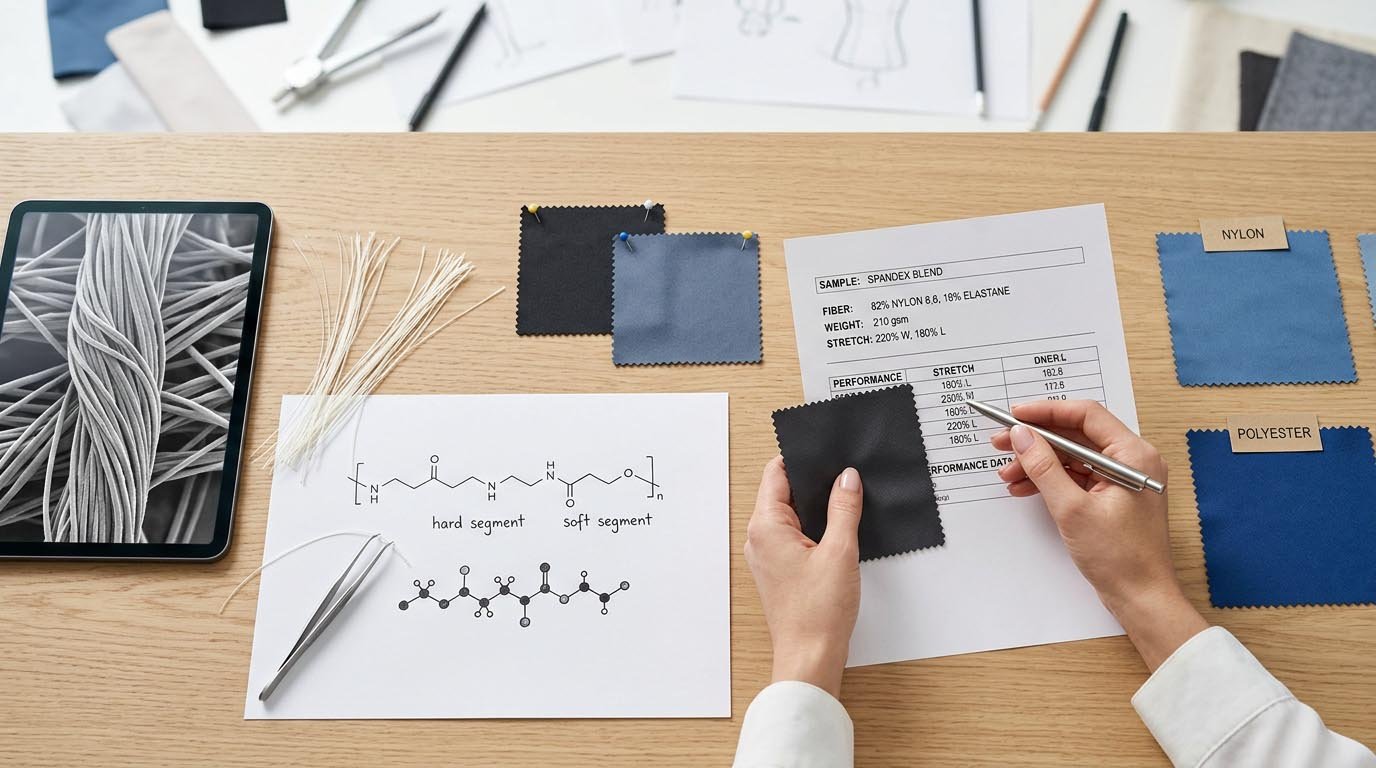
During polymerization, these components react to form long‑chain molecules with alternating soft (flexible) and hard (rigid) segments. The soft segments uncoil when you pull; the hard segments anchor the structure so it snaps back. This segmented architecture is why spandex can stretch 400–700% of its original length and still recover.
Spandex vs LYCRA vs Elastane: Name It Right to Decide Right
| Term | What It Means | Why It Matters |
|---|---|---|
| Spandex | Generic fiber name (North America) | Use this in tech packs to keep sourcing open and competitive |
| Elastane | Generic fiber name (Europe, ISO) | Same fiber, different region—both refer to polyurethane elastic |
| LYCRA | Brand name by The LYCRA Company | Premium positioning but adds cost; specify brand only if client demands it |
I once worked with a startup that wrote "LYCRA content 20%" in their first tech pack. Their supplier quoted 30% higher than necessary because they assumed trademarked fiber. When we revised the spec to "spandex (elastane) 20%," three more mills bid and costs dropped. Naming it right protects your budget and opens your supply base.
Why Spandex Is Never Used Alone in Garments
Pure spandex filament is sticky, see‑through, weak under abrasion, and difficult to sew. Every activewear fabric you see blends spandex with a base fiber—usually nylon (polyamide) or polyester—at ratios from 5% to 40%. The base fiber provides structure, opacity, color depth, and durability. Spandex provides stretch and recovery. This is a system, not a single material.
How Spandex Is Manufactured Step by Step?
You do not need to become a chemical engineer. But knowing how spandex is spun and integrated into yarn helps you ask the right questions when your fabric does not perform as expected.
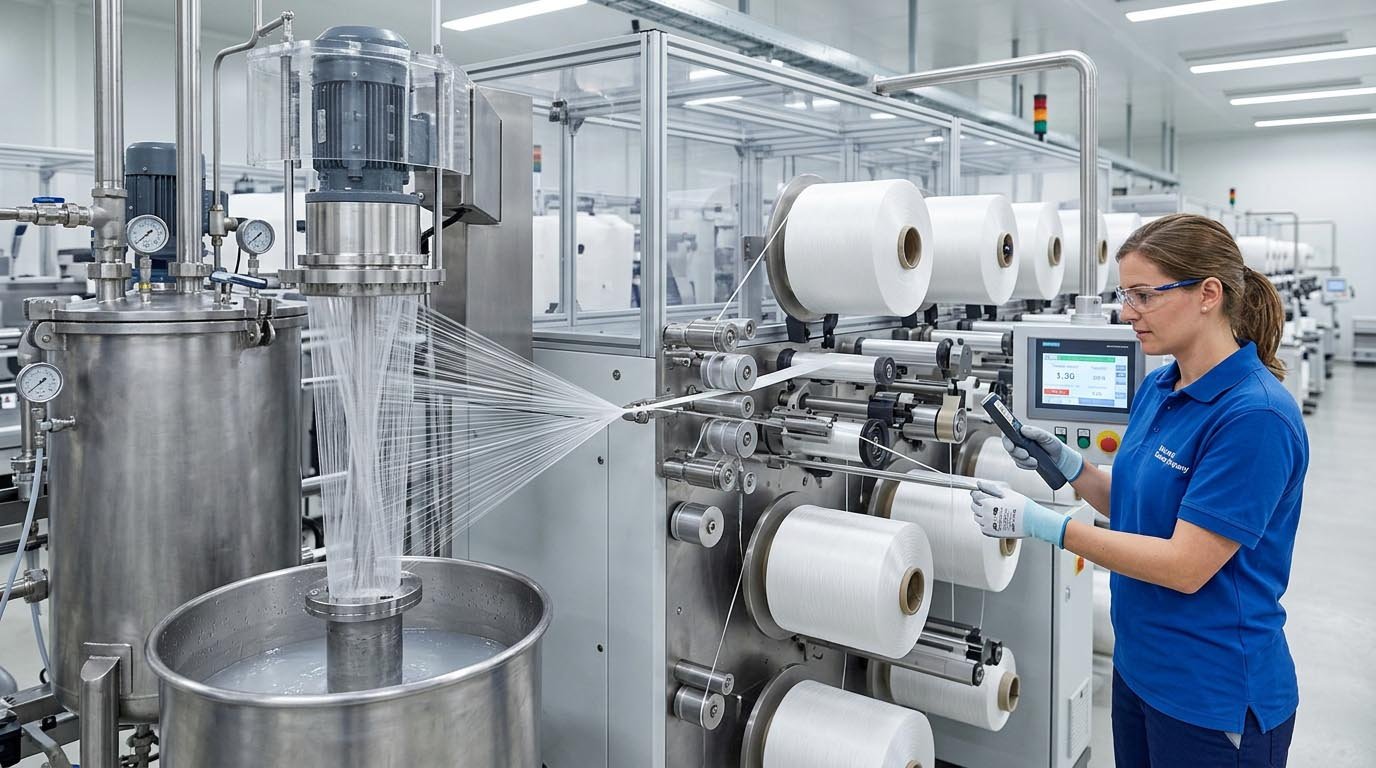
Spandex is produced through solution dry‑spinning: liquid polymer is extruded through a spinneret, the solvent evaporates in a heated column, and solid elastic filaments form. These filaments are then wound, drawn, and heat‑treated to stabilize molecular structure.
Step 1: Polymerization—Building the Elastic Polymer
Raw materials (polyol, diisocyanate, chain extender) are mixed and react in a vessel. The reaction creates a thick, viscous polyurethane solution. Producers control molecular weight and segment ratio here—higher molecular weight generally improves recovery and resilience, but also raises melt viscosity and cost.
This stage determines the spandex grade. Suppliers offer multiple grades with different stretch limits, recovery speeds, and heat tolerances. For example, a 40‑denier spandex at one supplier may have a heat limit of 185°C, while another's 40D grade tolerates 195°C. Always ask for the technical data sheet before locking your fabric recipe.
Step 2: Solution Preparation and Filtration
The thick polymer is dissolved in a solvent (often dimethylacetamide, DMAc) to create a spinnable solution. The solution is filtered to remove impurities that could break filaments or create weak spots. Consistency in this step affects uniformity—uneven solution leads to uneven denier and inconsistent recovery along the yarn length.
Step 3: Dry Spinning—From Liquid to Solid Filament
The polymer solution is pumped through a spinneret (a metal plate with dozens of tiny holes). As the streams exit into a heated spinning column, solvent evaporates and the polymer solidifies into continuous filaments. The filaments are collected on a bobbin.
Dry spinning (versus wet or melt spinning) is preferred for spandex because it allows fine control over filament diameter and produces high‑elasticity fibers. The process also recovers solvent for reuse, which reduces environmental impact compared to older methods.
Step 4: Drawing, Heat Treatment, and Finishing
Freshly spun filaments are still partially oriented. Producers draw (stretch) them slightly to align molecular chains, then heat‑treat them to lock in that orientation. This improves dimensional stability and recovery. Some producers also apply a surface finish (a lubricant or anti‑static agent) to ease knitting and reduce friction.
How Spandex Becomes Yarn: Bare, Single‑Covered, or Double‑Covered
Spandex filament alone is difficult to knit and handle. We integrate it into yarn in three ways:
| Yarn Type | Construction | Performance Trade‑Offs | Typical Use |
|---|---|---|---|
| Bare spandex | Naked spandex filament knitted with base yarn | Softest hand, lightest weight; higher snag and shine risk | Lightweight tees, lounge shorts |
| Single‑covered | One layer of nylon or polyester wrapped around spandex core | Balanced stability, moderate abrasion resistance | Yoga pants, training tops |
| Double‑covered | Two layers wrapped in opposite directions | Best abrasion/laddering resistance, best stitchability; heavier and costlier | Compression leggings, high‑support bras |
Air‑covering (wrapping yarn with compressed air jets) feels softer and lighter; mechanical covering (spindle wrapping) gives crisper control and dimensional stability. Your fabric mill should explain which method they use and why it fits your target handfeel and recovery.
Why Spandex Stretches and Recovers So Effectively?
Customers feel the stretch when they try on your leggings. They judge recovery after the first wash. If either fails, they return the item and leave a one‑star review. Let me explain the science in buyer terms.
Spandex stretches because its molecular chains contain long, coiled flexible segments that unwind under tension. It recovers because rigid segments act as anchor points, pulling the flexible segments back into their coiled state when tension is released.
The Molecular Mechanism: Coil, Uncoil, Snap Back
Imagine a spring made from alternating soft rubber and hard plastic sections. When you pull the spring, the rubber sections stretch. The plastic sections hold the structure and prevent permanent deformation. When you let go, the plastic sections pull the rubber back. Spandex works the same way at the molecular level.
The soft segments (polyol‑based) are amorphous and flexible—they coil at rest and uncoil when stretched. The hard segments (diisocyanate‑based) are crystalline and rigid—they form physical cross‑links that anchor the structure. When you release tension, elastic energy stored in the stretched chains drives recovery.
This is why spandex can stretch 400–700% and still return to near‑original length after thousands of cycles. No natural fiber (cotton, wool, silk) and no other common synthetic (polyester, nylon alone) can match this combination of high elongation and high recovery.
What Determines Stretch and Recovery in Your Fabric?
Stretch and recovery are not just about the spandex fiber. They are system outcomes. Here are the four variables I tune with every client:
-
Spandex content (%): Higher percentage gives more stretch potential, but also more weight, cost, and compression feel. For comfort stretch (tees, casual shorts), I recommend 5–15%. For shaping and support (leggings, sports bras), 20–40%.
-
Spandex denier: Denier measures the weight in grams of 9,000 meters of yarn. Lower denier (20D, 30D) creates lighter, softer, more transparent fabrics. Higher denier (40D, 70D, 140D) adds power, opacity, and recovery force. Match denier to fabric structure and end‑use: a 40D spandex at 20% content often outperforms a 20D spandex at 25% for high‑compression leggings.
-
Covering method (bare/single/double): Bare spandex is softest but snags easily. Single‑covered balances performance and cost. Double‑covered resists abrasion and laddering but adds weight and price. For high‑use training gear, I default to single‑ or double‑covered.
-
Heat‑setting protocol: Knitted fabric is heat‑set under tension to lock in shape and stabilize dimensions. If the temperature exceeds the spandex's tolerance (typically 185–195°C depending on grade), molecular chains can break, and recovery drops. I always request the mill's heat‑setting log and cross‑check it against the spandex supplier's datasheet.
Stretch vs Recovery: Two Different Things
Many buyers say "good stretch" when they mean "good recovery." Let me separate them:
-
Stretch (elongation): How far the fabric extends under a given force. Measured as a percentage (e.g., 150% elongation means the fabric stretches to 2.5× its original length).
-
Recovery: How close the fabric returns to its original length after stretching. Measured as a percentage of original length (e.g., 95% recovery means the fabric rebounds to within 5% of start length).
A fabric can have high stretch but poor recovery—it stretches easily but stays baggy. This is common when spandex content is too low, denier is too light, or heat‑setting damaged the fiber. Always test both metrics. We run stretch/recovery tests at 50% and 100% extension before and after five wash cycles. If recovery drops below 90%, the batch does not ship.
Key Properties, Benefits and Limitations of Spandex Fiber?
Every fiber has strengths and weaknesses. Spandex is no exception. I will share what I tell every new client during fabric selection: the benefits you can leverage and the limitations you must design around.
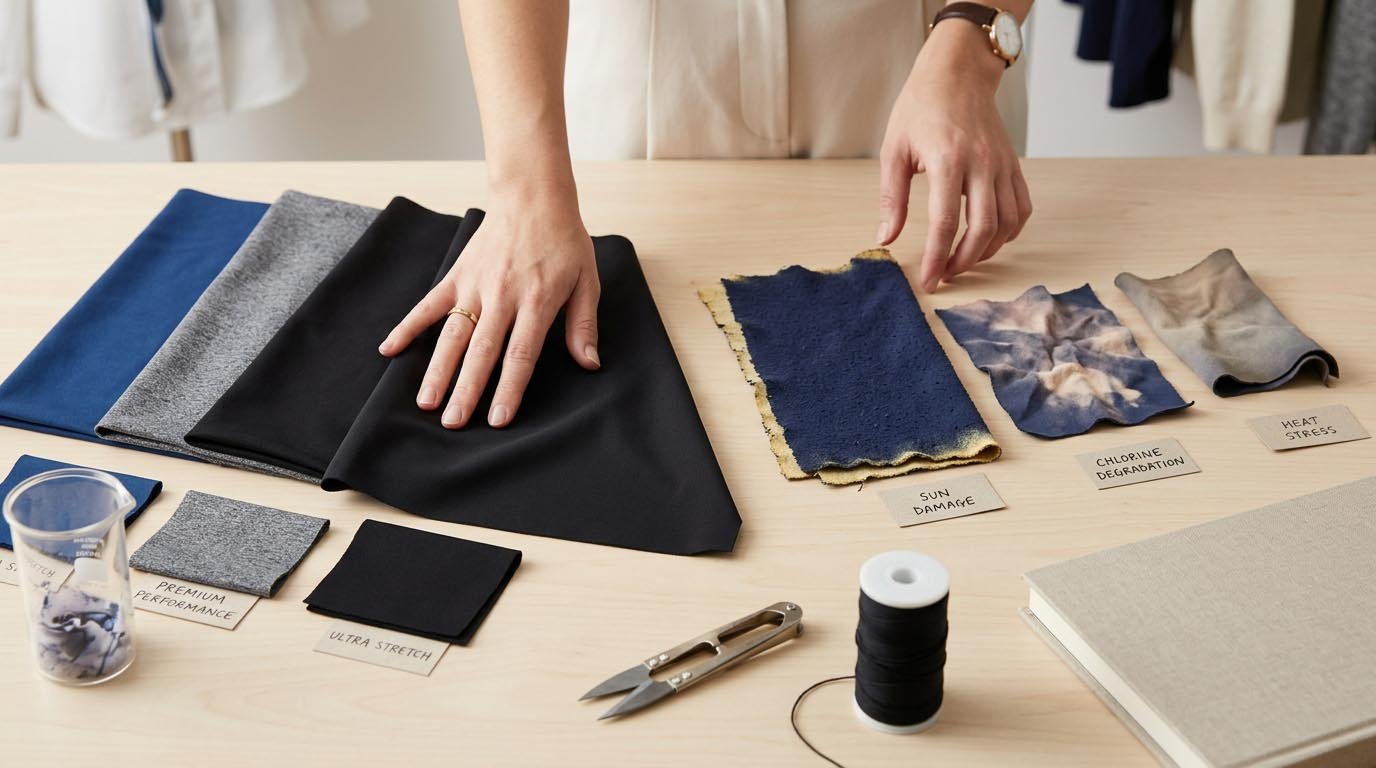
Spandex offers exceptional stretch (400–700%), excellent recovery (>90% after repeated cycles), lightweight comfort, and wrinkle resistance. Its limitations include sensitivity to heat (degradation above 180–195°C), chlorine (yellowing in pools), and UV (strength loss under prolonged sun exposure).
Benefits: Why Spandex Dominates Activewear
1. Unmatched Stretch and Recovery
Spandex can stretch 4–7 times its rest length and still bounce back. No other fiber comes close. This makes it essential for any garment that must move with the body—yoga pants, cycling shorts, swimwear, dance wear.
2. Lightweight and Low‑Bulk
Spandex filaments are fine and dense. You need only 5–20% spandex in most blends to achieve target stretch. This keeps fabric weight down—critical for performance apparel where every gram matters for comfort and speed.
3. Wrinkle Resistance
The elastic nature of spandex fibers prevents creasing. Garments with spandex content maintain a smooth appearance even after hours of wear or packing. Retailers appreciate this because items look fresh on the rack.
4. Excellent Dye Affinity When Blended
Pure spandex is difficult to dye, but when covered or blended with nylon or polyester, the base fiber carries the color. Nylon blends achieve deep, vibrant colors with acid or disperse dyes. Polyester blends offer superior colorfastness under wash and light.
5. Abrasion Resistance in Covered Forms
Single‑ and double‑covered spandex yarns resist pilling and snagging better than bare spandex. For high‑abrasion areas (inner thighs, underarms), we specify double‑covered spandex and run Martindale abrasion tests to confirm the fabric will last 20,000+ cycles without visible wear.
Limitations: What You Must Manage
1. Heat Sensitivity
Spandex degrades when exposed to temperatures above 180–195°C (varies by grade). During dyeing and heat‑setting, mills must stay within the safe window. Overheat causes yellowing, loss of elasticity, and brittleness. I always ask for the mill's process temperature log and the spandex supplier's thermal stability datasheet.
2. Chlorine Damage
Chlorine in swimming pools attacks polyurethane bonds, causing yellowing and strength loss. For swimwear, we either:
- Use chlorine‑resistant spandex grades (e.g., LYCRA XTRA LIFE, or equivalent generics)
- Warn customers to rinse suits immediately after pool use
- Lower expectations and price accordingly
Standard activewear‑grade spandex will degrade quickly in chlorinated water. Do not promise "pool‑safe" unless you have tested and specified the right grade.
3. UV Degradation
Prolonged exposure to sunlight (UV radiation) weakens polyurethane chains. Outdoor sportswear and swimwear need UV stabilizers in the dye recipe or a UV‑resistant spandex grade. Without protection, fabric loses strength and elasticity within a season of heavy outdoor use.
4. Sensitivity to Oils and Lotions
Sunscreen, body oils, and some laundry detergents can coat spandex filaments and interfere with recovery. This is a care issue more than a material flaw, but it affects customer satisfaction. We print care labels that recommend rinsing activewear in cold water immediately after sweating or applying lotions.
5. Cost Premium Over Non‑Stretch Fabrics
Spandex fiber costs $4–8 per kilogram (mid‑2027 range), versus $2–4/kg for standard polyester. Blended fabrics are pricier, and covering processes add labor. For budget lines, I help clients optimize spandex content—sometimes 12% spandex performs as well as 18% when paired with the right denier and covering method.
A Balanced View: No Fiber Is Perfect
I never tell clients that spandex is a miracle fiber. It is a tool. When used correctly—right grade, right blend, right processing—it delivers stretch and comfort that customers love. When misused—wrong heat‑setting, wrong chlorine exposure, wrong care—it fails and damages your brand. My job is to match the fiber system to your product's demands and set realistic expectations with your team and your customers.
Common Uses of Spandex in Apparel, Sportswear and Textiles?
Spandex is everywhere in modern clothing. You probably wore it today. But not all applications demand the same blend, denier, or covering. Let me show you how spandex content and construction vary across product categories.
Spandex is used in activewear, swimwear, undergarments, denim, hosiery, and medical compression garments. Content ranges from 2% (jeans) to 40% (shapewear), and covering method (bare, single, or double) is chosen based on performance, durability, and cost targets.
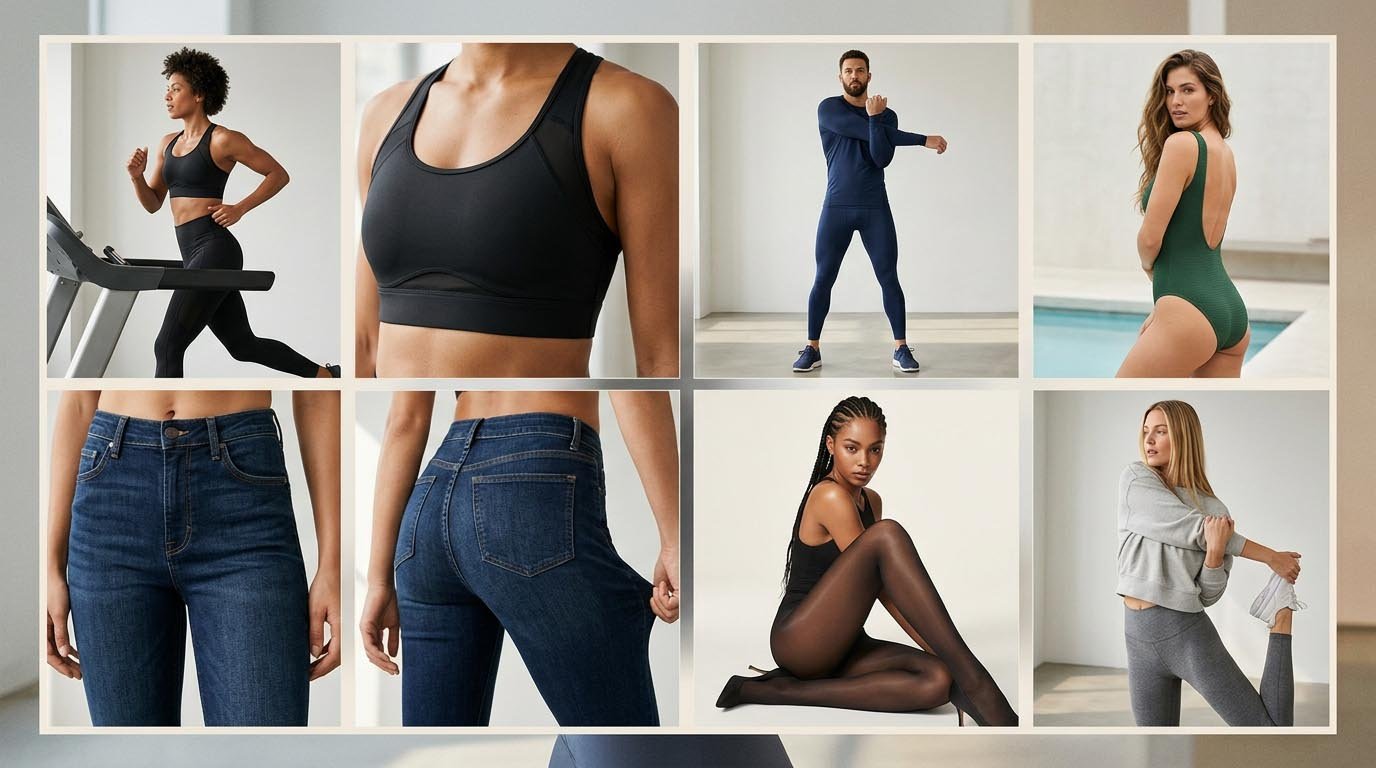
Activewear and Sportswear: The Largest Market
This is where I spend most of my time. Activewear demands stretch, recovery, breathability, moisture management, and durability—all at once.
Yoga Pants and Leggings
- Spandex content: 18–28%
- Typical construction: Single‑ or double‑covered spandex + nylon or polyester
- Denier: 40D or 70D
- Key tests: Stretch/recovery at 100% extension; opacity (squat test); pilling resistance
Yoga pants must stretch without showing skin, recover after hours of wear, and survive weekly washing. I recommend 20–25% spandex with nylon base for soft hand and polyester base for faster drying. Double‑covered spandex reduces show‑through in lighter colors.
Sports Bras and Compression Tops
- Spandex content: 25–40%
- Typical construction: Double‑covered spandex + nylon or polyester
- Denier: 70D or 140D
- Key tests: Compression pressure mapping; strap and band stretch/recovery; colorfastness
High‑support bras need firm compression and shape retention. Higher spandex content and heavier denier provide the necessary power. Double‑covered yarn resists abrasion where elastic bands meet skin and improves stitchability at seams.
Running Shorts and Training Tees
- Spandex content: 5–15%
- Typical construction: Bare or single‑covered spandex + polyester
- Denier: 20D or 30D
- Key tests: Lightweight (<150 GSM), moisture wicking, dimensional stability after wash
These garments prioritize comfort stretch and breathability over compression. Lower spandex content keeps weight and cost down. Polyester base dries quickly and holds shape better than nylon in high‑sweat conditions.
Swimwear: Chlorine and UV Resistance Required
Swimwear faces harsher conditions than any other apparel category. Chlorine, saltwater, UV rays, and repeated wet‑dry cycles attack spandex.
- Spandex content: 15–25%
- Spandex grade: Chlorine‑resistant (e.g., LYCRA XTRA LIFE or equivalent)
- Base fiber: Nylon (for colorfastness under chlorine) or polyester (for UV resistance)
- Key tests: Chlorine resistance (24‑hour soak in 100 ppm chlorine solution); colorfastness to light (AATCC 16); stretch/recovery after 50 wet/dry cycles
I always specify chlorine‑resistant spandex for swimwear. Standard grades yellow and lose strength within 10–20 pool sessions. Chlorine‑resistant grades extend life to 200+ sessions. Yes, they cost 20–30% more, but returns and bad reviews cost far more.
Denim and Casual Apparel: Comfort Stretch
Stretch denim revolutionized the jeans market. Consumers want the look of rigid denim with the comfort of knit.
- Spandex content: 2–5%
- Typical construction: Bare or single‑covered spandex core‑spun with cotton or cotton‑poly
- Key tests: Stretch at waist and thigh; recovery after 8‑hour wear; no bagging at knees
Even 2% spandex makes a noticeable difference in fit and comfort. Higher content (up to 5%) is used in "super stretch" or "jegging" styles. The challenge here is maintaining the denim aesthetic—too much stretch makes fabric look and feel like activewear. I recommend staying at 3–4% for authentic denim hand.
Hosiery and Shapewear: High Compression and Shaping
Hosiery (stockings, tights) and shapewear (bodysuits, control briefs) demand high compression and close fit.
- Spandex content: 15–40%
- Typical construction: Bare or single‑covered spandex + nylon
- Denier: 40D to 140D depending on compression level
- Key tests: Compression gradient (medical hosiery); laddering resistance; comfort after 8+ hours
High spandex content creates firm shaping. Nylon base provides softness and dye depth. I work with clients to match compression pressure to medical standards (e.g., 15–20 mmHg for light support, 20–30 mmHg for moderate) and validate with pressure mapping equipment.
Medical and Performance Compression Garments
Medical compression socks, sleeves, and bandages require precise pressure profiles and long‑term durability.
- Spandex content: 20–40%
- Spandex grade: Medical‑grade with certified compression and biocompatibility
- Key tests: Compression pressure at ankle/calf/thigh; retention after 100 wash cycles; skin sensitivity (ISO 10993)
This is a specialized category. I do not produce medical garments in volume, but I mention it to show the range of spandex applications. If a client requests medical‑grade compression, I refer them to certified suppliers and ensure all regulatory requirements (FDA, CE marking) are met.
FAQ: What Is Spandex Made Of, How It's Manufactured and Why It Stretches?
Buyers ask me the same questions every month. Here are the answers I give, backed by our production experience and test data.
What is the difference between spandex and elastane?
None. Spandex and elastane are two names for the same fiber—a synthetic elastic made from segmented polyurethane. "Spandex" is used in North America; "elastane" is the international (ISO) term used in Europe and most other regions. Both refer to a fiber that can stretch at least 400% and recover. Use whichever term your region prefers, but specify the same technical requirements (content %, denier, covering method) in your tech pack.
Can I make a garment from 100% spandex?
Technically yes, but I strongly advise against it. Pure spandex fabric is sticky, see‑through, fragile, and nearly impossible to sew with standard equipment. It offers no structure or opacity. Every commercial garment blends spandex with a base fiber (nylon or polyester) at 5–40% to provide the stretch while the base fiber provides coverage, strength, and color. If someone offers you "100% spandex leggings," they are either mislabeling the product or selling an experimental novelty item that will not perform.
Why does spandex turn yellow over time?
Yellowing is caused by heat, chlorine, or UV exposure breaking down polyurethane chains and oxidizing the polymer. Common triggers include:
- Heat‑setting above safe limits (>185–195°C for most grades)
- Chlorine in pools or cleaning products
- Prolonged sun exposure without UV stabilizers
- Body oils and sunscreens that coat fibers
We prevent yellowing by specifying heat‑stable spandex grades, using chlorine‑resistant types for swimwear, adding UV absorbers to dye recipes, and printing clear care labels. If your fabric yellows after production, request the mill's heat‑setting log and the spandex supplier's thermal datasheet to identify the cause.
How much spandex should I use in activewear?
It depends on your product's function:
- 5–10% spandex: Comfort stretch for tees, casual shorts, lightweight training tops
- 15–20% spandex: Moderate stretch and support for training pants, running tights, casual yoga wear
- 20–30% spandex: High stretch and compression for performance leggings, cycling shorts, high‑intensity training gear
- 30–40% spandex: Firm compression for shapewear, sports bras, medical‑grade compression garments
Do not guess based on fabric weight (GSM). Two fabrics can have the same GSM but very different stretch and recovery if one uses 40D spandex at 18% and the other uses 20D spandex at 25%. Always request strike‑offs, test stretch/recovery, and validate opacity before confirming the order.
What is the best base fiber to blend with spandex—nylon or polyester?
Both work, but they have different trade‑offs:
| Property | Nylon + Spandex | Polyester + Spandex |
|---|---|---|
| Hand feel | Softer, smoother | Crisper, more structured |
| Dye depth | Deeper, richer colors | Lighter, brighter colors |
| Moisture wicking | Moderate | Excellent |
| Drying speed | Slower | Faster |
| Abrasion resistance | Good | Excellent |
| Colorfastness | Moderate (fades under chlorine) | Excellent |
| Cost | Higher | Lower |
I recommend nylon blends for yoga pants, loungewear, and garments where soft hand and color depth matter. I recommend polyester blends for running shorts, training tees, and any high‑sweat, high‑wash‑frequency product. For budget lines, polyester also keeps costs down. For premium lines targeting comfort and drape, nylon is the better choice.
How do I test if my spandex fabric will hold up after washing?
Run these tests on strike‑offs before approving bulk production:
-
Stretch and recovery test (ASTM D2594): Cut a 200 mm × 50 mm strip along the stretch direction. Mark two lines 100 mm apart. Stretch to 150 mm (50% elongation) or 200 mm (100% elongation), hold for 30 seconds, release, wait 5 minutes, and measure. Recovery should be ≥90% (final length ≤110 mm for 50% test, ≤120 mm for 100% test).
-
Wash durability: Launder the sample 5 times at 40°C with standard detergent. Repeat the stretch/recovery test. Recovery should remain ≥85%.
-
Cyclic fatigue: Use a tensile tester to stretch the fabric to 50% elongation for 500 cycles at 30 cycles per minute. Measure recovery after cycling. Drop below 80% indicates poor long‑term durability.
-
Opacity (squat test): Stretch the fabric over a frame to 100% elongation and place it over a black‑and‑white checkerboard pattern. If you can clearly see the pattern through light‑colored fabric, increase spandex denier or base fabric density.
We run these tests in‑house on every new fabric recipe. If a client skips testing and goes straight to bulk, they risk expensive reruns or returns.
Is spandex safe to wear against skin?
Yes. Spandex is chemically inert and hypoallergenic when properly finished. Regulatory bodies (OEKO‑TEX, REACH, FDA) classify polyurethane elastane as safe for direct skin contact, including in intimate apparel and medical devices. Rare allergic reactions are usually triggered by residual solvents, dye chemicals, or surface finishes—not the spandex polymer itself. We source spandex from suppliers with OEKO‑TEX Standard 100 certification and request test reports for restricted substances (formaldehyde, heavy metals, aromatic amines) to ensure compliance.
Conclusion
Spandex is not just about "stretch." It is a system—base fiber choice, blend ratio, denier grade, and finishing—that determines whether your garments perform or fail. Test smart, specify clearly, and design within the fiber's limits to protect your brand.