.png)
A Shopify seller once asked me to recommend "the best fabric" for his men's activewear line. When I asked what activities his customers do, he said it didn't matter—premium fabric works for everything. Six months later he had $18,000 in unsold inventory because his heavyweight compression fabric overheated runners.
Men's activewear fabric selection is not about finding premium materials. It's about matching fiber properties and fabric construction to specific workout contexts, sweat patterns, and movement requirements that differ significantly from women's activewear.
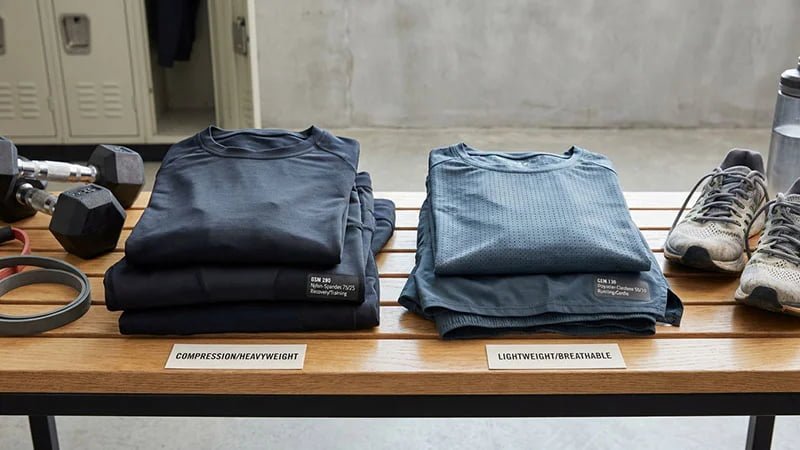
I see this pattern constantly. Brand owners choose fabrics based on feel or price without understanding how male customers use the products. I want to show you how to match fabrics to actual use cases.
Quick Answers: Men's Activewear Fabrics
Q: What's the best all-around gym/training fabric?
Polyester–spandex (85/15 or 92/8), 180–220 GSM.
Wicks sweat best, moves well, 15–20% cheaper than comparable nylon blends.
Q: Why do running shirts for men use different fabric than women's?
Men sweat 30–40% more; need lighter (140–180 GSM), ultra-wicking, mesh-vented fabrics.
Women’s compressive blends can trap heat in men’s designs.
Q: Does higher GSM mean better fabric?
No—GSM = weight, not quality.
For running: 140–180; gym/training: 180–220; recovery/warmup: 240–280.
High GSM overheats during intense activity.
Q: Cotton or synthetics for sweat-heavy training?
Use synthetics. Cotton stays wet, causes chafing. Cotton-poly blends (60/40 or 70/30) only work for light gym/athleisure, never high-intensity.
Q: How to avoid see-through men’s activewear?
Go with ≥180 GSM, darker/heathered colors, spec opacity testing.
Light colors, thin fabrics under 200 GSM, often show skin/underwear when stretching.
Core Fibers Compared: Polyester, Nylon, Spandex and Blends?
Last month a brand owner told me he wanted nylon for everything because it "feels more premium." When I explained the cost and performance tradeoffs, he was shocked. He thought all synthetic fibers were the same.
Polyester, nylon, and spandex each serve different functions in men's activewear. Your fiber choice affects moisture management, durability, cost, and hand feel—polyester dominates for sweat-heavy activities while nylon excels in abrasion resistance.
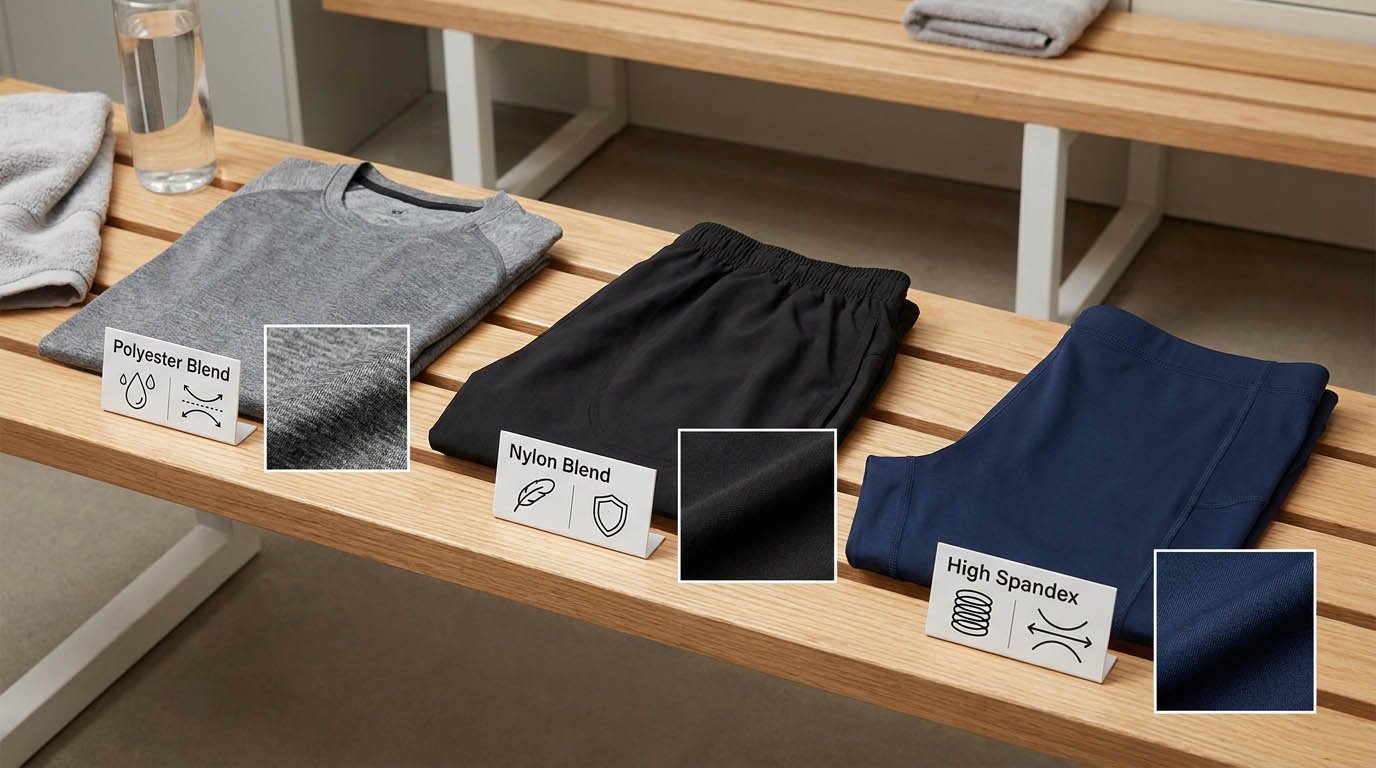
I need to break down what each fiber actually does in real workout scenarios. Most brand owners focus on hand feel during one showroom visit, then face performance complaints later.
Polyester: The Workhorse Fiber
In my ten years handling fabric consultations, polyester appears in 70%+ of men's gym and training wear orders. Here's why:
Performance advantages:
- Fastest moisture wicking: Hydrophobic structure pushes sweat away from skin
- Quick drying: Dries 2-3x faster than cotton, 30-40% faster than nylon
- Shape retention: Maintains dimensions after 50+ washes
- Cost efficiency: 15-20% cheaper than nylon for equivalent weight
Practical limitations:
- Retains odor faster than nylon (bacteria thrive in polyester structure)
- Slightly rougher hand feel compared to nylon
- Static cling in dry conditions
Best use cases for men's activewear:
- High-sweat gym training (weightlifting, CrossFit, HIIT)
- Running and cardio (when combined with mesh ventilation)
- Training tees and tanks
- Performance shorts
I tell clients: if your target customer is doing high-intensity training with heavy sweating, polyester should be your base fiber. Add anti-odor treatments to address the smell retention issue.
Nylon: Premium Feel with Tradeoffs
Nylon feels softer and more luxurious than polyester. That's why I see brand owners choose it. Then they struggle with the 15-25% higher cost and slightly slower drying times.
Performance advantages:
- Superior softness: Smoother hand feel than polyester
- Better abrasion resistance: Lasts longer in high-friction areas
- Lower odor retention: Less bacterial accumulation than polyester
- Better drape: Hangs more naturally on the body
Practical limitations:
- Higher cost: Adds $1.50-2.50 per unit compared to polyester equivalents
- Slower drying than polyester (20-30% longer)
- More prone to pilling over time
Best use cases for men's activewear:
- Running shorts and tights (durability matters)
- Outdoor training gear (abrasion from equipment or ground contact)
- Premium-positioned products where soft hand feel justifies price
- Training gear for low-sweat activities
Spandex (Elastane/Lycra): The Stretch Component
Spandex never appears alone in activewear. It's always blended with polyester or nylon to add stretch and recovery. The percentage matters more than most brand owners realize.
Common blend ratios and their effects:
| Blend Ratio | Stretch Level | Recovery | Best Use Case |
|---|---|---|---|
| 92/8 (poly/spandex) | Moderate stretch | Excellent | Training tees, running shirts |
| 85/15 (poly/spandex) | High stretch | Very good | Training shorts, base layers |
| 80/20 (nylon/spandex) | Very high stretch | Good | Compression wear, tights |
| 75/25 (nylon/spandex) | Maximum stretch | Fair | Yoga pants, recovery wear |
Critical insight from client experience:
A CrossFit brand once requested 80/20 blend for training shorts because they wanted "maximum flexibility." After their first bulk order, male customers complained the shorts felt too compressive and restrictive during squats. We switched them to 88/12 for their reorder. The lesson: men's training wear needs stretch for movement, not compression for fit.
Spandex percentage guidelines:
- 6-10% spandex: Basic mobility for tees and regular-fit shorts
- 12-18% spandex: Athletic stretch for performance wear
- 20-25% spandex: Compression and recovery garments
Higher spandex content adds $0.80-1.50 per unit and creates tighter fit. Most men's activewear works best in the 12-15% range unless compression is specifically required.
Blending Strategy by Activity Type
I've learned to ask clients: what's the primary activity? That determines the ideal fiber blend.
High-sweat training (gym, HIIT, CrossFit):
- Polyester-spandex 88/12 for tees and tanks
- Polyester-spandex 85/15 for shorts
- Prioritize wicking speed over hand feel
Running and cardio:
- Polyester-spandex 90/10 for shirts (lightweight with mesh panels)
- Nylon-spandex 85/15 for shorts (durability against chafing)
- Prioritize lightweight and quick-dry properties
Outdoor training:
- Nylon-spandex 88/12 for tops
- Nylon-spandex 82/18 for bottoms
- Prioritize abrasion resistance and durability
Recovery and casual training:
- Nylon-spandex 80/20 for compression benefits
- Modal or bamboo blends for soft feel (covered in next section)
- Prioritize comfort over performance
Natural & Hybrid Options: Merino, Cotton Blends and Bamboo Viscose?
Every few weeks someone asks if they should use natural fibers for men's activewear. They've heard cotton is "breathable" or bamboo is "eco-friendly." These conversations require reality checks.
Natural and hybrid fabrics serve specific niches in men's activewear—light training, athleisure, and recovery wear—but they fail in high-sweat scenarios where pure synthetics dominate. Understanding their limitations prevents expensive inventory mistakes.
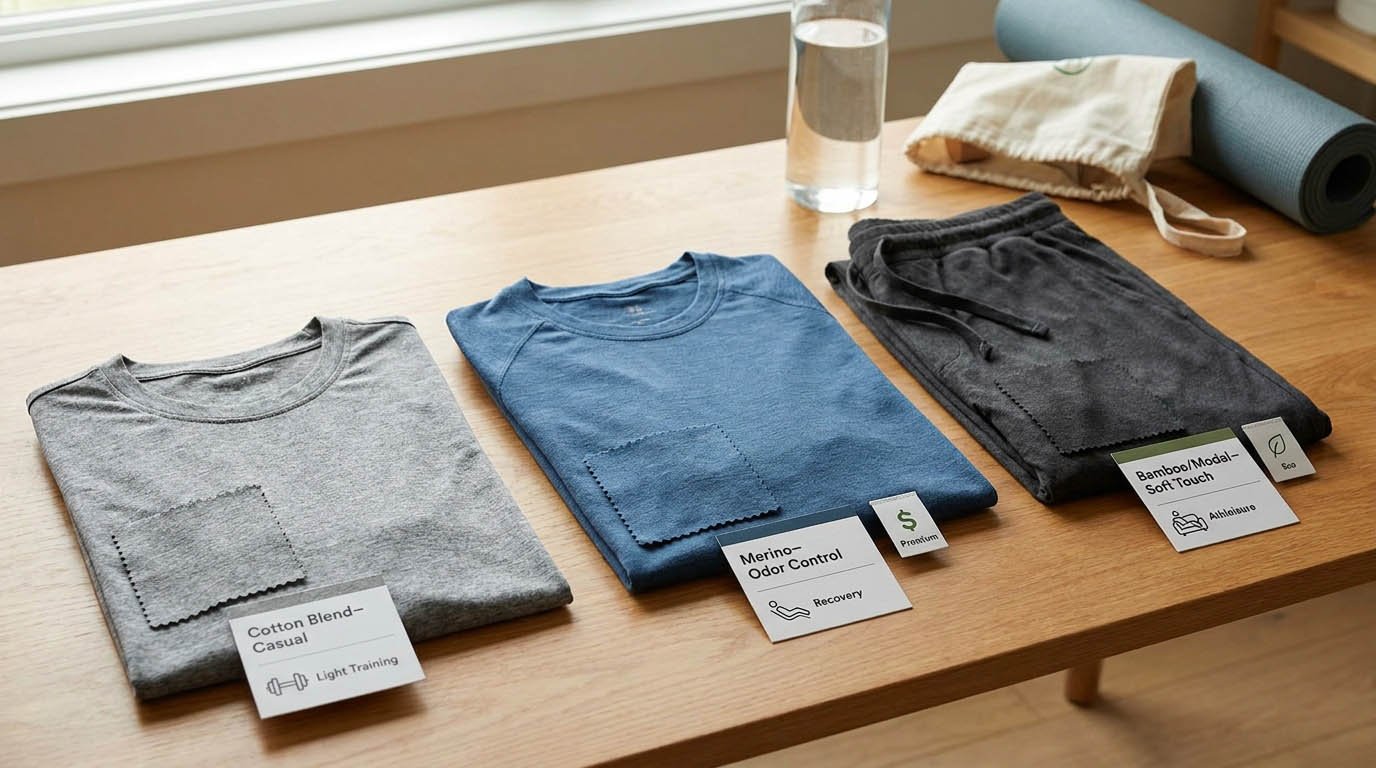
I need to explain when natural fibers make sense and when they create problems. The marketing around "natural" and "sustainable" materials sometimes overshadows performance realities.
Cotton and Cotton Blends: Limited Applications
Pure cotton in men's activewear is almost always a mistake. I've seen too many brands learn this the hard way.
Why pure cotton fails for men's training:
- Absorbs and holds moisture (becomes 30-40% heavier when saturated)
- Dries slowly (5-6x slower than polyester)
- Loses shape after repeated washing
- Causes chafing when wet
- Heavy feeling during high-sweat activities
When cotton blends work:
A running brand owner once insisted on cotton because his customers wanted "natural feel." I suggested polyester-cotton 70/30 instead of pure cotton. Here's when blends make sense:
- Light training wear: Low-intensity activities with minimal sweating
- Athleisure crossover: Gym-to-street casual wear
- Warm-up gear: Pre-workout or cool-down layers
- Lifestyle branding: When natural aesthetic outweighs performance needs
Recommended cotton blend ratios:
- Poly-cotton 60/40: Minimum synthetic content for basic moisture management
- Poly-cotton 70/30: Better balance for light training
- Poly-cotton 80/20: Mostly synthetic with cotton softness
Add $0.50-1.00 per unit compared to pure polyester. Cotton blends cost less than nylon but more than synthetic-only options.
Merino Wool: Premium Niche
Merino wool in men's activewear is rare in my client portfolio. It serves ultra-premium brands targeting specific customer segments.
Merino advantages for men's wear:
- Natural odor resistance: Does not retain smell like polyester
- Temperature regulation: Works across temperature ranges
- Soft hand feel: No itch like traditional wool
- Sustainable positioning: Appeals to eco-conscious customers
Practical limitations:
- High cost: Adds $4-8 per unit compared to polyester equivalents
- Requires special care (gentle wash, air dry)
- Lower durability than synthetics (wears out faster)
- Limited supplier options increase lead times
When merino makes sense:
- Premium outdoor training brands ($60+ retail price points)
- Cold-weather base layers
- Multi-day wear scenarios (hiking, travel)
- Customers who prioritize natural materials over cost
I recommend merino only if your brand positioning and pricing support the 50-80% cost premium over synthetics. Most mass-market men's activewear brands can't justify this.
Bamboo Viscose and Modal: The Soft Alternative
Bamboo and modal fabrics generate strong interest from eco-focused brand owners. The reality is more nuanced than the marketing suggests.
Bamboo viscose characteristics:
- Soft hand feel: Silky, luxurious texture
- Moisture absorption: Better than cotton, worse than polyester
- Antibacterial properties: Natural resistance to odor
- Marketing appeal: "Sustainable" and "eco-friendly" positioning
Technical realities:
- Viscose production involves chemical processing (not as eco-friendly as claimed)
- Lower durability than polyester (pills and wears faster)
- Requires gentler washing and care
- 15-25% cost premium over basic polyester
Modal characteristics:
Modal is a type of rayon with better properties than bamboo:
- Better shape retention: Maintains form after washing
- Higher durability: Lasts longer than bamboo viscose
- Excellent drape: Hangs naturally on male body types
- Moisture management: Better than cotton, similar to bamboo
Hybrid Blends for Men's Activewear
The best approach often combines natural softness with synthetic performance:
Polyester-modal blends (70/30 or 60/40):
- Wicking performance of polyester
- Soft feel of modal
- Better durability than pure modal
- Works for training tees and casual athletic wear
Polyester-bamboo blends (65/35 or 70/30):
- Fast drying with improved hand feel
- Some natural odor resistance
- Lower cost than merino
- Suitable for yoga, light training, athleisure
Nylon-merino blends (60/40 or 70/30):
- Durability of nylon with odor control of wool
- Temperature regulation with moisture management
- Premium positioning justified
- Best for outdoor training and cold-weather base layers
I tell clients: if you want natural fiber benefits without sacrificing all performance, use hybrid blends. Pure natural fibers in men's high-sweat activewear create customer dissatisfaction.
Constructions That Matter: Jersey, Piqué, Mesh, Tricot, Spacer and Wovens?
Fiber content gets all the attention. But fabric construction determines breathability, stretch direction, opacity, and durability just as much. I've seen brand owners specify perfect fiber blends then choose the wrong construction.
Fabric construction—the way yarns are knitted or woven together—affects performance more than fiber choice alone. Jersey, mesh, piqué, and tricot constructions each serve different men's activewear applications based on stretch needs and ventilation requirements.
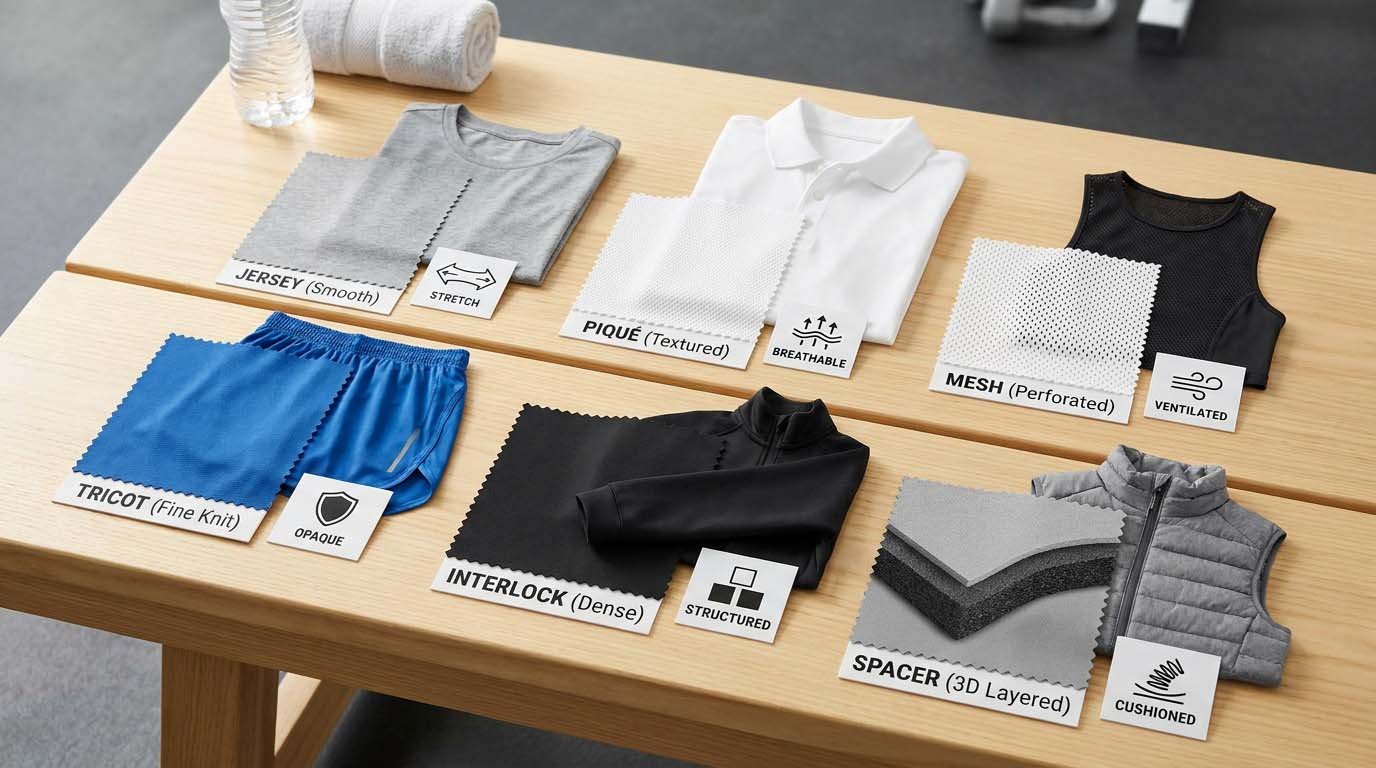
Most brand owners receive fabric swatches without understanding why one feels different from another even with identical fiber content. Construction explains it.
Single Jersey: The Basic Standard
Single jersey is the most common construction in men's training tees and tanks. It's your baseline comparison point.
Construction characteristics:
- Knit structure: Single-face fabric (different appearance on face vs. back)
- Stretch direction: Usually two-way stretch (horizontal direction)
- Weight range: 140-220 GSM for activewear applications
- Surface: Smooth face, slightly textured back
Performance profile:
- Good moisture wicking when made from polyester
- Moderate breathability
- Economical to produce
- Can show transparency under 180 GSM in light colors
Best applications:
- Basic training tees and tanks
- Budget-friendly product lines where cost matters
- Base layer options
- High-volume orders (easiest to source)
Pricing: Baseline reference. Other constructions typically cost 10-40% more than single jersey in equivalent fiber and weight.
Interlock and Double Knit: Enhanced Structure
Interlock and double knit fabrics appear less often but solve specific problems:
Construction characteristics:
- Two-layer structure: Fabric face and back look identical
- Stretch: Usually four-way stretch
- Weight range: 180-240 GSM
- Thickness: Denser than single jersey
Performance advantages:
- Better opacity: Solves see-through problems
- Superior shape retention: Doesn't stretch out
- Smoother surface: More refined appearance
- Enhanced durability: Lasts longer than single jersey
Cost impact: Adds 15-25% to fabric cost compared to single jersey.
Best applications:
- Premium training tees where opacity is critical
- Polo-style athletic shirts
- Products targeting $40+ retail price points
Piqué: Structured Texture
Piqué fabric has visible texture with raised geometric patterns. It's less common in pure performance wear but appears in athletic-casual crossover products.
Why piqué works for men's activewear:
- Enhanced breathability: Textured surface creates air gaps
- Visual interest: Looks more refined than plain jersey
- Hide sweat marks: Texture camouflages wet spots
- Professional aesthetic: Works for golf, tennis, casual training
Limitations:
- Slightly slower drying than smooth jersey
- Not ideal for compression or tight-fit garments
- Higher cost: Adds 20-30% over single jersey
I recommend piqué for brands targeting the golf, tennis, or athleisure segments where appearance matters as much as performance.
Mesh: Ventilation Zones
Mesh comes in various sizes from micro-mesh to large-hole athletic mesh. I see confusion about when to use each type.
Mesh categories for men's activewear:
| Mesh Type | Hole Size | Breathability | Opacity | Best Use |
|---|---|---|---|---|
| Micro-mesh | Very small | Good | High | T-shirt panels |
| Power mesh | Small | Very good | Medium | Strategic ventilation zones |
| Athletic mesh | Medium | Excellent | Low | Tank side panels, shorts liners |
| Spacer mesh | Layered | Excellent | High | Between-layer ventilation |
Strategic mesh placement:
- Back panels on tees: Where men sweat most during training
- Underarm gussets: High-movement, high-sweat zone
- Side panels on tanks: Maximum ventilation without transparency
- Shorts liners: Moisture management and comfort
Cost consideration: Combining mesh with main fabric adds $0.60-1.20 per unit in cutting and sewing complexity. But it significantly improves ventilation for high-sweat activities.
Tricot and Warp Knit: Shorts and Performance Bottoms
Tricot fabrics dominate men's training shorts and running shorts. The construction provides specific benefits for lower body garments.
Tricot construction benefits:
- Excellent stretch and recovery: Moves with the body without bagging
- Lightweight feel: Doesn't weigh down during movement
- Quick drying: Open structure promotes air circulation
- Smooth surface: Reduces friction and chafing
Common weights for men's shorts:
- 100-140 GSM: Running shorts, minimal coverage
- 140-180 GSM: Training shorts, moderate support
- 180-220 GSM: Longer training shorts or jogger-style bottoms
A basketball apparel brand once asked why we recommended tricot instead of jersey for shorts. I showed them samples after 50 washes. Jersey lost shape and sagged. Tricot maintained form.
Spacer and 3D Constructions: Advanced Options
Spacer fabrics have three-layer construction with air gap between outer layers. They're newer to mass-market men's activewear but gaining adoption.
Performance benefits:
- Superior breathability: Air gap allows continuous ventilation
- Comfort: Soft against skin with structural integrity
- Moisture transport: Pulls sweat away through layers
- Temperature regulation: Works across wider temperature ranges
Drawbacks:
- Higher cost: Adds 30-50% over standard constructions
- Limited supplier availability
- Higher MOQs for custom orders
- Longer lead times
I recommend spacer fabrics only for premium product lines where the performance justifies cost and the brand positioning supports $50+ retail prices.
Performance Finishes & Tests: Wicking, Quick-Dry, Anti-Odor, UV and DWR?
Fiber and construction are the foundation. Finishes are the final layer that delivers specific performance. This is where I see the most confusion and overspending.
Performance finishes add specific functions like moisture wicking enhancement, anti-odor protection, or UV blocking. But many finishes wash out after 10-20 cycles, making them marketing features rather than durable performance. Understanding test standards prevents paying for finishes that don't last.
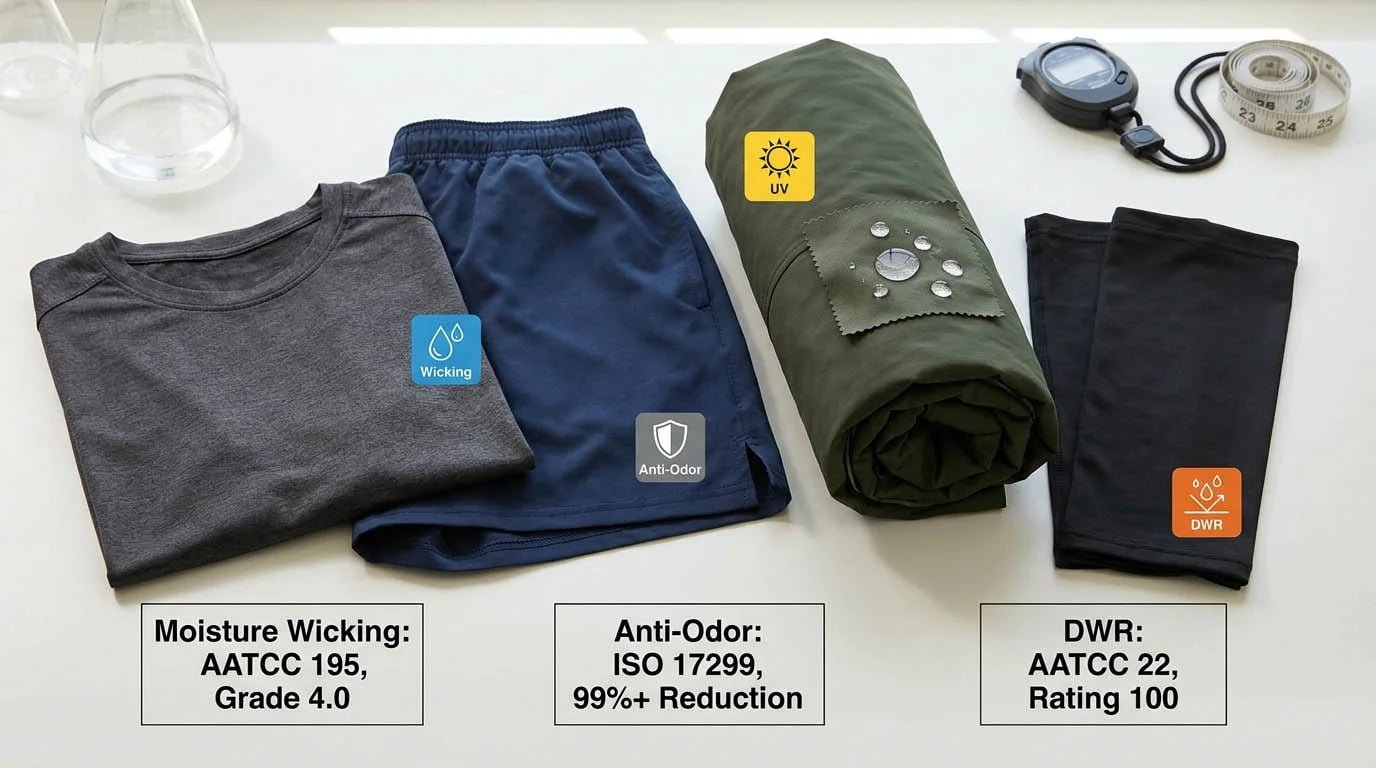
A yoga brand owner once paid extra for "permanent moisture wicking finish" on polyester fabric. I had to explain that polyester naturally wicks moisture—the finish was redundant. He overpaid by $0.80 per unit for 1,200 pieces.
Moisture Wicking: Natural vs. Applied
Here's a critical distinction most brand owners miss:
Natural wicking (fiber property):
- Polyester and nylon inherently push moisture away from skin
- This property never washes out
- No additional cost
- Most effective for men's high-sweat activities
Applied wicking finish:
- Chemical treatment on fabric surface
- Enhances wicking on cotton blends or improves synthetic performance
- Washes out after 15-30 cycles depending on quality
- Adds $0.40-0.80 per unit
When applied wicking makes sense:
- Cotton-polyester blends where cotton needs help
- Fabrics with dense constructions that restrict natural wicking
- Premium products where temporary enhancement justifies cost
When it's wasteful:
- Pure polyester or nylon fabrics (already wicks naturally)
- Budget products where finish cost affects margins
- High-wash frequency products (finish disappears quickly)
I tell clients: if you're using 85%+ polyester, skip the wicking finish. The fiber already does the job.
Quick-Dry Technology
"Quick-dry" is a marketing term, not a standardized performance metric. I need to show you what actually determines drying speed.
Factors affecting dry time:
- Fiber type: Polyester fastest, nylon moderate, cotton slowest
- Fabric weight: 140 GSM dries 2x faster than 240 GSM
- Construction: Open structures (mesh, tricot) dry faster than dense knits
- Surface area: Thinner fabrics expose more surface to air
Quick-dry finishes:
Some suppliers offer hydrophobic treatments that repel water. These work but:
- Add $0.50-0.90 per unit
- Wash out after 20-40 cycles
- Make minimal difference on already-hydrophobic polyester
Testing drying performance:
Ask suppliers for AATCC 201 test results showing:
- Time to 90% dryness from saturated state
- Test conditions (temperature, humidity, air flow)
Polyester jersey at 180 GSM should reach 90% dryness in 90-120 minutes under standard conditions. Cotton blends take 4-6 hours.
Anti-Odor Treatments: Temporary vs. Permanent
Men's activewear generates strong demand for odor control. Polyester retains smell after one intense workout. Here's how treatments compare:
Silver-based treatments (most common):
- Mechanism: Silver ions inhibit bacterial growth
- Duration: Effective for 30-50 washes depending on concentration
- Cost: Adds $0.60-1.20 per unit
- Effectiveness: Good to excellent
Zinc-based treatments:
- Mechanism: Zinc pyrithione kills odor-causing bacteria
- Duration: 20-40 washes
- Cost: $0.50-0.90 per unit
- Effectiveness: Moderate
Polygiene treatment (brand name):
- Mechanism: Silver chloride embedded in fiber
- Duration: Claimed permanent (actually 50+ washes)
- Cost: $1.20-1.80 per unit
- Effectiveness: Excellent but expensive
Natural fiber alternatives:
Merino wool and bamboo have inherent anti-odor properties. No treatment needed, but fibers cost 2-4x more.
My recommendation:
For men's gym and training wear where polyester is used, invest in silver-based anti-odor treatment. Customer satisfaction improves significantly. For running gear where ventilation handles odor, skip the treatment and save cost.
UV Protection: When It Matters
UV protection in activewear is oversold. Most fabrics already block significant UV without special treatment.
Natural UV blocking:
- Dark colors: Block 95%+ UV without treatment
- Tighter weaves: Dense constructions block more UV
- Fabric weight: 180+ GSM provides UPF 30-40 naturally
UV treatment finishes:
- Add UV-blocking chemicals to fabric surface
- Achieve UPF 50+ ratings
- Add $0.40-0.70 per unit
- Wash out after 30-50 cycles
When UV treatment makes sense:
- Outdoor training gear in light colors
- Products marketed for sun exposure (hiking, beach sports)
- Regions with extreme sun (Australia, Middle East, Southern US)
When it's unnecessary:
- Indoor gym wear
- Dark-colored products (already protective)
- Budget products where cost matters
DWR (Durable Water Repellent): Outdoor Applications
DWR finishes make fabric shed water rather than absorbing it. This appears more in outdoor activewear than pure gym wear.
Performance characteristics:
- Water beads up and rolls off fabric surface
- Fabric stays lighter when exposed to rain or moisture
- Improves comfort in wet conditions
- Does not make fabric waterproof, just water-resistant
Cost and durability:
- Adds $0.80-1.40 per unit depending on quality
- Effective for 20-30 washes (standard DWR)
- Better versions last 40-60 washes (add 30% more cost)
Applications for men's activewear:
- Outdoor training jackets and pants
- Running gear for all-weather athletes
- Hiking and trail running apparel
Not worth it for:
- Indoor training wear
- Hot-weather activewear
- Products targeting budget markets
Testing Standards and Verification
When suppliers claim performance finishes, request test documentation:
| Performance Claim | Test Standard | Acceptable Result |
|---|---|---|
| Moisture wicking | AATCC 195 | Spread time <3 seconds |
| Quick-dry | AATCC 201 | 90% dry in <2 hours |
| Anti-odor | AATCC 100 | 99%+ bacterial reduction |
| UV protection | AATCC 183 | UPF 30-50+ |
| Water repellent | AATCC 22 | Spray rating 80-100 |
Ask: can you provide test reports from third-party labs (SGS, Intertek, TÜV)? In-house testing is fine for development. Independent verification matters for bulk orders.
Choose by Use Case: Running, Training, Yoga, Outdoor and Recovery?
Everything I've covered leads to this decision framework. What activity are you serving? That determines which fabric parameters matter most and which are irrelevant.
Men's activewear fabric selection must start with use case analysis—running requires different fabric engineering than weightlifting, which differs from yoga or outdoor training. Matching fabric to specific movement patterns and sweat zones reduces returns and increases customer satisfaction.
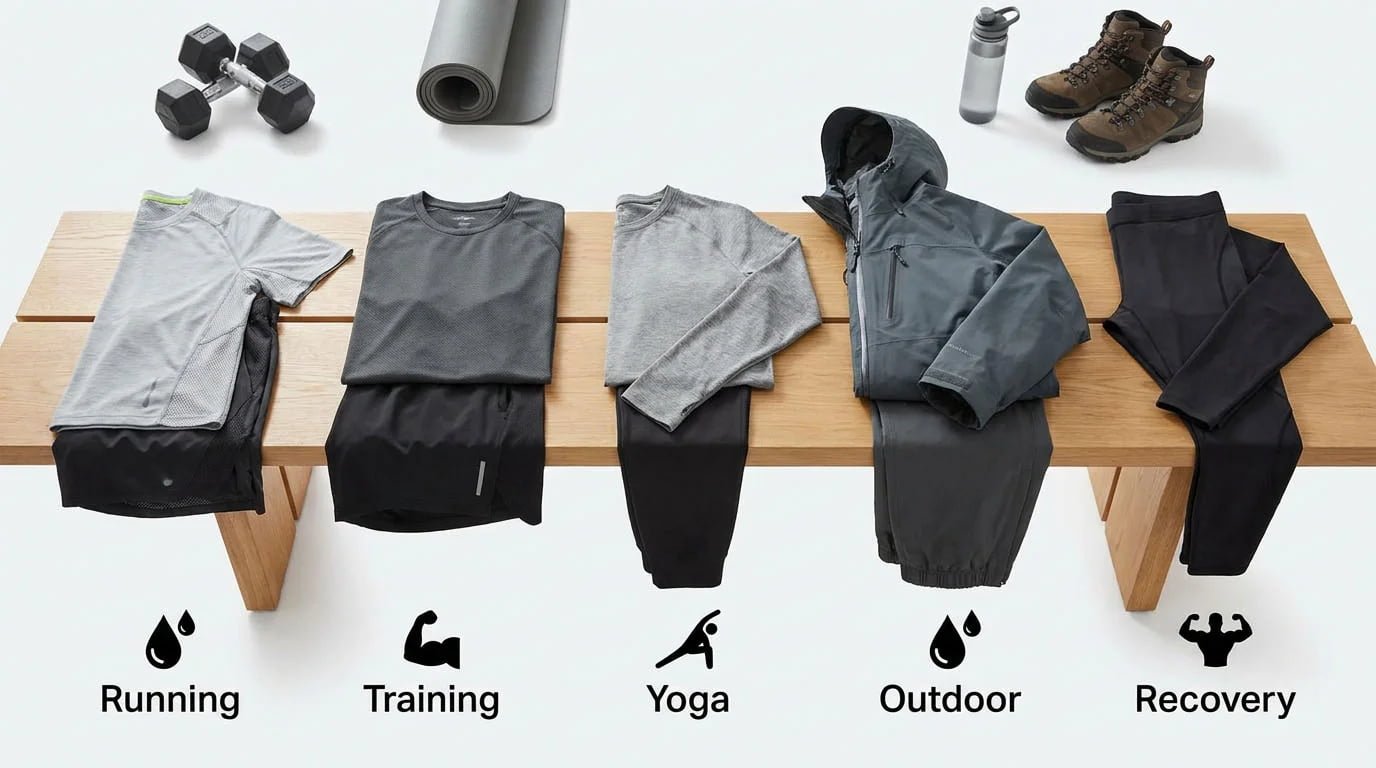
I walk every client through this framework. It prevents the most common mistake: choosing one fabric for everything and compromising performance across all categories.
Running and Cardio: Lightweight and Ventilation
Men's running generates 30-50% more sweat than strength training. Fabric needs to handle continuous moisture without weight gain.
Optimal fabric specifications:
- Fiber: Polyester-spandex 92/8 or 90/10
- Weight: 140-180 GSM (lighter for warm weather, heavier for cold)
- Construction: Single jersey or tricot with mesh panels
- Finish: None needed for polyester; anti-odor optional
Critical features:
- Mesh ventilation zones: Back panel and underarms
- Lightweight feel: Doesn't weigh down during long runs
- Quick drying: Stays comfortable during hour+ workouts
- Non-chafing: Flatlock seams, minimal tags
Cost target: $8-13 per unit for quality running tees, $6-10 for shorts.
Common mistakes to avoid:
- Using 200+ GSM fabric (too heavy, traps heat)
- Compression fit (restricts breathing and movement)
- Cotton blends over 20% content (stays wet, causes chafing)
A marathon training brand once ordered 220 GSM polyester because it felt "premium" in the showroom. After receiving customer complaints about overheating, they switched to 160 GSM with mesh panels for their next order.
Training and Gym: Durability and Movement
Weightlifting, CrossFit, and general gym training create different demands than running:
Optimal fabric specifications:
- Fiber: Polyester-spandex 85/15 or 88/12
- Weight: 180-220 GSM for durability
- Construction: Single jersey or interlock for opacity
- Finish: Anti-odor recommended (intense sweat in confined spaces)
Critical features:
- Four-way stretch: Accommodates squat depth, overhead movements
- Opacity: No see-through during bending or stretching
- Shape retention: Maintains fit after repeated washing
- Abrasion resistance: Handles barbell contact, floor work
Cost target: $10-15 per unit for training tees, $9-14 for shorts.
Shorts-specific requirements:
- Gusseted crotch: Prevents seam failure during squats
- Inseam length: 7-9 inches for mobility without exposure
- Drawstring waist: Adjustable security during dynamic movement
Yoga and Mobility: Stretch and Recovery
Men's yoga is growing fast but requires different fabric than women's compression-focused yoga wear.
Optimal fabric specifications:
- Fiber: Nylon-spandex 82/18 or polyester-modal 70/30
- Weight: 220-260 GSM for coverage without compression
- Construction: Interlock or double knit for opacity
- Finish: Anti-odor beneficial; moisture wicking less critical
Critical features:
- High stretch and recovery: Returns to shape after deep stretches
- Soft hand feel: Comfort during floor poses and static holds
- Non-restrictive fit: Movement freedom more important than compression
- Waistband stability: Doesn't roll during inversions
Cost target: $12-18 per unit for yoga pants, $9-13 for tops.
Key difference from women's yoga wear:
Men's yoga customers want looser fit with stretch, not compression fit. Using women's yoga fabric specs creates uncomfortable tightness.
Outdoor and Adventure: Weather Resistance
Outdoor training, hiking, and trail running need fabrics that handle variable conditions.
Optimal fabric specifications:
- Fiber: Nylon-spandex 88/12 for abrasion resistance
- Weight: 200-240 GSM for durability
- Construction: Tricot or warp knit with reinforcement zones
- Finish: DWR treatment recommended, UV protection for light colors
Critical features:
- Abrasion resistance: Stands up to trail contact, gear friction
- Weather protection: DWR coating for light rain
- Durability: Reinforced seams and high-stress zones
- Quick drying: Handles sweat and environmental moisture
Cost target: $14-20 per unit for outdoor training gear.
Recovery and Compression: Support Function
Recovery wear serves post-workout muscle support. It's a growing but still niche category in men's activewear.
Optimal fabric specifications:
- Fiber: Nylon-spandex 78/22 or 75/25
- Weight: 240-280 GSM for compression effect
- Construction: Circular knit for graduated compression
- Finish: Anti-odor optional; focus on compression retention
Critical features:
- Graduated compression: Tighter at extremities, looser at core
- Compression retention: Maintains pressure after 30+ washes
- Moisture management: Still needs to handle sweat
- Comfortable seams: Worn for extended periods
Cost target: $15-22 per unit (higher due to specialized construction).
Customer education required:
Men often don't understand compression wear benefits. Product descriptions must explain use cases: post-workout recovery, travel, muscle fatigue reduction.
FAQ: Men's Activewear Fabrics
What's the difference between GSM and thread count?
GSM (grams per square meter) measures fabric weight. Thread count measures yarn density in woven fabrics. For activewear (mostly knit fabrics), GSM is the relevant metric. 180-220 GSM works for most men's training wear. Thread count is irrelevant for knit activewear.
Why does my polyester activewear smell after one workout?
Polyester's hydrophobic structure allows bacteria to thrive in sweat residue. This creates odor. Solutions: use anti-odor treated fabrics (adds $0.60-1.20 per unit), wash immediately after workouts, or choose nylon blends which resist odor better. Merino wool naturally resists odor but costs 3-4x more.
Can I use the same fabric for men's and women's activewear?
Fabric can be the same but fit and construction must differ. Men produce more sweat and need different ventilation zones. Men's patterns require different stretch directions and compression levels. Using women's yoga fabric specs for men's training wear causes fit complaints and returns.
How do I test if fabric is see-through before bulk production?
Request opacity testing or do a manual check: hold fabric against white background with strong backlight. If skin or underlines show through, the fabric needs to be heavier (higher GSM), darker colored, or use tighter construction. Minimum 180 GSM for light colors, 160 GSM for dark colors.
What fabric weight should I use for men's shorts vs. tees?
Shorts typically use lighter weight than tees in the same activity category. Running shorts: 100-140 GSM. Training shorts: 140-180 GSM. Running tees: 140-180 GSM. Training tees: 180-220 GSM. Shorts need lightweight feel for leg mobility. Tops need more opacity.
Is four-way stretch necessary for all men's activewear?
No. Running tees and basic training wear work fine with two-way stretch (horizontal direction). Four-way stretch matters for bottoms (squat depth, lunges) and compression garments. Four-way stretch adds 10-15% to fabric cost. Use it only where movement patterns require it.
How long do performance finishes last?
Most finishes last 20-50 washes depending on quality and care. Silver-based anti-odor: 30-50 washes. DWR water repellent: 20-30 washes. Quick-dry treatments: 20-40 washes. "Permanent" usually means 50+ washes, not lifetime. Set customer expectations appropriately.
Conclusion
Men's activewear fabric selection is not about premium materials. It's about matching fiber content, fabric construction, weight, and finishes to specific workout contexts. Start with use case analysis, choose appropriate fiber blends and GSM, add finishes only where they deliver lasting value. Test fabrics before committing to bulk orders.