.png)
Last month a fitness trainer called me excited about launching her activewear line. She had $15,000 saved and beautiful designs. When I asked about her sampling budget, she went quiet. She thought sampling was optional. I explained that without testing, her $15,000 would likely become unsellable inventory.
Most activewear brand failures happen before production begins—not from bad designs, but from misallocated startup capital, wrong factory selection, and skipped testing phases. Success requires understanding that your budget must cover sampling, iterations, testing, and certifications before committing to bulk production.
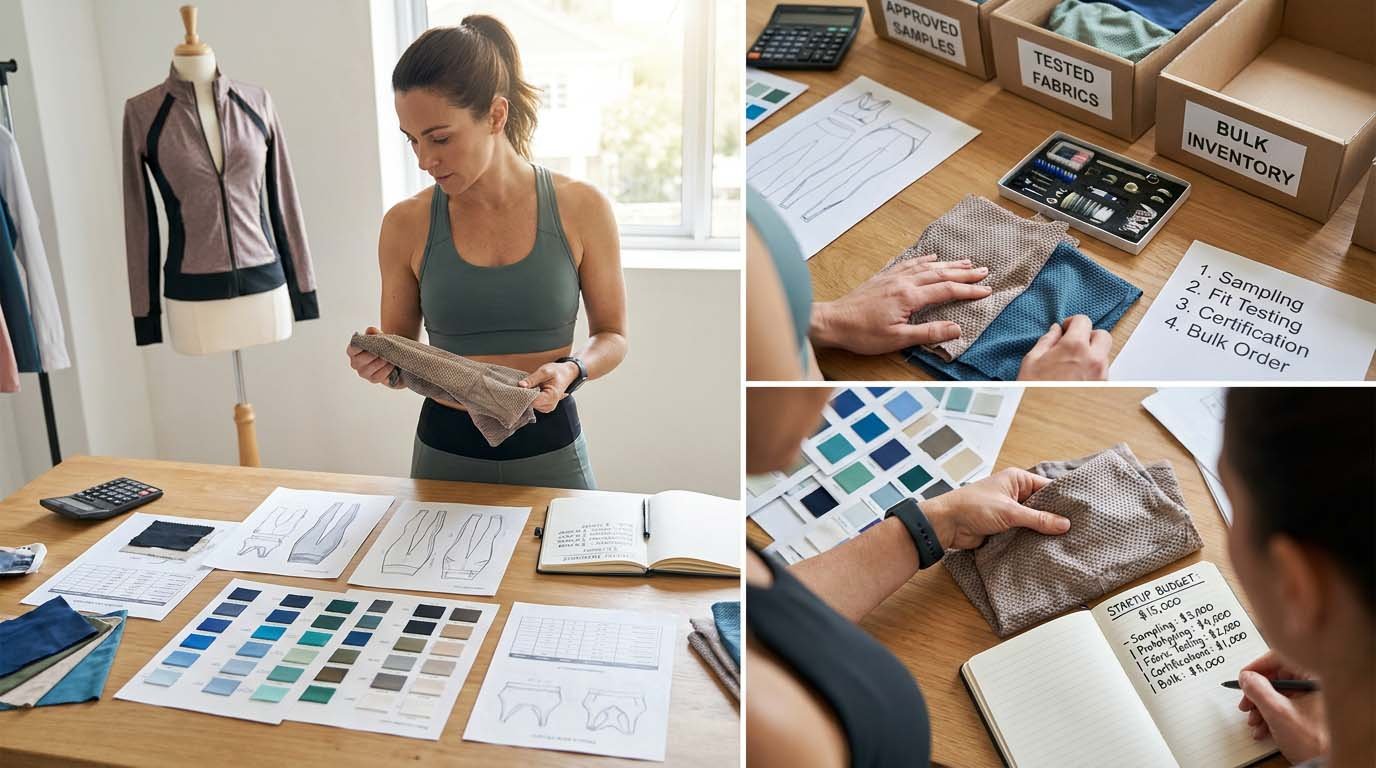
I have worked with over 150 brand launches in the past decade. The ones that succeed follow a different path than beginners expect. I want to show you where real risks hide and how to allocate resources correctly.
Quick Answers: Starting an Activewear Brand
How much money do I need to start an activewear brand?
Minimum $8,000-12,000 for a single-style launch: $800-1,500 for sampling and iterations, $300-600 for testing and certifications, $200-400 for tech pack development, $4,500-7,000 for first production (300-500 units), and $2,000-3,000 for buffer and unexpected costs. Don't start with less than $8,000.
What's the biggest mistake beginners make when starting an activewear brand?
Ordering full production without proper sampling and testing. I see this monthly—brands skip fit testing on real bodies, skip wash testing, or skip wear testing. Then 30-50% of inventory comes back as returns for fit issues, pilling, or color bleeding. Sampling costs $800-1,500 but saves thousands in unusable inventory.
How do I find a reliable activewear manufacturer?
Don't choose based on lowest MOQ or cheapest price—these usually signal quality problems. Instead evaluate: Can they provide sampling before bulk orders? Do they offer fabric testing reports? Can they show similar products they've made? Will they communicate clearly about timelines and costs? Expect 3-4 weeks to vet a manufacturer properly.
What's the minimum order quantity for starting an activewear brand?
Legitimate factories quote 300-500 pieces for custom activewear. Factories offering 100-piece MOQs often compromise on quality control, use inferior fabrics, or add hidden costs. ODM (factory-designed styles with your branding) may offer 200-300 pieces, a good option for first-time brands to test market without full custom development.
How long does it take from concept to first product in hand?
Plan 120-150 days for first production: 15-20 days supplier vetting and quoting, 20-30 days sampling and revisions, 10-15 days testing, 60-75 days production, 15-20 days shipping. Add buffer time—delays happen. Don't promise customers delivery dates based on best-case scenarios.
Define Your Niche and Brand Positioning?
A Shopify seller asked me to manufacture "activewear for women." I asked what kind. She said "all kinds—yoga, running, gym." I explained that each category requires different fabrics and construction. She had $10,000 total. That's not enough to do everything. She needed to choose.
Brand positioning determines your production strategy, not the other way around. Before contacting manufacturers, you must define what specific activewear problem you solve, who your customer is, and what price point you're targeting. These decisions directly affect fabric selection, MOQ requirements, and production costs.
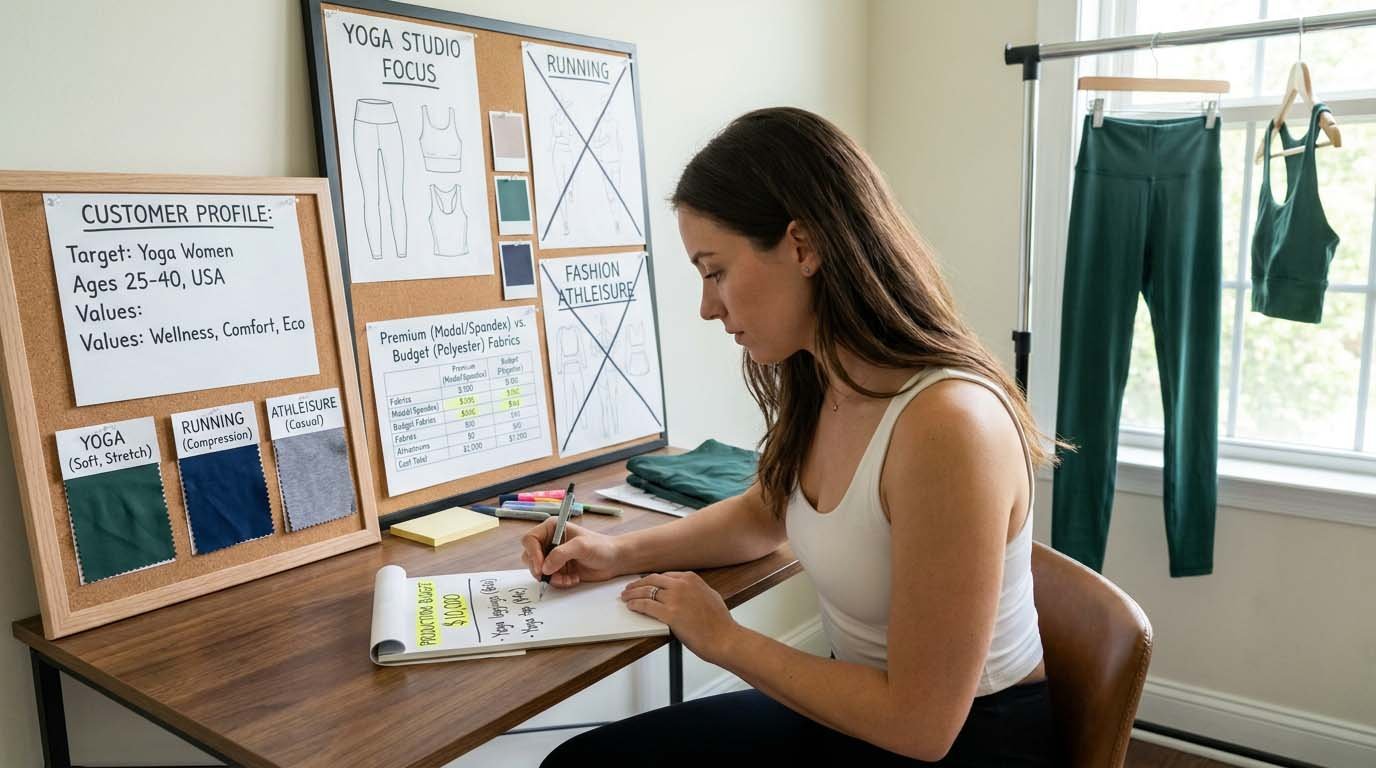
I see beginners make the same mistake. They want to be "everything for everyone" because they fear limiting their market. Actually, trying to serve everyone guarantees production problems and budget overruns.
Why Niche Selection Affects Production Costs
Different activewear categories have different technical requirements and cost structures:
Yoga and studio wear:
- Fabric requirements: Four-way stretch, 240-280 GSM, 20-25% spandex, squat-proof
- Construction: Gusseted crotch, high-rise waistbands, flatlock seams
- MOQ range: 300-500 pieces (standard fabric availability)
- Unit cost range: $11-16 for leggings, $7-11 for tops
- Development complexity: Medium
Running and performance wear:
- Fabric requirements: Moisture-wicking, quick-dry, 160-200 GSM, reflective elements
- Construction: Mesh panels, bonded seams, multiple pockets
- MOQ range: 500-800 pieces (technical fabrics have higher minimums)
- Unit cost range: $14-19 for performance pieces
- Development complexity: High
Athleisure and lifestyle:
- Fabric requirements: Soft hand feel, moderate stretch, 200-240 GSM
- Construction: Fashion details, color blocking, decorative elements
- MOQ range: 300-500 pieces
- Unit cost range: $13-18 depending on complexity
- Development complexity: Medium to high
Loungewear and recovery:
- Fabric requirements: Soft, breathable, 220-260 GSM, often natural blends
- Construction: Relaxed fit, simple construction
- MOQ range: 300-500 pieces
- Unit cost range: $10-15
- Development complexity: Low to medium
Budget implications:
If you have $10,000 and want to launch yoga wear, you can develop 1-2 styles properly. If you try to launch yoga + running + athleisure simultaneously, you're spreading that budget across 3-6 styles with no testing buffer.
Target Customer Affects Fabric Choices
Your customer profile determines acceptable fabric specifications and pricing:
Serious athletes and fitness enthusiasts:
- Expect high-performance fabrics with proven technical features
- Willing to pay $60-90 retail for quality
- Production implication: Can invest in $3-5 more per unit for premium fabrics
Casual exercisers and wellness focused:
- Value comfort and aesthetics over maximum performance
- Price range $40-60 retail
- Production implication: Balance fabric cost with soft hand feel
Fashion-first athleisure buyers:
- Want stylish design with adequate functionality
- Will pay $50-80 for trendy pieces
- Production implication: Budget for design details over technical features
Budget-conscious active consumers:
- Need functional basics at accessible prices
- Target $25-40 retail
- Production implication: Must minimize costs everywhere, volume is critical
Price Point Determines Production Strategy
Your intended retail price constrains production decisions:
Retail $25-40 (budget range):
- Production cost must be $8-12 per unit
- Requires higher volumes (500-1,000+ units) for economies of scale
- Limits fabric choices to standard polyester blends
- Minimal design complexity
- Often requires offshore production (Bangladesh, Pakistan)
Retail $40-60 (mid-market):
- Production cost $12-18 per unit acceptable
- Standard MOQs 300-500 units work
- Access to better fabric options (nylon blends, modal mixes)
- Moderate design features possible
- China, Vietnam production standard
Retail $60-90 (premium):
- Production cost $18-27 per unit supportable
- Can start with 300 units and maintain margin
- Premium fabrics and complex construction affordable
- Sustainability certifications feasible
- Can consider nearshoring for faster turnaround
Retail $90+ (luxury):
- Production cost $27-40+ per unit
- Smaller quantities viable (200-300 units through ODM or specialty factories)
- Bio-based materials and advanced features accessible
- Domestic production possible
- Must deliver exceptional quality
Reality check I give clients:
If you want to retail at $40 but insist on using premium Tencel-blend fabrics costing $3 more per unit, your margin doesn't work. Either raise your price point or choose fabrics that fit your cost structure.
Geographic Market Considerations
Where you're selling affects production decisions:
North America:
- Higher price tolerance, expects quality and performance
- Sustainability claims matter
- Athletic fit preferences (more compression, fitted)
- Production: Can support $15-20 unit costs
Europe:
- Sustainability and certifications often mandatory
- Fit preferences vary by country
- Compliance requirements strict (REACH, etc.)
- Production: Budget for $1-2 more per unit in certifications
Australia:
- Performance for outdoor lifestyle important
- Sun protection features valued
- Relaxed fit preferences
- Production: Similar cost structure to US
Southeast Asia:
- Strong price sensitivity
- Modesty considerations in some markets
- Growing activewear adoption
- Production: Must hit $10-14 unit costs for competitive pricing
My recommendation for beginners:
Start with one geographic market, one customer type, one category (like yoga leggings), and 1-2 styles. Master that before expanding. Every expansion multiplies complexity.
Build the Product: Fabrics, Fits, Tech Packs and Sampling?
A brand owner sent me inspiration photos from Instagram and asked for a quote. I asked for fabric specifications. She said "the fabric in the photo." I explained I can't identify fabric composition from a photo. We spent an hour educating her on fabric terminology before we could even start.
Product development for activewear requires specific technical documentation: fabric specifications with weight and composition, fit requirements with measurements, construction details in tech packs, and physical sampling on bodies. Skipping any of these steps leads to products that don't match expectations or don't perform as needed.
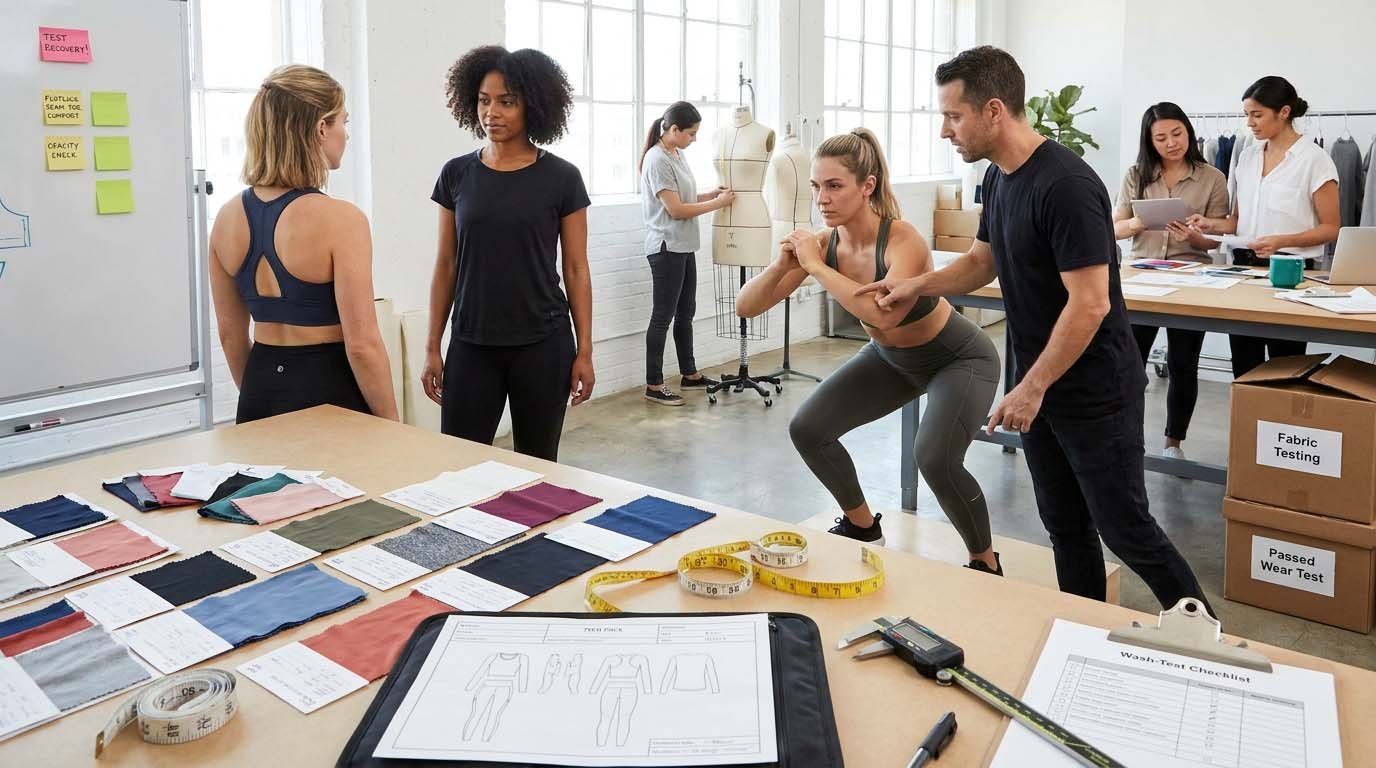
Beginners often think showing a photo is enough. From a manufacturer perspective, we need precise specifications to source materials and construct patterns. I walk through what's actually required.
Fabric Selection Beyond Aesthetics
Choosing fabric is not about how it looks—it's about performance specifications:
Essential fabric specifications you must provide:
- Fiber composition: Exact percentages (e.g., 85% nylon, 15% spandex)
- Fabric weight: GSM measurement (e.g., 240 GSM)
- Stretch type: Two-way or four-way stretch
- Stretch percentage: How much it stretches (e.g., 40% horizontal, 50% vertical)
- Recovery: How much it returns after stretching (e.g., 90% recovery)
- Finish: Any special treatments (moisture-wicking, anti-pilling, DWR)
Common fabric types and their applications:
| Fabric Type | Composition | Weight | Best For | Cost Range |
|---|---|---|---|---|
| Standard performance | 85/15 nylon-spandex | 240-280 GSM | Yoga leggings, training wear | $4-6/meter |
| Light compression | 82/18 poly-spandex | 200-240 GSM | Sports bras, bike shorts | $3.50-5/meter |
| High compression | 80/20 nylon-spandex | 260-300 GSM | Compression leggings, shapewear | $5-7/meter |
| Soft touch | 92/8 poly-spandex | 220-260 GSM | Athleisure, loungewear | $4-6/meter |
| Modal blend | 60/35/5 modal-poly-spandex | 240-280 GSM | Premium yoga, wellness | $6-9/meter |
Fabric testing requirements:
Before bulk production, test for:
- Stretch and recovery: ASTM D2594 testing
- Pilling resistance: Grade 3-4 minimum for activewear
- Color fastness: To washing, perspiration, light
- Dimensional stability: Shrinkage after washing
- Opacity: Squat test, especially for light colors
Testing costs: $300-600 for comprehensive fabric testing. Many beginners skip this, then discover pilling or shrinkage issues after selling to customers.
Fit and Pattern Development
Fit is where most activewear brands fail if they skip testing:
What you need to specify:
For leggings:
- Rise height (low, mid, high)
- Waistband width and construction
- Inseam length
- Leg opening width
- Gusset or no gusset
For sports bras:
- Support level (light, medium, high)
- Band width
- Strap style and adjustability
- Cup construction (removable, molded, none)
For tops:
- Length (crop, regular, long)
- Fit (compression, fitted, relaxed)
- Neckline style
- Sleeve length and armhole depth
Size grading requirements:
Standard size range is XS, S, M, L, XL (5 sizes):
- Pattern grading cost: $200-400 per style
- Fit sampling: Need 2-3 fit models across size range
- Revision rounds: Budget for 2-3 iterations at $150-300 each
Extended sizing (adding XXS, XXL, XXXL, etc.):
- Additional grading: $100-200 per size added
- Additional fit models: 1-2 more models needed
- Higher sampling costs: $200-400 more total
Client scenario:
A brand wanted to launch with 8 sizes (XXS-XXXL) to be inclusive. Pattern grading alone was $600 per style. With 3 styles, that's $1,800 before any sampling. She had $2,500 budgeted for entire development phase. We scaled back to 5 standard sizes ($400 grading per style, $1,200 total) for initial launch.
Tech Pack Creation
A tech pack is your product blueprint that manufacturers use for production:
Essential tech pack components:
- Technical sketches: Front, back, and side views with callouts
- Measurements: Detailed spec sheet for all sizes
- Materials: Fabric specs, trims, labels, threads
- Construction details: Seam types, stitching, finishing
- Colorways: Pantone codes or approved swatches
- Labels and tags: Placement, size, content
- Packaging: Poly bag, hangtag, any special requirements
Tech pack development options:
DIY tech packs:
- Use templates from online resources
- Cost: Your time only
- Risk: Missing critical details leads to production errors
Hire tech pack designer:
- Professional freelancer creates complete pack
- Cost: $200-500 per style
- Value: Reduces misunderstandings with factory
Factory-assisted tech packs:
- Some factories help create tech packs
- Cost: Often included in sampling
- Consideration: Factory may default to their standard methods
My recommendation:
For first-time brands, work with factory that provides tech pack assistance. Learn the process. Once you understand requirements, you can create your own for future styles.
Sampling Process and Iterations
Sampling is not optional. It's where you catch problems before spending thousands on bulk production:
Standard sampling timeline:
First sample (proto sample):
- Factory creates based on tech pack and fabric choices
- Timeline: 15-20 days
- Cost: $150-300 per style
- Purpose: Verify pattern, construction, general look
Fit sample:
- Test on actual bodies across size range
- Timeline: 10-15 days after proto approval
- Cost: $150-300 for 2-3 sizes
- Purpose: Verify sizing, comfort, movement
Pre-production sample (PP sample):
- Final sample before bulk using exact fabrics and trims
- Timeline: 10-15 days after fit approval
- Cost: $100-200 per style
- Purpose: Final approval before production starts
Revision rounds:
- Each round adds 7-10 days and $100-200 per revision
- Most styles need 2-3 revision rounds total
- Budget accordingly
Testing during sampling:
- Wear test: Have people wear samples for 2-3 workouts
- Wash test: Wash samples 5-10 times to check durability
- Movement test: Squat, stretch, jump to verify fit and opacity
- Comfort test: Wear for 4-6 hours to check seam irritation
Real scenario:
A yoga instructor designed leggings. First sample looked good on hanger. When she wore them for class, waistband rolled down during downward dog. We revised waistband construction. Second sample stayed up but seams irritated after one hour. We changed to flatlock seams. Third sample passed all tests. Total sampling: $900, 45 days. Without this process, she'd have ordered 2,000 units of unwearable leggings.
Costing and Margin Calculation
Understanding true cost per unit is critical:
Full unit cost includes:
- Fabric cost: Typically 30-40% of total
- Trim cost: Elastics, labels, threads (10-15%)
- Labor cost: Cutting, sewing, finishing (30-40%)
- Factory overhead: Quality control, management (10-15%)
- Profit margin: Factory needs to make profit too
Additional costs to factor:
- Certifications: OEKO-TEX, GRS, etc. ($300-800 per fabric)
- Testing: Fabric testing, wash testing ($300-600)
- Packaging: Poly bags, hangtags, labels ($0.30-0.80 per unit)
- Shipping: Freight, customs, duties ($1-3 per unit depending on location)
Retail pricing formula:
- Production cost × 2.5-3 = Wholesale price (if selling wholesale)
- Production cost × 4-5 = DTC retail price (if selling direct)
Example calculation:
Production cost: $14 per unit
Shipping and duties: $2 per unit
Total landed cost: $16 per unit
DTC retail: $16 × 4-5 = $64-80
Wholesale: $16 × 2.5 = $40 (retailer marks up to $80-100)
Buffer requirement:
Always budget 20-30% buffer for unexpected costs, delays, or minimum order increases.
Find Suppliers and Make It: Sourcing, MOQs, Timelines and Costs?
Last week someone asked me why our MOQ is 300 pieces when they found a factory offering 100 pieces. I asked to see that factory's work. The photos showed uneven stitching, pilling fabric, and inconsistent sizing. That's why their MOQ is lower—they cut corners everywhere.
Legitimate activewear manufacturers have minimum order quantities of 300-500 pieces for custom production because quality control, proper fabric sourcing, and skilled labor have real costs. Factories offering much lower MOQs usually compromise quality, use inferior materials, or add hidden fees that negate the initial savings.
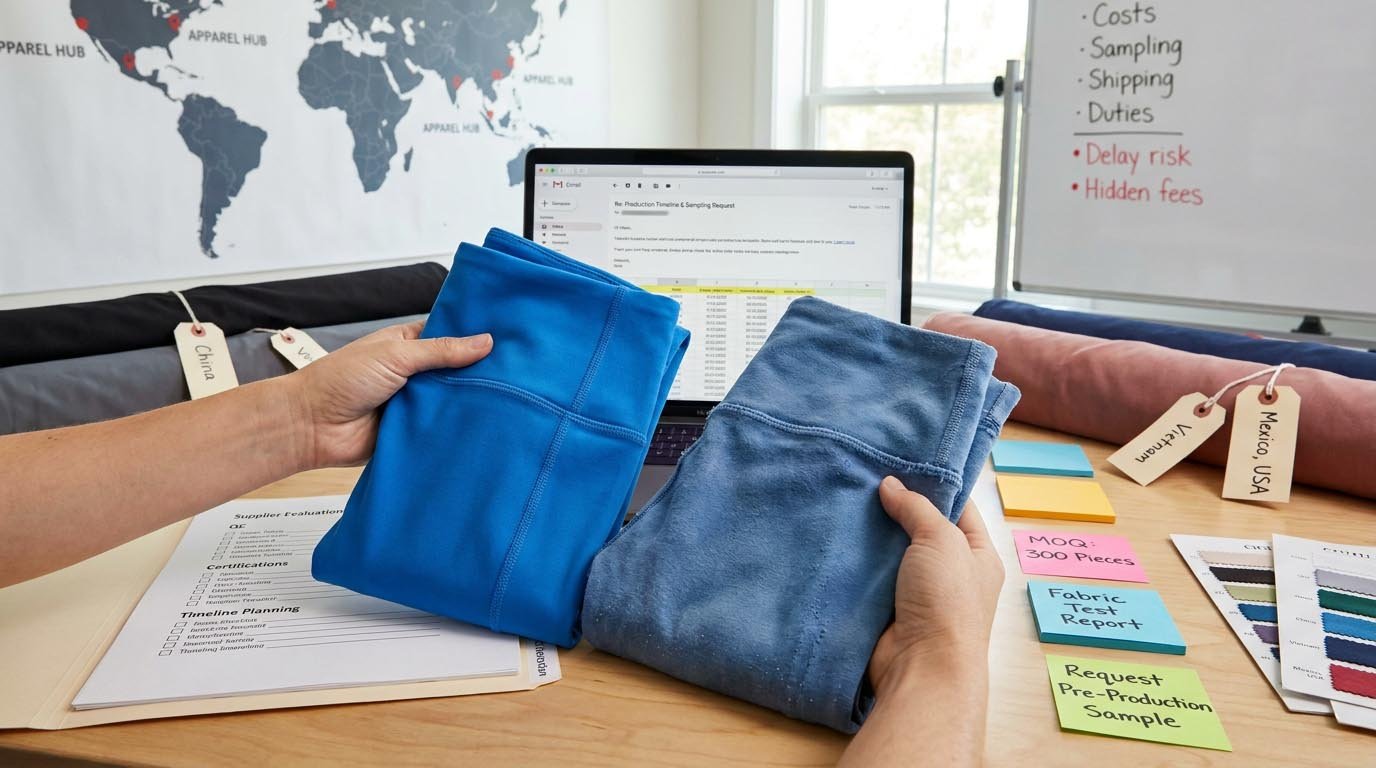
I need to explain what realistic expectations look like for supplier sourcing. Beginners often optimize for the wrong variables.
How to Evaluate Manufacturers
Don't choose based on price or MOQ alone. Evaluate these factors:
Production capabilities:
- Can they produce the specific category you need? (Yoga wear vs. performance wear requires different equipment)
- Do they have relevant samples to show?
- What's their typical order size? (If they normally do 5,000+ pieces, your 300-piece order gets low priority)
Quality systems:
- Do they have QC processes? Ask specifics.
- Can they provide fabric testing reports?
- Do they offer pre-production samples?
- What's their defect rate policy?
Communication and service:
- Response time to inquiries
- English proficiency (if you don't speak their language)
- Willingness to answer detailed questions
- Transparency about timelines and costs
Certifications and compliance:
- Factory certifications (ISO, WRAP, etc.)
- Fabric testing capabilities
- Understanding of export requirements
Financial stability:
- Payment terms offered
- How long they've been in business
- References from other clients
Red flags to avoid:
- Won't provide samples before full order
- Quote seems 30-50% cheaper than others (something's wrong)
- Pressure to order immediately
- Unclear or constantly changing timelines
- Won't answer specific technical questions
- No written contracts or clear terms
MOQ Reality Check
Understanding why MOQs exist helps set realistic expectations:
Why 300-500 pieces is standard:
Fabric minimums:
- Mills require 300-800 meters per color
- 1.5-1.8 meters needed per garment
- This sets floor at 200-500 pieces per colorway just from fabric constraints
Setup costs:
- Pattern making and grading: Fixed cost regardless of quantity
- Sample development: Fixed cost
- Production line setup: Takes same time for 100 or 500 pieces
- Quality control systems: Fixed overhead
Labor efficiency:
- Workers need 20-30 pieces to reach efficient pace
- Small batches mean constant line changes
- Higher per-unit labor costs for small quantities
Quality control:
- Proper QC requires inspecting 10-20% of production
- Below 300 pieces, inspection costs per unit become prohibitive
MOQ options for beginners:
Custom development (300-500 pieces):
- Your design, your fabrics, your brand only
- Development cost: $800-1,500 including sampling
- Unit cost: $11-18 for standard styles
- Timeline: 120-150 days first order
ODM with customization (200-300 pieces):
- Factory's existing designs with your branding
- Minor modifications allowed (colors, small details)
- Development cost: $300-600
- Unit cost: $9-15
- Timeline: 90-120 days
Private label (100-200 pieces):
- Factory's stock items with your labels
- No design modifications
- Development cost: $100-300
- Unit cost: $8-14 but limited style options
- Timeline: 60-90 days
My recommendation for true beginners:
Start with ODM to test market without huge development investment. Once you validate demand, invest in custom development for differentiation.
Production Timeline Breakdown
Understanding realistic timelines prevents customer disappointment:
Pre-production phase (45-60 days):
- Supplier vetting and selection: 7-10 days
- Initial sampling: 15-20 days
- Fit testing and revisions: 15-20 days
- Fabric testing: 10-15 days (can overlap with sampling)
- Final PP sample approval: 5-7 days
Production phase (60-75 days):
- Fabric sourcing and incoming inspection: 15-25 days
- Cutting and preparation: 5-7 days
- Sewing and assembly: 20-30 days
- Finishing and quality control: 5-7 days
- Packing and export documentation: 3-5 days
- Buffer for issues: 10-15 days
Shipping phase (15-30 days):
- Sea freight from Asia: 20-30 days
- Air freight: 5-7 days (expensive)
- Customs clearance: 3-5 days
- Domestic delivery: 2-3 days
Total realistic timeline: 120-165 days
Common delays that add time:
- Fabric out of stock: +15-30 days
- Failed testing requiring new fabric: +20-40 days
- Major fit issues needing pattern revision: +15-25 days
- Factory capacity constraints: +10-20 days
- Shipping delays: +5-15 days
Buffer recommendation:
Tell customers delivery is 30 days later than your expected date. Better to deliver early than explain delays.
Cost Structure and Payment Terms
Understanding payment expectations and full cost breakdown:
Standard payment terms:
For first-time customers:
- 30-50% deposit when order confirmed
- 50-70% balance before shipping
- No credit terms until relationship established
After proven relationship:
- 30% deposit, 70% before shipping standard
- Some factories offer net 30 after several successful orders
Payment methods:
- Bank wire transfer (most common)
- Letter of credit (for large orders)
- Trade assurance platforms (Alibaba, etc.)
Full cost breakdown example (300 pieces):
Production costs:
- Unit cost: $14 × 300 = $4,200
- Sampling and development: $800
- Fabric testing: $400
- Subtotal: $5,400
Additional costs:
- Shipping (sea freight): $600-900
- Customs duties: $400-600 (varies by country)
- Freight forwarding: $200-300
- Subtotal: $1,200-1,800
Total investment: $6,600-7,200 for first production
Hidden costs beginners miss:
- Revision samples: $200-400
- Rush fees for tight timelines: 10-20% premium
- Storage fees if delayed pickup: $50-150/month
- Inspection services: $200-400 (recommended for first orders)
Geographic Sourcing Considerations
Where you manufacture affects costs, timelines, and risks:
China (most common):
- Advantages: Established industry, wide fabric selection, experienced workforce
- MOQs: 300-500 pieces standard
- Unit costs: $11-18 for standard activewear
- Timeline: 120-150 days
- Communication: English proficiency varies
Vietnam/Bangladesh:
- Advantages: Lower labor costs, trade agreements with US/EU
- MOQs: 500-1,000 pieces (factories larger scale)
- Unit costs: $9-16
- Timeline: 120-150 days
- Consideration: Fewer technical fabric options
Mexico/Central America (nearshoring):
- Advantages: Faster shipping to US, easier communication, quicker turnaround
- MOQs: 300-500 pieces
- Unit costs: $15-22 (higher labor costs)
- Timeline: 90-120 days
- Best for: US brands wanting speed
Domestic (US/Europe):
- Advantages: Fastest turnaround, easiest communication, lowest minimums
- MOQs: 200-400 pieces
- Unit costs: $20-35 (high labor costs)
- Timeline: 60-90 days
- Best for: Premium brands, small batch testing
My recommendation:
For first production, prioritize communication quality and QC capabilities over lowest price. A $2 per unit savings means nothing if 30% of inventory is defective.
Quality, Compliance and Pricing: What Beginners Must Get Right?
A brand launched her leggings on Amazon. Within two weeks she had 15 returns from 50 sold—30% return rate. Customers complained about pilling after one wash. She skipped wash testing to save $200. That decision cost her $2,000 in returns and destroyed her Amazon ranking.
Quality control, compliance testing, and proper pricing are not optional expenses—they're fundamental requirements that separate successful brands from failures. Skipping fabric testing, wash testing, or compliance certifications leads to returns, legal issues, and reputation damage that cost far more than the testing would have.
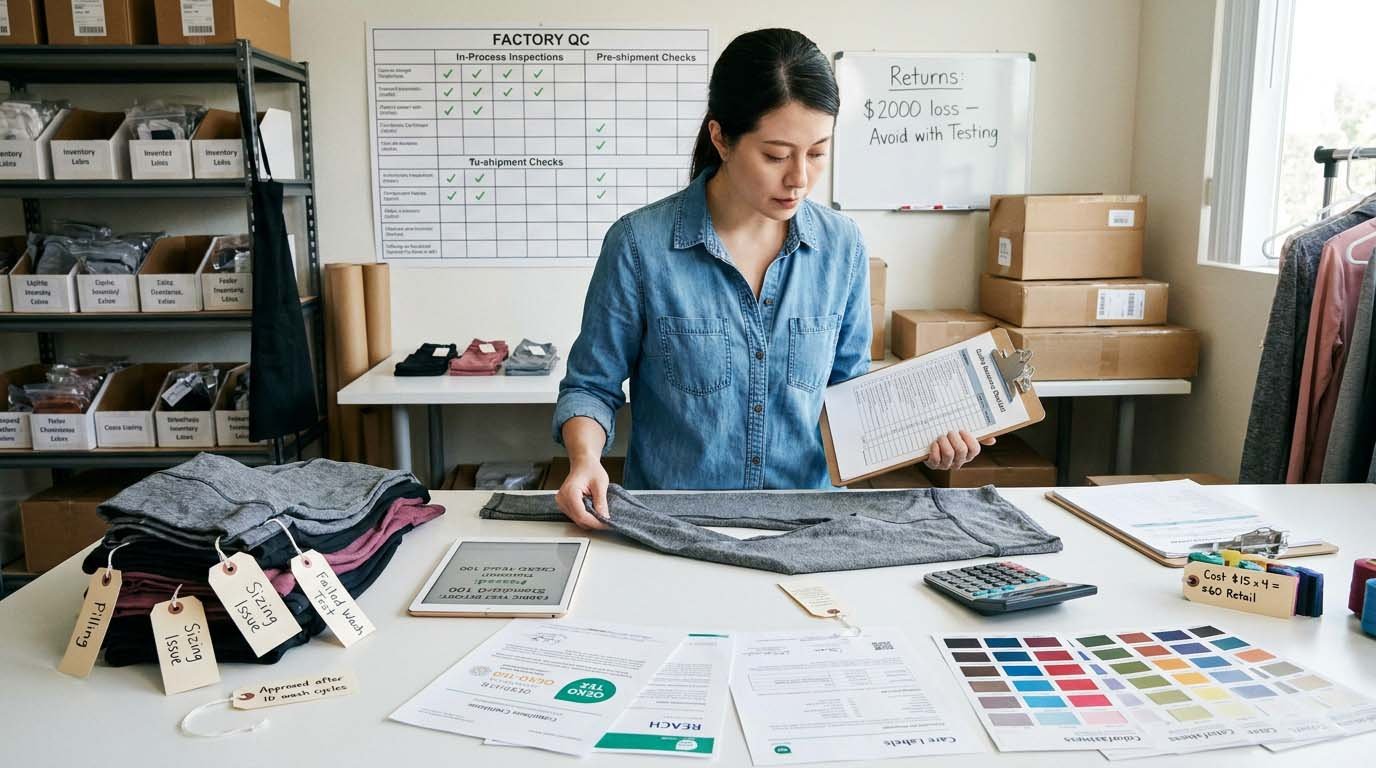
I see beginners treat quality and compliance as expenses to minimize. They're actually investments that determine whether your brand survives past first production.
Essential Quality Control Processes
Quality control happens at multiple stages, not just final inspection:
Fabric inspection (before cutting):
- Check fabric weight matches specifications
- Verify color against approved samples
- Inspect for defects (holes, stains, irregular weaving)
- Test stretch and recovery
- Cost if done by factory: Usually included
- Cost if third-party inspection: $200-300
In-process quality control:
- Check first few pieces before bulk sewing
- Monitor seam strength and stitch quality
- Verify measurements match size specs
- Ensure proper elastic tension
- Cost: Usually included in production
Pre-shipment inspection (PSI):
- Inspect 10-20% of finished goods randomly
- Check measurements, construction, finishing
- Verify packaging and labeling
- Test functionality (zippers, closures, etc.)
- Cost if done by factory: Often included but verify
- Cost if third-party: $300-400 (highly recommended for first orders)
Common quality issues in activewear:
- Seam failure: Poor stitching or weak thread
- Pilling: Low-quality fabric or incorrect finish
- Color bleeding: Inadequate dye fixing
- Shrinkage: Improper fabric pre-treatment
- Elastic degradation: Low-quality elastic or poor washing
- Sizing inconsistency: Poor pattern grading or cutting
Testing I insist clients do before bulk production:
Wash testing (5-10 wash cycles):
- Check for shrinkage
- Verify color fastness
- Assess pilling development
- Test seam integrity
- Evaluate elastic recovery
- Cost: Time + water + detergent (do it yourself)
Wear testing (2-3 actual workouts):
- Test comfort during activity
- Check for chafing or irritation
- Verify opacity during movement
- Assess moisture management
- Test whether garment stays in place
- Cost: Your time or testers' time
Compliance and Certification Requirements
Different markets have different mandatory requirements:
United States:
Required:
- Fiber content labeling (FTC regulations)
- Country of origin marking
- Care labels
- Flammability standards (16 CFR 1610)
Optional but valuable:
- OEKO-TEX Standard 100 (chemical safety)
- CPSIA compliance (if selling children's wear)
- California Prop 65 compliance
European Union:
Required:
- REACH compliance (chemical restrictions)
- Fiber composition labeling
- Country of origin
- Care labeling
Highly recommended:
- OEKO-TEX certification
- Bluesign certification (sustainability)
Certification costs and timelines:
| Certification | Cost | Timeline | Value |
|---|---|---|---|
| OEKO-TEX Standard 100 | $400-800 per fabric | 2-3 weeks | Chemical safety proof |
| GRS (recycled content) | $500-1,000 | 4-6 weeks | Sustainability marketing |
| GOTS (organic) | $600-1,200 | 6-8 weeks | Organic claims |
| Bluesign | $2,000-5,000 | 8-12 weeks | Premium sustainability |
My recommendation for beginners:
Start with OEKO-TEX Standard 100 for main fabric. It's affordable, widely recognized, and proves chemical safety. Add other certifications as brand grows.
Pricing Strategy from Production Perspective
I don't tell clients what retail price to charge—that's market strategy. But I help them understand if their cost structure supports their intended price:
Cost to retail multipliers:
Direct-to-consumer (DTC):
- Minimum 4x multiplier from production cost
- Better brands achieve 5-6x
- Formula: Production cost + shipping + duties = landed cost × 4-6 = retail price
Example: $14 production + $2 shipping/duties = $16 landed × 4 = $64 retail minimum
Wholesale model:
- Wholesale price typically 2.5x landed cost
- Retailer then marks up 2-2.5x wholesale
- Formula: Landed cost × 2.5 = wholesale × 2.2 = retail
Example: $16 landed × 2.5 = $40 wholesale → $88-100 retail
Hybrid model (DTC + wholesale):
- DTC price should be 1.5-2x wholesale price
- Protects wholesale partners from channel conflict
- Example: $40 wholesale, $60-80 DTC
Cost factors that affect pricing:
- Higher fabric quality: Can support $5-10 more retail
- Sustainability certifications: Justify $8-15 premium
- Complex construction: Supports $10-15 more retail
- Brand positioning: Premium brands achieve higher multipliers
Reality check questions I ask:
- Can your target customer afford your required retail price?
- Is your price competitive with similar products in market?
- Does your margin support advertising and customer acquisition?
- Can you maintain margins if you need to run sales or discounts?
Common pricing mistakes:
- Pricing too low to "compete" (unsustainable margins)
- Not accounting for customer acquisition costs
- Forgetting about returns and replacements (budget 5-10%)
- Ignoring payment processing fees (2-4% of revenue)
Go to Market: Branding, E-commerce, Marketing and Fulfillment?
A client had beautiful products ready but no clear plan for selling them. She asked if we could store inventory until she figured it out. I explained we're manufacturers, not warehouses. She hadn't thought about fulfillment at all. Her products sat in our facility for three months accumulating storage fees while she scrambled to set up systems.
Go-to-market planning must happen in parallel with production planning, not after. You need fulfillment solutions, sales channels, and inventory management systems ready before products arrive. Many brands focus entirely on product development and realize too late they have no infrastructure to actually sell and deliver.
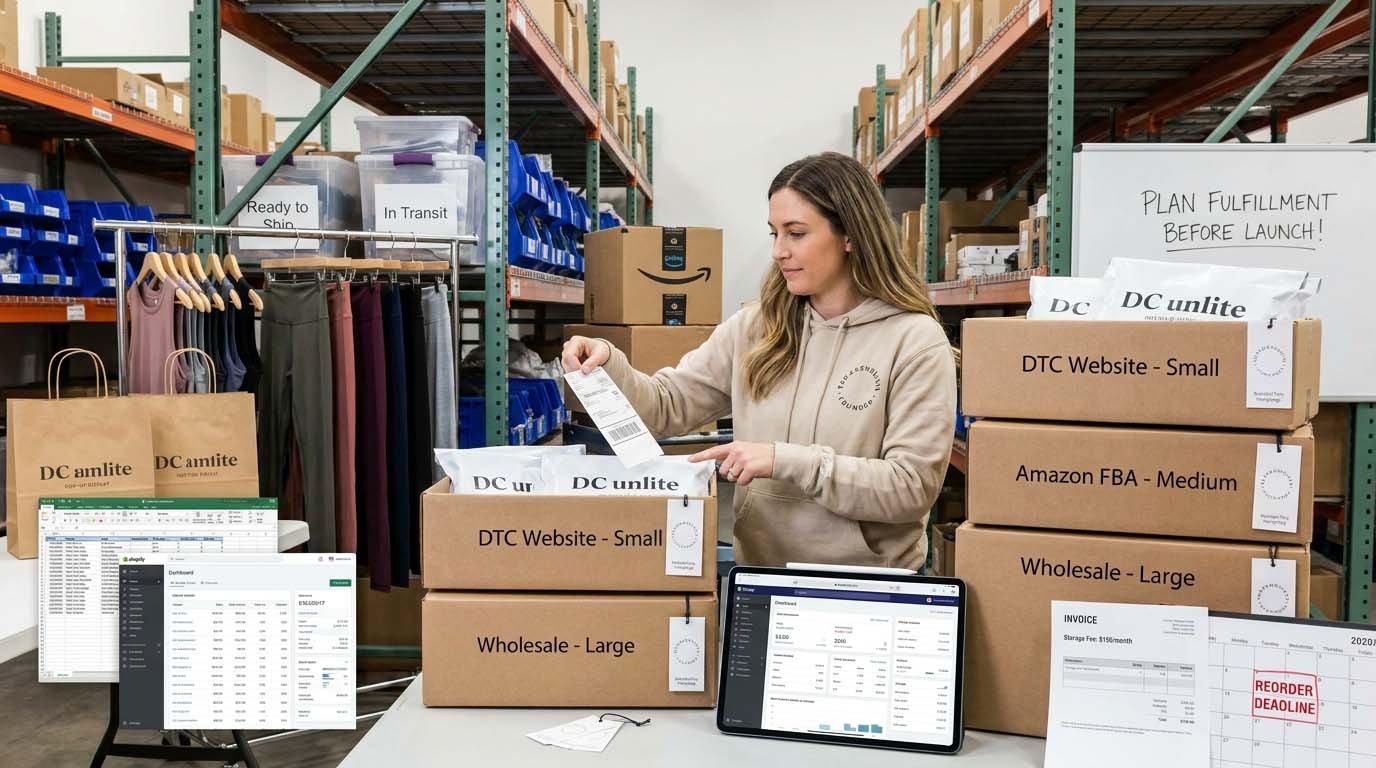
I stay in my lane—I don't give marketing advice. But I can explain the production and logistics implications of different go-to-market choices. Your sales strategy affects order quantities, packaging, and fulfillment planning.
Sales Channel Options and Inventory Implications
Different channels require different inventory strategies:
Direct-to-consumer (DTC) website:
Inventory requirements:
- Need full size range available (can't sell out of core sizes)
- 100-150 units per size minimum to maintain availability
- Total 500-750 units for 5-size range
Packaging needs:
- Individual poly bags
- Branded packaging (boxes, tissue, inserts) if desired
- Cost: $0.30-2.00 per unit depending on packaging level
Shipping considerations:
- Must integrate with shipping software
- Need poly mailers or boxes for shipping
- Cost: $0.50-1.50 per unit for packaging
Amazon and marketplaces:
Inventory requirements:
- Need deep inventory (algorithms punish stockouts)
- 200-300 units per size recommended
- Total 1,000-1,500 units for 5-size range
Packaging needs:
- Poly bags with suffocation warnings
- Amazon FBA labels
- May need prep services
- Cost: $0.30-0.60 per unit
Fulfillment:
- FBA (Fulfillment by Amazon) fees: $3-5 per unit
- Or use third-party fulfillment center
Wholesale to retailers:
Inventory requirements:
- Must allocate inventory to multiple accounts
- Typically 50-100 units per store per style
- With 5-10 stores, need 500-1,000 units total
Packaging needs:
- Hangtags with wholesale pricing removed
- Often shipped in bulk boxes, not individual packaging
- Cost: $0.20-0.40 per unit
Payment terms:
- Retailers often want net 30-60 payment terms
- You need capital to fund inventory float
Pop-up or events:
Inventory requirements:
- Need variety to show at events
- Lower quantity per SKU acceptable
- 300-500 units total across styles
Packaging:
- Must look retail-ready
- Need branded bags for customer purchases
- Display considerations
My observation:
Brands that start with DTC + Amazon see fastest growth but need larger inventory investment. Pure DTC allows smallest starting inventory but requires strong marketing to drive traffic.
Fulfillment and Warehousing Solutions
Where will products physically live and how will they ship?
Self-fulfillment (from home/small warehouse):
- Best for: Very small volumes (under 50 orders/week)
- Cost: Your time + shipping materials
- Advantages: Complete control, personal touch
- Disadvantages: Doesn't scale, takes significant time
Third-party fulfillment (3PL):
- Best for: Growing brands (50-500 orders/week)
- Cost: $3-6 per order plus storage ($0.50-1.50 per unit per month)
- Advantages: Scales with you, professional operation
- Disadvantages: Less control, minimums may apply
Amazon FBA:
- Best for: Brands selling primarily on Amazon
- Cost: $3-5 per order plus storage
- Advantages: Fast Prime shipping, Amazon handles customer service
- Disadvantages: Limited to Amazon sales, IPI requirements
Hybrid approach:
- Keep some inventory for DTC fulfillment
- Send some to Amazon FBA
- Reserve some for wholesale accounts
Storage considerations:
- Climate control: Important for elastic longevity
- Inventory tracking: Need system to know what you have
- Minimum storage: Some 3PLs require $200-500/month minimum
My recommendation:
For first 300-500 units, self-fulfill if possible to save costs and learn the process. Once you reach 100+ orders per week, transition to 3PL.
Inventory Management Basics
Tracking inventory is critical but often overlooked:
Essential tracking needs:
- How many units total
- How many units per size
- How many units per channel (if multichannel)
- What's been sold, what's remaining
- What's in transit vs. available
Software options:
- Spreadsheets: Free, manual, works for very small volumes
- Shopify inventory: Included with platform, basic but functional
- Dedicated inventory software: $50-300/month, robust features
- ERP systems: $500+/month, for larger operations
Reorder planning:
When to reorder:
- When inventory drops to 30-40% of original stock
- Allows 90-120 days for production and shipping
- Example: Started with 500 units, reorder at 150-200 units remaining
How much to reorder:
- Look at sales data: which sizes sold fastest?
- Adjust size distribution based on actual sales
- Often core sizes sell 1.5-2x faster than extreme sizes
Cash flow consideration:
Second order needs to be placed 60-90 days after first order arrives, meaning you're investing in Order 2 before Order 1 sells through. Plan cash flow accordingly.
Production Planning for Reorders
Successful first production sets up easier reorders:
What makes reorders faster:
- Patterns already developed
- Fabric already tested and approved
- Relationship with factory established
- You understand the process better
Reorder timeline:
- No sampling needed (unless making changes)
- Production + shipping: 75-100 days vs. 120-150 first time
- 30-45 days faster than initial order
Cost advantages on reorders:
- No development fees
- Often better pricing (proven customer)
- Less back-and-forth communication needed
When to make changes vs. reorder as-is:
Reorder as-is if:
- Product performing well
- No significant customer complaints
- Saves development time and cost
Make changes if:
- Consistent feedback on specific issue (fit, feature, etc.)
- Want to add new colorways
- But changes require sampling again (adds 20-30 days)
FAQ: Starting an Activewear Brand
Is $5,000 enough to start an activewear brand?
$5,000 is too tight for custom activewear development. Realistic minimum is $8,000-10,000: $1,000-1,500 for sampling and development, $500-800 for testing and certifications, $4,500-6,000 for 300-400 units production, $1,000-1,500 for shipping and duties, plus buffer. Consider starting with ODM (factory designs) to reduce development costs if budget is limited.
Should I start with multiple styles or focus on one product?
Start with 1-2 styles maximum. Multiple styles split your budget too thin, prevent adequate testing, and complicate inventory management. Master one product, validate market demand, use profits to fund additional styles. Successful brands launch narrow and expand deliberately, not the reverse.
How do I avoid choosing a bad manufacturer?
Request samples of similar work they've done. Ask for fabric testing reports. Verify they offer proper sampling process before bulk. Check communication responsiveness. Get references from other clients if possible. Avoid factories that pressure immediate orders, won't answer detailed questions, or quote 30-50% below market rates (quality corners being cut somewhere).
What certifications do I actually need as a beginner?
Required: Proper care labels and fiber content labels (regulations vary by country). Highly recommended: OEKO-TEX Standard 100 for fabric chemical safety ($400-800, takes 2-3 weeks). Optional but valuable: GRS if using recycled materials. Don't invest in expensive certifications (Bluesign, etc.) until you validate market demand—use that money for better sampling instead.
How do I price my products competitively while maintaining margin?
Work backward from your target retail price. Retail should be 4-6x your landed cost for DTC model. If target retail is $60, your maximum landed cost is $10-15 per unit. This constrains your fabric choices, production location, and design complexity. If cost structure doesn't support your target price, either raise prices or simplify design—don't launch with unsustainable margins.
Should I manufacture overseas or domestically?
Depends on your budget, timeline needs, and order volume. Overseas (China, Vietnam): Lower costs ($11-18/unit), longer timelines (120-150 days), MOQs 300-500 pieces. Domestic: Higher costs ($20-35/unit), faster (60-90 days), lower MOQs (200-400 pieces). Most beginners start overseas to achieve margins that support business growth, then potentially nearshore or domestically once established.
What's the most common mistake that causes brands to fail?
Skipping proper sampling and testing phases to save money or time. Brands order 300-500 units without wash testing, wear testing, or fit testing on real bodies. Then face 20-40% return rates, negative reviews, and reputation damage. The $800-1,500 spent on proper sampling and testing prevents $5,000-10,000+ in unsellable inventory and returns. Don't skip testing.
Conclusion
Starting an activewear brand requires $8,000-12,000 minimum budget, 120-150 days from concept to delivery, and disciplined focus on one niche and 1-2 styles initially. Prioritize proper sampling, testing, and quality control over trying to minimize costs. Partner with legitimate manufacturers offering 300-500 piece MOQs. Success comes from executing fundamentals correctly, not cutting corners.